

A restaurant can reach operating break-even and still leave its new owner short of the cash needed to fund the purchase. That’s why break-even analysis when buying a restaurant is more than a sales target: it tests whether the business can cover its costs under your ownership.
Start with a practical question: how much must this restaurant sell to cover its expenses after the sale? The answer depends on which costs you include, how the purchase is financed, and whether the sales figures reflect performance you can realistically sustain. Seller-provided numbers can be useful, but compare them with records and a workable operating plan.
This guide explains how to calculate a defensible restaurant break-even sales threshold, separate operating costs from acquisition and funding needs, and compare the result with documented sales. It also covers assumptions to scrutinize, from food and labor costs to rent, debt payments, and changes you may make after taking over. Treat the calculation as one part of a disciplined acquisition review, not a promise of profitability.
Key Takeaways
- Use break-even as a viability test for the restaurant’s sales plan, not as a profit forecast or guarantee.
- Apply the core formula: fixed costs divided by the contribution margin ratio, with variable costs clearly identified.
- In a break-even analysis when buying a restaurant, compare the threshold with documented historical sales for equivalent periods.
- Keep seller figures, buyer assumptions, and verified records distinct so you can see which inputs need scrutiny.
- Document each model input and its source, then review unresolved assumptions and cash needs separately.
What Break-Even Analysis Tells You When Buying a Restaurant
A restaurant’s break-even point is a practical operating threshold: the sales needed to cover the costs included in the calculation. It helps you assess whether revenue can support ongoing expenses, but it doesn’t show that the restaurant will earn a profit or that sales will reach that level.
In a break-even analysis when buying a restaurant, the result is only useful if you know what it includes. A model based on the seller’s staffing, menu, and occupancy costs may not match your intended operation. Treat the threshold as a test of a proposed plan, not a promise about future performance.
What does a restaurant break-even point mean?
A restaurant breaks even when revenue for a specified period equals the fixed and variable costs included in the calculation, leaving no operating profit or loss on those costs. The Break-even point concept is used broadly in business and economics, but a buyer needs to define the restaurant-specific costs and period being measured. A monthly threshold and an annual threshold answer different questions.
Why should buyers calculate it before an acquisition?
Comparing the threshold with credible sales records helps you assess whether revenue can support ongoing operations. It can also show how much your conclusion depends on assumptions such as projected sales growth, food costs, or staffing levels. Use the calculation alongside a review of financial records and the proposed operating plan, not as a standalone reason to buy or walk away.
Keep operating break-even separate from acquisition cash needs. An operating estimate measures whether sales cover the costs you chose to include. It doesn’t automatically account for all the cash required to complete the purchase or support the business through a transition. Those are related but distinct parts of your financial plan. If you combine them without labeling each item, the break-even result can become difficult to interpret.
For example, you might calculate a monthly operating threshold using expected rent, payroll, and food costs, then plan separately for transaction-related cash needs and working capital. Whether a particular item belongs in the operating calculation depends on the model’s purpose. State what is included and what is handled separately so the result isn’t mistaken for a complete funding plan.
Before relying on a result, define three things:
- Period: State whether the estimate is weekly, monthly, or annual, and compare it with sales from the same period.
- Cost scope: List the expenses included and identify important obligations or cash needs kept outside the operating estimate.
- Assumptions: Distinguish documented figures from seller estimates and your own projections.
A threshold can look attainable under one set of assumptions and demanding under another. Reviewing the inputs makes that sensitivity visible. If a small change in expected sales or costs materially shifts the result, examine the supporting records and operating plan more closely. The calculation is most useful when it clarifies what must be true for the restaurant to cover its included costs.
How to Calculate a Restaurant Break-Even Point Step by Step
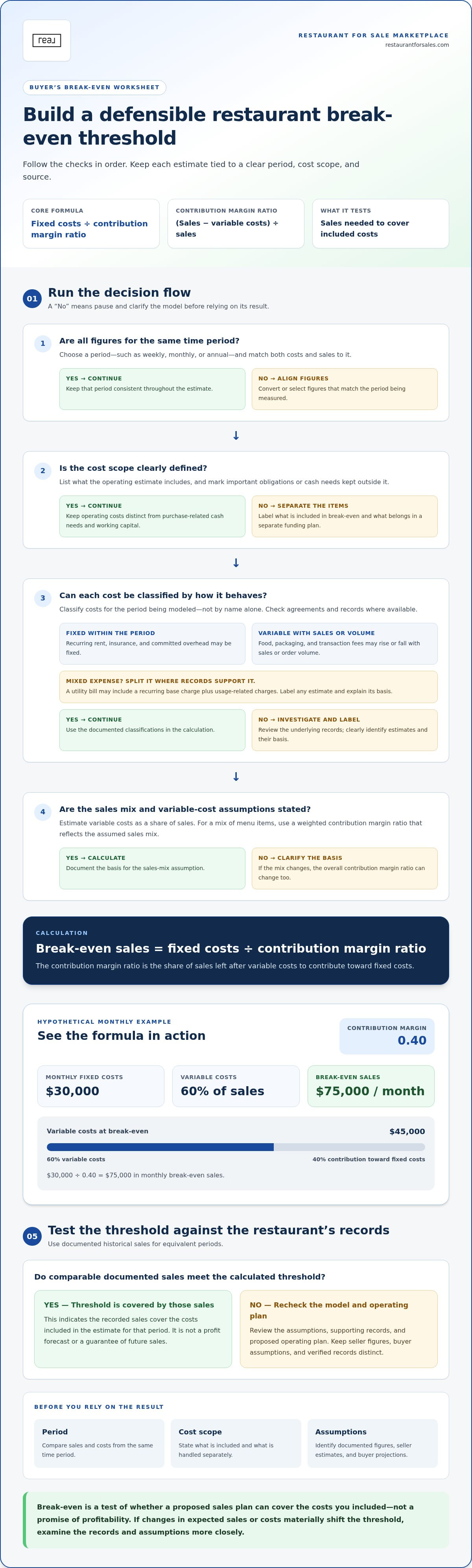
Start with a consistent time period and a clear definition of the costs you’re measuring. The sales break-even formula is:
Break-even sales = fixed costs ÷ contribution margin ratio
The contribution margin ratio is the share of sales left after variable costs: (sales − variable costs) ÷ sales. This amount contributes toward fixed costs. Once those costs are covered, sales above the threshold may contribute to profit, depending on the other costs and assumptions in the model.
Which costs belong in the calculation?
Classify costs according to how they behave during the period being modeled. Recurring rent, insurance, and committed overhead may be fixed within that period. Food, packaging, and transaction fees may rise or fall with sales or order volume. Don’t classify a cost by its name alone. Review the underlying agreement or records to understand how it changes.
Some expenses are mixed. A utility bill, for example, may include a recurring base charge plus usage-related charges. Separate the fixed portion from the variable portion where records support it. If you need to estimate, label the estimate and explain its basis. Clear classifications make it easier to test how different operating assumptions affect the threshold.
How do you apply the break-even formula?
Use this sequence to build a sales-based estimate for one period:
- Choose the period, such as a month, and use figures that match it.
- Total the fixed costs included in the operating analysis.
- Estimate variable costs as a share of sales, then calculate the contribution margin ratio.
- Divide fixed costs by that ratio to find break-even sales.
A restaurant sells a mix of menu items, each with its own selling price and variable costs. Use a weighted contribution margin ratio that reflects the assumed sales mix. If the mix changes, the overall ratio can change too, so document the basis for your assumption.
Hypothetical example: Assume monthly fixed costs are $30,000, and variable costs are estimated at 60% of sales. For every dollar of sales, 40 cents remain as contribution toward fixed costs, so the contribution margin ratio is 0.40. The calculation is $30,000 ÷ 0.40, giving break-even sales of $75,000 for the month. At that sales level, estimated variable costs are $45,000; together with $30,000 in fixed costs, they equal $75,000 in revenue. These figures are illustrative only, not an industry benchmark.
If the model uses individual units instead of sales dollars, calculate contribution per unit by subtracting variable cost per unit from its selling price. Then use fixed costs ÷ contribution per unit to estimate the units needed to break even. For a restaurant with multiple items, the result depends on the assumed product mix.
In a break-even analysis when buying a restaurant, tie the calculation to its stated period and assumptions. As you compare a model with available restaurant listings, use the threshold as a starting point for examining supporting sales and cost information.
How to Test a Restaurant Purchase Against Break-Even Sales
Once you have a break-even threshold, test it against documented sales for the same period. Compare monthly with monthly or annual with annual, and make sure both figures use the same sales definition. Gross sales, net sales, and sales after discounts or refunds may not be directly comparable. Sales above operating break-even don’t automatically make a restaurant a sound acquisition. Consider the gap alongside the reliability of the records, the operating plan, and cash obligations outside the calculation.
How should buyers check the sales assumptions?
Keep three categories distinct in your model: seller-provided figures, buyer assumptions, and amounts supported by records you’ve reviewed. Note the source, period, and definition for each input. If reported sales differ across documents, or figures use different accounting periods, record the discrepancy rather than choosing the most favorable number.
Check whether the historical period reflects seasonal patterns, the restaurant’s operating hours, and its capacity. Document planned changes, such as extended hours or a different menu mix, as assumptions rather than established sales. Don’t build in growth simply because a change seems promising. Flag unsupported inputs for follow-up in the broader financial review.
A scenario table can make assumptions easier to compare without disguising uncertainty as precision:
| Scenario | Sales assumption | How to test it |
|---|---|---|
| Conservative | Lower sales supported by comparable documented periods or a clearly stated downside assumption | Check whether sales still cover the calculated operating threshold |
| Expected | Sales supported by reviewed records and the buyer’s stated operating plan | Compare the period-matched estimate with break-even sales |
| Stronger | Higher sales only where a specific, documented reason supports the assumption | Keep the upside case separate from the baseline; don’t treat it as certain |
Use the same cost definitions and period across scenarios. Otherwise, a result may reflect inconsistent inputs rather than a meaningful change in expected performance.
Which post-purchase obligations change the picture?
Separate recurring operating expenses from one-time acquisition or opening expenses. Buyer-specific financing payments can increase the cash the business needs beyond an operating break-even estimate, so show them separately rather than silently folding them into the operating threshold. Also identify whether owner compensation and working capital are included. If they’re excluded, model them in the broader cash plan.
- Operating view: Does documented or supportable sales performance cover the ongoing costs included?
- Cash view: What additional funds are needed for transaction obligations, financing payments, transition needs, and working capital?
This distinction is central to a break-even analysis when buying a restaurant. A model can show operating sales above break-even while leaving unanswered whether you can meet post-purchase cash demands. Treat that gap as a diligence question, not a reason to assume the business is financially secure.
How to Build a Useful Break-Even Model Before You Buy
A useful model lets you trace each result back to its source. Start with available financial records, organize inputs by period, and keep documented history separate from your operating assumptions. This makes the break-even result transparent and shows where further review may change it.
What should a buyer record in the model?
Build a simple input schedule before calculating the threshold. For each figure, record its amount, measurement period, source, and status, such as documented, seller-provided, or buyer-assumed. Include the sales basis and variable-cost assumptions, along with fixed expenses such as recurring rent and insurance where applicable. Note uncertainty rather than filling a gap with an unsupported estimate.
- Sales: Record the period covered, how sales are defined, and whether the figure comes from historical records or a buyer’s plan.
- Variable costs: Note the basis for each sales-linked cost and whether it reflects historical performance or an assumption.
- Fixed expenses: List recurring commitments included in the operating model, with their relevant periods.
- Purchase-related items: Keep financing assumptions and one-time transaction costs separately identifiable from operating inputs.
Use consistent periods across the model. If a source reports annual figures while the calculation is monthly, document how you converted the input and preserve the original figure for reference. This makes the calculation easier to review and update as better records become available.
How can scenario testing reveal risk?
Test lower, expected, and higher sales cases using assumptions you can explain. Then change one material input at a time to see how it affects break-even sales. For example, adjust food costs while holding other inputs steady, then run a separate test for labor, occupancy, or operating schedule. This shows which assumption is driving the result instead of blending several changes into one unexplained forecast.
Pay close attention to assumptions that move the threshold materially. If the model depends on higher sales, lower costs, or an expanded schedule that isn’t supported by available information, mark the input for further review. Scenario testing doesn’t establish which outcome will occur. It shows how sensitive the proposed purchase is to the assumptions behind it.
In a break-even analysis when buying a restaurant, a spreadsheet is only as reliable as its inputs. Add a brief note beside each scenario explaining what changed and why. That record helps distinguish a documented operating case from an optimistic possibility.
Use the model as one part of acquisition due diligence, not as a substitute for reviewing the underlying financial records, transaction details, and operating plan. A clear break-even result can focus that review, but it can’t resolve unsupported figures on its own. If you’re comparing opportunities, explore restaurants for sale and apply a consistent set of documented assumptions to each one.
Use Break-Even Analysis to Choose Your Next Restaurant-Buying Step
A break-even result can help you decide whether a restaurant merits further review, but it can’t establish that a purchase will succeed. Apply three tests: Are the inputs credible? Does the sales threshold appear attainable based on documented performance and a realistic operating plan? Have you separately assessed acquisition cash needs and other obligations outside the operating model?
If an assumption remains unsupported, treat it as a diligence question, not a fact. A low threshold based on unverified costs is no more reassuring than a high threshold based on overstated expenses. The value of break-even analysis when buying a restaurant is that it clarifies what must be true for the business to cover the costs in your model.
When does the analysis support further evaluation?
Further evaluation may make sense when historical sales records support the comparison, costs and buyer assumptions are explainable, and the resulting threshold fits a plausible operating plan. That’s a reason to investigate, not proof that the deal is sound. A restaurant valuation guide can complement the break-even calculation by helping you consider value and financial performance together.
If the threshold appears difficult to reach, or the result depends on assumptions you can’t substantiate, identify the specific gap. It may require closer review of sales records, operating costs, or your plan. Keep the issue visible in your decision notes rather than smoothing it over with a more favorable estimate.
Where can buyers continue their research?
Compare relevant restaurant listings with your operating plan, including the type of business, its reported performance, and the costs your model addresses. A complete guide to buying a restaurant can put the calculation in the context of the wider acquisition process, while valuation resources can add perspective to your assessment of the proposed purchase. Use the same disciplined approach for each opportunity, and record what is documented, assumed, or still unresolved.
Before moving forward, summarize your findings in a short decision note:
- Inputs: Which figures are supported by records, and which rely on estimates?
- Threshold: What sales level must the business reach to cover the costs included in your operating model?
- Cash needs: Which purchase, financing, owner compensation, or working-capital requirements sit outside that threshold?
- Open questions: What still needs support or further review?
A clear note keeps the calculation tied to the evidence as you review transaction details and compare opportunities. To continue your search, explore restaurant listings and buyer resources.
Move From the Numbers to a More Informed Search
Use your analysis to sharpen what you’re looking for. Decide which operating conditions matter most, what evidence you’ll need to assess them, and which open questions could change your view of a potential purchase. This gives you a stronger basis for comparing opportunities than relying on a single attractive figure.
A break-even analysis when buying a restaurant is most useful as part of a broader acquisition review. Restaurant valuation can add another perspective on a business, while brokerage support can help buyers assess opportunities. Valuation and financing tools can also inform your research as you consider the transaction.
When you’re ready to take the next step, browse restaurant listings and buyer resources.
Frequently Asked Questions
What is the break-even point for a restaurant?
It’s the level of sales at which revenue matches the costs included in a defined calculation, leaving no profit on those costs. The result depends on what the model includes. For example, a restaurant may cover its listed operating expenses but still need additional cash for debt payments or owner compensation if those items were excluded. Identify the period and cost scope before using the figure to compare businesses.
How do you calculate break-even sales for a restaurant?
Divide fixed costs for the period by the contribution margin ratio. Calculate that ratio by subtracting variable costs from sales, then dividing the result by sales. For instance, if variable costs use 60% of sales, the ratio is 40%; divide the period’s fixed costs by 0.40. In a break-even analysis when buying a restaurant, keep the sales mix and period consistent with the records you’re assessing.
Which costs should be included in a restaurant break-even analysis?
Include the costs relevant to the question the model is meant to answer. Recurring rent, insurance, and other committed overhead may be fixed; food, packaging, and sales-linked transaction fees may vary with volume. Costs such as utilities can combine fixed and variable portions. Use records or contract terms to classify them, and flag uncertain items. List excluded expenses separately so the result isn’t mistaken for a full cash plan.
Does restaurant break-even analysis include loan payments?
Not necessarily. An operating break-even calculation may exclude acquisition financing, so it won’t show whether cash flow can cover scheduled payments. Keep loan assumptions separate from operating costs, then prepare a second cash-coverage view that includes your expected payment obligations. This distinction answers two different questions: whether operations cover their modeled costs and whether you can meet cash commitments after the purchase.
Can a restaurant be above break-even and still lose money?
Yes. Sales may exceed an operating threshold while the restaurant still reports a loss if important expenses were left out of the model. For example, the calculation might exclude financing costs, owner compensation, or other expenses relevant to the business’s financial results. Check what the threshold covers before interpreting sales above it as profitability. A positive operating result under one model isn’t the same as a complete assessment of earnings.
How do I use a break-even analysis when buying an existing restaurant?
Compare the calculated threshold with sales records for matching periods, then investigate gaps between reported figures and your plan. Keep documented records separate from seller estimates and your own assumptions. For example, if your plan assumes longer operating hours, treat the resulting sales change as a scenario until it’s supported. Use the analysis alongside a review of the restaurant’s financial information, transaction terms, and your cash plan.
What happens if the restaurant’s sales projections are below break-even?
That indicates the projection doesn’t cover the costs included in the model under those assumptions. First check for input errors or mismatched periods. Then identify what would need to change, such as documented sales performance, the cost structure, or the operating plan, and test those changes without treating hoped-for growth as certain. If the gap remains unexplained, record it as a key diligence concern before deciding whether to proceed.


