

What if a restaurant’s headline earnings look strong, but the cash available after paying a replacement owner, servicing debt, and funding needed repairs tells a different story? That’s the question cash flow analysis for a restaurant purchase needs to answer. Seller financials are a starting point, not proof: trace reported performance to supporting records, then assess which adjustments are reasonable under your ownership plan.
Profit matters when comparing restaurants, but it doesn’t show whether the business can support your plans or withstand a slower period. A disciplined review separates repeatable operating cash flow from one-time items, owner-specific expenses, and costs that may arise after closing.
This guide explains how to build a traceable cash flow estimate, test it against downside scenarios, and account for debt payments, working capital, and ongoing reinvestment. You’ll also learn how to apply the same framework across restaurant and bar listings, so you can compare a potential acquisition with other options on consistent terms.
Key Takeaways
- Cash flow analysis for a restaurant purchase starts with supporting records, not the seller’s headline earnings.
- Separate operating cash flow, net income, EBITDA, and owner benefit to understand what each figure can and can’t tell you.
- Compare reported earnings, seller add-backs, and buyer-verified cash flow across multiple periods to assess how repeatable performance is.
- Model base, downside, and recovery scenarios, accounting separately for debt service, working capital, taxes, capital spending, and transition needs.
- Turn gaps in the analysis into a clear decision: proceed, revise assumptions, renegotiate, or pause.
What Cash Flow Analysis Reveals Before You Buy a Restaurant
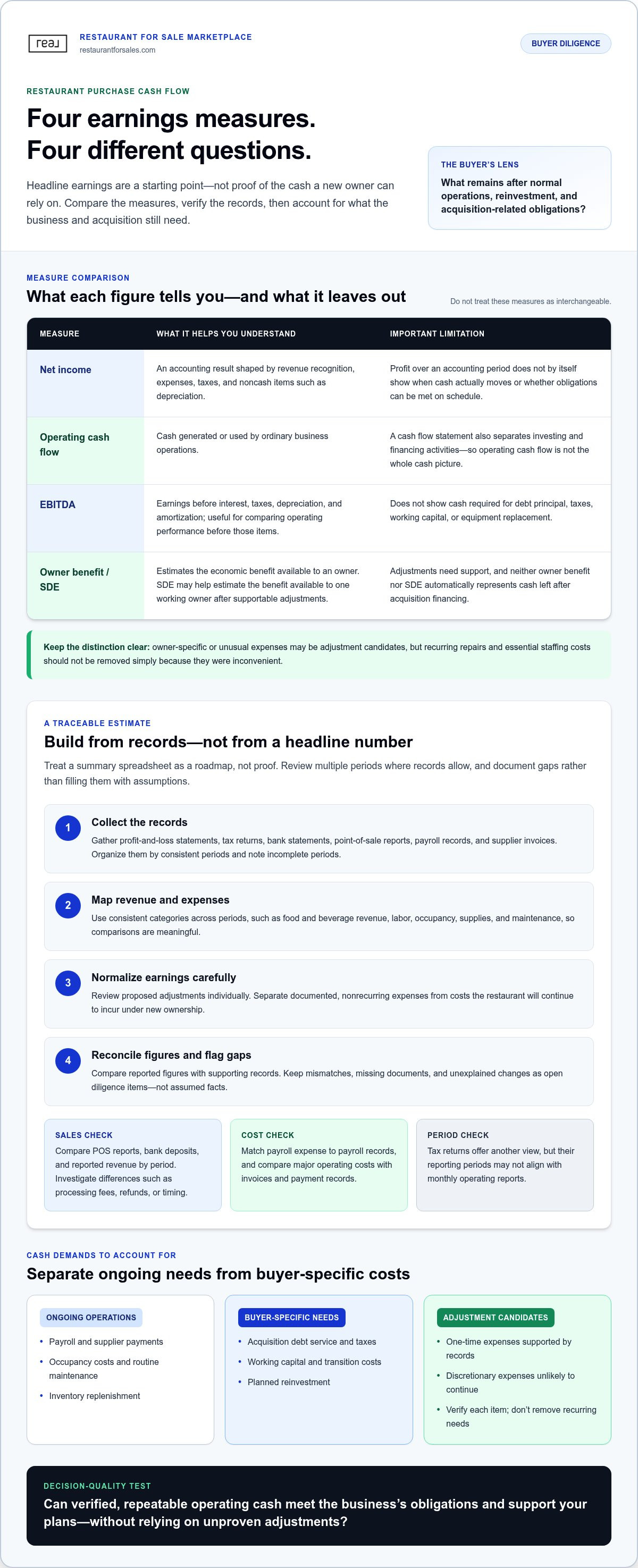
Purchase cash flow estimates the cash a restaurant can generate for a new owner after normal operating needs, required reinvestment, and acquisition-related obligations are considered. It isn’t the same as the seller’s accounting profit or the earnings figure used to market the business. Cash flow analysis for a restaurant purchase helps you trace reported results to records, then assess what may remain under your ownership.
Start by distinguishing the financial measures. Net income is an accounting result shaped by revenue recognition, expenses, taxes, and noncash items such as depreciation. Operating cash flow focuses on cash generated or used by ordinary business operations. A cash flow statement organizes cash movements into operating, investing, and financing activities, offering a different view from an income statement.
EBITDA means earnings before interest, taxes, depreciation, and amortization. It can help compare operating performance before those items, but it doesn’t show the cash required for debt principal, taxes, working capital, or equipment replacement. Owner benefit estimates the economic benefit available to an owner, often including adjustments for owner compensation and certain discretionary expenses. Each measure answers a different question, so don’t treat them as interchangeable.
Which cash flow measure should a restaurant buyer examine?
For an owner-operated restaurant, Seller’s Discretionary Earnings (SDE) may help estimate the benefit available to one working owner after supportable adjustments. EBITDA serves a different analytical purpose, particularly when assessing earnings independent of a specific owner’s compensation. Neither figure automatically represents cash left after acquisition financing. For a fuller metric comparison, use the existing SDE-versus-EBITDA article as a companion resource.
Why a profitable restaurant can still face cash pressure
Profit is measured over an accounting period; liquidity depends on when money actually moves. A restaurant may record sales before card payments settle, while payroll and supplier invoices come due on fixed schedules. Seasonal traffic can make receipts uneven, and building inventory ahead of a busy period can increase near-term cash needs even if sales later rise.
Next, account for obligations the earnings figure may not capture. Loan principal, taxes, working capital, and planned equipment or facility spending can all reduce cash available to the buyer. Separate ongoing operating requirements from one-time costs and discretionary expenses. A seller’s personal or unusual expense may be an adjustment candidate, but recurring repairs or essential staffing costs shouldn’t be removed simply because they were inconvenient.
- Recurring needs: payroll, supplier payments, occupancy costs, routine maintenance, and inventory replenishment.
- Buyer-specific demands: acquisition debt service, transition costs, working capital, taxes, and planned reinvestment.
- Potential adjustments: one-time or discretionary expenses that can be supported by records and are unlikely to continue.
The practical question isn’t just whether the restaurant reported a profit. It’s whether verified, repeatable operating cash can meet the business’s obligations and support your plans without relying on unproven adjustments.
How to Build a Restaurant Purchase Cash Flow Estimate from Records
Build a reliable estimate in stages: start with the seller’s reported results, trace important figures to original records, adjust only for supported items, and document anything unresolved. For cash flow analysis for a restaurant purchase, treat a summary spreadsheet as a roadmap, not proof. Review multiple periods where records allow, so seasonal patterns and isolated anomalies don’t define the whole business.
- Collect the records. Request profit-and-loss statements, tax returns, bank statements, point-of-sale (POS) reports, payroll records, and supplier invoices. Organize them by month or another consistent period, and note which periods are incomplete.
- Map revenue and expenses. Group sales and costs into consistent categories, such as food and beverage revenue, labor, occupancy, supplies, and maintenance. Keep categories aligned across periods so comparisons are meaningful.
- Normalize earnings. Review proposed adjustments individually. Separate documented, nonrecurring expenses from costs the restaurant will continue to incur under new ownership.
- Reconcile and flag gaps. Compare reported figures with the records behind them. Record mismatches, missing documents, and unexplained changes as open diligence items instead of filling gaps with estimates.
Gather the records that support the seller’s figures
Compare sales by period across POS reports, bank deposits, and reported revenue. These totals may differ because of processing fees, refunds, timing, or other reconciling items. Identify the reason for each difference rather than assuming the figures should match exactly. Match payroll expense to payroll records for the same periods, and compare major operating costs with invoices and payment records. Tax returns provide another view, but their reporting periods may not align with monthly operating reports.
Look across multiple periods where available. A strong month may reflect a seasonal peak, a one-time event, or a genuine improvement. Compare the same periods across years when records permit, and investigate material shifts in sales, labor, or supplier costs. If an amount appears in a spreadsheet but not in supporting records, label its source and status clearly.
Normalize earnings without overstating buyer cash flow
Keep an adjustment schedule rather than blending add-backs into one total. For each proposed item, record the amount, period, rationale, supporting document, and whether it is likely to continue after closing. This makes the seller’s calculation traceable and gives you a clear basis for accepting, revising, or excluding an adjustment.
A documented one-time expense may warrant review. By contrast, ongoing labor, routine maintenance, and essential operating costs should generally remain in the estimate if the buyer will face them too. An owner’s expense isn’t automatically discretionary. Establish its business purpose and whether replacing that function will create a cost for you.
- Supported: the record and explanation substantiate the adjustment.
- Unresolved: evidence is missing or the reason for the difference is unclear.
- Excluded: the expense is recurring or will continue under the buyer.
Apply the same record-based process to each opportunity you assess. Restaurant listings for buyers are easier to compare when you use the same periods, categories, and evidence standards.
How to Test Restaurant Cash Flow Quality and Seller Add-Backs
A seller’s earnings figure is only the starting point. Test how much is supported by records, how consistently the restaurant produces it, and what could change after closing. In cash flow analysis for a restaurant purchase, keep three figures distinct: reported earnings, seller-adjusted earnings, and cash flow you can verify under your ownership assumptions.
| Measure | What it represents | Buyer’s test |
|---|---|---|
| Seller-reported earnings | The figure presented in the seller’s financial summary or statements. | Reconcile it to accounting records, tax filings, POS activity, and other source documents. |
| Seller-adjusted earnings | Reported earnings plus proposed add-backs or other adjustments. | Review each adjustment’s rationale, period, and supporting evidence. |
| Buyer-verified cash flow | An estimate based on supported results and costs expected to continue or arise after closing. | Account for replacement labor, operating requirements, and risks that may affect future cash generation. |
That final estimate isn’t a guarantee of future results. It’s a more disciplined basis for judging whether the seller’s earnings story holds up against evidence and your operating plan.
Which add-backs deserve closer scrutiny?
An add-back should have a clear explanation and evidence, such as an invoice, ledger entry, or other relevant record. A documented, nonrecurring expense may warrant adjustment; an owner’s discretionary choice may not disappear if the buyer would make the same expenditure. Assess each add-back against the records and your plans, because its relevance depends on whether the cost was truly unusual and whether it will recur under new ownership.
Owner compensation deserves particular attention. If the seller performs day-to-day work, estimate what it would take to replace that labor, whether through your own time or paid staff. Don’t treat the full compensation amount as available cash if the restaurant still needs someone to handle those duties. Classify unsupported adjustments as unverified, not as established buyer earnings.
How to identify fragile or inconsistent restaurant earnings
Review results across multiple periods, not just the strongest month. Track revenue, sales mix, labor costs, supplier costs, and operating margins consistently. Changes may reflect seasonality or normal variation, but unexplained shifts can mean earnings are less repeatable than the seller’s summary suggests. Reconcile POS sales, bank deposits, tax filings, and accounting records, then document any differences that remain unresolved.
Look beyond the totals. Sales concentrated in a short season, dependence on a key employee or owner, deferred repairs, or a meaningful change in product mix can each affect post-close cash generation. A restaurant with steady reported earnings may still require spending to address neglected equipment or staffing gaps. Note the evidence, potential cash impact, and assumptions that need further testing.
- Recurring and supported: consistent results that reconcile across records and periods.
- Variable but explainable: changes tied to identifiable seasonality or operating events.
- Unresolved or at risk: unsupported adjustments, unexplained record differences, or costs likely to emerge after closing.
Use these categories to distinguish repeatable performance from claims that depend on uncertain adjustments. The gaps you identify can guide the next stage of diligence and help shape realistic assumptions for the purchase decision.
How to Stress-Test Cash Flow Against Financing and Operating Needs
A restaurant’s historical performance is only one input to a purchase decision. Test whether cash remains available after ordinary operating needs and the obligations created by your acquisition plan. In cash flow analysis for a restaurant purchase, keep the business’s underlying operating results separate from financing assumptions. This shows whether a risk comes from the restaurant, the proposed deal structure, or both.
Build three scenarios from documented results and explicit assumptions. A base case reflects a reasonable continuation of supported patterns, not an automatic repeat of the best period. A downside case combines plausible pressures, such as lower sales, higher labor or food costs, and an unexpected repair. A recovery case can show how cash might respond if specific operating conditions improve, but don’t treat that outcome as guaranteed.
Model the cash demands that follow closing
Lay out cash needs by type and timing. Recurring operating requirements include payroll, supplier payments, rent, and inventory replenishment. Put acquisition-related financing payments on a separate line so you can see the restaurant’s operating capacity before and after debt service. Include taxes, planned capital spending, and transition needs separately rather than burying them in a single expense estimate.
Working capital is a timing issue as well as a total. Inventory may need to be purchased before a busy period, while payroll and supplier bills come due on their own schedules. Map expected inflows and outflows by period to identify when the business may need a larger cash reserve. List repairs and equipment replacement as known or potential needs, but don’t assign exact costs without support.
Compare scenarios and define decision thresholds
Make assumptions visible so you can see what changes from one case to another. For example, the downside case might assume softer sales alongside higher labor costs and a repair requirement, while the base case holds those inputs near verified historical patterns. A recovery case should identify the operational change behind any improvement. Avoid using an unexplained growth assumption to make the purchase appear affordable.
Before reviewing the results, decide what minimum cash coverage and reserve level your plan requires. These thresholds depend on your obligations, risk tolerance, and operating plans; they aren’t universal benchmarks. Compare each scenario against them. If the downside case breaches a threshold, identify which assumption drives the shortfall and whether a change to the purchase terms, financing structure, or operating plan could address it.
- Operating performance: cash generated before acquisition financing.
- Post-financing cash: operating cash after scheduled debt service and other buyer obligations.
- Available reserve: cash remaining for working capital, transition demands, and unexpected needs.
A financing structure changes the buyer’s cash demands, but strong operating results alone don’t guarantee loan approval. Treat proposed terms as assumptions until established, and rerun the scenarios if the structure changes. To compare acquisition opportunities against the same operating and financing assumptions, review restaurant listings for sale using this framework.
Turn Your Restaurant Cash Flow Analysis into a Purchase Decision
A completed model should lead to a decision, not just another spreadsheet. Summarize what the records support, what remains uncertain, and whether the restaurant meets your requirements in both the base and downside scenarios. Cash flow analysis for a restaurant purchase is most useful when its findings point to a next step: proceed, revise assumptions, renegotiate, or pause.
- Proceed: verified cash flow supports your plan, and key diligence questions are resolved.
- Revise assumptions: new evidence or a clearer understanding of your operating role changes the model.
- Renegotiate: supported cash flow or identified requirements affect the purchase terms you can justify.
- Pause: material earnings gaps or unresolved risks prevent a reliable decision.
Keep a question log for every material uncertainty. State the issue, its potential effect on cash flow, the record or explanation needed, and who is responsible for resolving it. For example, if reported revenue doesn’t reconcile to source records, identify the periods and documents involved, assess the possible decision impact without inventing a figure, and assign follow-up within the transaction team. This turns a broad concern into focused diligence.
Use the findings to shape diligence and deal discussions
Carry material discrepancies into document requests and deal discussions before treating an assumption as settled. Cash flow is one part of the acquisition review, alongside lease terms, assets, staffing, and operational requirements that may affect future costs or continuity. A broader how to buy a restaurant guide can help place financial findings within the full transaction process, from evaluating an opportunity to completing diligence.
Compare potential acquisitions on the same basis. Use consistent periods, earnings definitions, treatment of add-backs, and buyer-specific assumptions for labor, financing, reserves, and reinvestment. Otherwise, a restaurant with more optimistic adjustments may appear stronger than one assessed with stricter evidence standards. Keep unresolved items visible so a clean-looking total doesn’t conceal important differences.
Choose a clear next step for your acquisition search
If an opportunity appears promising, refine the model with transaction-specific records and the relevant professional input. If earnings remain uncertain, define what evidence would change your view and whether the seller’s response addresses the issue. If a key assumption can’t be supported, preserve that uncertainty in the decision rather than counting it as available cash.
Restaurant For Sale Marketplace offers buyers restaurant and bar listings to assess using this framework, along with brokerage and valuation resources relevant to acquisition research. Use the same decision criteria for each opportunity, then explore available listings or brokerage resources when you’re ready to evaluate the next step.
Make Your Next Acquisition Decision with Confidence
Turn your analysis into clear decision guardrails. Identify the evidence you still need, the cash requirements your plan must meet, and the conditions that would make you revise or stop pursuing a deal. That discipline keeps a promising opportunity from becoming an assumption-driven commitment. A careful cash flow analysis for a restaurant purchase can also help you compare an acquisition with other options on consistent terms.
As you continue your search, use restaurant and bar listings to identify opportunities worth evaluating, and draw on brokerage and valuation resources relevant to your transaction. Restaurant For Sale Marketplace brings these acquisition resources together for buyers assessing their next move.
Explore restaurant listings and acquisition resources, then take the next step with a clear view of what the numbers support. Use Restaurant For Sale Marketplace’s listings, brokerage, and valuation resources to evaluate your next acquisition opportunity.
Frequently Asked Questions
What is cash flow analysis for a restaurant purchase?
Cash flow analysis for a restaurant purchase estimates how much cash the business may generate for you after operating demands and buyer-specific obligations. It helps distinguish accounting results from funds available to run the restaurant, meet financing payments, and carry out your plans. For example, a buyer who intends to work in the business should account for that role differently from a buyer who needs to hire an operator.
How do you calculate cash flow for a restaurant acquisition?
Start with earnings supported by business records, then adjust for verified items that won’t continue under your ownership. From that estimate, account separately for taxes, working capital changes, planned equipment or facility spending, and acquisition debt payments. Build the calculation by period so you can see cash timing, not just an annual total. Keep each adjustment and assumption visible so you can update the estimate when new diligence information arrives.
What financial documents should I review before buying a restaurant?
Review profit-and-loss statements, tax returns, bank statements, POS reports, payroll records, and supplier invoices. Also consider balance sheets, accounts payable and receivable details, inventory records, and records of major repairs or equipment purchases where available. These documents answer different questions: POS reports show recorded transactions, bank statements show deposits and payments, and invoices support costs. Compare matching periods and note differences that need an explanation rather than assuming one file is definitive.
Is SDE the same as cash flow for a restaurant buyer?
No. Seller’s Discretionary Earnings (SDE) is commonly used to assess the benefit associated with an owner-operated business, including certain adjustments to earnings. Buyer cash flow must reflect the buyer’s own role, operating costs, financing, and expected reinvestment. If the seller works substantial hours, for example, an absentee buyer may need to budget for replacement management or labor. Treat SDE as one analytical measure, not as cash automatically available after closing.
Can a restaurant show a profit but have cash flow problems?
Yes. Profit recorded for a period doesn’t guarantee enough cash is available on each payment date. A restaurant might make sales during a busy period but face payroll, supplier, rent, and tax outflows before all receipts are settled. It may also use cash to build inventory or replace equipment. Reviewing a monthly cash schedule alongside the income statement can reveal timing shortfalls that an annual profit figure won’t show.
How do I evaluate seller add-backs in a restaurant purchase?
Review each proposed add-back as a separate claim, not as an automatic increase to buyer earnings. Ask what the expense covered, when it occurred, whether it is supported by records, and whether you’ll face a similar cost after closing. A one-time professional expense may differ from recurring maintenance or labor. If the seller’s explanation lacks documentation, keep the adjustment outside your verified estimate until the evidence supports it.
How should I stress-test a restaurant’s cash flow before buying?
Compare a base case with a downside case that reflects plausible pressures, then consider a recovery case only if its assumptions have a clear basis. Test lower sales, cost increases, repairs, and changes in staffing against your cash coverage and reserve requirements. Keep loan payments separate from operating performance, and update the model if financing terms change. A shortfall points to an assumption or deal condition that needs resolution before proceeding.


