

A restaurant’s balance sheet can look strong while leaving important questions unanswered. Learning how to read a restaurant balance sheet means looking beyond the totals: cash, inventory, equipment, debt, and owner balances each tell part of the story, but none alone proves the business is profitable or worth a particular price.
If accounting terms make the statement difficult to interpret, you’re not alone. A balance sheet is a snapshot of assets, liabilities, and equity on a specific date. It can show what the restaurant owns and owes, but it doesn’t explain operating performance as clearly as an income statement. The details and context matter, especially when you’re assessing a restaurant as an owner or buyer.
This practical 2026 guide explains each section in plain language and highlights figures that may call for a closer look, including inventory, equipment, outstanding debt, and amounts due to or from owners. You’ll learn what questions the figures can raise, how to review the statement alongside other financial information, and how balance-sheet literacy can support informed purchase or sale discussions.
Key Takeaways
- Learn how assets, liabilities, and owners’ equity fit together, while allowing for differences in account labels and classifications.
- Understand why a balance sheet is a dated snapshot, not a standalone measure of restaurant profitability or value.
- Use liquidity and debt-to-equity ratios to prompt further review, not as universal pass-or-fail tests.
- Follow a consistent review process: check the statement date and accounting basis, compare periods, and investigate material changes.
- Use balance-sheet details to frame better questions during a purchase or sale, and understand when a formal valuation may be relevant.
What a Restaurant Balance Sheet Shows, and What It Cannot Tell You
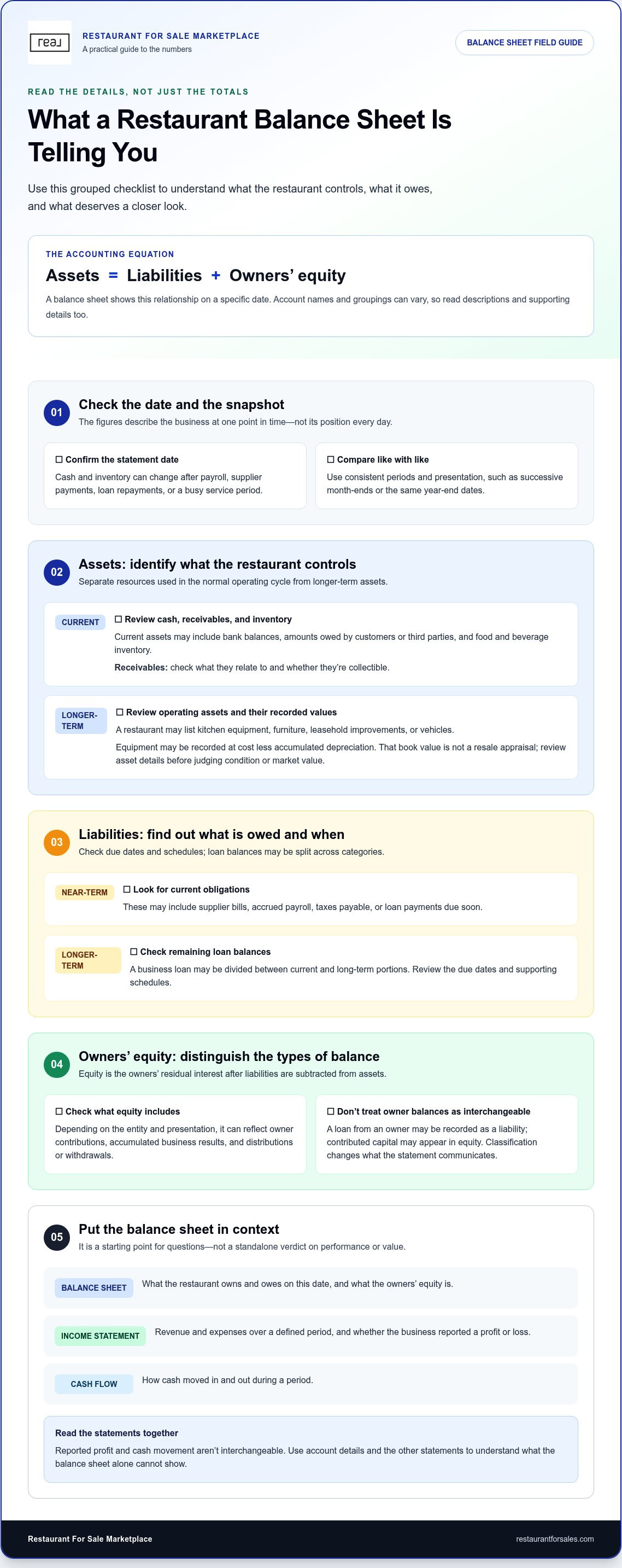
A restaurant balance sheet shows that, on a specific date, assets equal liabilities plus owners’ equity. Assets are resources the business controls, liabilities are amounts it owes, and equity is the owners’ remaining interest after liabilities are accounted for. This accounting equation is the structure behind the statement. The Balance Sheet on Wikipedia offers a broader overview of its purpose and components.
For an owner, this report can organize questions about available resources and obligations. For a prospective buyer, it can provide a starting point for reviewing the business’s financial position. It isn’t, however, a verdict on performance or value. A balance sheet can’t show whether sales and expenses produced a profit or explain every movement in cash. Those questions require other statements and supporting context. This distinction is central to reading a restaurant balance sheet responsibly.
Why the balance-sheet date matters
The figures describe the business on the date shown, not its financial position at every point in time. Cash may shift after payroll, a supplier payment, a loan repayment, or a busy service period. Inventory changes as ingredients are purchased and used. A month-end balance sheet is therefore a snapshot, not a summary of the whole year’s performance.
To see whether a balance reflects a pattern or a temporary position, compare statements from consistent periods, such as successive month-ends or the same year-end dates. Check that the reports use a consistent presentation before interpreting changes. Comparisons are less useful when dates, account groupings, or reporting periods differ. The date doesn’t make the statement less valuable; it shows how to interpret the figures and what may have changed since.
Balance sheet versus income statement and cash flow statement
Each financial statement answers a different question:
- Balance sheet: What does the restaurant own and owe on this date, and what is the owners’ equity?
- Income statement: What revenue and expenses were recorded over a defined period, and did the business report a profit or loss?
- Cash flow statement: How did cash move in and out during a period?
Reported profit and cash movement aren’t interchangeable. Revenue may be recorded before a customer pays, while cash may be used to buy equipment or repay debt without appearing as an ordinary operating expense in the same way. A restaurant can report a profit yet face pressure on available cash, or have cash on hand without strong operating results. Read the statements together with account details to get a more useful picture than any one report can provide alone.
Use the balance sheet to identify what needs context, not to draw a final conclusion. A buyer can use it to frame follow-up questions, while an owner can track changes in the business’s financial position. Profitability, cash flow, and a formal assessment of value require a broader financial review.
How to Read Restaurant Balance Sheet Assets, Liabilities, and Equity
Start with the accounting equation: assets = liabilities + owners’ equity. The three sections show what the restaurant controls, what it owes, and the residual interest belonging to its owners. Account names and groupings can vary, so read the descriptions and supporting details rather than relying on familiar labels alone. This is a practical starting point for understanding how to read a restaurant balance sheet.
Restaurant assets: cash, receivables, inventory, and equipment
Assets are resources the business owns or controls. Current assets are expected to be used, sold, or converted into cash in the normal operating cycle. They may include bank balances, customer or third-party receivables, and food and beverage inventory. Receivables represent amounts owed to the restaurant. Check what they relate to and whether they’re collectible.
Longer-term assets support operations beyond the immediate cycle. A restaurant may list kitchen equipment, furniture, leasehold improvements, or vehicles here. Equipment may appear at its recorded cost less accumulated depreciation, not at the amount it could sell for today. That book value is an accounting figure, not a resale appraisal. Review the underlying asset details before drawing conclusions about condition or market value.
Restaurant liabilities and owners’ equity
Liabilities are obligations the restaurant owes. Current liabilities are generally due in the near term and may include supplier bills, accrued payroll, taxes payable, or loan payments due soon. Longer-term liabilities can include the remaining portion of a business loan. Labels differ, and a loan may be split between current and long-term portions, so check due dates and supporting schedules.
Owners’ equity is the residual interest after liabilities are subtracted from assets. Depending on the entity and how its accounts are presented, it can reflect owner contributions, accumulated business results, and distributions or withdrawals. A loan from an owner may be recorded as a liability, while contributed capital may appear in equity. Don’t treat every owner-related balance as interchangeable; its classification affects what the statement communicates.
Illustrative example, not an industry benchmark: Assume a restaurant reports $180,000 in total assets and $110,000 in total liabilities on the statement date. Owners’ equity is $70,000, because $180,000 minus $110,000 equals $70,000. The equation balances. These totals alone don’t show whether the inventory is usable, whether equipment could sell for its recorded amount, or whether the restaurant is profitable.
For a useful review, trace major totals back to their component accounts. If equipment is listed, review the asset schedule; if a loan appears, compare it with the lender’s balance information. These details help owners and buyers prepare clearer transaction discussions. If you need a formal assessment of business value, restaurant valuation services may be a relevant next step.
How to Interpret Restaurant Balance Sheet Ratios and Patterns
Ratios turn account balances into questions about liquidity and financing. They aren’t universal pass-or-fail scores. When learning how to read a restaurant balance sheet, calculate each measure consistently, then consider what sits behind the totals, how the restaurant operates, and whether the same pattern appears across multiple reporting dates.
Liquidity: can the business meet near-term obligations?
Working capital is current assets minus current liabilities. It shows what remains after subtracting near-term obligations from assets expected to be used or converted into cash in the operating cycle. The current ratio is current assets divided by current liabilities. It compares those totals, but doesn’t show how quickly each asset can be used to pay a bill.
For example, if a restaurant reports $60,000 in current assets and $50,000 in current liabilities, working capital is $10,000 and the current ratio is 1.2. These figures are illustrative, not a recommended target. Cash is available immediately, while food inventory must be sold or used and receivables collected. Supplier payables and other upcoming bills also have different due dates. A single statement date may fall before or after a busy period, payroll, or a major supplier payment. Compare consistent dates and review cash patterns separately.
Debt, equity, and restaurant-specific context
A debt-to-equity ratio compares debt with owners’ equity, but its calculation can vary. Some analyses use total liabilities; others focus on interest-bearing debt. Identify the definition before comparing results. Equipment financing may create debt alongside the equipment asset. Lease-related assets or liabilities may also appear depending on the accounting basis and reporting treatment. Consider these balances alongside the restaurant’s assets, equity, and repayment obligations.
Use ratios as signals for investigation, not conclusions about profitability or business value. Seasonality can shift cash, inventory, and payables. Accounting methods affect classifications and recorded balances, while business structure can affect how owner activity appears. Comparisons with another business are less meaningful if reporting practices or operating cycles differ.
If a ratio changes sharply, trace the movement to the underlying accounts and compare more than one period. That context makes the measure useful for follow-up without turning it into a verdict.
How to Review a Restaurant Balance Sheet and Spot Questions
A useful review goes beyond checking whether the totals balance. Confirm the statement’s date and accounting basis, compare it with prior periods, and trace notable changes to supporting records. This repeatable process helps owners and prospective buyers focus on evidence rather than treating an unusual figure as proof of a problem.
A repeatable five-step balance-sheet review
- Confirm the date and basis. Note the reporting date and whether the statement uses cash or accrual accounting. Make sure the periods you compare use the same basis and a consistent format.
- Scan all three sections. Review assets, liabilities, and equity for completeness. Look for new accounts, large changes, or balances that seem out of place, then identify the account details behind each total.
- Compare multiple periods. Check consistent month-end or year-end statements rather than relying on one report. A rise or drop may reflect normal timing, seasonality, a transaction, or a change in account classification.
- Trace material changes. Compare figures with relevant records, such as inventory counts, receivable aging, supplier statements, loan schedules, equipment records, and owner transaction details. Supporting information can clarify what a balance represents.
- Record questions and context. Note what changed, which records could explain it, and what remains unresolved. Separate a confirmed explanation from an open question, especially when reviewing records for a potential purchase or sale.
For example, a higher inventory balance may reflect a recent purchase, but the total alone won’t establish whether items are usable or current. A growing receivable balance can prompt a review of aging and collection history. If a loan balance doesn’t match a schedule, reconcile the figures before drawing a conclusion. Owner-related balances also need detail: determine whether they reflect contributions, distributions, amounts owed to an owner, or another transaction.
Common interpretation mistakes to avoid
Positive equity doesn’t prove profitability or strong cash flow. It is one balance-sheet measure, not a substitute for reviewing operating results and cash movement. Likewise, don’t assume inventory and equipment can be converted into cash at their recorded book values. Their condition, usability, and marketability need separate context.
Comparisons also require care. Different accounting treatments or account classifications can make two restaurants’ statements look more alike, or more different, than they really are. Understand the basis and definitions before drawing conclusions.
An unusual figure is a prompt for investigation, not proof of misconduct, failure, or an inaccurate statement. Work through the records, ask focused questions, and distinguish what the balance sheet establishes from what needs further support. If you’re preparing for a restaurant purchase or sale, explore restaurant brokerage services as part of planning the transaction discussion.
How Balance Sheet Reading Supports a Restaurant Purchase or Sale
In a transaction, a balance sheet is most useful as a map for further review. It can help buyers identify balances that need explanation and help sellers prepare records that make the restaurant’s financial position easier to understand. It cannot establish the business’s full strength or value on its own. Learning how to read a restaurant balance sheet helps both sides approach a purchase or sale discussion with focused questions.
For buyers: connect the snapshot to the wider financial picture
Use the statement to identify balances that need reconciliation or additional documentation. For example, a buyer may want to understand how a reported inventory total relates to stock records, or how loan balances compare with current debt schedules. Receivables, equipment, and amounts involving owners can also prompt requests for account details or supporting records. Treat these as diligence questions, not assumptions about the seller or the business.
Then connect the balance-sheet details to operating results and cash-flow evidence. Revenue and expenses help show performance over time; cash-flow records help explain actual cash movement. Together, these materials provide context for whether recorded assets and obligations fit the restaurant’s activity. For a wider view of the purchase process, see the restaurant acquisition guide.
For sellers: prepare clear financial records
Organize statements by consistent reporting periods and keep account schedules, loan details, inventory records, and explanations for material changes accessible. Clear, consistent documentation makes it easier to explain what a balance represents and why it changed. If a figure reflects a one-time event or timing difference, the supporting record can help distinguish it from an ongoing pattern.
A balance sheet is one input in a business valuation, not a standalone valuation. It describes assets, liabilities, and equity at a point in time, while an assessment of value considers broader financial and business context. For more on the valuation process, consult the 2026 restaurant valuation guide.
For buyers, sellers, and owners preparing for a transaction, financial clarity can make discussions more informed without replacing a full review. Explore restaurant brokerage and valuation services as a next step in transaction planning.
Put Your Financial Review to Work
Turn what you’ve learned about how to read a restaurant balance sheet into a clear set of transaction priorities. Before a purchase or sale discussion, note which figures need supporting records, what you still need to understand, and how the financial picture connects to your goals. This preparation helps keep decisions grounded in evidence rather than a single number or report.
Restaurant For Sale Marketplace connects restaurant and bar buyers and sellers nationally, with brokerage and professional valuation services to support transaction planning. If you’re considering a sale, acquisition, or formal assessment of value, explore restaurant brokerage and valuation services.
A thoughtful financial review is a practical step toward your next opportunity. Move forward with clear questions and confidence in the process.
Frequently Asked Questions
What is a restaurant balance sheet?
A restaurant balance sheet is a financial report showing the business’s assets, liabilities, and owners’ equity on a specific date. Its accounting equation is assets = liabilities + owners’ equity. Unlike an income statement, which covers revenue and expenses over a period, the balance sheet records the business’s position at one point in time. Account labels vary, so identify what each account represents and how it fits into these categories.
How do you read a restaurant balance sheet step by step?
To understand how to read a restaurant balance sheet, start by checking its date and accounting basis. Then review assets, liabilities, and equity, and compare the same accounts across prior periods. Investigate meaningful changes by tracing them to records such as inventory counts, receivable details, loan schedules, or owner transactions. For example, a lower cash balance may reflect a scheduled debt payment, but the statement alone won’t establish why it changed or whether the business is performing well.
What is a good current ratio for a restaurant?
There’s no single current ratio that’s right for every restaurant. The measure divides current assets by current liabilities, but its meaning depends on the business’s seasonality, payment timing, inventory mix, and operating model. A restaurant with substantial food inventory may have a different liquidity picture from one holding more cash. Compare consistent reporting periods and examine what makes up each balance instead of treating a general benchmark as a definitive pass-or-fail test.
Does a restaurant balance sheet show whether the business is profitable?
No. A balance sheet doesn’t directly report profit for a period. It records financial position on a particular date, while an income statement summarizes revenue and expenses over a defined period. For example, a cash balance may rise because of borrowing rather than profitable operations. Review the income statement to assess reported operating results, then consider cash-flow information to understand cash movement before drawing conclusions about performance.
What does negative equity mean on a restaurant balance sheet?
Negative equity means recorded liabilities exceed recorded assets. It may result from accumulated losses, owner distributions, financing decisions, or other accounting circumstances, so the figure alone doesn’t diagnose the restaurant’s condition. Review how equity changed over time and trace the underlying accounts. For instance, compare retained earnings and owner activity with operating results and debt records before deciding what the negative balance means for the business.
How often should a restaurant balance sheet be reviewed?
Review frequency should match the restaurant’s reporting practices and the decisions being made. Regular monthly reviews can help an owner notice account changes sooner, while a buyer evaluating an opportunity may examine statements covering multiple periods. Compare reports with consistent dates and accounting treatment so trends are meaningful. A single statement may reflect unusual payment or inventory timing, so use a series of reports to distinguish short-term movement from a recurring pattern.
Can you value a restaurant using only its balance sheet?
No, a balance sheet alone isn’t enough to establish a restaurant’s market value. It records assets, liabilities, and equity under accounting conventions, but doesn’t capture the full financial performance or transaction context needed for valuation. A fuller assessment considers information beyond the snapshot. For broader context on the process and factors involved, read the 2026 restaurant valuation guide.


