

The National Restaurant Association projects that industry sales will reach $1.55 trillion in 2026, making this an era of significant opportunity for commercial investors. However, learning how to buy a restaurant involves much more than finding a kitchen you like; it's a tactical financial acquisition that requires a rigorous, investor-first approach. You likely feel the pressure of this high-stakes environment, perhaps worrying about inheriting hidden tax liens or struggling to secure a lease assignment from a difficult landlord. These concerns are valid and common among even the most experienced entrepreneurs.
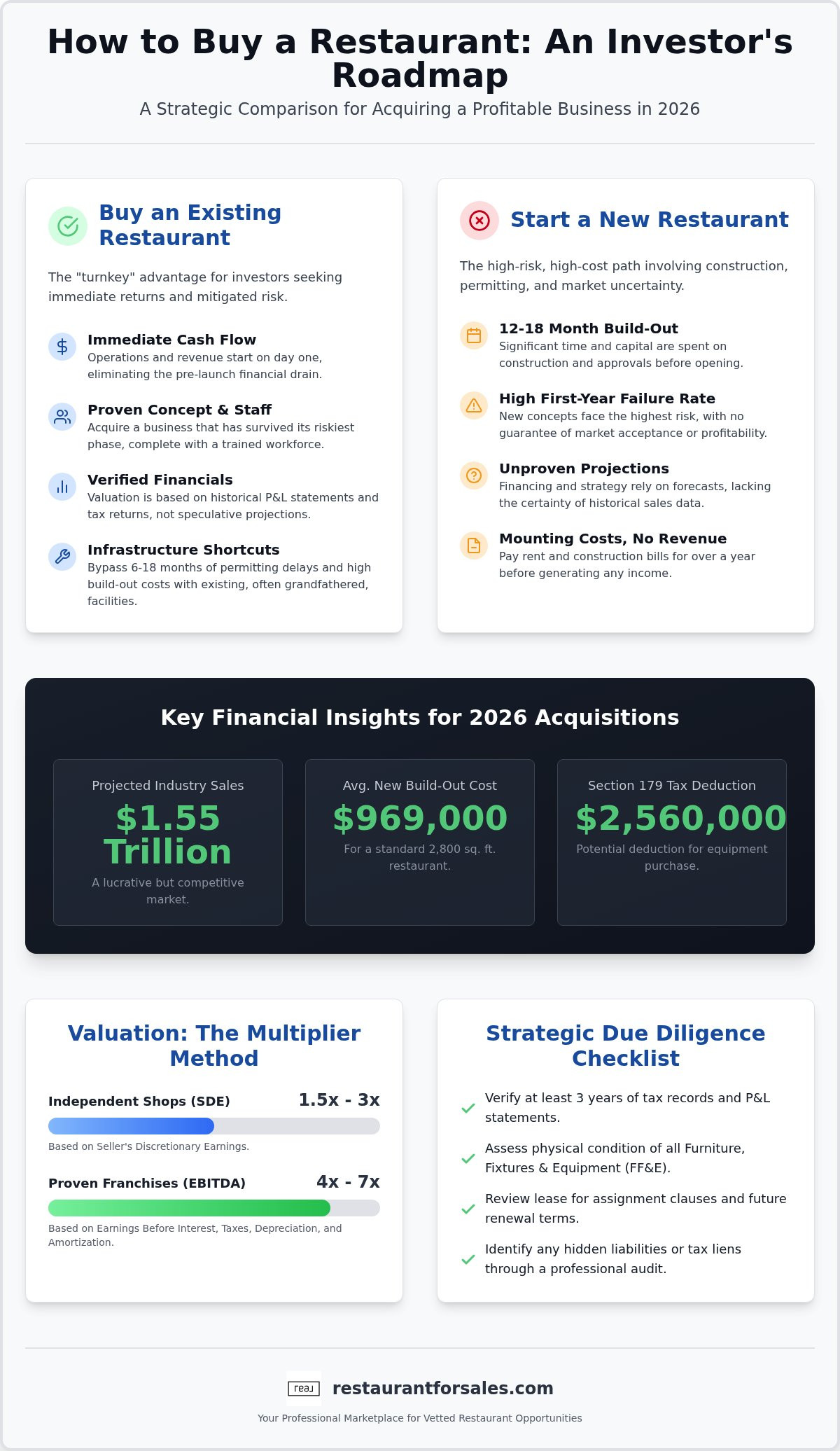
This guide provides the authoritative roadmap you need to acquire a profitable business with confidence. You'll master the strategic process of valuation, using current benchmarks like the 1.5 to 3x SDE multiple for independent shops or the 4 to 7x EBITDA range for proven franchises. We'll break down the due diligence steps required to identify liabilities and explain how to leverage 2026 tax benefits like the $2,560,000 Section 179 deduction. From the initial search to the final closing, you'll gain a clear framework for evaluating ROI and ensuring a seamless transition of ownership with minimal downtime.
Key Takeaways
- Understand the turnkey advantage of immediate cash flow and staff retention compared to the high-risk, 12-month build-out phase of a new startup.
- Master the multiplier method to accurately determine a business's value when learning how to buy a restaurant, focusing on the critical differences between SDE and EBITDA.
- Implement a strategic due diligence framework that verifies three years of tax records and assesses the physical condition of all essential furniture, fixtures, and equipment.
- Identify the right investment model by filtering active listings for hands-on owner-operator roles or passive, absentee-owner opportunities.
- Leverage professional brokerage expertise to navigate high-stakes negotiations and secure your financial interests through a structured escrow process.
Why Buy an Existing Restaurant vs. Starting from Scratch?
Building a new concept from the ground up often involves a 12 to 18-month timeline before you serve your first customer. During this period, you face mounting construction costs, rent without revenue, and the uncertainty of local zoning approvals. When you explore how to buy a restaurant that is already operational, you trade that development risk for immediate cash flow. An established business provides a "turnkey" advantage where the systems, staff, and sales are already in place on day one.
Risk mitigation is the primary driver for seasoned investors. With the National Restaurant Association projecting $1.55 trillion in sales for 2026, the market is lucrative but competitive. Starting from scratch carries a high failure rate in the first year; however, an existing restaurant has already survived the most volatile phase of its lifecycle. You aren't just buying equipment; you're acquiring a proven location and a predictable customer base.
The Benefits of a Proven Concept
Historical sales data is your most powerful tool for risk assessment. Unlike a startup's projections, an existing business offers verified tax returns and P&L statements to justify its valuation. This transparency allows you to predict future performance with a high degree of accuracy. You also inherit "human capital" in the form of a trained workforce. Hiring and training a full staff in the current labor market is a significant hurdle. Acquiring a team that already understands the menu and operational flow is an invaluable asset that reduces your management burden during the transition.
Infrastructure and Permitting Shortcuts
The technical requirements for a modern kitchen are extensive and expensive. A standard full-service restaurant of 2,800 square feet can cost approximately $969,000 to build out in 2026. By purchasing an existing facility, you often bypass the 6 to 18-month delay associated with health department and zoning approvals. Many older facilities hold "grandfathered" status, allowing you to operate with existing kitchen hoods, grease traps, and HVAC systems that might require massive capital investment to install from scratch today. This established infrastructure significantly lowers your initial capital requirements and accelerates your path to profitability.
When you evaluate how to buy a restaurant, consider the value of these shortcuts. The ability to begin operations immediately, rather than waiting on a construction crew, ensures your capital starts working for you from the moment of closing.
Identifying High-Potential Restaurant Investment Opportunities
Finding the right acquisition requires moving beyond public consumer-facing sites. Professional marketplaces allow you to filter by specific financial metrics such as annual revenue and Seller’s Discretionary Earnings (SDE). When researching how to buy a restaurant, you must first decide on your involvement level. An Owner-Operator model requires your daily presence but maximizes take-home pay by eliminating a high-level manager's salary. Conversely, an Absentee Owner model relies on established management systems, allowing you to treat the restaurant as a passive investment, though it typically requires higher gross margins to remain profitable.
Watch for "motivated seller" tags in listing descriptions. While this can signal a deal, it often hints at underlying issues like a non-renewable lease or a sudden shift in local foot traffic. Accessing the truth behind these listings requires a signed Non-Disclosure Agreement (NDA). Only after this legal step will a broker release the Confidential Information Memorandum (CIM), which contains the granular financial data necessary for a preliminary valuation. To streamline your search, you can browse active restaurant listings that have already been vetted for financial transparency.
Filtering for Profitability and Growth
Distinguish between lifestyle businesses and scalable investment opportunities. A lifestyle business may provide a steady income for one person but lacks the systems to expand. If your goal is growth, look for "Second Generation" spaces. These are locations where the previous tenant has closed, but the essential infrastructure, like hoods and grease traps, remains. This allows you to implement a new concept at a fraction of the cost of a full build-out. Use market data from 2026 to identify underserved niches, such as delivery-first models or tech-integrated fast-casual concepts, which are projected to drive the industry toward its $1.55 trillion sales goal.
The Importance of Confidentiality
Maintaining secrecy is vital during the discovery phase. If employees or competitors learn a business is for sale, it can trigger staff turnover or a loss of customer loyalty. Conduct a "secret shopper" visit to evaluate the operation. Observe the service quality, food consistency, and equipment condition without revealing your identity as a potential buyer. Direct communication with the seller's staff is strictly prohibited until a formal letter of intent (LOI) is accepted. Respecting these boundaries protects the business's value and ensures you understand how to buy a restaurant without damaging the very assets you intend to acquire.
Valuation Methods: Determining What a Restaurant is Actually Worth
Determining a fair purchase price is the most technical phase of how to buy a restaurant. Professional valuation typically relies on the Multiplier Method, which applies a numerical factor to the business's earnings to calculate its market value. In 2026, most independent restaurants sell for between 2x and 4x earnings, though this range fluctuates based on the specific earnings metric used and the stability of the concept's cash flow.
Investors must distinguish between Seller’s Discretionary Earnings (SDE) and EBITDA. SDE is used for owner-operated establishments where the buyer intends to manage daily operations. EBITDA (Earnings Before Interest, Taxes, Depreciation, and Amortization) applies to larger, multi-unit independents or franchise groups where the owner remains passive. For 2026, owner-operated independent restaurants typically sell for 1.5 to 3x SDE. Established multi-unit independents often command 3 to 5x EBITDA, while franchise operators with proven unit economics can reach multiples between 4 and 7x EBITDA.
If a business is not currently profitable, an asset-based valuation becomes the fallback. This method focuses on the tangible value of the Furniture, Fixtures, and Equipment (FF&E). In the 2026 tax year, the Section 179 deduction limit has increased to $2,560,000, and 100% bonus depreciation is fully restored. These tax incentives make high-value equipment packages particularly attractive to buyers, as they allow for substantial first-year write-offs that can offset acquisition costs.
The Seller’s Discretionary Earnings (SDE) Framework
SDE is the total financial benefit to a single owner-operator. To arrive at this figure, brokers use "add-backs" to normalize the profit and loss statement. These include the owner's salary, personal health insurance, and one-time expenses like a major kitchen repair or an upgraded point-of-sale system. SDE remains the standard for small to mid-sized independent restaurants because it accurately reflects the actual cash available to the person running the business after all personal and non-recurring expenses are removed.
Market-Based vs. Income-Based Appraisals
Income-based appraisals focus on future cash flow, while market-based methods compare the subject restaurant to recent sales of similar establishments in the same region. Factors like a below-market lease or a long-term liquor license create "Goodwill," which can justify a higher premium. Because these variables are complex, securing a professional Broker Opinion of Value (BOV) is essential. A BOV ensures the asking price aligns with current market realities, preventing you from overpaying for a concept that lacks the earnings to support your debt service.
The Due Diligence Phase: A Strategic Financial Interrogation
Due diligence is the period where you verify every claim made by the seller. It's the most critical stage in learning how to buy a restaurant because it protects you from inheriting undisclosed debts or failing infrastructure. This process typically follows a structured five-step framework:
- Financial Verification: Compare three years of federal tax returns against internal P&L statements.
- Asset Inspection: Physically test all FF&E to ensure kitchen hoods, refrigeration units, and HVAC systems meet current standards.
- Lease Review: Analyze assignment clauses, landlord consent requirements, and remaining lease terms.
- Liability Search: Check for outstanding sales tax audits, health department violations, and UCC-1 liens on equipment.
- Labor Audit: Validate payroll tax compliance, workers' compensation history, and employee eligibility records.
Financial Verification and Tax Compliance
Cross-reference POS reports directly with monthly bank statements to confirm revenue claims. If a seller mentions "off-the-books" cash income, disregard it during your valuation. You shouldn't pay a premium for income that isn't documented on a tax return. Additionally, evaluate the Cost of Goods Sold (COGS). In 2026, food costs generally range from 28% to 38% of revenue. If the COGS sits significantly outside this industry-standard range, it may indicate waste, theft, or poor vendor management. For expert assistance in verifying these complex metrics, you can utilize our professional restaurant valuation services to ensure your offer remains grounded in reality.
The Lease Assignment and Transfer Process
The choice between an asset purchase and an entity purchase determines your legal liability. In an asset purchase, you buy the equipment and goodwill while leaving the seller's corporate liabilities behind. This path usually requires a lease assignment, where the landlord must formally approve you as the new tenant. Prepare a "Buyer Profile" that includes your personal financial statement and industry experience to secure this approval. Negotiate for lease extensions or additional five-year options as a non-negotiable condition of the sale. Securing a long-term lease is vital for protecting your investment, as rent and occupancy-related expenses often account for 5% to 10% of monthly revenue. Ensure all licenses, including liquor permits which can take 30 to 180 days to transfer, are addressed in the closing timeline.
Closing the Deal: Why Professional Brokerage is Essential
The final stage of how to buy a restaurant is the most legally complex and emotionally charged part of the acquisition. A professional broker acts as a critical buffer during high-stakes negotiations, ensuring that both parties remain focused on the technical requirements of the transaction. Their role is to manage the flow of information and documents between attorneys, landlords, and lenders, preventing minor friction from de-railing the entire deal. This oversight is vital when drafting the Asset Purchase Agreement (APA), which is the standard contract for most acquisitions. Unlike a stock purchase, an APA allows you to buy the business's equipment and goodwill while leaving behind the seller's corporate liabilities and historical debts.
Navigating the Legal and Escrow Maze
Bulk sale escrow is a mandatory safeguard that protects you from inheriting the seller's undisclosed financial obligations. During this process, an escrow agent holds the purchase funds while performing a final check for tax liens, UCC-1 filings, and unpaid vendor accounts. The final Closing Statement provides a line-by-line accounting of the transaction, including the proration of rent, utility deposits, and any prepaid service contracts. You must also secure a robust non-compete agreement as part of the closing documents. This covenant prevents the seller from opening a similar concept within a defined geographic radius, ensuring they don't leverage their local reputation to siphon away the customers you've just paid to acquire.
Transitioning Ownership Successfully
A successful transition requires a clearly defined training period. Most buyers negotiate for two to four weeks of on-site support from the seller to learn proprietary recipes, staff management styles, and vendor ordering schedules. This period is essential for maintaining operational continuity and guest satisfaction during the ownership change. On the evening before the official closing, conduct a final inventory count. The purchase price is adjusted to reflect the actual value of the food and liquor on hand, ensuring you aren't paying for stock that has already been depleted. This methodical approach minimizes downtime and allows you to focus on growth from the first day of operation.
Ready to find your next investment? Browse our active restaurant listings today!
Securing Your Position in the 2026 Restaurant Market
Acquiring an established business is a strategic move that bypasses the high-risk development phase and places you directly into a revenue-generating operation. Success in this complex marketplace requires more than just industry passion; it demands a disciplined approach to financial interrogation and a clear understanding of how to buy a restaurant using modern valuation benchmarks. By prioritizing turnkey infrastructure and proven customer bases, you significantly reduce the volatility associated with new ventures.
Our team provides the specialized expertise necessary to navigate these high-stakes transactions. We offer professional restaurant valuation services to ensure your investment is sound, along with expert lease assignment support to manage landlord negotiations effectively. Our success-based brokerage commissions ensure our goals remain perfectly aligned with your acquisition objectives from the initial search to the final escrow closing. If you're ready to take the next step toward ownership, View Active Restaurant and Bar Listings Across the Country today. Your future as a successful restaurant owner starts with a single, well-informed decision.
Frequently Asked Questions
How much money do I need as a down payment to buy a restaurant?
You generally need a down payment of 20% to 30% of the purchase price when securing SBA 7(a) financing for a restaurant acquisition. While some seller-financed deals may allow for lower entry costs, institutional lenders require this equity stake to mitigate risk. It's also vital to budget for $50,000 to $200,000 in working capital reserves to cover initial operating expenses and unexpected contingencies during the ownership transition.
Can I buy a restaurant with no experience in the industry?
You can buy a restaurant without direct industry experience, but it complicates the financing and leasing process. SBA lenders and landlords often require a resume that demonstrates management or business ownership expertise. If you lack a culinary background, consider an "Absentee Owner" model with an established management team or look for a franchise resale where the franchisor provides mandatory operational training as part of the transfer.
What is the difference between buying the assets and buying the stock of a restaurant?
An asset purchase involves buying specific items like equipment, inventory, and goodwill while leaving the seller's corporate liabilities behind. This is the standard method for most independent acquisitions. A stock purchase involves buying the entire legal entity, meaning you inherit all past debts, tax obligations, and legal risks. Most buyers prefer asset deals to ensure they start their new venture with a clean financial slate.
How long does the process of buying a restaurant typically take?
The process of how to buy a restaurant typically takes between 90 and 180 days from the initial offer to the final closing. This timeline is largely driven by the due diligence phase, SBA loan processing, and lease assignment negotiations. Additionally, transferring a liquor license can take 30 to 180 days depending on local regulations, which often dictates the final date you can legally begin full operations.
Is it possible to get SBA financing for an existing restaurant purchase?
SBA 7(a) loans are the primary financing vehicle for restaurant purchases up to $5 million. In August 2026, interest rates for these loans are approximately SOFR plus 2.75% to 4.75%, resulting in an estimated range of 6.38% to 8.38%. To qualify, the business must show enough Seller's Discretionary Earnings to cover the debt service while providing the owner with a reasonable living wage after all expenses are paid.
What happens to the existing employees when I buy a restaurant?
Existing employees typically remain with the business to ensure operational continuity, though they are technically terminated by the seller and rehired by your new legal entity. This transition allows you to reset payroll records and implement new employment agreements. Retaining a trained workforce is a major advantage of buying an existing concept, as it eliminates the high costs and delays associated with recruiting a full team from scratch.
Do I need a lawyer and a broker to buy a restaurant?
You should utilize both a professional broker and a commercial attorney to navigate the acquisition safely. A broker acts as the matchmaker and negotiator, while an attorney reviews the Asset Purchase Agreement and ensures the lease assignment protects your long-term interests. Given the high-stakes nature of commercial real estate and business transfers, skipping professional representation often leads to expensive errors in valuation or liability protection.
What are the most common red flags when reviewing a restaurant’s financials?
Common red flags include declining year-over-year sales, food costs exceeding the 38% industry benchmark, and unverified cash income claims. When learning how to buy a restaurant, be wary of sellers who cannot provide three years of clean tax returns. Discrepancies between point-of-sale reports and bank deposits often indicate poor management or potential financial instability that could jeopardize your future return on investment.


