

The most valuable asset in a diner acquisition isn't the secret recipe or the vintage neon; it’s the use-intensity of the commercial infrastructure and the durability of the lease assignment. When you begin searching for diners for sale, you aren't just buying a neighborhood landmark; you're acquiring a high-utilization engine that must withstand constant operational stress. Evaluating these opportunities requires a shift from emotional nostalgia to rigorous financial and physical due diligence.
It’s understandable to feel uncertain about verifying historical cash flow in cash-heavy operations or calculating the remaining lifespan of expensive kitchen lines. This guide provides a comprehensive framework for analyzing the 2026 market, ensuring you identify turnkey opportunities with modern infrastructure. You'll learn how to secure favorable lease terms, utilize professional valuation services to justify asking prices, and minimize operational downtime during the ownership transfer. We'll break down the specific factors that separate a profitable investment from a high-maintenance liability.
Key Takeaways
- Understand why diners outperform standard restaurant models during economic shifts due to high-volume counter service and diverse revenue streams.
- Learn to evaluate high-intensity use assets, prioritizing modern infrastructure to avoid immediate capital expenditures on griddles and HVAC systems.
- Master the due diligence process by reconciling POS reports with bank statements and identifying restrictive clauses in lease assignments.
- Utilize specialized restaurant brokerage services to navigate the complexities of 24/7 labor models and EBITDA protection.
- Effectively filter active listings for diners for sale to find turnkey opportunities that minimize operational downtime during ownership transfer.
The Unique Value Proposition of Diners as a Business Asset
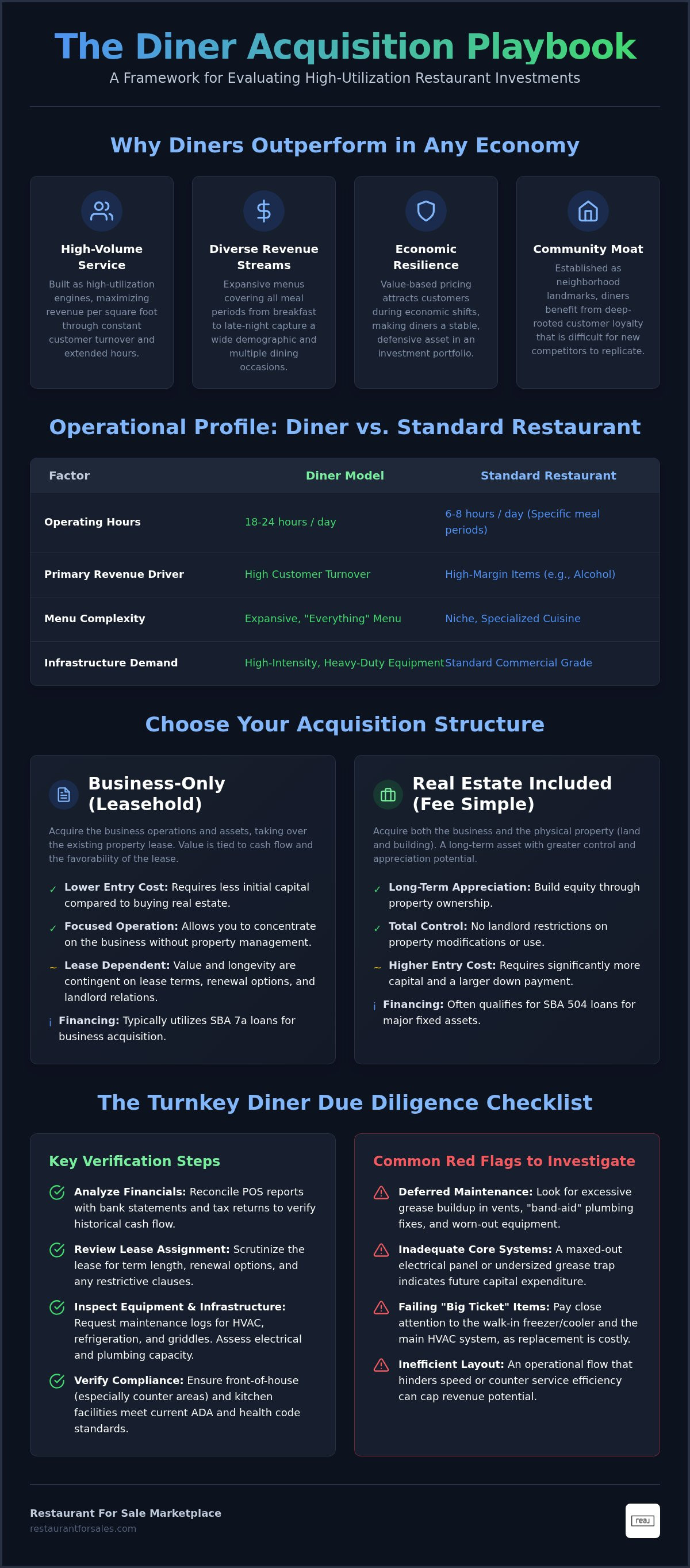
A diner is defined by its high-volume service model, expansive menu, and specialized counter-service infrastructure. Unlike niche bistros or seasonal cafes, these establishments are designed as high-utilization engines. When evaluating diners for sale, investors are looking at a business with a unique "community moat." This moat is built on established customer loyalty and the diner’s status as a neighborhood "third place," which provides a reliable stream of recurring revenue that is difficult for new competitors to replicate.
Historically, diners show remarkable resilience during economic fluctuations. Their value-based pricing attracts a broad demographic, making them a defensive asset in any portfolio. This stability is supported by high asset density; the business value is heavily weighted in specialized kitchen equipment, walk-in refrigeration, and built-in fixtures. These assets are built for constant use and represent significant capital that a buyer doesn't have to install from scratch. This makes a turnkey diner a more efficient investment than a ground-up build.
Diner vs. Standard Restaurant: Key Differences
The operational profile of a diner differs significantly from a standard restaurant. While many eateries focus on specific meal periods, diners often thrive on extended hours or 24/7 models. This maximizes revenue per square foot but requires a robust labor strategy to manage multiple shifts. The "everything" kitchen is another differentiator; it requires heavy-duty venting and high-capacity griddles to support a menu that spans breakfast through late-night dining. High customer turnover rates are the primary driver of daily revenue, prioritizing efficiency and speed over high-margin alcohol sales.
Business-Only vs. Real Estate Included
Investors must choose between acquiring a leasehold interest or a fee-simple acquisition that includes the land and building. A leasehold interest offers a lower entry cost, though its value depends entirely on the quality of the lease assignment and the remaining term. If you own the real estate, you gain long-term appreciation and greater control over the property. Real estate ownership also changes your financing landscape. Acquisitions involving property often qualify for SBA 504 loans, which provide fixed-rate, long-term financing for major fixed assets. Conversely, business-only purchases typically utilize SBA 7a loans. Analyzing diners for sale requires a clear understanding of how these different structures impact your total ROI and exit strategy.
Evaluating Physical Assets and Infrastructure
In the restaurant industry, diner equipment is subjected to what's known as "high-intensity use." Unlike a fine-dining kitchen that operates for six hours a day, a diner line often runs for 18 to 24 hours. This constant thermal cycling and physical wear mean that griddles, fryers, and refrigeration units reach their end-of-life cycle much faster than standard restaurant gear. When reviewing diners for sale, you must look beyond the gleaming stainless steel and verify the actual age and service history of every asset.
Infrastructure health is the backbone of a high-volume diner. You need to assess the grease traps, plumbing, and electrical capacity. A 24-hour operation puts immense strain on these systems. If the plumbing can't handle the constant flow or the electrical panel is maxed out by modern POS systems and high-draw kitchen appliances, you're looking at a massive capital expenditure. Additionally, the layout must be optimized for speed. Counter seating efficiency is a primary revenue driver, but in older structures, you must ensure these areas meet current ADA compliance standards to avoid legal liabilities.
The Turnkey Diner Checklist
A turnkey diner is a business ready for immediate operation without the need for additional capital expenditure. To verify this status, request equipment maintenance logs to confirm regular servicing of specialized HVAC and refrigeration units. Balance your assessment of "front of house" aesthetics with functional requirements; a new coat of paint is worthless if the walk-in freezer is failing. If you're unsure about the technical state of a listing, utilizing professional restaurant valuation services can help you reconcile the asking price with the actual condition of the physical assets.
Common Red Flags in Diner Facilities
Watch for signs of deferred maintenance in high-volume kitchens, such as excessive grease buildup in ventilation ducts or "band-aid" repairs on essential plumbing. Inadequate ventilation is a frequent issue in vintage diners; modern building codes require significantly more airflow for large-scale griddle cooking than was standard 30 years ago. Compliance issues with the National Electric Code (NEC) or local fire safety ordinances are often hidden behind the walls of older diner structures. Identifying these red flags early prevents you from inheriting a facility that requires a total overhaul just to pass a health inspection.
Analyzing Financial Performance and Operational Models
The financial viability of a diner depends on its ability to sweat the assets across multiple dayparts. When browsing diners for sale, you'll notice that the most profitable units utilize a "multi-shift multiplier." This model maximizes revenue per square foot by capturing different customer segments, such as early morning commuters, lunch workers, and late-night patrons, within the same 24-hour cycle. Unlike traditional restaurants that might see 60% of their revenue during a four-hour dinner window, a well-run diner distributes its earnings more evenly. Breakfast often remains the highest-margin period because the cost of eggs, grains, and coffee doesn't fluctuate as wildly as dinner proteins.
Managing labor costs is the primary challenge in a 24/7 or extended-hour environment. Staffing three distinct shifts can significantly compress EBITDA if not managed with precision. You must analyze the payroll records to ensure that late-night or "graveyard" shifts are actually contributing to the bottom line rather than just covering their own variable costs. Food cost volatility in 2026 also requires a dynamic approach to menu engineering. With diverse menus, diners often face higher waste potential; successful operators mitigate this by cross-utilizing ingredients across breakfast, lunch, and dinner offerings to maintain inventory efficiency.
Key Performance Indicators (KPIs) for Diners
- Average Check Size vs. Table Turnover: Diners thrive on volume. A lower average check is acceptable only if the table turnover speed remains high enough to drive total daily volume.
- Prime Cost Analysis: Your combined food and labor costs should ideally stay below 65% of total sales to maintain healthy margins in a high-inflation environment.
- Occupancy Cost Ratios: For leased properties, occupancy costs shouldn't exceed 8-10% of gross sales. If you own the real estate, this ratio shifts toward debt service and property tax management.
Modernizing the Diner Model in 2026
Profitability in the current market requires integrating modern revenue streams without disrupting the core counter-service experience. Many diners for sale now feature dedicated pickup windows or separate staging areas for delivery and takeout orders. This prevents "delivery fatigue" among in-house diners who don't want their experience disrupted. Implementing Kitchen Display Systems (KDS) is another essential upgrade; it replaces handwritten tickets, reducing errors and increasing ticket speed. Some operators are even utilizing their high-capacity kitchens as ghost kitchen hubs during off-peak hours, preparing delivery-only brands to boost revenue without increasing the physical footprint of the business.
The Due Diligence Process for Diner Acquisitions
Due diligence is the critical phase where an investor moves from interest to verification. When you identify promising diners for sale, your first priority is financial reconciliation. You must cross-reference Point of Sale (POS) reports with federal tax returns and monthly bank statements. In cash-heavy diner operations, discrepancies between reported income and actual deposits are common red flags. If the seller’s claims don't align with documented bank activity, the business valuation must be adjusted to reflect verifiable earnings only. A thorough audit of staffing and payroll is also necessary. Review employee turnover rates and verify if key back-of-house staff have existing contracts that must be honored post-acquisition.
Permit and license audits are equally vital. You must confirm that health department permits, certificates of occupancy, and liquor licenses are transferable to a new owner. Some jurisdictions require a full facility inspection before a permit transfer, which could trigger mandatory upgrades to meet 2026 building codes. If these permits aren't transferable, you face significant operational downtime and unexpected costs. Verify the status of every license early to ensure the business remains "turnkey" throughout the ownership transition.
Navigating Lease Assignments and Transfers
The landlord is a silent but powerful party in any diner transaction. Most commercial leases contain "assignment" clauses that require landlord approval of the buyer’s financial standing and operational experience. You must identify if the sale triggers an assignment fee or a scheduled rent escalation. In some cases, a landlord may attempt to renegotiate the entire lease upon transfer, which can strip the business of its profitability. Utilizing professional Restaurant Lease Assignments services is essential to manage these negotiations and ensure your occupancy costs remain stable after the closing.
Verifying Hidden Liabilities
Beyond the visible assets, you must search for encumbrances that could follow the business. Check for outstanding sales tax liens or unemployment insurance liabilities that the current owner may have neglected. Review all equipment leases and service contracts for assumability; if a high-capacity griddle or dishwasher is leased rather than owned, you need to know the remaining payoff and monthly obligation. Due diligence is the only period where a buyer can legally verify the seller's claims. If you don't uncover these liabilities before the closing date, they become your financial responsibility. Take the time to audit every vendor agreement to ensure you're starting with a clean slate.
Finding and Closing Your Diner Investment
Identifying the right opportunity requires a methodical approach to market data. When you search for diners for sale, use specific filters to narrow your focus by cash flow, real estate inclusion, or equipment age. A generic search often yields outdated or poorly documented listings. By focusing on specialized platforms, you gain access to businesses where the "multi-shift multiplier" and asset density have already been analyzed. This saves time and ensures you're only evaluating units that meet your specific ROI criteria.
Working with a specialized restaurant broker provides a distinct advantage during the acquisition process. These professionals understand the nuances of diner operations, from the stress on HVAC systems to the complexities of 24-hour labor models. They act as a pragmatic partner, helping you navigate the "matchmaking" process between your investment goals and the seller's exit strategy. A broker’s expertise is particularly valuable when reconciling the cash-heavy records typical of classic diners with the requirements of modern lenders.
Financing is the final hurdle in the acquisition journey. Most buyers utilize SBA 7(a) loans for business-only purchases, as these are designed for companies with significant goodwill and equipment assets. If the real estate is included, an SBA 504 loan offers long-term, fixed-rate financing that protects your occupancy costs. Seller financing is also a common tool in the diner industry; it often bridges the gap between your down payment and the primary loan, while signaling the seller's confidence in the business's future performance. Closing typically takes 60 to 90 days, followed by a structured transition period where the seller trains you on local vendor relationships and staff management.
Why Use a Professional Marketplace?
A professional marketplace offers more than just a list of names. It provides a secure environment where you can review formal business valuation data and vetted financial statements. Confidentiality is managed strictly to protect the business's daily operations; employees and competitors won't know the diner is on the market until a deal is finalized. This stability is crucial for maintaining the "community moat" that gives the diner its value. You can also leverage broker expertise to handle the heavy lifting of lease assignments and permit audits.
Next Steps: From Search to Closing
To move from a passive search to an active acquisition, register for real-time alerts. This ensures you're notified the moment new diners for sale hit the market. Prepare a professional "Buyer Profile" that includes a summary of your liquid assets and relevant management experience. A strong profile impresses both sellers and landlords, making your offer more competitive in a high-demand market. Browse our active diner listings today to find your next investment opportunity.
Securing Your Position in the 2026 Diner Market
Acquiring a diner is a strategic investment in a resilient business model built on high-volume infrastructure and a loyal customer moat. Success in this sector requires more than just operational passion; it demands a technical approach to asset evaluation and lease stability. By focusing on high-intensity equipment health and verifying cash flows through professional valuation, you mitigate the risks associated with vintage facilities. It's vital to remember that the quality of your lease assignment is often as valuable as the kitchen line itself.
Navigating the marketplace for diners for sale is a complex process that benefits from expert guidance. Our platform provides access to a national database of vetted listings, supported by expert restaurant valuation services and specialized lease assignment support to ensure a seamless transition. Prepare your buyer profile now to demonstrate your readiness to landlords and sellers alike. Your path to owning a profitable, turnkey business begins with a methodical search. Search Active Diner Listings and Start Your Acquisition Today to find the right opportunity for your portfolio. We look forward to facilitating your success in this classic American industry.
Frequently Asked Questions
What is the average price-to-earnings multiple for a diner in 2026?
In the current 2026 market, the average price-to-earnings multiple for a diner typically ranges between 2.5 and 3.5 times Seller's Discretionary Earnings (SDE). These figures are heavily influenced by the condition of the high-intensity equipment and the remaining term of the lease assignment. Diners with modern infrastructure and consistent 24-hour revenue streams often command the higher end of this range during a formal valuation.
Is it better to buy a diner with or without the real estate?
Choosing between a leasehold interest and real estate ownership depends on your capital and long-term strategy. Owning the property provides equity appreciation and protects you from future rent escalations. However, a business-only acquisition offers a lower entry cost and a faster path to operational cash flow. Many investors searching for diners for sale prioritize real estate to gain access to more favorable SBA 504 financing options.
How do I verify the cash flow of a diner for sale?
Verifying cash flow requires a meticulous reconciliation of Point of Sale (POS) reports against monthly bank statements and federal tax returns. You must look for consistency across these three data points to confirm the accuracy of reported earnings. In cash-heavy diner operations, actual bank deposits are the most reliable metric of performance. Utilizing professional valuation services can help you identify discrepancies and ensure the asking price reflects verifiable historical earnings.
Can I buy a diner with an SBA loan?
Yes, you can utilize SBA loans to acquire a diner, provided the business meets specific cash flow and management requirements. The SBA 7(a) program is the standard choice for business-only transfers involving goodwill and equipment assets. If your acquisition includes the physical property, the SBA 504 loan offers fixed-rate, long-term financing for major fixed assets. Both programs require a clean financial history and a comprehensive business plan from the prospective buyer.
What happens to the existing staff when a diner is sold?
Most diner acquisitions involve the retention of existing staff to ensure operational continuity and maintain the established customer moat. You should review any existing employment contracts and turnover rates during the due diligence period. While some buyers introduce new management, keeping the experienced back-of-house team is often critical for preserving menu quality. Clear communication with the team during the ownership transfer helps minimize turnover and prevents operational downtime.
How long does the lease assignment process typically take?
The lease assignment process typically takes between 30 and 60 days, depending on the landlord's responsiveness and the complexity of the agreement. This timeline includes the landlord’s review of your financial standing and operational experience. It’s essential to begin this process early in the transaction to avoid delays in the final closing. Working with a broker experienced in lease transfers can streamline these negotiations and help you navigate any requested rent escalations.
What are the biggest red flags when buying a turnkey diner?
Major red flags include deferred maintenance on high-intensity equipment and short-term leases without renewal options. If a kitchen line shows signs of "band-aid" repairs or the ventilation system is outdated, you may face immediate capital expenditures post-closing. Inconsistent financial records that don't match bank deposits also signal significant risk. You should also watch for high staff turnover or pending health department violations, as these can derail the business’s reputation and profitability.
Do I need a specialized broker to buy a diner?
Utilizing a specialized restaurant broker is highly recommended for navigating the unique complexities of diner acquisitions. These experts understand how to value high-utilization assets and manage the intricacies of 24-hour labor models. They provide access to vetted diners for sale and act as an essential facilitator during lease assignments. A specialized broker ensures that you aren't just buying a business, but acquiring a sustainable investment with a clear path to long-term growth.


