

The most lucrative cafe for sale California has to offer in 2026 is rarely the one with the most attractive storefront. It's the one with a clean lease assignment and a verifiable bottom line. You probably feel the pressure of searching a market where "confidential" listings and complex NDAs make it difficult to distinguish a turnkey opportunity from a financial "lemon." It's natural to worry about declining revenue or the rising operational costs associated with new 2026 regulations, such as the Allergen Disclosure for Dining Experiences Act.
We'll show you how to master the art of the California cafe market by decoding active listings and moving from browsing to a successful acquisition. You will learn to calculate true EBITDA while accounting for varying local minimum wages across the state. This article provides a methodical framework for comparing independent cafes with franchise resales; it also explains how a professional broker ensures your transaction remains transparent and secure. By the end of this guide, you will have the technical skills to identify growth opportunities in a complex regional landscape.
Key Takeaways
- Identify why purchasing an existing operation offers a faster, more cost-effective path to ownership than a new build-out in the current market.
- Learn how to filter every cafe for sale California listing by specific operational niches to find the most profitable turnkey opportunities.
- Evaluate the long-term sustainability of an investment by prioritizing lease assignment terms and "Rent-to-Revenue" ratios over physical assets.
- Navigate the confidential acquisition process with professional protocols for NDAs and site visits to protect sensitive financial information.
- Gain access to exclusive "pocket listings" and expert valuation services by partnering with a specialized restaurant broker.
The California Cafe Market: Navigating Opportunities in 2026
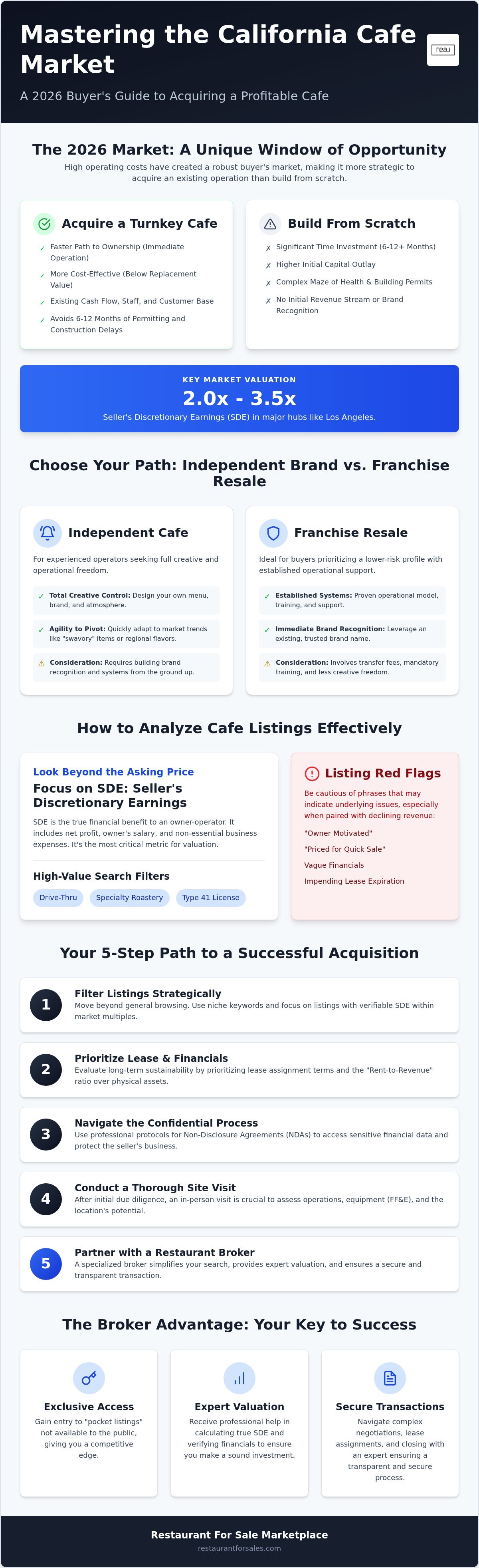
The 2026 California hospitality market represents a unique window for strategic acquisitions. While high operating costs have led to an increase in independent closures over the last few years, this churn has created a robust buyer's market. Finding a cafe for sale California entrepreneurs can actually scale requires understanding that current prices often sit well below replacement value. It's almost always more cost-effective to acquire a turnkey operation than to fund a fresh build-out. Building from scratch involves navigating a maze of health permits and construction delays that can keep a business dark for six to twelve months.
Success in this market depends on your ability to identify active listings versus stale ones. Active listings are typically priced according to current market multiples, which currently range from 2.0x to 3.5x of Seller's Discretionary Earnings (SDE) in major hubs like Los Angeles. Stale listings often reflect unrealistic pricing expectations or hidden lease complications that have deterred previous buyers. You must set realistic expectations for ROI; while the market is favorable for buyers, compressed consumer budgets and high labor costs mean that operational efficiency is the primary driver of profitability in 2026.
Why California Remains a Top Destination for Cafe Investors
California's "third place" culture remains resilient despite broader economic shifts. Verified data from July 2026 showed a 1.2% year-over-year increase in dining visits across the state. In high-density business hubs, cafes serve as essential community nodes where professional and social lives intersect. This consistent demand, paired with the state's massive population density, provides a reliable customer base for well-positioned shops. Investors are currently targeting growth categories like dessert-focused concepts and creperies, which have shown higher resilience in the current economic climate.
Independent vs. Franchise: Which Path Fits Your Goals?
Choosing between an independent brand and a franchise resale depends on your operational experience and risk tolerance. Independent cafes offer total creative control, allowing you to pivot quickly toward trending "swavory" menu items or regional Asian flavors without corporate approval. Conversely, franchise resales provide established systems, training, and immediate brand recognition. When evaluating different Restaurant business models, consider that franchise resales in California involve specific transfer fees and mandatory training periods. These costs are often justified by the lower risk profile of a proven operational system. Whether you choose an independent cafe for sale California listing or a franchise, your focus must remain on the strength of the existing lease and the accuracy of the financial disclosures.
How to Browse Active Restaurant Listings Effectively
Browsing for a cafe for sale California requires a shift in perspective. Most buyers focus on the asking price first; however, the most critical data point is the Seller’s Discretionary Earnings (SDE). This figure represents the total financial benefit available to a single owner-operator, including net profit, owner salary, and non-essential expenses. In the 2026 market, Los Angeles cafes typically trade between 2.0x and 3.5x SDE. If a listing price significantly exceeds these multiples without including real estate, it requires rigorous justification.
Effective searching also involves using specific keyword filters. Don't just browse general categories. Use terms like "drive-thru," "specialty roastery," or "Type 41 license" to find high-value niches. Be wary of "red flag" phrasing such as "owner motivated" or "priced for quick sale" when paired with declining revenue. These often indicate operational trouble or impending lease expirations. You can find a curated list of verified opportunities by exploring active restaurant listings that have already undergone preliminary vetting.
Decoding Industry-Specific Listing Terminology
Understand the difference between a "Turnkey" opportunity and an "Asset Sale." A turnkey cafe is a fully operational business with existing staff, customers, and cash flow. An asset sale usually means you are purchasing the equipment and lease rights of a closed or struggling business. You should also scrutinize the term "Absentee Owner." While it suggests the business runs itself, it often masks high management costs that eat into your margins. Finally, ensure the "FF&E" (Furniture, Fixtures, and Equipment) section includes a detailed inventory. In California, all businesses must pay a minimum $800 annual franchise tax, so even an underperforming asset sale carries fixed carry costs you must account for in your initial budget.
The 5-Step Framework for Evaluating a Listing
- Step 1: Verify Status. Confirm the listing is current. Stale data can lead to wasted due diligence on businesses already under contract.
- Step 2: Cross-Reference Demographics. Analyze the local population. Use resources for California business permits to understand the specific regulatory environment and licensing requirements for that municipality.
- Step 3: Analyze Lease Terms. A cafe is only as valuable as its right to occupy the space. Check the remaining term and any "options to renew" that protect your investment.
- Step 4: Request an Equipment List. Verify the age and condition of refrigeration, espresso machines, and grease traps. Replacing these items post-sale can cost tens of thousands of dollars.
- Step 5: Reconcile Financials. Compare the listed SDE against tax returns or Profit and Loss statements. Ensure the numbers reflect the reality of 2026 labor costs and utility rates.
Evaluating Cafe Assets: Financials and Lease Assignments
In the competitive landscape of a cafe for sale California investment, the lease agreement often holds more intrinsic value than the espresso machines or kitchen assets. Equipment depreciates the moment it's installed; however, a secured location in a high-traffic district with favorable terms is an appreciating asset. You must prioritize the quality of the real estate and the longevity of the occupancy rights during your initial evaluation. A sustainable "Rent-to-Revenue" ratio for a California cafe typically ranges between 6% and 10% of gross sales. If the rent exceeds 12%, the business may struggle to absorb the state's high labor costs and the 8.84% corporate tax rate.
Verifying financial claims requires more than a cursory glance at a Profit and Loss statement. Demand access to federal tax returns, specifically Schedule C or Form 1120-S, and reconcile these against daily Point of Sale (POS) reports. Sellers might present "pro forma" numbers that reflect potential rather than reality. Your goal is to identify the actual cash flow that will be available to you on day one of ownership.
Mastering the Restaurant Lease Transfer
Landlord approval is often the most significant hurdle in a business acquisition. During a lease assignment, the landlord must consent to the transfer of the existing agreement from the seller to you. This process usually requires you to submit a personal financial statement, a professional resume, and a detailed business plan. Be aware of the difference between an assignment and a new lease negotiation; an assignment preserves the current rent and remaining "options to renew," while a new lease may trigger a market-rate adjustment. Carefully review the lease for hidden Common Area Maintenance (CAM) charges and annual CPI escalations that could impact your future margins.
Financial Due Diligence: Beyond the P&L
Sellers frequently apply "add-backs" to their net income to calculate the Seller’s Discretionary Earnings. These are one-time or personal expenses, such as travel, family meals, or personal vehicle leases, that won't carry over to a new owner. You must scrutinize these figures to ensure they are legitimate operational adjustments rather than inflated projections. When conducting this deep dive, refer to the SBA guide to buying an existing business to ensure you've covered all legal and financial checkpoints.
Beyond the bottom line, verify that the business is compliant with California's strict labor laws, including the $16.00 per hour statewide minimum wage and accurate worker’s comp records. EBITDA represents a cafe's earnings before interest, taxes, depreciation, and amortization, serving as a standardized metric to evaluate the business's cash flow regardless of its capital structure. Securing a cafe for sale California listing requires this level of granular detail to avoid inheriting undisclosed liabilities.
The Step-by-Step Inquiry Process: From Listing to Site Visit
Most profitable cafes don't have "For Sale" signs in the window. Sellers prioritize confidentiality to prevent staff turnover and customer loss, meaning the best opportunities are often masked behind generic descriptions. When you find a cafe for sale California listing that aligns with your goals, expect to sign a Non-Disclosure Agreement (NDA) before receiving sensitive data. This legal document ensures that proprietary financial records, lease details, and employee information remain private during the discovery phase.
To get a broker's attention in a competitive market, you must prepare a professional Buyer Profile. This summary should highlight your hospitality experience and provide preliminary proof of funds. Brokers prioritize buyers who demonstrate they are financially capable and operationally ready. Once you've cleared the initial screening, you can browse exclusive cafe listings and begin the formal inquiry process with the support of a dedicated professional.
Navigating the Confidential Inquiry
Professional etiquette is paramount during this stage. Never walk into a business and ask employees about the sale; this can jeopardize the transaction and damage the business's value. After you sign the NDA, you'll receive a Confidential Information Memorandum (CIM). This package includes detailed financials, lease terms, and an itemized equipment list. The broker acts as a buffer, facilitating your questions and coordinating communication without disrupting daily operations. Use this time to reconcile the CIM data with the valuation principles discussed in earlier sections.
The First Site Visit: What to Look For
Conduct a "secret shopper" visit before scheduling a formal showing. Buy a coffee, sit in the dining area, and observe the "flow" of the operation. Is the staff efficient during the morning rush? Does the neighborhood "vibe" match the brand's positioning? Peak hours are the best time to gauge true foot traffic and customer demographics. Observations made as a customer often reveal operational strengths or weaknesses that aren't apparent in financial reports.
During the formal site visit, inspect high-value assets directly. Check the service records for espresso machines and the maintenance logs for grease traps. In California, health department compliance is rigorous, so look for any obvious deferred maintenance that could trigger a permit violation during the transfer. Evaluate the physical layout for bottlenecks that might hinder speed of service. These observations will help you determine if the asking price aligns with the physical reality of the turnkey asset.
Why Partnering with a Restaurant Broker Simplifies Your Search
Attempting to identify a viable cafe for sale California entrepreneurs can grow requires more than a laptop and a search engine. While aggregators provide a high volume of data, they lack the specialized oversight needed to navigate a complex commercial transaction. Professional brokerage services provide a critical filter, ensuring you only spend time on listings that have been pre-vetted for financial accuracy and lease viability. Because most brokers operate on success-based commissions, their goals are directly aligned with yours: finding a sustainable business at a fair market price.
Brokers also provide access to "pocket listings," which are confidential opportunities that never reach public sites. These businesses are often the highest performing assets in the market, kept off the public record to protect employee morale and customer loyalty. Searching for a cafe for sale California is more efficient when you have a guide who understands these local nuances. By leveraging professional valuation services, you can verify if a listing price aligns with the 2.0x to 3.5x SDE multiples typical of the current market.
The Broker as Your Strategic Negotiator
A skilled broker acts as a pragmatic partner who bridges the gap between a seller's emotional attachment and your investment reality. They manage the technical complexities of California's regulatory environment, including health department compliance and the 2026 allergen disclosure mandates. This oversight reduces the risk of a failed transaction by identifying potential deal-breakers early in the due diligence phase. Your broker facilitates clear communication between landlords, attorneys, and sellers, ensuring that every party stays focused on the final outcome.
Closing the Deal: What to Expect
The transition from an accepted offer to holding the keys involves several technical milestones. This period typically includes the opening of an Escrow account to protect all funds and the filing of UCC-1 statements to ensure the business is sold free of undisclosed liens. If the cafe includes a beer and wine license, the broker coordinates the ABC license transfer, which is a strictly regulated process in California. The final stages also involve securing the lease assignment and preparing a transition plan for the existing staff.
A smooth handover is essential for maintaining the customer base and operational momentum. Browse our current active restaurant listings today to begin your search with the support of a seasoned facilitator who understands the local landscape.
Securing Your Future in the California Cafe Market
Acquiring a profitable business in 2026 requires moving beyond surface-level aesthetics to focus on the underlying financial and legal structures. You've learned that a sustainable cafe for sale California opportunity is defined by its lease longevity and verifiable cash flow rather than just its physical assets. Prioritizing rigorous due diligence on Seller’s Discretionary Earnings (SDE) and navigating the complexities of landlord approval will protect your capital from common market pitfalls.
The path to ownership is significantly more efficient when you leverage professional expertise. At **Restaurant For Sale Marketplace**, we specialize in California's unique hospitality market and provide professional valuation services to ensure your offer reflects true market value. You can gain a competitive edge by accessing exclusive, confidential restaurant listings that aren't available on public platforms. Start your search for the perfect California cafe with our expert brokers to move from browsing to a successful closing. Your next investment is waiting for the right strategic approach.
Frequently Asked Questions
Why do I need to sign an NDA to see a cafe's financial information?
Sellers require a Non-Disclosure Agreement to protect the confidentiality of their business operations and sensitive financial data. Public knowledge of a sale can destabilize staff morale and lead to customer attrition. By signing, you agree to keep the proprietary information private. This allows the broker to release detailed tax returns and lease agreements necessary for your due diligence without risking the business's stability.
What is a typical EBITDA multiple for a cafe for sale in California?
In the 2026 market, a cafe for sale California typically trades at a multiple between 2.0x and 3.5x of its Seller’s Discretionary Earnings (SDE). While EBITDA is a standard metric, small to mid-sized cafes are usually valued based on SDE to account for the owner's salary and personal add-backs. High-performing locations with established drive-thrus or specialty roasteries often command multiples at the higher end of this range.
Can I buy a cafe if I don't have experience in the food and beverage industry?
You can certainly acquire a cafe without prior industry experience, though it requires a steeper learning curve. Landlords and lenders often prefer buyers with a background in management or hospitality to ensure the business's long-term stability. If you lack experience, consider a franchise resale where the franchisor provides structured training systems, or retain the existing manager to handle daily operations during your transition period.
What happens to the existing employees when a cafe is sold?
Most cafe acquisitions are structured as asset sales where you, as the new owner, choose which employees to retain. It's standard practice for the seller to terminate staff at the close of escrow, after which you immediately rehire the desired team members. This process protects you from inheriting the seller's past labor liabilities while ensuring operational continuity for your customers on the first day of your ownership.
How much liquid capital do I need to buy a cafe in California?
You generally need liquid capital equal to 20% to 30% of the purchase price plus additional funds for working capital and closing costs. For a cafe for sale California listing, this includes the down payment for SBA financing and the $800 minimum franchise tax due annually. You must also account for utility deposits and initial inventory purchases required to keep the business running during the first month.
What is the difference between an asset sale and a stock sale for a restaurant?
An asset sale involves purchasing individual business components like equipment, inventory, and lease rights, which allows you to step up the tax basis of those assets. A stock sale involves buying the legal entity itself, including all its history and potential liabilities. Most cafe transactions are asset sales because they provide the buyer with better tax advantages and significantly less legal risk regarding undisclosed debts or past litigation.
How long does the lease assignment process usually take?
The lease assignment process typically takes between 30 and 60 days to complete. This timeline depends on how quickly the landlord reviews your financial package and professional resume. Start this process as early as possible within your due diligence period. Delays often occur if the landlord requests additional security deposits or specific lease amendments before granting their final written consent to the transfer of the space.
Are there financing options available for buying an existing cafe?
Financing is widely available through the Small Business Administration (SBA), which can cover up to 90% of the acquisition cost for qualified buyers. Conventional bank loans are also an option, though they often require higher down payments and more extensive industry experience. Some sellers may offer seller financing, where they carry a portion of the purchase price as a promissory note, demonstrating their confidence in the business's future success.


