

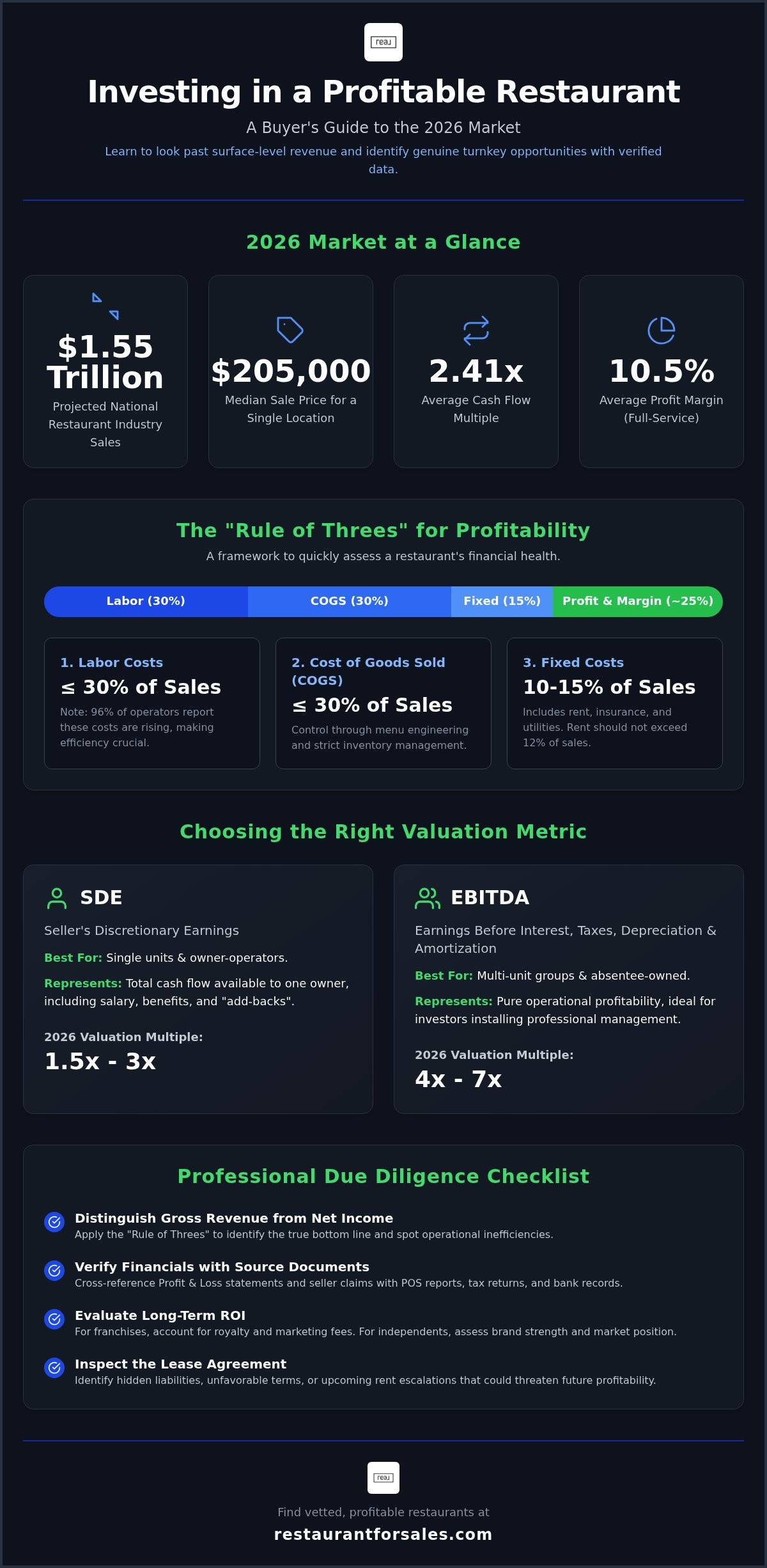
While the national restaurant industry is projected to reach $1.55 trillion in sales in 2026, the median sale price for an individual location sits at a remarkably accessible $205,000. This gap creates a unique window for investors, but finding a truly profitable restaurant for sale requires looking past surface-level revenue. You've likely encountered sellers with inflated earnings claims or hidden lease liabilities that threaten your ROI before you even take the keys. It's frustrating to sort through listings when you can't tell which ones offer a genuine turnkey opportunity.
We understand that a successful acquisition is built on verified data, not optimistic projections. This article provides the framework you need to identify and compare high-yield investments in today's market. You'll learn how to evaluate the 2.41 average cash flow multiple seen in early 2026 and determine if a franchise resale or an independent brand fits your goals. We'll examine how to verify financial records and secure strong lease terms so you can acquire a cash-flowing business with confidence.
Key Takeaways
- Distinguish between gross revenue and net operating income using the "Rule of Threes" to identify a truly profitable restaurant for sale.
- Apply the correct valuation metrics, such as SDE for single units or EBITDA for multi-unit groups, to verify the accuracy of the asking price.
- Evaluate the long-term ROI of franchise systems versus independent brands by accounting for royalty fees and marketing costs.
- Execute a professional due diligence checklist that includes cross-referencing POS reports with bank records and identifying hidden lease liabilities.
- Leverage specialized marketplace filters to isolate high-value listings, such as those with real estate included or absentee-owner structures.
What Defines a Truly Profitable Restaurant for Sale?
Acquiring a profitable restaurant for sale requires a disciplined analysis of financial health that goes far beyond top-line revenue. While a seller might highlight impressive gross sales, your focus must remain on net operating income (NOI). In 2026, the average profit margin for a full-service restaurant is approximately 10.5%. If a listing's margins fall significantly below this benchmark, it may indicate structural inefficiencies rather than a high-yield opportunity. A "turnkey" label simply means the equipment and permits are in place; it doesn't guarantee that the business model is currently generating a surplus.
To evaluate a venue's viability, professional investors use the "Rule of Threes." This framework categorizes the primary drains on capital:
- Labor Costs: Ideally capped at 30% of sales, though 96% of 2026 operators report these costs are rising.
- Cost of Goods Sold (COGS): Target 30% through aggressive menu engineering and inventory management.
- Fixed Costs: Rent, insurance, and utilities should stay within 10% to 15% to protect the bottom line.
When these three pillars consume 90% of revenue, the remaining 10% represents your profit. Any deviation requires a deep dive into the operational records to ensure the investment remains secure.
Cash Flow vs. Pro-Forma Projections
Always prioritize historical tax returns and verified profit and loss statements over pro-forma projections. Pro-forma numbers are essentially "what-if" scenarios that reflect a seller's optimism rather than market reality. You must identify "add-backs," which are non-essential or one-time expenses the seller paid through the business to reduce tax liability. Common add-backs include personal travel, cell phone plans, or non-recurring repairs. Understanding various business valuation methods is essential here to distinguish between legitimate adjustments and attempts to inflate perceived earnings. Look for sustainable growth trends rather than one-time revenue spikes caused by local events or temporary fads.
The Role of Owner-Operator Models
The profitability of a restaurant often depends on who is running the floor. An owner-operator model relies on the "sweat equity" of the buyer to maintain margins, whereas an absentee-owned model requires a robust management team that adds to the payroll. Seller’s Discretionary Earnings (SDE) is the standard for small restaurant valuation, representing the total cash flow available to a single owner-operator after all necessary expenses. When comparing a profitable restaurant for sale to an underperforming one, calculate the true cost of your time. If the "profit" only exists because the owner works 80 hours a week without a salary, the investment may be less attractive than a lower-margin venue with a professional management structure in place.
Core Metrics for Comparing Restaurant Investment Opportunities
Comparing two different listings requires a standardized approach to financial data. Most buyers start with Seller’s Discretionary Earnings (SDE), which is the total financial benefit an owner-operator derives from the business, including salary, benefits, and non-essential add-backs. This metric is the primary benchmark for smaller, independent venues where the buyer intends to be active in daily operations. In contrast, larger acquisitions or multi-unit groups rely on EBITDA. This metric provides a clearer picture of profitability for investors who plan to install professional management rather than working on-site themselves.
Operational efficiency is best measured through Prime Cost and the Rent-to-Sales ratio. Your Prime Cost, which combines the cost of goods sold and total labor, should ideally stay below 60% of gross sales to maintain healthy margins. Rent is another critical factor; successful operators target a benchmark of 10% or less of gross sales for long-term viability. If rent exceeds 12%, the business often struggles to absorb food cost fluctuations or labor spikes. To see how these metrics apply to current listings, you can browse a profitable restaurant for sale on the Restaurant For Sale Marketplace that has already undergone professional financial screening.
Valuation Multiples in 2026
Market data from the first half of 2026 shows that single-unit, owner-operated restaurants typically trade at 1.5 to 3 times SDE. Multi-unit restaurant groups command higher multiples, often ranging from 4 to 7 times EBITDA, because they offer more stability and scalable systems. Franchise restaurants also command a premium, frequently selling for 3 to 5 times SDE for single units. These higher multiples are driven by brand recognition and established operating manuals that reduce the risk for the incoming owner. High-quality equipment and furniture, fixtures, and equipment (FF&E) also bolster the final price, as they reduce the immediate need for capital reinvestment.
The Importance of the P&L Statement
A thorough analysis of the last three years of profit and loss (P&L) statements is non-negotiable. Look for consistency in labor costs and inventory management across different seasons. Sharp spikes in revenue without a corresponding increase in food costs can signal poor record-keeping or "padded" sales figures. You should also verify that the current owner isn't deferring necessary maintenance to make the bottom line look more attractive. A 15% net profit margin is considered "best-in-class" for full-service restaurants. If the P&L shows margins consistently above this level, investigate whether the owner is underpaying themselves or neglecting essential overhead like insurance or marketing.
Franchise Resales vs. Independent Concepts: A Comparison
Choosing a profitable restaurant for sale often requires a choice between established infrastructure and operational freedom. In June 2026, franchise resales accounted for 45% of brokerage closings. This surge reflects a growing buyer preference for "ready-made" systems and brand recognition. However, this stability comes with a structural cost that directly impacts your monthly net income. For most major US food franchises, combined royalty and marketing fees range from 8% to 11% of gross sales. For example, a McDonald's resale typically involves fees of 8% to 9%, while Burger King units sit at 9%. These percentages are calculated from top-line revenue, meaning they remain a fixed obligation regardless of your monthly margins.
The Pros and Cons of Franchise Resales
Buying an existing franchise offers predictable cash flow and a battle-tested supply chain. You aren't just acquiring a kitchen; you're acquiring a customer base that already trusts the brand. This recognition generally leads to a faster ROI than starting a new concept. Despite these benefits, the acquisition process is more complex than an independent transaction. You must navigate corporate approval hurdles and pay a transfer fee to the franchisor. Lease assignment complexities are also common. The franchisor may hold the master lease or require specific language to protect their brand interests. If you prioritize minimal operational guesswork, the franchise model provides a secure, structured path.
The Upside of Independent Turnkey Restaurants
Independent concepts offer a different path to profitability by eliminating ongoing royalty payments. You keep 100% of the net profit. This allows for significantly higher margins if you manage labor and food costs effectively. This model provides total creative control. You can pivot the menu or concept based on local 2026 market trends without seeking corporate permission. While independent venues carry a higher risk profile, they often feature a lower entry cost and higher potential for localized brand equity. Success in this category depends on modern technology integration. Currently, 81% of operators report that off-premise dining systems are essential for maintaining a competitive edge. When evaluating an independent profitable restaurant for sale, verify that the brand's success is tied to its systems rather than the current owner's personal reputation.
Verifying Profitability: The Due Diligence Checklist
Confirming the claims of a profitable restaurant for sale requires a methodical verification process. You must look beyond the provided profit and loss statements to find the ground truth of the operation. Start by cross-referencing Point of Sale (POS) reports with monthly bank deposits. If the revenue recorded in the system doesn't match the cash hitting the bank, the business may have unrecorded expenses or accounting irregularities. This step is the only way to ensure the cash flow you are buying actually exists.
Your second priority is the lease agreement. Review the document for upcoming rent escalations or "demolition clauses" that allow a landlord to terminate the lease for redevelopment. A restaurant's value is intrinsically tied to its location; losing the site can render your investment worthless. You should also evaluate the physical state of the kitchen equipment. Deferred maintenance on walk-in coolers or hood systems can lead to thousands of dollars in immediate capital expenditures. Finally, audit the payroll records. With 96% of operators reporting increased labor costs in 2026, you must confirm that the current owner isn't masking high turnover or "under-the-table" payments that will disappear under professional management.
Hidden Liabilities That Drain Profit
Profitability can be eroded by liabilities that don't appear on a standard P&L statement. Outstanding gift card balances and unfulfilled catering contracts represent future labor and food costs for which you won't receive new revenue. You must also check for unpaid sales tax or employment tax liens that could transfer to you during the acquisition. A major red flag for any profitable restaurant for sale is a lease with less than five years remaining without a guaranteed option to renew. Without a secure long-term lease, you lack the time necessary to achieve a full return on your investment. Always verify the transferability of liquor licenses and health permits early, as local regulatory delays can stall your opening for months.
The Value of a Professional Valuation
Using a broker's professional opinion of value protects you from the emotional pricing often set by sellers. A valuation expert distinguishes between an asset sale, where you buy the equipment and lease, and a stock sale, where you acquire the entire legal entity including its history and liabilities. Most small to mid-sized transactions are structured as asset sales to protect the buyer from the previous owner's legal or tax mistakes. To ensure you are making a sound investment, Get a professional restaurant valuation before you make an offer. Securing verified financial records through a specialized marketplace is the most efficient way to filter out underperforming listings and focus on high-yield opportunities.
Finding the Right Opportunity on a Specialized Marketplace
General business listing sites often lack the niche granularity required for hospitality investments. They treat a bistro the same as a dry cleaner or a tech startup. Finding a truly profitable restaurant for sale requires a platform that understands industry-specific metrics like Prime Cost and Rent-to-Sales ratios. Specialized marketplaces outperform general sites by providing filters tailored to restaurant buyers. You can isolate listings that are "absentee-owned" or those that include the real estate, allowing you to focus only on high-yield opportunities that match your specific investment criteria.
In the first half of 2026, buyer intent for equipped asset-sale opportunities increased by 400%. This trend suggests that experienced operators are prioritizing turnkey spaces to avoid the rising costs of new construction. Setting up automated alerts on a specialized platform ensures you are the first to know when these high-value listings hit the market. Since restaurants currently sell for an average of 90.3% of their asking price, being early to the table gives you a significant advantage in negotiations. A dedicated marketplace acts as a filter, removing underperforming venues and highlighting businesses with consistent cash flow.
The Benefits of Broker-Managed Listings
Working with a dedicated restaurant broker provides a layer of professional oversight that general marketplaces lack. Brokers manage the due diligence room, ensuring that tax returns, POS reports, and lease agreements are organized and ready for review. They are also experts in lease assignments. This is a critical service, as the transfer of a lease is often the most complex part of a restaurant acquisition. Brokers maintain strict confidentiality throughout the process. This protects the business's current operations, ensuring that employees and customers are not disrupted during the transition of ownership.
Taking the Next Step in Your Acquisition
To access confidential offering memorandums and detailed financial data, you must register for a buyer profile. This process typically includes signing a non-disclosure agreement (NDA) to protect the seller's proprietary information. You should also prepare your proof of funds before initiating contact. In a market where serious, committed buyers are the norm, showing your financial capacity ensures that brokers and sellers prioritize your inquiries. Having your documentation ready allows you to move quickly when a secure investment appears. Browse active profitable restaurant listings today.
Secure Your Investment in the 2026 Restaurant Market
Acquiring a high-yield business requires moving beyond broad market interest to rigorous financial verification. As industry sales climb toward the projected $1.55 trillion mark, the ability to filter for a truly profitable restaurant for sale becomes your most valuable competitive advantage. You now have the framework to analyze Prime Costs, evaluate the structural differences between franchise and independent models, and execute a due diligence checklist that uncovers hidden liabilities. Success in this complex marketplace depends on prioritizing historical tax records over optimistic pro-forma projections.
We provide the professional oversight needed to navigate these transactions with confidence. Our team specializes in restaurant and bar transactions, offering expert lease assignment support and market-leading valuation services to protect your capital. By leveraging a specialized marketplace, you bypass underperforming listings and focus on assets with verified cash flow and secure lease terms. Find Your Next Profitable Restaurant Investment today and begin the process of securing a turnkey, high-performing business. Your next successful venture is within reach when you lead with data and professional expertise.
Frequently Asked Questions
What is a good profit margin for a restaurant for sale?
A good profit margin for a full-service restaurant typically sits around 10.5%. While best-in-class venues can reach 15% net profit, anything consistently above 10% indicates a healthy, viable operation. You should verify that this margin remains stable after accounting for all labor, food costs, and fixed overhead. Be wary of margins that seem unusually high, as they might result from an owner-operator who isn't drawing a market-rate salary.
Is it better to buy a profitable restaurant or a turnaround opportunity?
Buying a profitable restaurant for sale is generally safer for most investors because it offers immediate cash flow and proven systems. Turnaround opportunities often require significant capital for renovations and marketing to reverse poor reputations or outdated concepts. While turnarounds can offer a higher eventual ROI, they carry a much higher risk of failure. Most professional buyers prefer established profitability to avoid the high burn rate of a rebrand.
How do I verify the sales figures of a restaurant listing?
You should verify sales figures by cross-referencing daily Point of Sale reports with monthly bank deposits and sales tax filings. Discrepancies between these records are immediate red flags that require a deeper audit. Professional due diligence also involves reviewing three years of federal tax returns to ensure the reported income is consistent. If a seller cannot produce these documents, the financial risk of the acquisition increases significantly.
What is the average multiple for a profitable restaurant in 2026?
The average cash flow multiple for restaurants in the first half of 2026 is 2.41. Specifically, single-unit, owner-operated venues are valued between 1.5 and 3 times Seller’s Discretionary Earnings. Multi-unit groups or those with established management teams often command higher multiples, typically 4 to 7 times EBITDA. These figures vary based on the strength of the lease terms and the quality of the equipment included in the sale.
Can I buy a profitable restaurant with an SBA loan?
Yes, you can buy a profitable restaurant for sale using an SBA 7(a) loan if the business has clean tax returns that support the debt service. Lenders currently offer variable rates around 9.0% APR for loans over $250,000. To qualify, the restaurant must show enough net income to cover your personal expenses and the loan payments. Profitable businesses are much easier to finance than asset sales because they provide historical data.
What happens to the existing employees when I buy a profitable restaurant?
Existing employees typically stay with the business during an asset sale, although you aren't legally required to keep them unless specified in the contract. Retaining key staff is critical in 2026, as 80% of operators report being short at least one position. You should meet with management early in the due diligence process to assess their willingness to continue. Maintaining a stable team ensures a smoother transition and protects the restaurant's cash flow.
How does a lease assignment work when buying a restaurant?
A lease assignment is the process of transferring the existing lease from the seller to the buyer with the landlord's written consent. This is a critical step because the landlord must approve your financial background and experience before the sale can close. You should review the remaining term and any upcoming rent escalations carefully. Some landlords may require a personal guarantee or an increase in the security deposit to finalize the transfer.
What is the difference between SDE and EBITDA in restaurant listings?
SDE represents the total financial benefit to one owner-operator, including their salary and personal add-backs. EBITDA is used for larger, manager-run businesses to show profit as an investment vehicle. When you look at a restaurant listing, use SDE if you plan to work in the business daily. Use EBITDA if you intend to remain an absentee owner. This distinction ensures you're applying the correct valuation multiple to the business's actual earnings.


