

Your restaurant lease is either your most valuable asset or your most significant liability when it comes time to sell your business. Most operators focus on the monthly rent figure, but the real dangers often hide in the fine print of occupancy costs and transfer clauses. You've likely felt the pressure of rising food and labor costs, and the last thing you need is a landlord who holds your exit strategy hostage. Successfully negotiating restaurant lease terms requires looking past the immediate move-in date to ensure your investment remains liquid and protected.
This guide identifies the specific red flags that can drain your cash flow or prevent a future sale. You'll learn how to cap Common Area Maintenance (CAM) fees at the 3% to 5% industry standard and establish clear boundaries for expensive kitchen infrastructure repairs. We provide a comprehensive negotiation checklist that covers assignment rights, maintenance responsibilities, and the hidden traps that often lead to the 80% of restaurants closing before their fifth anniversary. By the end of this article, you'll have the tools to secure a lease that supports both daily growth and your eventual exit from the marketplace.
Key Takeaways
- Identify and cap hidden occupancy costs like CAM fees to prevent unpredictable rent hikes from eroding your monthly margins.
- Protect your long-term flexibility by ensuring "Permitted Use" clauses allow for menu expansion and future changes to your service model.
- Learn the essential strategies for negotiating restaurant lease terms that guarantee favorable assignment rights for a smooth future business sale.
- Establish clear boundaries for expensive kitchen infrastructure maintenance to avoid unexpected capital expenditures during your tenancy.
- Follow a professional checklist that utilizes specialized brokerage expertise and detailed Letters of Intent to secure a competitive advantage.
What Is a Restaurant Lease and Why Is It Unique?
A restaurant lease is a specialized commercial agreement that defines the operational boundaries of a food service business. It isn't just about floor space; it's about the infrastructure that makes cooking and service possible. While a clothing boutique only needs basic lighting and climate control, a restaurant requires heavy-duty plumbing, grease traps, dedicated gas lines, and sophisticated fire suppression systems. These technical demands mean that negotiating restaurant lease terms requires a deep understanding of how physical space impacts your daily overhead and long-term liability.
The lease structure you choose dictates your financial risk for the duration of your tenancy. Landlords act as pragmatic partners in your business, but their interests often conflict with yours. They prioritize stable cash flow and property appreciation, while you need operational flexibility to adapt to changing market trends. A standard retail lease template is insufficient for food service because it rarely accounts for the high-intensity use of utilities and the specific health code requirements that govern the industry.
The Three Types of Commercial Leases
Commercial property owners typically use one of three structures to collect rent and recover operating expenses:
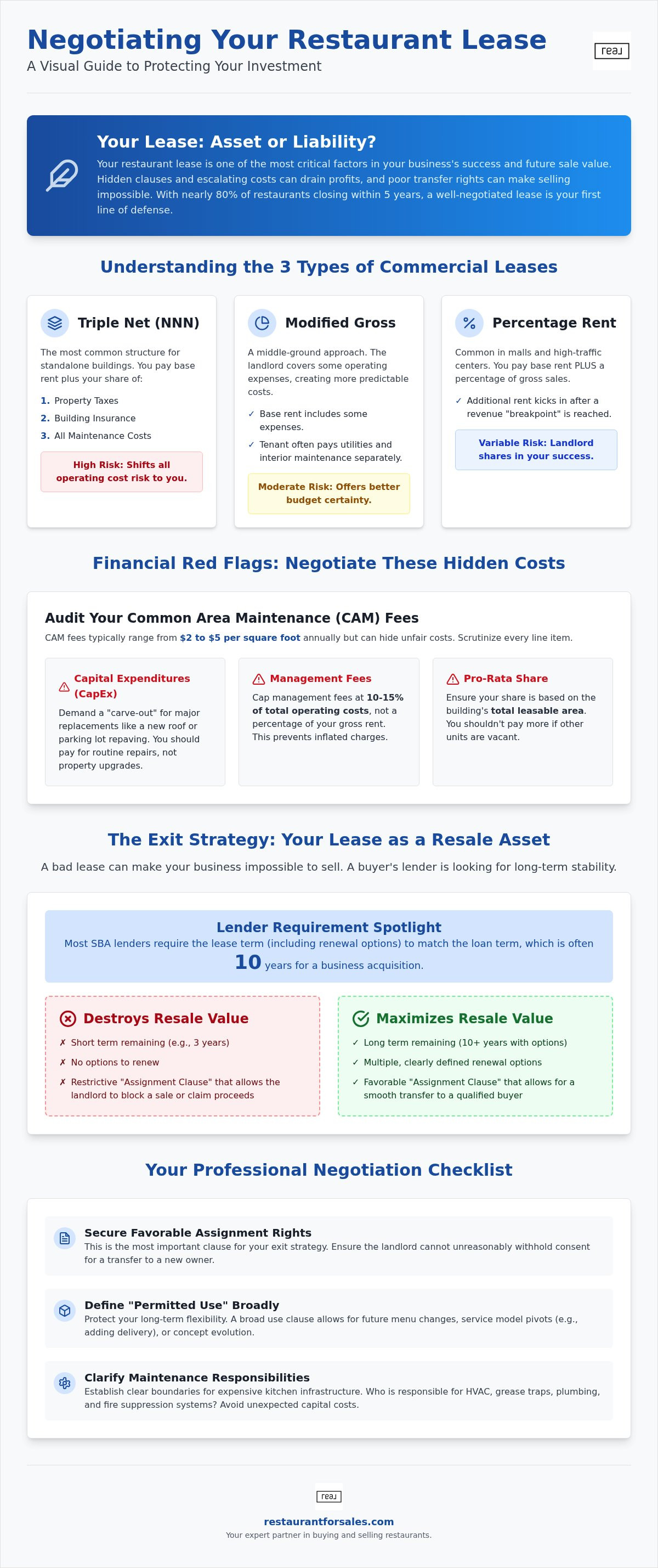
- Triple Net Lease (NNN): This is the most common structure for standalone restaurant buildings. In a Triple Net Lease (NNN), the tenant pays a base rent plus their pro-rata share of property taxes, insurance, and all maintenance costs. This shifts the risk of rising property taxes or unexpected roof repairs directly onto the operator.
- Modified Gross Lease: This represents a middle ground. The tenant pays a base rent that includes some operating expenses, but they may be responsible for their own utilities and interior maintenance. It provides more budget certainty than an NNN lease.
- Percentage Rent: Often found in malls or high-traffic lifestyle centers, this clause requires the tenant to pay a base rent plus a percentage of gross sales once a specific revenue "breakpoint" is reached. Landlords use this to share in the success of high-performing concepts.
Why Your Lease Is a Resale Asset
Your lease is a critical component of your business valuation. If you plan to sell your restaurant, the lease must be transferable and have enough time remaining to satisfy a buyer’s lender. Most SBA lenders require the lease term to match the length of the loan, which is typically ten years for a business acquisition. A lease with only three years left and no options to renew effectively destroys your resale value because a buyer cannot secure financing. When negotiating restaurant lease terms, you must prioritize the "Assignment" clause. This section determines if the landlord can block a sale or demand a portion of your sale proceeds, making it the most important paragraph for your eventual exit strategy.
Financial Red Flags: Hidden Costs to Negotiate
Most operators focus on the base rent, but the "additional rent" often determines long-term profitability. When negotiating restaurant lease terms, you must scrutinize the operating expenses that landlords pass through to tenants. These costs fluctuate wildly. They can turn a seemingly affordable space into a financial burden that eats your margins. You need to define exactly what you are paying for before you sign the document.
The CAM Audit: Don't Pay for the Landlord's Mistakes
Common Area Maintenance (CAM) fees typically range between $2 and $5 per square foot annually in the current market. These figures often include "garbage" costs that shouldn't be your responsibility. You must request a "carve-out" for capital expenditures (CapEx). If the landlord replaces the entire roof or repaves the parking lot, these are structural improvements that increase property value. They aren't routine maintenance. Tenants should pay for repairs, not replacements that extend the building's life.
Demand that management fees within CAM are capped at 10% to 15% of the total operating costs rather than a percentage of your gross rent. Ensure your pro-rata share is calculated based on the total leasable area of the building. If the building is 50% empty, you shouldn't pay a larger share of the landscaping bill just because other units are vacant. A professional restaurant valuation often reveals if these pass-through costs are out of line with regional market standards.
Personal Guarantees and 'Burn-Down' Clauses
Landlords almost always require a personal guarantee for new entities. This means your personal assets, like your home or savings, are on the line if the business fails. To mitigate this risk, negotiate a "burn-down" clause. This provision reduces or eliminates the personal guarantee after a set period of timely payments, such as three or five years. It rewards your success by lowering your personal exposure as the business matures and proves its stability.
Another alternative is the "Good Guy" clause. This allows you to vacate the premises and end your personal liability if you give sufficient notice and leave the space in "broom-clean" condition. It protects the landlord from a sudden vacancy while preventing you from being sued for the remaining years of the lease. When negotiating restaurant lease terms, these protections are just as vital as the rent amount itself. They provide a safe exit if the market shifts unexpectedly.
Operational Red Flags: Use Clauses and Exclusivity
Operational clauses define the limits of your daily business activity. While financial terms impact your bank account, these clauses impact your ability to adapt to the market. When negotiating restaurant lease terms, you must ensure the language doesn't trap you into a rigid business model that can't evolve. A "Permitted Use" clause that is too narrow, such as "high-end sushi only," can prevent you from adding a ramen bar or transitioning to a more casual concept if consumer tastes shift.
Exclusivity and Non-Compete Protections
You don't want a direct competitor opening next door six months after you launch. A strong exclusivity clause defines your "primary use" and prohibits the landlord from leasing space to concepts with similar menus. Be specific about what constitutes a competitor. If you run a gourmet pizza parlor, an "incidental" sales clause might allow a nearby deli to sell pizza by the slice. You need to cap those incidental sales at a low percentage of their gross revenue, such as 10%, to protect your market share.
Demand a radius restriction for the landlord. This prevents them from leasing space to a direct competitor in another property they own within a specific distance, typically two to five miles. Without this, your landlord could effectively compete against themselves at your expense. These protections ensure that your location remains a unique destination in the local trade area.
The Infrastructure Checklist
Infrastructure is where many new owners find their biggest "gotchas." Unlike a retail store, a restaurant's mechanical needs are extreme. You must verify the utility capacity before signing. Many older buildings lack the amperage for modern electric ovens or the gas line diameter for high-output ranges. Upgrading these systems is a major capital expense that should be settled during the negotiating restaurant lease terms phase.
- HVAC: Negotiate a "useful life" provision. If the rooftop unit is more than seven years old, the landlord should be responsible for replacement costs, while you handle routine filter changes and service.
- Grease Traps: Clarify who is responsible for the grease interceptor. If the city requires an upgrade to a larger exterior trap to meet current codes, that should be a landlord expense.
- Operating Hours: Avoid "continuous operation" clauses that force you to stay open during unprofitable hours or on major holidays. Ensure you have the autonomy to adjust hours based on staffing levels or seasonality without being in default of your lease.
The Exit Strategy: Assignment and Transfer Rights
A restaurant is only as valuable as the lease that houses it. If you cannot transfer your lease to a qualified buyer, your business is effectively worthless at the time of sale. When negotiating restaurant lease terms, you must view the document through the eyes of a future purchaser. Landlords often view a business sale as an opportunity to reset rent to market rates or "recapture" the space to lease it to a national chain. You need to prevent these scenarios by securing strong assignment and transfer rights from day one.
The "Assignment" clause dictates how you can pass the lease to a new owner. You must ensure the landlord cannot "unreasonably withhold, condition, or delay" their consent. Without this specific language, a landlord could block your sale simply because they don't like the buyer's concept. Additionally, watch out for profit-sharing clauses. Some leases require you to pay the landlord 25% to 50% of the "key money" or profit you receive from selling your business. This is a landlord tax on your hard-earned equity that you should negotiate out of the contract entirely.
Negotiating the Right to Assign
To streamline a future sale, pre-define what a "qualified buyer" looks like in the lease. This usually involves setting a minimum net worth or a specific number of years of restaurant experience. If the buyer meets these criteria, the landlord's consent should be a formality. You should also fight for a "release of liability." Most standard leases keep the original tenant on the hook even after the sale. If the new owner fails three years later, the landlord can sue you for the remaining rent. A clean break is essential for a true exit.
Renewal Options and Term Length
Buyers and their lenders prioritize the remaining lease term. Most SBA-backed loans require a ten-year term, which can be a combination of the current lease and guaranteed renewal options. A lease with only four years left and no options is unfinanceable for most buyers. When negotiating restaurant lease terms, aim for a five-year initial term with at least two five-year options. Ensure your renewal rent is capped at a fixed percentage increase or tied to a specific index. Avoid "market rate" renewals without a ceiling, as this gives the landlord total leverage to hike your rent when you are most vulnerable.
Securing these transfer rights ensures your business remains a liquid asset. If you are preparing for a transition, our team provides expert restaurant lease assignments to help you navigate these complex landlord negotiations.
How to Negotiate: Your Restaurant Lease Checklist
Negotiating restaurant lease terms is a methodical process that requires balancing market data with legal protection. You shouldn't walk into a negotiation without a clear roadmap. The most successful operators follow a structured sequence that starts with professional representation and ends with a meticulous legal review. This ensures that the business terms you agreed upon are actually reflected in the final 70 page document.
First, hire a restaurant-specialized broker. Unlike general commercial agents, a specialized broker has access to granular, "off-market" data regarding what other food service tenants in your specific trade area are paying. This transparency is your greatest leverage when bridging the gap between a landlord's asking price and your operating budget. You can utilize platforms like Restaurant For Sale Marketplace to identify turnkey opportunities where favorable leases are already in place, potentially saving you months of construction and negotiation.
Second, formalize your intent with a detailed Letter of Intent (LOI). This non-binding document should lock in the critical business terms, such as rent escalations, assignment rights, and maintenance boundaries, before you involve legal counsel. Third, conduct a professional valuation of the leasehold improvements. If you're buying an existing business, you need to know the remaining "useful life" of the kitchen infrastructure you're inheriting. Finally, engage a real estate attorney only after the business terms are settled. Their role is to ensure the lease reflects the LOI, not to negotiate the rent on your behalf.
The Strategic Advantage of Professional Brokerage
A broker acts as a buffer between you and the landlord. They handle the high-stakes back-and-forth, allowing you to maintain a professional relationship with your future landlord. By leveraging regional market knowledge, they ensure you aren't overpaying for Common Area Maintenance (CAM) or accepting unmarketable assignment restrictions. They understand that negotiating restaurant lease terms is about protecting your future exit as much as your current entry.
Final Review: The Red Flag Checklist
Before you sign the final execution copy, conduct a final "red flag" audit. Many standard leases contain clauses that can quietly destroy your business value if the landlord decides to sell the building or renovate the center.
- Demolition Clauses: Ensure the landlord cannot terminate your lease early just because they decide to redevelop the property.
- Relocation Clauses: If the landlord has the right to move you, the new space must have comparable visibility and foot traffic, and the landlord must pay for all build-out costs.
- Force Majeure: Verify that this clause specifically covers government-mandated health closures to protect you from paying full rent during future civil emergencies.
Securing Your Restaurant’s Future through Strategic Lease Terms
A well-negotiated lease is the backbone of your business's resale value. By identifying hidden CAM traps and securing favorable assignment rights, you ensure your investment remains protected against market shifts. Success in this industry requires a proactive approach to negotiating restaurant lease terms that prioritizes operational flexibility and long-term exit stability. You don't want to discover a restrictive clause only when you're ready to sell; preparation starts before the first rent check is signed.
As a national marketplace for bars and restaurants, we provide the expert restaurant brokerage services and professional business valuation tools needed to navigate complex commercial transactions. Our team acts as a steady hand, helping you find locations with favorable infrastructure and transferable agreements. Whether you are a first-time buyer or a seasoned seller, leveraging professional expertise is the most efficient way to mitigate risk and maximize your return.
Browse active restaurant listings and turnkey lease opportunities to find your next investment today. With the right preparation and expert guidance, you can build a sustainable business that thrives for years to come.
Frequently Asked Questions
What is a Triple Net (NNN) lease in a restaurant context?
A Triple Net (NNN) lease requires the tenant to pay a base rent plus their pro-rata share of property taxes, insurance, and all maintenance costs. It's the most common structure for standalone restaurant buildings and shifts the risk of rising operating expenses directly to the operator. You must audit these pass-through costs annually to ensure you aren't paying for major structural replacements that should be the landlord's capital expense.
Can I sell my restaurant if the landlord refuses to transfer the lease?
No, you cannot finalize a business sale if the landlord refuses to assign the lease to your buyer. A buyer's lender will not fund a transaction without a valid lease that covers the entire loan term. This reality makes negotiating restaurant lease terms with clear assignment rights essential, as it prevents the landlord from blocking your exit or demanding a portion of your sale proceeds.
How much should I expect to pay in CAM fees for a restaurant?
Standard Common Area Maintenance (CAM) fees for restaurant spaces in 2026 typically range between $2 and $5 per square foot per year. These fees cover shared costs like parking lot maintenance, landscaping, and property management. To protect your margins, you should negotiate a strict percentage cap on annual CAM increases, ideally keeping escalations between 3% and 5% regardless of inflation.
What is a 'Good Guy' clause in a commercial lease?
A 'Good Guy' clause is a limited personal guarantee that releases the tenant from future rent obligations if they vacate the premises and leave the space in "broom-clean" condition. It requires the tenant to provide sufficient notice, typically 90 to 180 days, and stay current on rent until they leave. It protects the landlord from a sudden abandonment while shielding the operator's personal assets from long-term liability.
Is it better to lease an empty space or buy a restaurant with an existing lease?
Buying a restaurant with an existing lease is usually more efficient because you inherit critical infrastructure like grease traps, hoods, and HVAC systems. Leasing an empty space requires a significant capital investment for a new build-out and months of permitting delays. Turnkey opportunities allow you to bypass the 80% failure rate often seen in first-year startups by taking over a location with proven utility capacity.
How do I negotiate an exclusivity clause for my restaurant?
Define your "primary use" specifically in the lease to prevent the landlord from renting nearby units to direct competitors. You should prohibit concepts with similar menus and limit "incidental" sales by neighboring tenants. For example, if you sell pizza, ensure a neighboring deli cannot derive more than 10% of its gross revenue from pizza sales, protecting your specific market niche within the center.
What happens to my restaurant lease if the building is sold?
Your lease remains legally binding if the property changes ownership, and the new landlord must honor all existing terms and renewal options. The transition is usually seamless, but you must verify that your lease does not contain a "demolition clause." Such a provision could allow a new developer to terminate your tenancy early if they intend to redevelop the property into a different use.
Can I negotiate my rent down if my restaurant sales are low?
Landlords are rarely obligated to lower rent due to poor performance unless you have a specific "percentage rent" structure or a "force majeure" clause that applies. With a national retail vacancy rate of 5.4% in 2026, landlords have significant leverage. Success in negotiating restaurant lease terms during a downturn often requires offering a lease extension or other concessions in exchange for temporary rent relief.


