

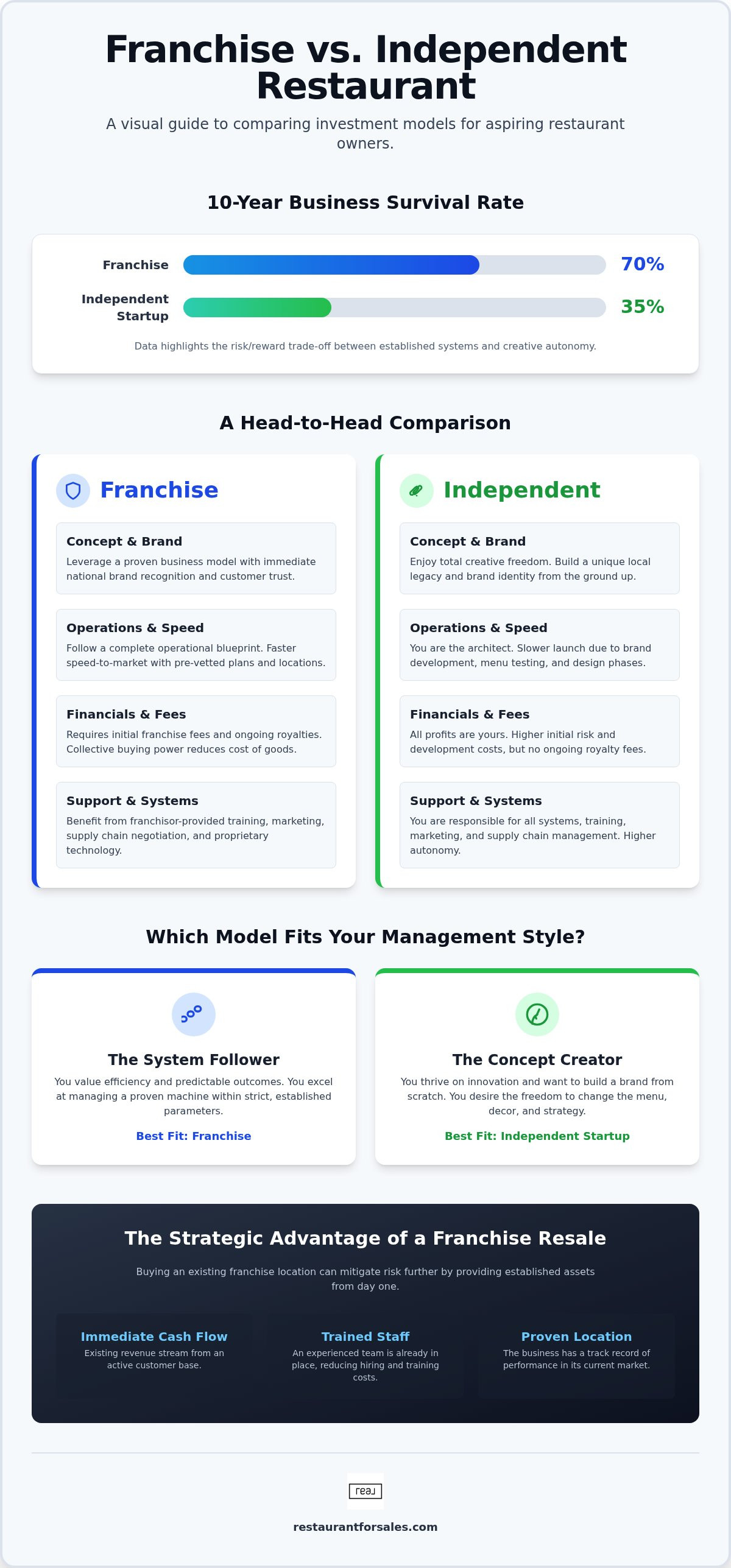
Did you know that after ten years, a restaurant franchise has a survival rate of nearly 70 percent, while only about 35 percent of independent startups remain in business? This data highlights the fundamental tension between established systems and creative autonomy. You want to build a profitable legacy, but the fear of high failure rates in the independent sector is a valid concern. At the same time, the prospect of restrictive agreements and complex fee structures can feel overwhelming when you're trying to calculate your total investment costs.
This article provides a clear framework to evaluate the risks and rewards of both investment models. You'll learn how to compare the financial trade-offs, including the typical 2026 initial investment ranges and ongoing royalty fees. We'll also break down the operational realities of system-driven growth versus creative-driven equity. By the end, you'll understand which model suits your management style and have the tools to make a confident investment decision in the current marketplace. Choosing the right path isn't just about the food; it's about selecting the business structure that matches your long-term financial objectives.
Key Takeaways
- Identify the 2026 financial requirements for both models, including initial fees and ongoing royalty structures, to ensure your capital is allocated efficiently.
- Evaluate the operational trade-offs between following a proven franchise system and the total creative freedom of an independent startup.
- Explore the strategic advantages of a franchise resale, such as immediate cash flow and existing staff, compared to the risks of a new build.
- Analyze the survival rates and average profit margins of each model to align your investment with your long-term financial goals.
- Apply a management-style framework to determine whether you are better suited for established systems or brand-building from scratch.
What is a Restaurant Franchise? Understanding the Licensing Model
Understanding the fundamental structure of a restaurant investment is the first step toward a successful acquisition. At its core, a What is a Franchise? is a legal and operational relationship where a franchisor grants a license to an individual or entity, the franchisee, to conduct business under their established brand. It's a partnership built on mutual benefit. The franchisor expands their brand footprint using third-party capital, while the franchisee gains access to a developed business model.
In the food industry, this usually takes the form of a "Business Format" model. Unlike "Product Distribution" models seen in the automotive or beverage sectors, the business format provides a complete blueprint for operations. This includes everything from the menu and decor to marketing strategies and inventory management systems. The restaurant sector dominates the global marketplace because food concepts are highly replicable. Investors trade a portion of their gross profit, often through ongoing royalties, for a proven operational blueprint that has already survived market testing. This trade-off allows you to focus on execution rather than invention.
Key Components of the Franchise Relationship
A successful franchise relies on a clear division of responsibilities. The franchisor maintains brand standards, provides initial training, and manages the global supply chain to ensure consistency across all units. Conversely, the franchisee handles daily operations and local community engagement. The following roles are standard in most agreements:
- Franchisor: Responsible for brand innovation, national marketing, and supply chain negotiation.
- Franchisee: Responsible for hiring, daily management, and the initial capital investment.
Transparency in this relationship is facilitated by the Franchise Disclosure Document (FDD). This legal document is required by the FTC and provides critical data on the franchisor's financial health, litigation history, and the total estimated investment costs. Reviewing the FDD is non-negotiable for any serious investor.
Why Investors Choose the Franchise Route
Investors often choose this path to mitigate the high failure rates associated with independent startups. By 2026, the restaurant industry is projected to reach $1.55 trillion in sales, and established brands capture a significant share of that volume. You gain access to proprietary systems and technology that would be cost-prohibitive to develop alone. Additionally, the collective buying power of a national brand reduces the cost of goods sold (COGS), providing a buffer against food price inflation. This scale allows for competitive pricing that independent operators struggle to match.
The Personality Fit: System Follower vs. Concept Creator
Success in this model depends heavily on your personality. If you're a "system follower" who values efficiency and predictable outcomes, this structure provides a steady hand. However, if you're a "concept creator" who wants to change the menu or decor on a whim, the standardized nature of a franchise may feel restrictive. You aren't just buying a job; you're buying a system. It's about deciding whether you want to be the architect of a new brand or the manager of a proven machine that operates within strict parameters.
Franchise vs. Independent Restaurant: A Comparative Analysis
Choosing between a corporate system and a solo venture requires a clear-eyed look at your operational priorities. When Comparing Franchise Vs. Independent Restaurants, the primary distinction lies in the balance of risk and control. A franchise offers a turnkey solution with national brand equity, while an independent startup allows you to build a local legacy from the ground up. National recognition provides an immediate trust factor; customers know exactly what to expect, which lowers the barrier to that critical first purchase. Building a local legacy requires years of consistent quality to earn that same level of community trust.
Speed to market is another major differentiator. A corporate model provides a pre-vetted location and construction plan, significantly reducing the lead time required to open your doors. In contrast, an independent concept involves a long development phase, including menu testing and brand design. While the startup phase is longer for independents, they retain 100% of their net income. Franchisees must account for royalty deductions, usually between 4% and 6% of gross sales, which directly impacts the bottom line. This is the fundamental trade-off: you're paying for a system that reduces the likelihood of failure.
The Reality of Creative Control
Franchise agreements are legally binding contracts that strictly limit your ability to modify the menu, decor, or local marketing materials. These systems ensure brand consistency across thousands of locations, but they can frustrate owners who want to pivot based on hyper-local trends. Independent ownership offers total creative freedom. If a specific ingredient becomes popular in your neighborhood, you can add it to the menu by dinner time. This agility is why "lifestyle" owners, who view their restaurant as a personal expression of their culinary vision, often prefer the independent path over a rigid corporate structure.
Marketing and Customer Acquisition
The power of a national advertising fund is a significant advantage for any franchise. You benefit from multi-million dollar campaigns that drive foot traffic from day one, something a solo operator can't replicate. For an independent eatery, the challenge of building brand awareness is a heavy lift that requires a dedicated local strategy and a significant time investment. While a franchise benefits from a standardized, high-authority corporate website, independent restaurants must invest heavily in local SEO and custom web development to compete for search visibility.
If you're ready to evaluate specific opportunities in your area, you can search Franchise Resale Listings to see how these different models perform in real-world market scenarios.
Financial Realities: Fees, Royalties, and Total Investment
Investing in a restaurant requires a granular understanding of both immediate capital requirements and long-term operational costs. For a franchise, the initial entry price is clearly defined in the Franchise Disclosure Document (FDD). In 2026, the typical one-time initial fee ranges from $20,000 to $50,000, though premium brands can exceed $75,000. This payment secures your right to the brand name and initial training. However, the total initial investment is much higher. While a small kiosk might start at $100,000, a traditional quick-service restaurant can range from $1 million to over $2.5 million.
Ongoing costs are where the models diverge significantly. Franchisees typically pay royalty fees between 4% and 6% of gross sales. It's critical to remember these are calculated from top-line revenue, not net profit. You'll also contribute to a national marketing fund. Beyond these, you must account for expenses such as mandatory technology upgrades, specialized POS systems, and periodic audit fees required by the franchisor. These structured costs provide predictability but create a higher monthly overhead that you must clear before reaching profitability.
The True Cost of an Independent Startup
Independent restaurants often appear cheaper on paper, with a median opening cost of approximately $375,500. These figures can be deceptive due to unpredictable expenses in branding, menu development, and system creation. You don't have a pre-negotiated supply chain, which often leads to higher food costs. There's also a "trial and error tax." Early operational mistakes, such as poor kitchen workflow or ineffective marketing, carry a heavy financial impact. Lenders generally view a solo venture as higher risk than a brand with a 70% ten-year survival rate, making it harder to secure competitive interest rates.
Profitability and EBITDA in the Restaurant Context
Net profit margins reflect the reality of these different cost structures. Statistics show that franchise restaurants typically maintain net profit margins of 4% to 9%, while independent restaurants average between 3% and 6%. The royalty fee directly affects your break-even point, requiring higher sales volume to achieve the same take-home pay as a successful independent owner. However, the resale value is often higher for a brand-name unit. A professional Restaurant Valuation Service can help you determine if the entry price aligns with the projected EBITDA. Whether you're buying an asset or building one, understanding the math behind the margins is essential for a sustainable investment.
Franchise Resale vs. Starting New: The Strategic Advantage
While many investors focus on building a new location from the ground up, a franchise resale offers a distinct strategic path. A resale involves purchasing an existing, operational unit directly from a current owner. This model provides a turnkey advantage that new developments cannot match. You inherit a trained staff, an established customer base, and, most importantly, verifiable cash flow from day one. This historical performance data makes resales significantly easier to finance compared to new territory developments. Lenders prefer actual profit and loss statements over speculative projections.
Professional restaurant brokerage services are essential for navigating these transactions. A broker facilitates the complex transfer process, ensuring that asset transfers and lease assignments are handled legally and efficiently. They act as the pragmatic intermediary between the buyer, seller, franchisor, and landlord. This support is vital for maintaining professional integrity and ensuring a successful outcome for all commercial interests involved.
Evaluating a Franchise Resale Opportunity
Evaluating a potential acquisition requires a rigorous review of historical performance. Analyze at least three years of financial statements to identify trends in labor and food costs. You must also assess the remaining term on the franchise agreement and the property lease. If the lease term is short, you lose the security of your location. Use this checklist during your due diligence:
- Financial Review: Verify EBITDA and owner's discretionary earnings.
- Lease Terms: Confirm renewal options and assignment clauses.
- Operational Upside: Identify areas where better inventory management can boost margins.
- Asset Condition: Audit equipment and decor for mandatory brand upgrades.
Steps to Navigating a Franchise Transfer
The transfer process follows a methodical sequence that mirrors the natural progression of a commercial transaction. First, you must secure franchisor approval, which typically involves a formal interview and a financial background check. Simultaneously, managing the lease assignment requires negotiation with the landlord to ensure they accept you as the new tenant under favorable terms. Finally, coordinate the closing with the mandatory training requirements set by the brand. This structured approach ensures you're fully prepared to take the reins without disrupting daily operations.
To view available opportunities that provide immediate cash flow, explore our current Franchise Resale Listings and begin your evaluation process today.
Making Your Decision: Which Model Fits Your Goals?
Finalizing your investment choice requires an honest assessment of your management style and financial objectives. If you're a "system follower" who values operational efficiency and predictable outcomes, the franchise model provides the necessary framework for success. However, "concept creators" who want to control every aspect of the dining experience often find these systems restrictive. These individuals prioritize the high-upside potential of building original brand equity over the immediate cash flow stability of an established name. Your risk tolerance dictates whether you value the safety net of national support or the total autonomy of an independent startup.
Your decision should also align with your long-term exit strategy. Independent restaurants offer the chance to build a unique brand that could eventually be sold or even franchised itself. Conversely, buying into a proven system allows you to step into a business with a 70 percent ten-year survival rate. It's about deciding whether you want to be the architect of a new concept or the manager of a high-performance machine. Reviewing active listings is the best way to see how these different realities manifest in the current market.
The Hybrid Approach: Multi-Unit Franchising
Scaling a restaurant investment often leads to multi-unit ownership. As of 2026, approximately 54% of all franchise units are owned by multi-unit operators. This approach allows experienced investors to build a diverse portfolio of restaurant assets across different geographic regions. Multi-unit ownership changes the ROI calculation by spreading fixed administrative and management costs over several locations. This structure increases overall efficiency and provides a significant buffer against localized economic shifts, making it an attractive path for those focused on rapid growth.
How a Restaurant Broker Simplifies the Search
Navigating the complexities of the commercial marketplace requires specialized expertise. A professional restaurant broker provides access to off-market listings and confidential sales that aren't available through public search engines. They leverage professional valuation services to analyze profit and loss statements, ensuring you don't overpay for an underperforming asset. By acting as a pragmatic partner, a broker manages the intricacies of lease assignments and asset transfers, allowing you to focus on the operational transition. This expertise is vital for a transparent and successful business transaction.
Ready to take the next step in your investment journey? Browse current franchise and independent restaurant listings today to find the opportunity that matches your professional goals.
Securing Your Future in the Restaurant Industry
Choosing the right investment model is a high-stakes decision that requires a balance of market data and personal ambition. Whether you prioritize the proven operational blueprint of a franchise or the high-upside potential of an independent brand, your success depends on thorough due diligence. You've seen how established systems can mitigate risk, while resales offer the strategic advantage of immediate cash flow and existing staff. It's about aligning your capital with a business structure that matches your management style.
Expert guidance is essential when navigating these complex commercial transactions. We provide professional business valuation and appraisals to ensure you enter the market at a fair price. As a specialized brokerage, we focus on successful outcomes through an expert franchise resale approach and a success-based commission model. This pragmatic partnership ensures your interests are protected from discovery to finalization. Take the next step in your professional journey today by utilizing our regional expertise and comprehensive marketplace tools.
Search Active Restaurant and Franchise Listings Nationwide and identify the opportunity that matches your goals. We're ready to help you navigate the complexities of the local business landscape with confidence.
Frequently Asked Questions
Is it better to buy an existing franchise or start a new one?
Buying an existing unit is often better for investors seeking immediate cash flow and a turnkey operation. You inherit a trained team and an established customer base, which significantly reduces the initial startup risk. While starting a new unit allows for territory selection and brand-new equipment, a resale provides historical P&L statements. These verified financial records make securing commercial financing much simpler for most buyers.
What is the average royalty fee for a restaurant franchise?
The average royalty fee for a restaurant franchise in 2026 typically ranges between 4% and 6% of gross sales. This recurring payment covers brand usage. It's important to calculate this as a top-line expense that affects your break-even point. You'll also likely contribute 1% to 4% to a national marketing fund. These fees are mandatory and are deducted regardless of your net profitability.
Can I change the menu in a franchise restaurant?
You generally cannot change the menu because the franchisor requires strict consistency across all locations. Agreements mandate that you use only approved recipes, ingredients, and suppliers. This lack of creative control is the trade-off for using a proven system. If you want to experiment with culinary trends or hyper-local ingredients, an independent model is a better fit for your professional goals.
How do I get approved by a franchisor to buy an existing unit?
To get approved, you must undergo a rigorous vetting process that includes a financial background check and a formal interview. The franchisor needs to verify that you have the liquid capital and net worth required by the Franchise Disclosure Document. They also evaluate your management experience to ensure you can maintain their brand standards. This structured process ensures only qualified operators enter the system.
What are the biggest risks of buying an independent restaurant?
The biggest risk of an independent restaurant is the high failure rate, with only about 35 percent of startups surviving ten years. You lack the collective buying power of a national brand. This often leads to higher food and supply costs. Without a proven operational blueprint, you'll face expensive trial and error periods while building your local reputation and brand equity from scratch.
How long does a franchise transfer typically take?
A franchise transfer typically takes between 60 and 90 days to finalize. This period includes the time needed for franchisor approval, lease assignment negotiations, and the completion of mandatory training programs. Delays often occur during the landlord's review of the new tenant's financial standing. Working with a professional broker helps keep this methodical sequence on track and ensures all legal requirements are met.
Do I need previous restaurant experience to buy a franchise?
You don't always need previous restaurant experience to buy into a brand. Many franchisors prioritize general business management skills and strong leadership over culinary expertise. They provide comprehensive training programs to teach you their specific operational systems and software. However, some premium brands may require a designated operating partner with industry experience if the primary investor lacks a background in food service operations.
What is a lease assignment and why is it important in a franchise sale?
A lease assignment is a legal transfer of the existing rental agreement from the seller to the buyer. It's critical. The business cannot operate without the rights to the physical location. Landlords must approve the new tenant, often requiring proof of financial stability and professional integrity. Securing this assignment is a mandatory prerequisite for closing the business transaction and ensuring long-term operational security.


