

Can a restaurant maintain its market value amidst rising minimum wages and competitive labor costs? Many owners feel uncertain about how these increasing expenses and persistent inflation affect their final valuation. It's a valid concern. The current market is complex; understanding the average restaurant selling price that California buyers are willing to pay requires looking beyond simple revenue totals to the quality of your earnings.
We'll analyze the latest data to help you determine a realistic asking price range based on current SDE and EBITDA multiples. You'll learn which 2026 trends, from AI-driven automation to off-premise revenue growth, are currently commanding the highest premiums. This guide provides a clear path to valuing your business accurately and identifying the specific factors that increase marketability for a successful transition.
Key Takeaways
- Understand how inflation-adjusted revenue and real sales growth impacts your business value in the current California landscape.
- Identify the specific SDE and EBITDA multiples used to determine the average restaurant selling price California investors are currently paying for independent and franchise locations.
- Learn why off-premise efficiency and the experience economy are the primary drivers of premium asset valuations in 2026.
- Discover how technology integration, such as AI-driven labor scheduling, directly improves bottom-line profitability and increases marketability to serious buyers.
- Prepare for a successful exit by auditing your sales data and ensuring your financial reporting meets the transparent standards required for buyer financing.
The State of the California Restaurant Market in 2026
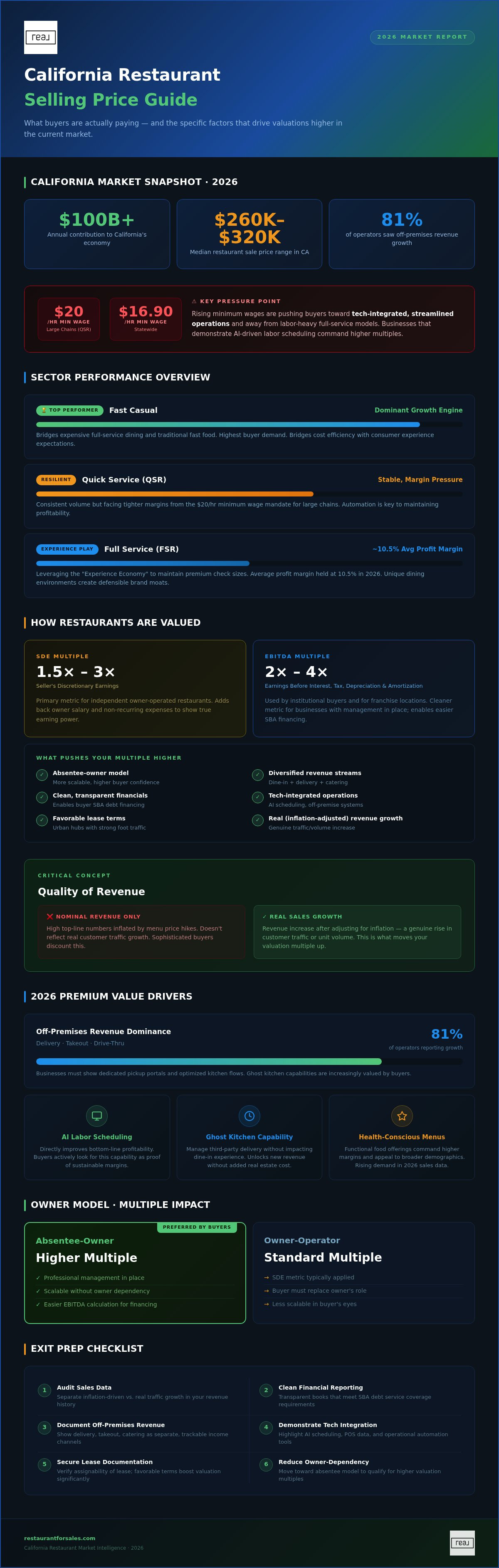
California's restaurant industry remains a powerhouse, contributing over $100 billion annually to the state's economy. As we move through 2026, the market has entered a phase of stabilization following years of aggressive price hikes. Owners and investors now focus on "Quality of Revenue." This metric determines the average restaurant selling price California buyers are prepared to offer. While nominal revenue often looks impressive, savvy buyers use sophisticated business valuation methods to strip away the inflation fluff and identify the true earning potential of an asset. Consumer confidence has leveled, leading to more predictable dining frequencies and check sizes compared to the volatility of previous years.
Revenue Growth Projections by Sector
The fast-casual sector has emerged as the dominant growth engine in 2026. These concepts successfully bridge the gap between expensive full-service dining and traditional fast food. Quick Service Restaurants (QSR) continue to show resilience, though they face tighter margins due to the $20.00 per hour minimum wage for large chains. Conversely, Full Service Restaurants (FSR) are leveraging the experience economy to maintain check sizes, even as discretionary spending tightens. Real Sales Growth in the current market refers to the increase in revenue after adjusting for menu price inflation, representing a genuine rise in customer traffic or unit volume. Without real growth, a business's market value may stagnate despite higher top-line numbers.
Economic Drivers Affecting Transaction Volume
Transaction volume is currently dictated by the cost of capital and labor stability. While interest rates have leveled, they remain a primary hurdle for buyers seeking SBA financing. This environment favors clean books that allow for easy debt service coverage. Labor market shifts also play a role. With the statewide minimum wage at $16.90, many buyers are moving away from labor-heavy full-service models toward streamlined, tech-integrated operations. We've seen a distinct trend where absentee-owner models command higher multiples than owner-operator setups, as they offer more scalability. Regional spending power remains the final piece of the puzzle. In high-density urban hubs, the average restaurant selling price California sellers achieve is often bolstered by favorable lease terms and consistent local foot traffic. Currently, median sale prices for restaurants in the state range between $260,000 and $320,000, reflecting a market that values operational stability over speculative growth.
Shifting Consumer Demands and Their Impact on Asset Value
Consumer habits in 2026 directly dictate the multiples buyers pay. Off-premises sales, including delivery, takeout, and drive-thru, continue to dominate the California market. According to recent industry reports, 81% of operators have seen an increase in this revenue stream. While high-volume foot traffic was once the primary driver of value, the average restaurant selling price California investors are willing to pay now depends on how efficiently a business serves the off-premises diner.
Full Service Restaurants (FSRs) are finding success through the "Experience Economy." By offering unique, high-touch dining environments, these establishments command premium menu pricing that offsets rising labor costs. In 2026, the average profit margin for full-service restaurants has held at approximately 10.5%. This experiential factor creates a competitive moat that delivery-only concepts can't replicate. Institutional buyers specifically look for this brand defensibility when evaluating potential acquisitions.
Diversified revenue streams make a business far more attractive to sophisticated investors. A restaurant that balances dine-in, delivery, and catering is inherently more resilient. When applying professional restaurant valuation methods, these varied income channels are often weighted more heavily. They provide a safety net against localized economic shifts. Additionally, 2026 sales data shows a significant rise in health-conscious and functional food menus, which command higher margins and appeal to a broader demographic.
The Off-Premises Influence on Real Estate
The physical footprint of a successful restaurant is changing. High delivery volume requires dedicated pickup portals and optimized kitchen flows to prevent bottlenecking. Traditional assets are increasingly incorporating "ghost kitchen" capabilities to manage third-party orders without impacting the in-house guest experience. This evolution has major implications for lease assignments. If a significant portion of your sales occurs off-site, you may no longer need a massive dining room. Buyers now value efficient square footage over sheer size, which is a major factor in the average restaurant selling price California sellers can expect for urban locations.
Loyalty Data and Customer Lifetime Value
Data has become a critical asset in 2026 transaction data. Buyers look for transparency through loyalty programs and subscription models that turn casual diners into recurring revenue. Active loyalty program participation strengthens the "goodwill" component of a business valuation by demonstrating predictable customer behavior and high lifetime value. This data-driven approach reduces risk for the purchaser. If you want to see how your specific revenue mix impacts your marketability, you can request a professional restaurant valuation to benchmark your business against current trends.
Calculating the Average Restaurant Selling Price: Multiples and Metrics
Determining the average restaurant selling price California owners can expect requires a move away from top-line revenue toward bottom-line sustainability. In 2026, the market prioritizes "stable" revenue over high-growth, high-risk models. A restaurant showing consistent 5% annual growth with predictable margins is often more valuable to a lender than a viral concept with fluctuating numbers. Transferability is the critical factor here. If the business depends entirely on the current owner's personal reputation or unique skill set, the multiple drops significantly. Lenders and buyers want to see a turnkey operation where the systems, not the individual, drive the profit.
Understanding SDE and EBITDA Multiples
Most independent restaurants in California sell based on a multiple of Seller’s Discretionary Earnings (SDE). For 2026, these multiples typically range from 1.5 to 3.5 times SDE. In contrast, franchises and high-volume quick-service restaurants are often valued at 3.0 to 4.0 times EBITDA. Ownership of your tech stack also influences these numbers. If you own your kiosks and POS hardware outright rather than leasing them, your lower monthly overhead increases the net profit, which directly elevates the business value. For a precise calculation of these figures, utilizing professional Restaurant Valuation Services is essential to ensure no "add-backs" are missed.
Valuing Intangible Assets and Reputation
Intangible assets now carry measurable weight in 2026 transactions. A strong social media presence and a high rating on review platforms act as a digital lease, securing future foot traffic. Lenders currently view "Owner Add-Backs", such as personal travel or non-essential vehicle expenses, with more scrutiny than in previous years. They require clear documentation to prove these expenses are truly discretionary.
Lease terms are perhaps the most influential non-financial metric. In California’s high-rent environment, a favorable lease with long-term options can increase a valuation by 20% to 40%. Conversely, an upcoming expiration or aggressive rent escalations can slash the asking price by 15% to 30%. Because the lease is often the largest fixed cost, its transferability and remaining term are just as important as the cash flow itself. Ensuring your lease assignment is structured correctly is a vital step in maximizing the final average restaurant selling price California buyers are willing to pay.
Technology Integration as a Driver for Higher Sales Prices
Technology has transitioned from a competitive advantage to a fundamental valuation metric. In 2026, a restaurant's "tech stack" is often as critical as its physical kitchen equipment. 52% of operators now report that automation leads to measurably faster service. This speed directly increases table turnover and off-premises throughput. For a seller, these efficiencies translate into higher Seller's Discretionary Earnings (SDE), which is the primary driver of the average restaurant selling price California brokers use for valuations. Buyers aren't just purchasing a menu; they're buying automated systems that protect the bottom line against rising operational costs.
AI and Operational Efficiency
Predictive ordering systems have become a standard tool for mitigating food waste. By integrating POS data with real-time inventory management, AI forecasts prep levels with high precision. This reduces the cost of goods sold (COGS) and boosts overall profitability. These systems are particularly attractive to "lifestyle" investors who prioritize absentee ownership. They seek businesses where software handles repetitive tasks like labor scheduling and stock replenishing. AI also enhances guest retention through personalized marketing, which increases the average order value without requiring additional manual labor from the staff.
The Changing Face of Labor and Service Models
The labor market continues to present significant challenges for owners. 80% of restaurants reported being short at least one position in 2025. In response, 2026 service models have shifted toward leaner, hospitality-focused staffing. Self-service kiosks and mobile ordering now handle the transactional side of the business. This allows the remaining staff to focus on high-value guest interactions rather than order entry. This shift is essential in a state where the minimum wage is $16.90 per hour for most employers and $20.00 per hour for large fast-food chains. Automation protects margins by ensuring that labor costs remain a manageable percentage of gross sales.
Integrating these technologies builds a transparent data trail that appeals to sophisticated buyers. When you prove that your labor scheduling is optimized by AI and your waste is minimized by predictive software, you reduce the perceived risk for the purchaser. This data-driven transparency often allows sellers to command the higher end of the 1.5x to 3.5x SDE multiple range. If you're unsure how your current technology impacts your business's market value, you should consult with a restaurant brokerage expert to evaluate your operation's efficiency. Modernizing your service model is one of the most effective ways to secure a premium average restaurant selling price California buyers are currently offering.
Strategic Positioning: Maximizing Value in the 2026 Market
Positioning your business for sale in 2026 requires a shift from operational management to asset optimization. Achieving a premium average restaurant selling price California buyers respect requires more than just high revenue. It demands proof of sustainability. Start by auditing your sales data to separate one-time spikes from consistent growth. Buyers and lenders in the current economic climate prioritize transparency. Clean books and detailed tax returns aren't just administrative requirements; they're the foundation of your business's market value. When your financial reporting is beyond reproach, you reduce the risk for the purchaser, which often results in a faster closing and a higher valuation multiple.
Use the 2026 industry trends discussed in previous sections to justify your asking price. If your restaurant has successfully integrated AI-driven labor scheduling or commands a high percentage of off-premises sales, highlight these as "future-proof" assets. A professional broker plays a vital role here. Navigating the complexities of California's regulatory environment, including the $16.90 minimum wage and strict food safety labeling laws, requires specialized knowledge. An expert facilitator ensures that these operational hurdles are presented as managed risks rather than deal-breakers.
Preparing Your Exit Strategy
The most successful exits begin 12 to 24 months before the business actually hits the market. This window allows you to identify "low-hanging fruit" that can boost your appraisal value. For example, renegotiating a lease with favorable options or trimming underperforming menu items can immediately improve your net profit. These small adjustments compound when a multiple is applied to your SDE. Understanding the role of a restaurant broker during this preparatory phase is essential. They provide the market perspective needed to align your internal improvements with what current buyers are actually seeking in a 2026 acquisition.
Finding the Right Buyer for Your Concept
The buyer pool in California has bifurcated into two distinct groups. Individual "lifestyle" buyers often seek turnkey operations that offer stable income and manageable hours. Conversely, institutional or strategic investors look for concepts that are "trend-ready" and scalable. To attract the right interest, your marketing materials must emphasize your concept's readiness for the future. Highlight your data-driven loyalty programs and your lean staffing models as evidence of a modern, resilient business. If you're ready to see how your operation stacks up against current market benchmarks, contact us for a professional Broker Opinion of Value today. Securing an expert valuation is the first step toward achieving a successful exit and a premium average restaurant selling price California investors are eager to pay.
Secure Your Exit in the 2026 Market
Success in today's California marketplace depends on your ability to translate operational efficiency into measurable market value. Buyers aren't just looking for high sales volume. They're searching for "future-proof" assets that leverage technology and diversified revenue streams to protect margins. Understanding the average restaurant selling price California investors are currently paying is just the first step. To maximize your return, you must focus on clean financial reporting and strategic lease positioning well before you list.
Our professional restaurant valuation experts are ready to help you navigate these complexities. We offer success-based brokerage commissions and access to a national network of qualified buyers and sellers. This ensures your concept reaches the right audience at the right time. Whether you're ready to sell or just beginning to plan your exit, the right data makes the difference. Browse Active Restaurant Listings and Get Expert Brokerage Support to start your journey today. Your hard work deserves a successful transition.
Frequently Asked Questions
What is the average profit margin for California restaurants in 2026?
The average profit margin for full-service restaurants in California is approximately 10.5% in 2026. This figure has remained stable because operators have implemented technology to offset rising labor costs and adjusted menu pricing. Quick-service segments often see slightly higher margins due to lower staffing requirements and faster turnover. Monitoring these margins is essential for maintaining a competitive business valuation during a sale.
How do current sales trends affect the asking price of my restaurant?
Current sales trends shift the focus from total volume to the quality of your revenue. Buyers pay a premium for businesses with high off-premises sales and automated labor scheduling. If your sales data shows resilience against inflation through these tech-enabled channels, you can justify a higher multiple. These trends directly influence the average restaurant selling price California buyers are willing to pay for a modern operation.
Are franchise resales performing better than independent restaurants in California?
Franchise resales generally command higher valuation multiples than independent restaurants due to their proven systems and brand recognition. In 2026, franchises often sell for 3.0 to 4.0 times EBITDA, while independent concepts typically range from 1.5 to 3.5 times SDE. The established support structure of a franchise reduces risk for lenders and institutional buyers, which stabilizes transaction volume even in a complex market.
What is the most important factor in a restaurant valuation today?
Net cash flow, specifically Seller's Discretionary Earnings (SDE), remains the most critical factor in any valuation. However, the transferability of that cash flow is equally important. If a restaurant's success depends entirely on the current owner's personal presence, the value decreases. Buyers prioritize businesses where systems and management teams ensure the profit continues after the ownership transfer is complete.
How much impact does a long-term lease have on a restaurant sale price?
A favorable, long-term lease can increase a restaurant's valuation by 20% to 40%. Because the lease is often the largest fixed cost, favorable terms and multiple five-year options provide the security buyers need. Conversely, an upcoming expiration or high rent escalations can decrease the asking price by up to 30%. Securing your lease assignment is a vital step in the sales process.
Is 2026 a good year to sell a restaurant in California?
2026 is a strong year for sellers who have modernized their operations. The market has stabilized and consumer dining frequency remains high despite broader economic shifts. Buyers are actively seeking tech-integrated businesses that have already mitigated the impact of the $16.90 minimum wage. If your books are clean and your revenue is stable, you're in a prime position to exit successfully.
How can I increase my restaurant sales to prepare for a future sale?
Focus on growing your recurring revenue through data-driven loyalty programs and subscription models. These programs increase the lifetime value of your customers and provide the transparent data trails that buyers love. Enhancing your delivery and takeout efficiency also boosts sales without requiring more dining room space. These improvements directly increase the average restaurant selling price California investors will offer for your business.
What are the red flags to look for in a restaurant’s financial statements?
Inconsistent food cost percentages and high owner dependence are major red flags for any buyer. If the cost of goods sold fluctuates wildly month to month, it suggests poor inventory management or waste. Another concern is unrecorded cash sales that aren't reflected in tax returns. Lenders won't recognize income that isn't documented, which makes financing nearly impossible for the purchaser.


