

A turnkey acquisition is a purchase of momentum, not just a collection of used kitchen equipment. While securing a turnkey restaurant for sale Bay Area offers a faster path to profitability than a build-out from scratch, it also inherits the previous owner's operational history. You likely understand that the region's high minimum wages, such as San Francisco's $19.61 per hour, and complex regulatory environment require more than just a passion for food; they demand a rigorous, professional approach to due diligence.
We'll help you master the complexities of this high-stakes transaction with a comprehensive, broker-verified checklist designed to protect your investment. You'll gain the clarity needed to navigate lease assignments, verify equipment valuations, and uncover any hidden legal liabilities before you sign the final asset transfer. This guide provides a clear roadmap for the acquisition process, ensuring you transition into your new role with confidence and a solid foundation for growth. We will examine the essential steps of the asset transfer process, from initial valuation to the final operational handover.
Key Takeaways
- Define the distinction between asset and stock sales to select the acquisition structure that best limits your future liability.
- Conduct a thorough audit of Furniture, Fixtures, and Equipment (FF&E) to confirm clear title and verify the condition of all physical assets.
- Reconcile P&L statements with POS data to determine the accurate valuation and true profitability of a turnkey restaurant for sale Bay Area.
- Execute a seamless transition by following a structured timeline for health department permits, liquor license transfers, and confidential staff notifications.
- Leverage the expertise of a specialized broker to navigate complex lease assignments and manage the escrow process for a secure transfer.
What Exactly is a Turnkey Restaurant for Sale?
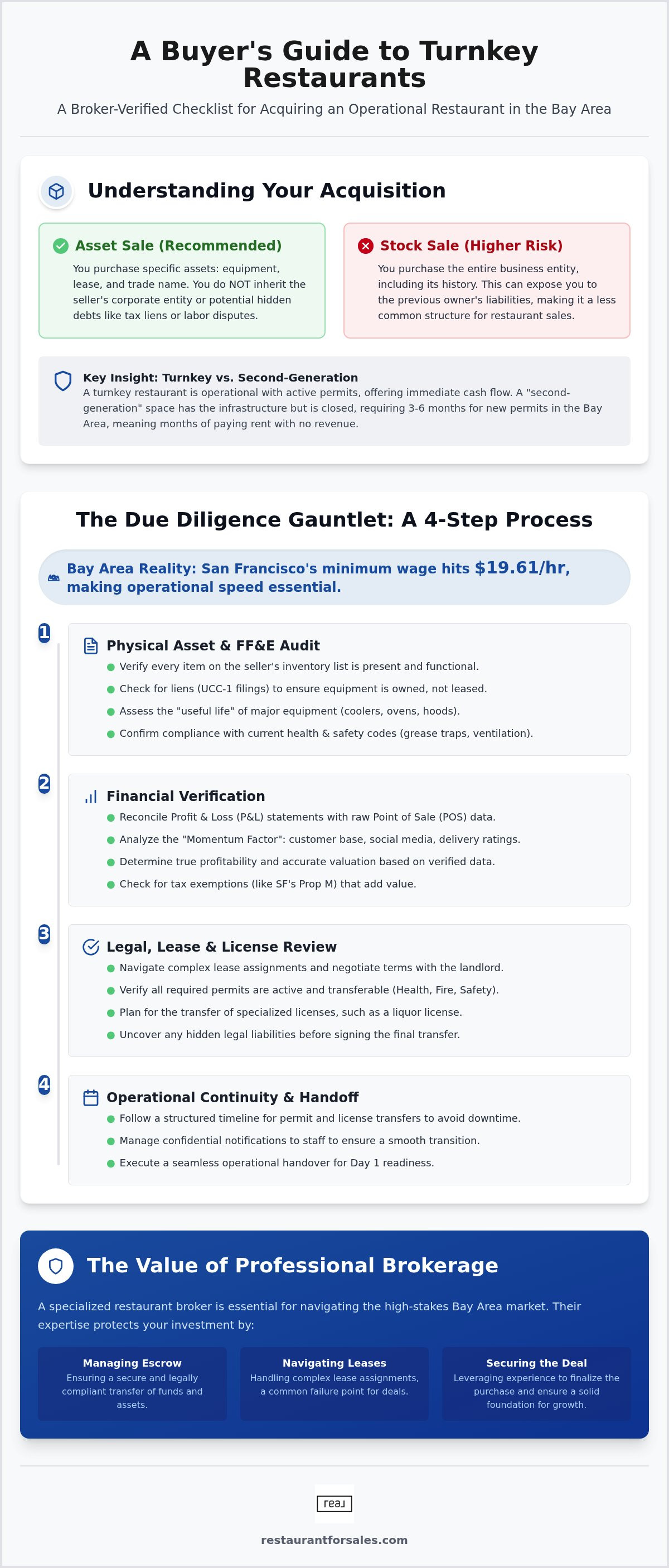
A turnkey restaurant for sale Bay Area represents a business that is fully equipped, currently permitted, and operational at the time of transfer. Unlike a vacant space, a turnkey listing includes the "invisible infrastructure" of a working kitchen: health department approvals, fire safety certifications, and a functioning staff. When you acquire a turnkey operation, you are purchasing the right to step into a moving vehicle rather than building one from the chassis up. This includes all Furniture, Fixtures, and Equipment (FF&E), existing leasehold interests, and often the established trade name and intellectual property.
Most transactions in this sector are structured as asset sales rather than stock sales. In an asset sale, you purchase specific items like the hood system, refrigeration, and the lease itself, while leaving behind the seller's corporate entity and potential hidden debts. Understanding the legal nuances of the business acquisition process is essential to ensure you don't inherit the previous owner's tax liens or labor disputes. By focusing on the assets, you gain the benefit of the existing setup without the baggage of the prior corporation's history.
Turnkey vs. Second-Generation Spaces
The primary difference between a turnkey operation and a "second-generation" space is the status of the permits and utility. A second-generation space is a closed restaurant that still has its kitchen infrastructure, but the "breath of life" is gone. In the Bay Area, where building permits for tenant improvements can take three to six months to clear, the speed of a turnkey acquisition is its greatest asset. Buying an active brand allows for immediate cash flow, which is vital in a market where the San Francisco minimum wage is $19.61 per hour as of July 2026. You skip the months of rent payments during construction and move straight to revenue generation.
The "Momentum" Factor in Business Valuation
Valuation for a turnkey restaurant for sale Bay Area relies heavily on momentum. This includes the existing customer base, social media presence, and historical revenue data. Brokers look at the digital footprint and delivery platform ratings as tangible assets that drive foot traffic. If the restaurant is currently exempt from gross-receipts taxes under San Francisco's Proposition M, that operational efficiency adds direct value to the bottom line. Turnkey value is ultimately defined by the business's ability to generate revenue from the very first hour of the new owner's tenure. This operational readiness justifies the market premium often seen in high-demand neighborhoods like Oakland or Berkeley, where starting from scratch is both expensive and time-consuming.
The FF&E and Physical Asset Checklist
The Furniture, Fixtures, and Equipment (FF&E) included in a turnkey restaurant for sale Bay Area often represent a significant portion of the total purchase price. You must verify that every item on the seller’s inventory list is present, functional, and owned outright. It isn't enough to see a stove; you need to know if it's paid for. Many buyers discover too late that high-value items like dishwashers or soda systems are actually leased, not owned. A thorough due diligence checklist should always include a search for UCC-1 filings to ensure no creditors have a lien on the kitchen hardware.
Assessing the "useful life" of heavy kitchen equipment is equally vital. Walk-in coolers, ovens, and hood systems have finite lifespans. If the equipment is nearing the end of its utility, the business's valuation should reflect the upcoming capital expenditure. You should also check for compliance with current health and safety codes. Standards for grease traps and ventilation often change, and what was "grandfathered in" for the previous owner might require an expensive upgrade for you upon transfer of the permit.
Kitchen and Bar Equipment Audit
Perform a hands-on inspection of all mechanical systems. Test refrigeration temperatures and ventilation efficiency during a live shift if possible. Reviewing maintenance logs for high-value items like espresso machines or POS systems can reveal chronic issues that might disrupt your early days of operation. Don't overlook "hidden" assets like smallwares, high-quality cutlery, and specialized bar tools. These items are often excluded from high-level descriptions but are essential for a seamless transition. For a more accurate picture of what's included, you can request a detailed restaurant valuation report to see how physical assets are weighted against the total asking price.
Dining Room and Aesthetic Assets
The condition of the dining room furniture and decor dictates how much you'll need to spend on rebranding. Evaluate the condition of tables and chairs, ensuring they align with your intended concept. Beyond the furniture, focus on "leasehold improvements" like custom lighting, flooring, and HVAC systems. These are assets that are physically attached to the property. It is important to distinguish between personal property and business assets in the sale agreement. Items like specific pieces of art or a family-owned antique bar back might be excluded from the sale. Clarifying these details early prevents disputes during the final walkthrough and ensures you get exactly what you paid for in your turnkey restaurant for sale Bay Area acquisition.
Financial Verification and Lease Assignment Realities
When evaluating a turnkey restaurant for sale Bay Area, your financial audit must go beyond the surface of a Profit and Loss (P&L) statement. You need to reconcile these statements with actual Point of Sale (POS) reports and federal tax returns to ensure the revenue is verifiable. Professional valuation relies heavily on EBITDA (Earnings Before Interest, Taxes, Depreciation, and Amortization). This metric provides a clear picture of the business’s operating performance before personal financial decisions or accounting methods cloud the view. Be vigilant about "add-backs," which are expenses the owner claims won't carry over to you. While some, like a one-time repair, are legitimate, others may be used to artificially inflate the perceived cash flow.
The SBA guide to buying a business emphasizes the importance of verifying that all sales tax payments are current and that no undisclosed vendor liens exist. In a high-stakes market like San Francisco or Oakland, financial transparency is the only way to mitigate the risk of inheriting debt. You should demand at least three years of tax returns to look for consistency in margins and growth patterns. If the numbers don't align with the POS data, it's a significant red flag that requires immediate clarification from the seller.
The Due Diligence Financial Deep-Dive
Analyze food and labor costs against current regional benchmarks. In 2026, the survival line for prime costs (COGS plus total labor) in San Francisco is 60% of gross sales. With the city's minimum wage at $19.61 per hour, your labor costs will likely sit between 30% and 34%. Compare the restaurant's historical food costs, typically 22% to 26% in this market, to ensure they aren't being suppressed by neglecting quality or inventory management. Reviewing these figures ensures the business model is sustainable under current economic pressures.
Securing the Premises: Lease Terms
The lease is arguably the most critical asset in a turnkey restaurant for sale Bay Area. You must evaluate the remaining term and any available renewal options to ensure long-term stability. Most commercial leases in the region are "Triple Net" (NNN), meaning you're responsible for property taxes, insurance, and maintenance. The lease assignment process is often the biggest bottleneck in a transaction. Landlords will require a full financial package from you, including bank statements and a personal financial statement, before consenting to the transfer. Negotiate these terms early to understand if the landlord will require an increased security deposit or a personal guarantee as a condition of the assignment.
Operational Continuity: A Step-by-Step Transfer Guide
The successful transfer of a turnkey restaurant for sale Bay Area requires a surgical approach to confidentiality. Prematurely notifying the staff can trigger unnecessary turnover and destabilize the business before you take the keys. Most professional acquisitions involve a strictly timed announcement, usually occurring only after all contingencies are removed and the escrow is nearly finalized. This protects the operational engine you're purchasing and ensures that the "momentum" mentioned in earlier sections remains intact during the transition of ownership.
Transitioning vendor accounts and utility services requires a coordinated schedule to avoid service interruptions. You must set up new accounts for waste management, linen services, and food distributors at least two weeks before closing. Simultaneously, ensure that the seller’s final bills are paid through escrow so you don't inherit past-due balances that could lead to a "stop-service" order on your first day. Defining the seller’s post-sale involvement period in the purchase agreement is equally vital. A standard handover typically includes two to four weeks of on-site training to familiarize you with proprietary recipes, POS nuances, and specific kitchen workflows.
Permits, Licenses, and Legal Compliance
The timeline for Alcoholic Beverage Control (ABC) license transfers is a critical path in your acquisition schedule. In 2026, the California ABC increased license fees by 2.72%, and while the application fee for a new general on-sale license is $19,840, the resale market in high-demand Bay Area counties can be significantly more expensive. You must also verify that the "Certificate of Occupancy" remains valid for your specific concept. Unpermitted kitchen modifications made by previous owners represent a significant hidden liability that can trigger mandatory shutdowns or expensive code corrections during your first post-transfer health inspection. If you're ready to begin this process, explore our current restaurant brokerage services to find a listing that matches your operational goals.
Staff Retention and Culture
Interviewing key personnel like the Executive Chef or General Manager is a standard part of late-stage due diligence. You need to review existing employment contracts and understand any outstanding benefits obligations, such as accrued vacation time, which the seller should settle at closing. Developing a "Day One" plan is essential to maintain the operational momentum you’ve purchased. Focus on retaining the "back-of-house" talent that understands the existing equipment and menu, as this stability is often what justifies the premium price of a turnkey restaurant for sale Bay Area. Clear communication regarding the new ownership's vision can prevent the loss of institutional knowledge that is vital for long-term success.
Finalising the Purchase: The Value of Professional Brokerage
Navigating the final stages of a turnkey restaurant for sale Bay Area requires a disciplined approach to legal and financial closure. Using a success-based broker provides a layer of protection during price negotiations, as their interests align with a successful, clean transfer. Professional valuation services are essential here to prevent you from overpaying for "goodwill," which is often an emotional figure set by the seller rather than a data-driven one. By grounding the price in the EBITDA and asset values discussed in previous sections, you ensure the investment remains viable from day one.
The escrow process serves as the primary safeguard for both parties. It holds the purchase funds until all contingencies, such as the lease assignment and permit transfers, are fully satisfied. Escrow also ensures that the seller uses the proceeds to clear any undisclosed vendor liens or tax obligations, delivering a clean title to the buyer. This protection is critical in the Bay Area market, where historical liabilities can be substantial if not properly identified and cleared before the final asset transfer.
Negotiation and the Purchase Agreement
Your purchase agreement is the definitive roadmap for the transaction. It must clearly outline the earnest money requirements, financing contingencies, and the specific closing date. Pay close attention to the "Representations and Warranties" section; this is where the seller legally guarantees the accuracy of the financial records and the condition of the assets. Brokers play a vital role in facilitating the lease assignment, often acting as the mediator between the buyer, seller, and landlord to prevent the delays that frequently derail commercial deals. This professional oversight ensures that the complex requirements of Bay Area property owners are met without compromising your timeline.
Next Steps for the Aspiring Owner
Conduct a final walkthrough of the premises exactly 24 hours before closing. This is your last opportunity to verify that the FF&E inventory is complete and that the equipment is in the working condition promised in the contract. Simultaneously, you must finalize your new business entity and secure comprehensive insurance coverage, including general liability and workers' compensation. Once the escrow officer confirms the recording of the sale, the operational transition begins in earnest for your turnkey restaurant for sale Bay Area. To start your journey, View our active restaurant listings to find your turnkey opportunity and evaluate the current market options available in your target neighborhood.
Securing Your Future in the Bay Area Restaurant Market
Acquiring a turnkey restaurant for sale Bay Area is a strategic investment in existing momentum. Success depends on your ability to verify every physical and financial asset before the final transfer. By following a broker-verified checklist, you ensure that equipment is owned outright, lease terms are sustainable, and operational permits are fully compliant with local regulations. These steps transform a high-stakes transaction into a manageable roadmap for long-term growth.
As part of the BBMT, Inc. network, we provide expert restaurant valuation services to ensure you pay a fair market price based on verified performance. Our success-based brokerage commissions mean our goals align with yours; we prioritize a secure, transparent, and efficient transfer of ownership. Transitioning into the Bay Area hospitality market is a complex process. However, with the right due diligence and professional support, you can take over an operational business with absolute confidence.
Browse Active Turnkey Restaurant Listings to identify the right match for your culinary vision. We're ready to help you navigate this transition and secure your place in the region's competitive dining landscape.
Frequently Asked Questions
What is included in a turnkey restaurant sale?
A turnkey sale includes all the physical and intangible assets required to operate the business immediately. This typically encompasses the Furniture, Fixtures, and Equipment (FF&E), the leasehold interest, and all active health and safety permits. You also acquire the brand’s intellectual property, which includes the trade name, proprietary recipes, and established social media presence.
How long does it take to buy a turnkey restaurant?
The acquisition process generally spans between 60 and 120 days from the signed letter of intent to the close of escrow. This timeline is often dictated by the speed of the landlord’s lease assignment and the processing of regulatory transfers. In the Bay Area, escrow timelines for restaurant transfers in 2026 frequently approach the 90-day mark to accommodate thorough financial due diligence.
Do I need a new liquor license when buying an existing restaurant?
You typically transfer the seller's existing license through a person-to-person transfer with the California Department of Alcoholic Beverage Control (ABC). This process ensures you can continue serving alcohol without the delay of a new application. It is important to note that ABC license fees increased by 2.72% in 2026, so you should account for these updated administrative costs in your closing budget.
What are the risks of buying a turnkey restaurant?
The primary risks include inheriting undisclosed tax liens, labor disputes, or failing kitchen equipment that requires immediate replacement. You must also be vigilant about unpermitted modifications made by previous owners, as these can lead to mandatory code corrections. Conducting a professional valuation on a turnkey restaurant for sale Bay Area helps identify these hidden liabilities before you finalize the purchase.
How do I verify the revenue of a restaurant for sale?
Verify revenue by performing a three-way reconciliation of Point of Sale (POS) reports, monthly bank statements, and federal tax returns. You should review at least three years of tax filings to confirm the consistency of the reported income. If the bank deposits don't align with the POS data, it indicates a lack of financial transparency that warrants further investigation.
What is a lease assignment in a restaurant sale?
A lease assignment is the legal transfer of the existing rental agreement from the seller to the buyer. This process requires the landlord’s formal consent, which is usually contingent on a review of your financial strength and restaurant experience. Landlords may require an updated security deposit or a personal guarantee as a condition for approving the assignment of the premises.
Should I buy the real estate or just the restaurant business?
Buying the real estate provides an asset that can appreciate and protects you from future rent hikes, though it requires a much larger capital outlay. Most entrepreneurs looking for a turnkey restaurant for sale Bay Area opt for an asset sale. This allows you to purchase the operational business and leasehold interest while keeping your initial investment focused on cash-flow-generating assets.
How much is a turnkey restaurant worth compared to its annual profit?
Most turnkey restaurants are valued between 2 and 4 times their annual Seller’s Discretionary Earnings (SDE). A business with a long-term lease and modern, owned equipment will typically sit at the higher end of that range. If the lease is nearing its end or the equipment has a short remaining useful life, the valuation multiple will decrease accordingly.


