

Why would you spend decades paying off your landlord's mortgage when you could be building your own legacy? Most restaurateurs accept unpredictable rent hikes and restrictive lease terms as the unavoidable price of doing business. You've likely felt the frustration of investing in property improvements only to see that value benefit someone else's balance sheet while your occupancy costs continue to climb. For many, the hurdle isn't a lack of ambition but the perceived difficulty of financing a restaurant with real estate in a high-stakes market.
You can master the financial strategies, loan structures, and ROI differences between buying a restaurant business and owning the underlying property. This guide will show you how to secure fixed occupancy costs and equity growth by leveraging the latest 2026 lending standards. We'll explore how to navigate the new $10 million SBA borrowing limit and utilize 504 loan structures to turn a volatile service business into a stable, tangible asset. We'll preview the specific steps required to move from the uncertainty of leasing to the long-term security of property ownership.
Key Takeaways
- Identify how the owner-user model stabilizes 2026 profit margins by eliminating unpredictable rent escalations and landlord interference.
- Navigate the complex structures of SBA 504 and 7(a) programs to secure more favorable terms when financing a restaurant with real estate.
- Evaluate the initial capital outlay and long-term ROI differences between acquiring a leasehold and owning the underlying property.
- Execute a "Dual Due Diligence" strategy that covers both the operational financial audit and the physical Phase I Environmental Site Assessment.
- Leverage specialized restaurant brokerage expertise to access off-market listings and navigate the complexities of combined business and property escrows.
The Strategic Shift: Why Financing a Restaurant with Real Estate Changes the Game
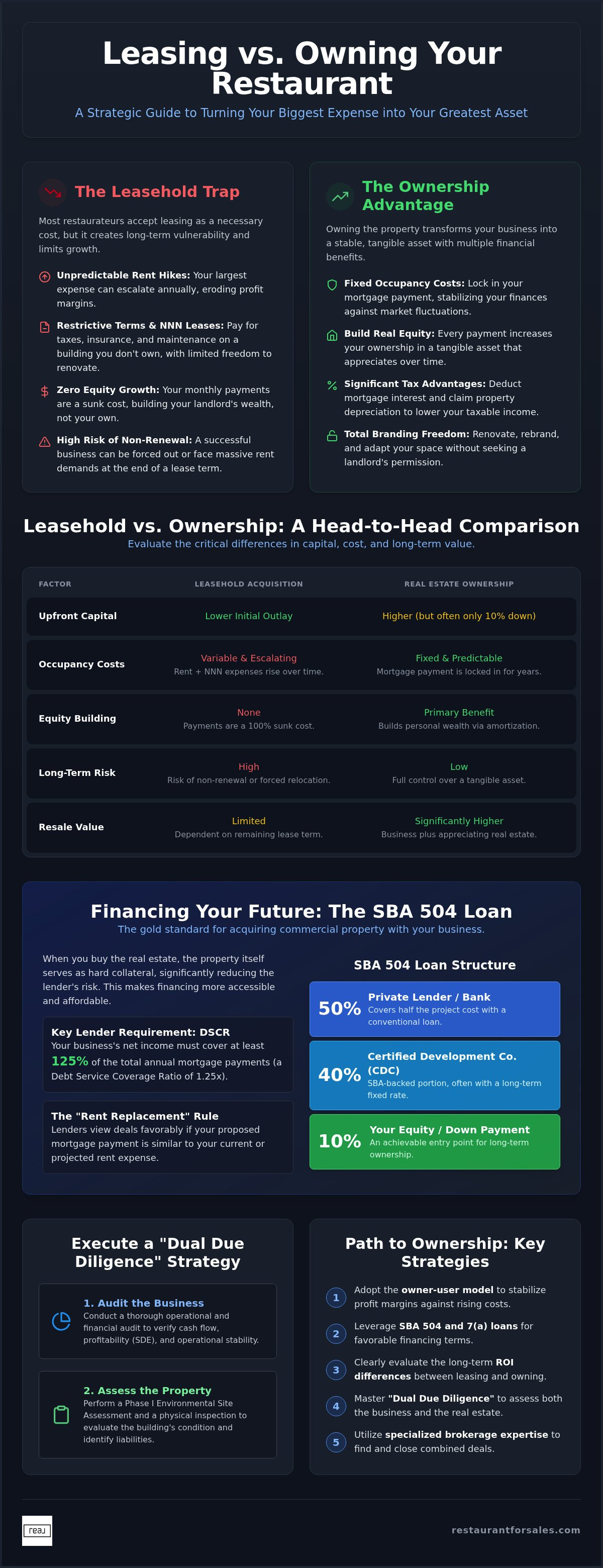
The "owner-user" model represents a fundamental shift in how hospitality professionals approach their balance sheets. Instead of paying for the right to occupy space, you become the landlord. This transition eliminates the largest variable expense for most operators: escalating rent. In 2026, with food-away-from-home prices forecasted to rise by 3.9%, controlling fixed costs is a critical survival strategy. Financing a restaurant with real estate allows you to lock in occupancy costs while your competitors face annual escalations. It also grants you total branding freedom. You won't need a landlord's permission to renovate the facade or upgrade the outdoor seating to meet the rising demand for experiential dining.
Leasehold Model: Low Entry, High Long-Term Risk
Many buyers choose leases because they require less upfront capital. However, the hidden costs often outweigh the savings. Most commercial agreements are Triple Net (NNN) leases, meaning you pay for property taxes, insurance, and maintenance. When these costs spike, your profit margins disappear. There's also the risk of non-renewal. If your restaurant becomes the local hotspot, a landlord might refuse to renew your lease or demand a massive hike to capture your success. This vulnerability drastically reduces your business's resale value. Buyers are wary of short lease terms, and lenders often refuse to finance a business purchase if the lease doesn't extend well beyond the loan's maturity date.
Real Estate Ownership: Building Equity Beyond the Kitchen
Owning the property transforms your monthly payment from a sunk cost into a wealth-building investment. Through amortization, every payment increases your equity in a tangible asset. When you utilize a commercial mortgage to purchase the building, you also unlock significant tax advantages. You can often deduct interest payments and claim depreciation, which lowers your total taxable income. This ownership structure is particularly effective in 2026 as we see a "flight to quality" in the commercial market. High-quality, well-maintained buildings are retaining value better than unrenovated retail spaces. Perhaps most importantly, the real estate provides a safety net. While the median restaurant sells for 2.15 times its SDE, the underlying land often appreciates independently of the business's daily performance. Financing a restaurant with real estate ensures that even if you decide to change your concept or retire, you still hold a valuable piece of the local market.
Financing Architecture: SBA 504 and 7(a) Loans for Combined Deals
Security is a lender's primary concern when evaluating a hospitality deal. A leasehold represents an intangible right to occupy space, but real estate is a hard asset that provides tangible collateral. When you are financing a restaurant with real estate, you offer the bank a primary lien on the property, which significantly reduces their risk profile. Lenders evaluate these combined transactions using the "Rent Replacement" rule. If your current or projected rent matches the proposed mortgage payment, the deal is viewed as highly viable. Most lenders require a Debt Service Coverage Ratio (DSCR) of at least 1.25x. This means your net operating income must cover 125% of your annual debt obligations. Lenders calculate this by dividing your Seller's Discretionary Earnings (SDE) by the total annual principal and interest payments.
In the 2026 market, well-qualified buyers can often secure these deals with as little as a 10% down payment, whereas business-only acquisitions frequently demand 20% or more. It's important to recognize that as of March 2026, owners must be U.S. citizens or nationals to qualify for these SBA programs. This requirement applies to both direct and indirect business owners. Lenders also scrutinize the property's condition more than the business's daily sales. A "flight to quality" in 2026 means that modern, efficient layouts receive faster approvals and more competitive terms. It's essential to pre-qualify to remain competitive in a market where consistently profitable restaurants with clean financial records are in high demand.
The SBA 504 Loan: The Gold Standard for Property
The 504 structure is built for long-term stability and is the preferred choice for property-heavy deals. It involves a partnership where a private lender covers 50% of the project, a Certified Development Company (CDC) covers 40%, and you provide 10%. As of August 2026, the CDC portion offers fixed rates between 6.5% and 7.5%. This program is ideal for SBA 504 loans because it provides 25-year fully amortized terms, protecting you from future interest rate volatility. Your restaurant must occupy at least 51% of the building's total square footage to qualify.
The SBA 7(a) Loan: Versatility for Business and Assets
The 7(a) program is a versatile tool for financing a restaurant with real estate because it covers both the business acquisition and the property in a single package. Following the July 4, 2026, rule change, the total SBA borrowing limit doubled to $10 million, allowing you to hold up to $5 million in 7(a) loans and $5 million in 504 loans simultaneously. Variable rates currently range from 9.0% to 11.5% based on the 6.75% Prime Rate. You can explore Restaurant For Sale Marketplace to see which opportunities currently fit these specific loan structures.
Side-by-Side: Leasehold Acquisition vs. Real Estate Ownership
Deciding between a leasehold and ownership requires a cold analysis of both immediate cash flow and terminal value. Leaseholds often appear attractive because of the lower initial capital outlay. You typically only need to finance the business value, which might require a 20% down payment on a smaller total price. However, financing a restaurant with real estate fundamentally changes the math of your exit strategy. While the upfront check is larger, you are often financing 90% of the total project value, including the building. This creates a dual-asset class: a cash-flowing business and a tangible real estate holding. Over a ten-year horizon, the difference in ROI is stark. A tenant faces 1.5% average nationwide rent growth, whereas an owner-user captures that same percentage in equity appreciation while paying down a fixed mortgage.
Operational flexibility is another overlooked differentiator. In a lease, you might be responsible for the grease trap and HVAC maintenance under NNN terms, yet you have no ownership of these systems. If you need to replace a roof to keep the kitchen dry, that capital investment stays with the landlord when you leave. Ownership gives you total control over the physical plant. You decide the quality of the materials and the timing of the upgrades. This control ensures that your operational efficiency isn't at the mercy of a landlord's slow response time or budget constraints.
The Landlord Factor
Selling a leasehold business involves navigating the "assignment" minefield. Landlords often charge significant assignment fees and must approve the new buyer's creditworthiness. This can stall or even kill a deal at the finish line. When you own the property, you act as your own landlord, which streamlines future transactions. You can sell the business and the real estate as a package, or sell the brand while retaining the property to collect rent from the new operator. This flexibility significantly increases your "Blue Sky" valuation because the buyer gains the security of a long-term, stable location without third-party interference.
Terminal Value Analysis
The most critical difference appears at the end of your career. When a 20-year lease ends, the tenant is left with used equipment and no further rights to the space. For property owners, the SBA 504 loan program facilitates a path toward massive terminal value. You can utilize a 1031 exchange to defer capital gains taxes when selling the property and moving into a larger investment. For chefs and operators, property ownership serves as a definitive retirement plan that exists independently of the daily grind in the kitchen.
Due Diligence Checklist: Assessing the Building and the Business
Financing a restaurant with real estate requires a rigorous "Dual Due Diligence" process. You must investigate the operational health of the brand and the structural integrity of the property simultaneously. Lenders will mandate a Phase I Environmental Site Assessment to ensure the land is free from historical contamination. This step is non-negotiable for most commercial real estate transactions. You must also verify that the building's zoning and permits are "grandfathered" for hospitality use. Changing a building's use classification in 2026 can be a lengthy, expensive process that disrupts your timeline. Be particularly mindful of ADA compliance. Bringing an older facility up to modern accessibility codes can cost tens of thousands of dollars in unforeseen renovations.
The Physical Plant Inspection
A standard commercial inspection is insufficient for a hospitality deal. You need specialized contractors to evaluate the HVAC capacity specifically for commercial kitchen exhaust needs. A failing roof or cracked parking lot can drain your working capital before you even open your doors. Inspect the kitchen infrastructure with precision. Verify the condition of grease traps, hoods, and fire suppression systems. These components are often the most expensive to replace and are subject to strict health and fire department regulations. Ensure the existing equipment meets current 2026 safety standards to avoid immediate post-closing expenses. If the physical plant requires significant upgrades, use these findings to renegotiate the purchase price before the due diligence period expires.
The Financial Deep Dive
Your financial audit must separate the business operations from the real estate expenses. Review at least three years of tax returns and POS data to verify the cash flow. Use this data to confirm the "Rent Replacement" math discussed in previous sections. Lenders focus on documented, transferable cash flow rather than just gross revenue. Because the median restaurant sells for 2.15 times its SDE, your valuation must be precise to satisfy bank appraisers. Explore our Restaurant Valuation Services to ensure your offer aligns with current market multiples. If the financials are messy or records are missing, the risk of a loan denial increases significantly. For a professional assessment of your potential acquisition, contact our experts to discuss our specialized Restaurant Brokerage Services.
Closing the Deal: Using specialized Brokerage and Valuation
General real estate agents often struggle with the nuances of a hospitality transaction. These generalists might understand local property values, but they rarely grasp the intricacies of liquor license transfers, health department permits, or specialized kitchen equipment valuation. When you are financing a restaurant with real estate, you need a facilitator who understands how these components interact. A specialized broker manages the dual escrow process, ensuring that the business transfer and the property sale close simultaneously. This coordination is vital. A failure in one escrow can jeopardize the entire project and leave you with a building you can't use or a business with no home.
Expert brokers also provide access to off-market opportunities. Many owners prefer to sell quietly to protect staff morale and customer confidence. By working with a specialist, you gain access to high-equity opportunities that never reach public listing sites. Before making an offer, secure a formal Opinion of Value. This document provides a data-driven foundation for your negotiations and ensures your offer remains realistic for bank financing. It's the best way to prove to a seller that your offer is based on market reality rather than speculation.
Professional Valuation Services
Valuing a combined asset requires a two-pronged approach. You must apply a multiple to the Seller's Discretionary Earnings (SDE) for the business while simultaneously determining the Cap Rate for the real estate. Professional valuation prevents you from overpaying for the "bricks and mortar" by analyzing local market comparables and current rent replacement math. This expertise is critical when justifying the purchase price to SBA lenders. Lenders don't just look at the business; they rely on expert appraisals to confirm that the business's cash flow can support the debt service while the property value provides sufficient collateral.
Navigating the Marketplace
Protecting the business's operational integrity during a real estate transfer is paramount. Confidentiality agreements ensure that sensitive financial data and the intent to sell remain private until the deal is finalized. Our platform, the Restaurant For Sale Marketplace, simplifies this search by allowing you to filter listings specifically for "Real Estate Included," saving you from vetting leasehold-only properties. Start your search with a focused strategy. Browse national restaurants with real estate for sale today to identify high-potential assets that fit your investment criteria. Using a specialized marketplace ensures you're looking at deals where the financing a restaurant with real estate has already been considered by the seller.
Securing Your Legacy in the 2026 Hospitality Market
Transitioning from a tenant to an owner-user transforms your business from a volatile service operation into a diversified investment portfolio. By mastering the nuances of financing a restaurant with real estate, you eliminate the risk of landlord interference and capture long-term equity growth. Success in the 2026 market depends on utilizing specialized SBA loan structures and conducting rigorous dual due diligence on both the brand and the physical building. Each deal requires a steady hand to manage the complexities of combined escrows and asset transfers.
Our team provides the professional valuation expertise and specialized brokerage services required to navigate these high-stakes transactions. We utilize success-based commissions to ensure our goals remain fully aligned with your acquisition objectives. This professional approach protects your capital while ensuring the physical plant meets modern operational standards. Don't leave your terminal value to the whims of a commercial lease agreement. You deserve a tangible asset that grows alongside your culinary success.
Browse All National Restaurants With Real Estate For Sale today to find high-equity opportunities that secure your financial future. Your path to long-term stability and wealth starts with selecting the right property for your vision.
Frequently Asked Questions
Is it better to own or lease restaurant real estate?
Ownership is generally superior for long-term wealth building because it provides fixed occupancy costs and equity growth. While leasing offers lower entry costs, it exposes you to annual rent escalations and the risk of lease non-renewal. Property owners capture the 1.5% average nationwide rent growth as equity rather than an expense. Ownership also grants you total control over renovations and branding without requiring landlord consent.
What is the typical down payment for a restaurant with real estate?
You can typically secure a combined deal with a 10% down payment using SBA 504 or 7(a) loan programs. This is a significant advantage over business-only acquisitions, which frequently require 20% or more in liquid capital. Lenders offer these better terms because the real estate serves as high-quality collateral. To qualify for these 10% down programs in 2026, all business owners must be U.S. citizens or nationals.
Can I use an SBA 504 loan for a restaurant business purchase?
You can only use the 504 program if the transaction includes the acquisition of the underlying property. These loans are specifically designed for fixed assets like land and buildings; they don't fund standalone business purchases or working capital. When financing a restaurant with real estate, the 504 loan covers the property while a companion 7(a) loan can fund the business value and equipment. This dual structure protects you from interest rate volatility.
Does owning the real estate make a restaurant easier to sell?
Ownership significantly simplifies the sale process by removing the landlord as a third-party gatekeeper. You don't have to worry about lease assignment fees or the landlord rejecting your buyer's credit. Combined deals are more attractive to lenders, which helps your buyer secure financing faster. This stability often results in a higher "Blue Sky" valuation because the buyer isn't at risk of losing their location when a lease expires.
What are the main tax benefits of owning your restaurant building?
Property owners can lower their taxable income through depreciation and mortgage interest deductions. These tax advantages aren't available to tenants paying standard rent. You can also utilize a 1031 exchange to defer capital gains taxes when you sell the property to upgrade to a larger location. These benefits transform your occupancy cost into a strategic retirement plan that builds value independently of your daily food sales.
How do I value a restaurant when the real estate is included?
You must perform two separate valuations: a multiple of earnings for the business and a Cap Rate analysis for the property. The median restaurant currently sells for 2.15 times its Seller's Discretionary Earnings (SDE). Financing a restaurant with real estate requires this dual approach to satisfy bank appraisers and ensure your total offer matches market reality. Professional valuation services are essential to justify these combined purchase prices to SBA lenders.
What is a Phase I Environmental Assessment in a restaurant deal?
A Phase I assessment is a mandatory report that investigates the property's history to identify potential soil or groundwater contamination. Lenders require this document to ensure they aren't financing a property with significant environmental liabilities. If the report identifies "Recognized Environmental Conditions," you may need further testing before the loan is approved. This due diligence step protects you from inheriting costly cleanup responsibilities from previous owners.
Can I buy the building and lease it back to my own restaurant corporation?
This is a common and effective strategy for separating your real estate assets from your business operations. Most owners hold the property in a separate LLC and sign a formal lease with their restaurant corporation. This structure provides a layer of liability protection and allows you to pay yourself market-rate rent. Lenders favor this arrangement because it clearly demonstrates the "Rent Replacement" math required to cover your mortgage debt service.


