

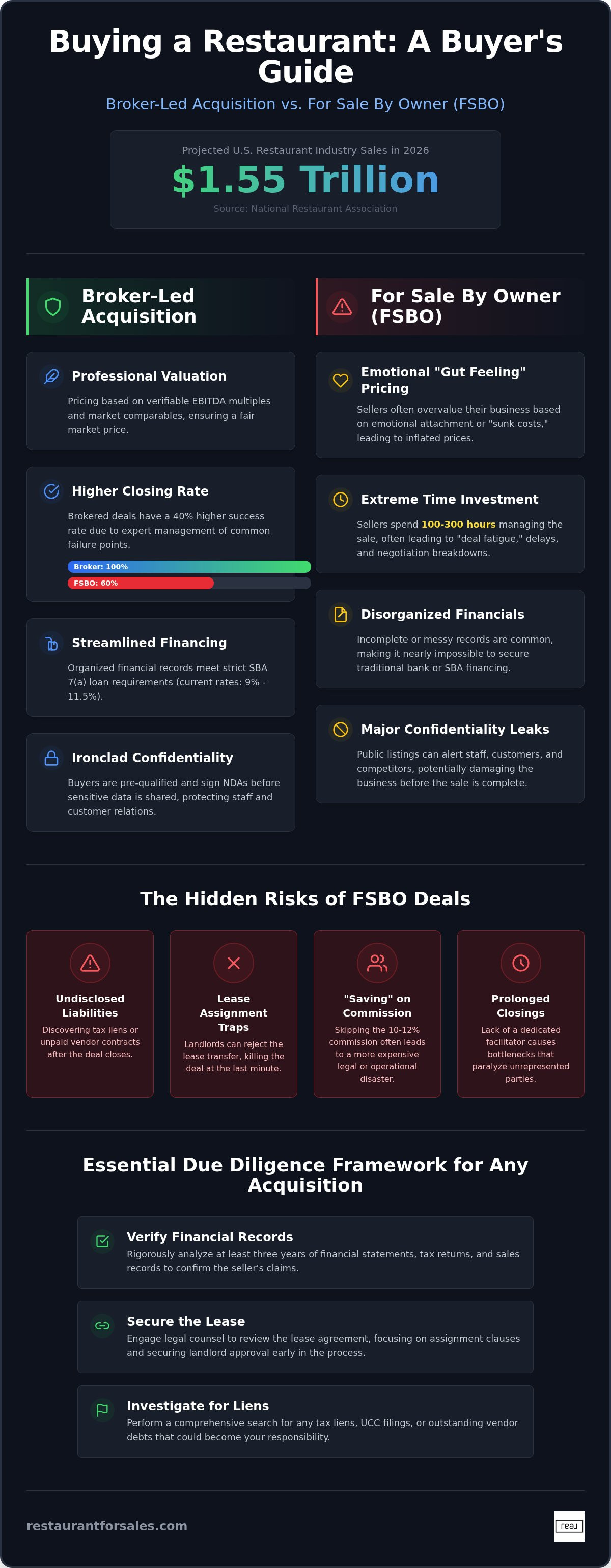
Skipping the 10% to 12% brokerage commission on restaurants for sale by owner might seem like an immediate financial win, but it often leads to a much more expensive legal or operational disaster. You likely want to bypass the middleman to keep your startup capital intact and secure a direct line to the seller's history. It's natural to feel anxious about overpaying for a business based on an owner's emotional valuation rather than a professional EBITDA-based appraisal. With the National Restaurant Association projecting industry sales to reach $1.55 trillion in 2026, the stakes for your investment have never been higher.
This guide will help you evaluate the high-stakes complexities of direct acquisitions by comparing FSBO risks against the structural protections of professional brokerage. You'll learn how to secure a profitable restaurant at a fair market price while minimizing the legal risks associated with lease assignments and undisclosed liabilities. We'll examine the critical differences in securing SBA 7(a) financing, which currently sees variable rates between 9% and 11.5%, and how professional mediation ensures a smooth transition without losing your core staff or customer base.
Key Takeaways
- Evaluate the 2026 shift toward direct listings and why commission avoidance often creates hidden hurdles for unprepared buyers.
- Differentiate between professional EBITDA-based appraisals and the emotional "gut feeling" pricing common in restaurants for sale by owner.
- Master a rigorous due diligence framework that includes verifying three years of financial records and executing comprehensive NDAs.
- Identify undisclosed liabilities such as tax liens or unpaid vendor contracts before they compromise your business investment.
- Leverage professional marketplaces and lease assignment expertise to ensure a smooth transition and prevent common closing delays.
The Landscape of Restaurants for Sale by Owner in 2026
In the hospitality sector, a For Sale By Owner (FSBO) transaction occurs when a restaurateur lists their business for sale without the representation of a professional broker. This approach shifts the entire burden of marketing, valuation, and legal coordination onto the owner. While common in residential real estate, FSBO listings in the restaurant industry present unique challenges due to the operational complexity of the assets involved. As the National Restaurant Association projects industry sales to reach $1.55 trillion in 2026, the volume of these direct transactions continues to grow as owners look for ways to maximize their exit proceeds.
The rise of digital marketplaces has made it easier for unrepresented sellers to reach a national audience. However, this accessibility creates a "Bargain Myth." Many buyers assume that searching for restaurants for sale by owner will lead to a lower purchase price because there is no broker commission involved. In reality, without a professional valuation, owners frequently set prices based on emotional attachment or "sunk costs" rather than actual EBITDA multiples. This often results in listings that are significantly overpriced compared to verified market standards, leading to prolonged time on the market and deal fatigue.
Why Owners Choose the FSBO Route
The primary motivation for a direct sale is financial. By bypassing a professional facilitator, owners aim to save on success-based commissions, which typically range from 10% to 12% for restaurant-specific brokerages. Beyond the money, many sellers want total control over the narrative and buyer screening process. They believe they're the best people to tell their restaurant's story. Unfortunately, there is a persistent misconception that selling a hospitality business is as simple as selling a vehicle. This mindset ignores the technical requirements of asset transfers, such as liquor license transitions and health department compliance.
The Buyer’s Perspective: Seeking the "Off-Market" Deal
Experienced investors often target direct listings in hopes of finding "off-market" gems with less competition from institutional buyers. They often anticipate more flexible seller financing terms or a direct line to the owner for honest operational insights. However, this path requires extreme due diligence. Direct buyers frequently encounter significant hurdles that a broker would typically resolve before a listing goes live. Common issues include:
- Incomplete or unorganized financial records that fail to meet SBA loan requirements.
- Undisclosed liabilities, such as tax liens or unpaid vendor contracts.
- Lease agreements that contain strict non-assignment clauses.
- Inaccurate equipment inventories that don't reflect the actual condition of the kitchen.
Broker-Led vs. FSBO: A Side-by-Side Comparison
Choosing between a broker and searching for restaurants for sale by owner is a decision that dictates the trajectory of your entire acquisition. While direct deals offer the allure of lower entry costs, the structural differences in how these transactions are managed often lead to vastly different outcomes. Brokered deals typically close faster because a dedicated facilitator handles the logistical bottlenecks that often paralyze unrepresented parties. This steady hand is essential in a market where the National Restaurant Association projects sales to reach $1.55 trillion by the end of 2026.
Research indicates that selling a restaurant without professional help requires a massive time investment of 100 to 300 hours from the owner. This administrative burden frequently leads to "deal fatigue," where one or both parties lose momentum during the long months of negotiation. Professional brokerage services often achieve a 40% higher closing rate than FSBO attempts because they manage the specific friction points, like lease assignments and equipment inspections, that cause direct deals to fail. Confidentiality is another area where the two paths diverge. In a direct sale, maintaining secrecy is notoriously difficult. Owners often inadvertently alert staff or competitors when they list on public boards. Brokers act as a protective buffer, requiring financial pre-qualification and signed non-disclosure agreements before disclosing any sensitive operational data.
Valuation Accuracy and Pricing Realities
Accurate pricing is the foundation of a successful transfer. Owners selling directly often rely on "gut feeling" or Seller’s Discretionary Earnings (SDE) inflation, which can lead to unrealistic expectations. Professional brokers use market comparables and historical data to prevent buyers from overpaying. For a more objective approach, you should follow a comprehensive guide to buying a business to understand the underlying metrics. Earnings Before Interest, Taxes, Depreciation, and Amortization (EBITDA) remains the industry gold standard for 2026 restaurant valuations, providing a clear picture of operational cash flow. Typical valuation ranges for 2026 fall between 2.5x and 5x adjusted EBITDA, depending on the asset quality and location.
The Complexity of the Closing Process
Managing the transition of funds and legal titles requires a methodical approach that most FSBO participants lack. Without a neutral third party to manage escrow, buyers risk releasing funds before all contingencies are met. The burden of drafting the Asset Purchase Agreement (APA) also falls on the parties, often leading to expensive legal revisions later. Professional brokerage services streamline this by coordinating with attorneys and landlords to ensure all paperwork is compliant. If you are unsure about the true value of a listing, obtaining a professional restaurant valuation can provide the clarity needed to proceed with confidence. This level of oversight is why brokered transactions consistently reach the finish line with fewer legal complications.
The Hidden Risks of Buying Directly from an Owner
A common objection among buyers is that professional brokers simply add an unnecessary layer of cost to a transaction. While saving on a success-based commission feels like an immediate win, it often exposes you to structural risks that a facilitator would typically filter out. Searching for restaurants for sale by owner might seem like a shortcut to a better deal, but without professional mediation, you're responsible for uncovering every hidden liability yourself. If you miss a single detail during the discovery phase, the "savings" from bypassing a broker can quickly evaporate into legal fees and settlement costs.
Confidentiality is another area where direct deals frequently collapse. When an owner manages their own listing, they often lack the tools to keep the sale quiet. If news of a pending transfer leaks to the staff, key employees may begin looking for more stable employment, leading to a sudden labor shortage right when you take over. Similarly, customer trust can erode if they perceive the change as a sign of financial distress. Brokers act as a protective shield, ensuring that the identity of the business remains hidden until a qualified buyer has signed a binding non-disclosure agreement.
Undisclosed Financial and Legal Liabilities
One of the most dangerous aspects of an unmediated deal is the presence of "ghost" debts. These are liabilities that the current owner might not even be aware of, such as lingering sales tax audits or unpaid vendor balances that follow the business assets. You must perform a comprehensive UCC lien search to ensure the equipment you're buying isn't actually collateral for an undisclosed loan. Following official guidance on buying a business is critical here; you need to verify that all tax clearances are in hand before any funds leave escrow. Professional due diligence protects you from future litigation by ensuring the asset transfer is clean and legally binding.
The Lease Assignment Hurdle
Landlords are often the biggest obstacle in FSBO transactions. Many property owners are hesitant to work with unrepresented buyers because they lack the assurance that the newcomer has been properly vetted for financial stability. It's vital to understand the technicality of a "Leasehold Interest" versus a simple "Asset Purchase." In many restaurants for sale by owner, the seller assumes the landlord will automatically approve a lease assignment, but this is rarely the case. A broker facilitates the landlord interview process, preparing a professional "Buyer’s Bio" and financial package that demonstrates your competence. This preparation prevents the deal from dying at the landlord's desk, which is where a significant percentage of direct acquisitions fail.
Due Diligence Framework for FSBO Restaurant Acquisitions
When engaging with restaurants for sale by owner, your primary defense against a bad investment is a rigid due diligence framework. Without a broker to vet the seller's claims, the burden of verification falls entirely on your shoulders. This process begins with a comprehensive Non-Disclosure Agreement (NDA) to protect the business's operational secrets while you gain access to the books. Confidentiality is paramount; you must ensure that your investigation doesn't alert employees or vendors, which could destabilize the very asset you intend to buy.
- Step 1: Execute a binding NDA before reviewing any sensitive documents.
- Step 2: Demand three years of federal tax returns and year-to-date Profit and Loss (P&L) statements.
- Step 3: Perform a physical equipment inspection and have a legal professional "re-read" the lease for hidden clauses.
- Step 4: Audit the current inventory and verify the standing of all health and liquor permits.
- Step 5: Secure a professional valuation to confirm the asking price aligns with 2026 market multiples.
If the seller's asking price seems inflated, you should schedule professional restaurant valuation services to obtain an objective, EBITDA-based figure. This step is essential because most U.S. restaurants sell for 1.5 to 3x Seller's Discretionary Earnings (SDE), and an unverified price can lead to immediate equity loss.
Financial Auditing and EBITDA Verification
You must verify the accuracy of the reported income by comparing Point of Sale (POS) reports directly to bank deposits. Discrepancies here are a red flag for unrecorded expenses or inflated sales. Analyze "add-backs" carefully; legitimate add-backs include one-time repairs or the owner's salary, but "fluff" like personal travel or unrelated vehicle expenses should be scrutinized. Verify food cost percentages against industry benchmarks by cross-referencing purchase invoices with the total menu sales reported in the POS system. In 2026, typical restaurant valuations range from 2.5x to 5x adjusted EBITDA, so ensuring your baseline number is accurate is the difference between a profit and a loss.
Licensing and Permit Transfers
The technicality of transferring permits can delay a closing by months. In 2026, liquor license transfers remain one of the most complex hurdles, often requiring 60 to 120 days depending on the jurisdiction. You must also ensure the "Certificate of Occupancy" is valid for your specific concept, as a change in use can trigger expensive building code upgrades. To avoid a shutdown, coordinate with the local health department for "re-permitting." Many counties allow for a professional transition that lets you keep the doors open during the transfer, provided there are no major health code violations found during the change-of-ownership inspection.
Scaling Your Search: Why a Professional Marketplace Wins
Searching for restaurants for sale by owner on social media or local bulletin boards might turn up an occasional lead, but it's an inefficient way to build a serious commercial portfolio. Professional marketplaces offer a centralized hub of vetted opportunities that have already passed a preliminary screening process. This high-signal environment saves you months of chasing unorganized sellers who may not be truly ready to exit. By focusing on a professional platform, you gain access to a wider pool of listings that meet specific financial and operational criteria.
A significant advantage of using a professional marketplace is the success-based commission structure. Unlike consultants who charge hourly fees regardless of the outcome, a broker only earns their fee when the deal actually reaches the closing table. This aligns their interests perfectly with yours. They are motivated to resolve the specific friction points, like lease assignments or SBA financing hurdles, that often kill direct FSBO deals. Brokers also act as a shield against the emotional overpricing common in direct listings, ensuring that every negotiation is rooted in current 2026 market data rather than a seller's sentiment.
The Value of Professional Brokerage Services
Restaurant For Sale Marketplace manages the entire end-to-end transaction, providing a steady hand through the complexities of asset transfers. One of the most critical advantages is the ability to leverage broker networks to find "quiet" or off-market listings. Many high-performing, profitable restaurants never appear on public boards because the owners want to avoid alerting staff or competitors. Brokers connect qualified buyers with these premium assets while maintaining strict confidentiality. This structured approach ensures that the lease assignment and escrow processes move forward without the typical delays found in unmediated transactions.
Next Steps for Serious Buyers
If you're ready to transition from browsing to acquiring, you should begin by registering on a professional platform. This gives you immediate access to active listings and automated alerts when new opportunities that match your criteria hit the market. If you've already identified a property through a restaurants for sale by owner listing, don't move forward without a professional safety net. Request a professional valuation before making a formal offer to ensure your investment is protected by real-world EBITDA multiples. Taking these steps transforms a high-risk gamble into a calculated, professional acquisition.
Browse our verified restaurant listings today to find your next investment and secure a smooth transition into restaurant ownership.
Securing Your Future in the 2026 Restaurant Market
Buying a restaurant is a high-stakes commercial investment that demands professional precision. While the prospect of browsing restaurants for sale by owner offers a direct path to sellers, the lack of mediation often leads to structural failures in lease assignments or financial discovery. You now understand that a professional framework isn't just a convenience; it's a safeguard for your capital and your long-term reputation in the hospitality industry.
Success in this sector depends on entering a deal with a fair market valuation and a clear title. By utilizing a national marketplace with success-based commissions, you align your goals with experts who only win when you close. Our professional appraisal services and deep regional knowledge provide the steady hand you need to navigate this complex landscape with confidence. Don't leave your investment to chance when you can leverage a national reach across all major US markets.
Start your search with our verified Restaurant Brokerage Services to access a wider pool of vetted opportunities. Your journey toward a profitable restaurant acquisition begins with the right data and a professional partner by your side.
Frequently Asked Questions
Is it cheaper to buy a restaurant for sale by owner?
Buying directly from an owner doesn't always result in a lower price because many sellers set their asking price based on emotional attachment rather than market data. While you bypass the standard 10% to 12% brokerage commission, you risk overpaying if the seller uses "gut feeling" pricing. Without a professional valuation, you might pay significantly more than the 2026 industry average multiple of 2.5x to 5x EBITDA.
What are the biggest risks of buying a restaurant without a broker?
The primary risks include inheriting undisclosed liabilities and experiencing deal fatigue during a long closing process. You may discover tax liens or unpaid vendor debts after the sale that follow the business assets. Additionally, the lack of a professional buffer often leads to confidentiality leaks. This can cause sudden staff turnover or a loss of customer trust before you even take possession of the restaurants for sale by owner.
How do I verify the financial claims of an FSBO seller?
Verifying claims requires a deep audit of POS reports, bank deposits, and three years of federal tax returns. You must cross-reference these documents to ensure the reported income matches the actual cash flow. It's also vital to analyze "add-backs" to distinguish between legitimate one-time expenses and fluff. Many buyers hire professional valuation services to confirm that the seller's discretionary earnings are accurately represented.
Can I get SBA financing for a restaurant for sale by owner?
You can obtain SBA 7(a) or 504 financing for a direct purchase, though the process is often more difficult without a broker's organized data package. As of August 2026, variable rates for SBA 7(a) loans are approximately 9% to 11.5% APR. Lenders require a clean financial trail and a professional business plan. Most FSBO sellers struggle to provide the standardized documentation required to meet these strict federal lending guidelines.
What is the standard commission for a restaurant broker in 2026?
The standard commission for a specialized restaurant broker in 2026 typically ranges from 10% to 12% of the final sale price. This rate reflects the high level of technical expertise required to manage liquor license transfers and complex lease assignments. Most brokerage firms also implement a minimum fee, which commonly falls between $15,000 and $25,000 for smaller transactions. These fees are generally success-based and paid at the closing table.
How do I handle the lease transfer when buying directly from an owner?
You must contact the landlord early to request a formal lease assignment or negotiate a new long-term agreement. Landlords are often the biggest hurdle in restaurants for sale by owner transactions because they require proof of your financial stability and operational experience. Prepare a professional buyer's package, including a financial statement and resume, to demonstrate that you are a low-risk tenant. This prevents the deal from failing at the landlord approval stage.
Do I need a lawyer if I am buying a restaurant for sale by owner?
Hiring a specialized business attorney is essential when you aren't working with a broker to manage the technical paperwork. An attorney will draft the Asset Purchase Agreement and ensure that all UCC lien searches are conducted properly. They also play a critical role in managing the escrow process. This ensures that the seller's debts are satisfied and the title is clear before any funds are released to the owner.
How long does a typical FSBO restaurant sale take to close?
A direct sale typically takes six to nine months to close, which is often longer than a brokered transaction. Owners must invest an estimated 100 to 300 hours into the sale process while simultaneously managing daily operations. Without a professional facilitator to drive the timeline, delays are frequent. These setbacks usually occur during the due diligence phase or while waiting for the landlord's consent on a lease assignment.


