

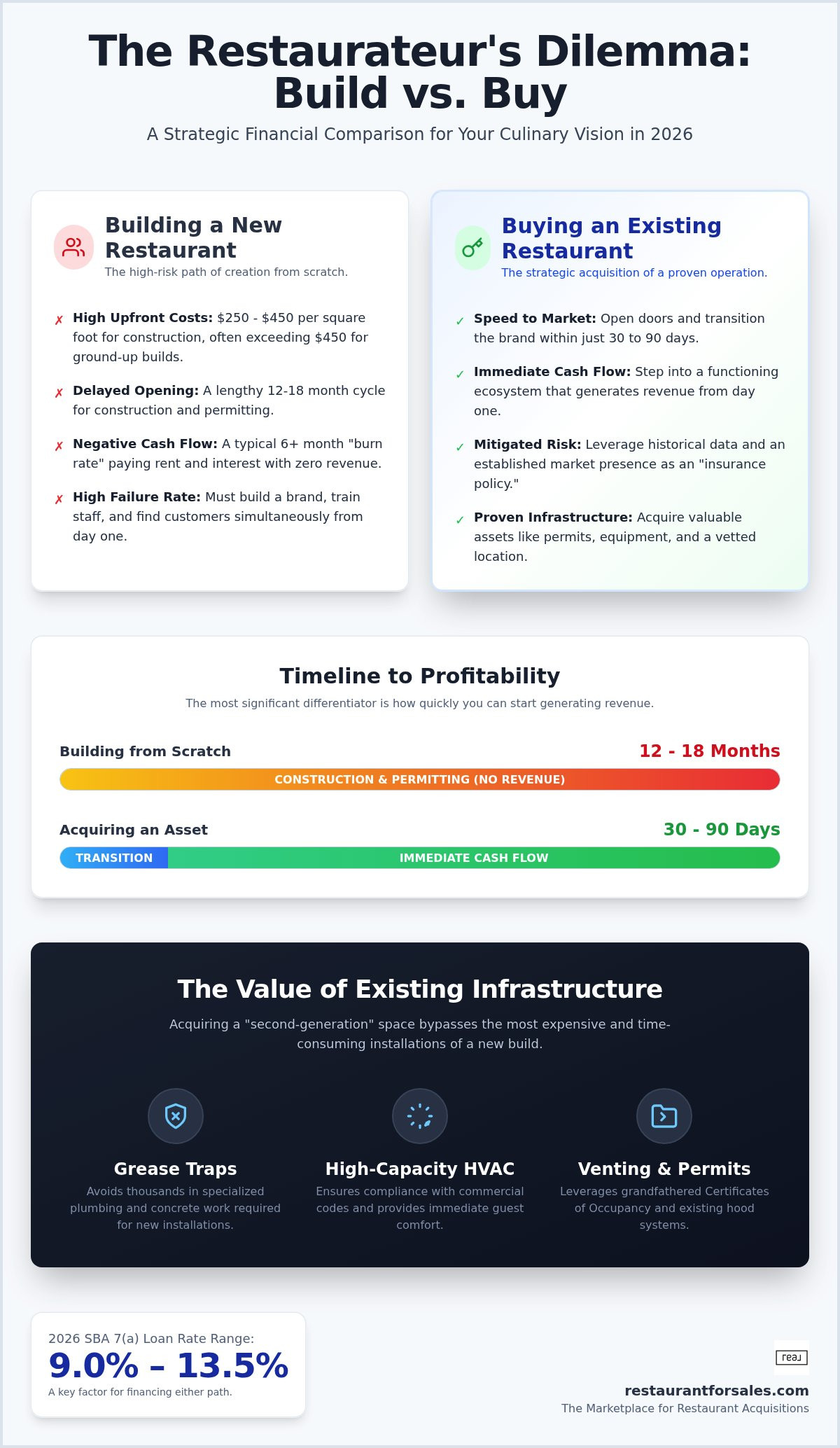
The romantic dream of building a restaurant from the studs up is often the most expensive way to lose money in 2026. Most entrepreneurs believe that total creative control is the only path to success, yet they often underestimate the burden of $250 to $450 per square foot construction costs. You're likely concerned about construction delays, permit hurdles, and the high cost of new equipment. When weighing the options of starting a restaurant vs buying an existing one, the primary factor is how quickly you need to generate cash flow.
This strategic comparison provides a clear financial framework to help you determine whether a ground-up startup or a strategic acquisition offers the best ROI for your culinary vision. You'll gain a realistic understanding of current SBA loan rates, which currently range from 9.0% to 13.5% for 7(a) loans. We also break down the timeline for profitability and provide the technical knowledge needed to handle complex lease transfers. Use this data to move from the discovery phase to a confident investment decision.
Key Takeaways
- Identify the "Speed to Market" benefits of acquisition to bypass the high 2026 construction costs and permitting delays associated with new builds.
- Assess the financial risk of starting a restaurant vs buying an existing one by comparing immediate cash flow against the typical six-month burn rate of a startup.
- Learn to evaluate second-generation restaurant spaces for lease to capture the value of existing infrastructure like grease traps and HVAC systems.
- Understand how to use Seller’s Discretionary Earnings (SDE) as a benchmark for professional business valuation during the due diligence phase.
- Utilize a specialized brokerage marketplace to simplify the legal and logistical complexities of restaurant lease assignments and asset transfers.
The Restaurateur’s Dilemma: Visionary Creation vs. Proven Infrastructure
Entering the hospitality industry requires a fundamental choice between creation and acquisition. Many aspiring owners approach the market with a chef's mindset, focusing on menu design and interior aesthetics. However, the 2026 market demands a transition toward a business owner's perspective. While starting from scratch offers total creative freedom, it forces you to build a brand from zero while managing extreme overhead. Current market conditions, characterized by high construction costs and regulatory hurdles, often make proven infrastructure the more pragmatic choice.
When evaluating starting a restaurant vs buying an existing one, you must consider the professional framework of business acquisition strategies. Buying an existing operation allows you to skip the branding phase and step directly into a functioning ecosystem. You're not just buying kitchen equipment; you're acquiring a location that's already been vetted by the local market. This approach prioritizes immediate operational stability over the long, uncertain process of establishing a new identity.
The Timeline Factor: Months vs. Years
Speed to market is perhaps the most significant differentiator in your decision. If you acquire an existing asset, you can often open your doors or transition the brand within 30 to 90 days. In contrast, starting from scratch involves navigating a 12 to 18 month construction and permitting cycle. During this long build-out, you're paying rent and interest without generating a single dollar in sales. This "lost revenue" cost is a hidden expense that can easily exceed six figures before the first customer even arrives.
Risk Mitigation and Failure Rates
The restaurant industry remains notoriously volatile. Startups face high first-year failure rates because they must solve every operational problem simultaneously. They have to find customers, train staff, and refine workflows all at once. An existing restaurant has already passed this initial survival test. By analyzing the "why" behind a seller's exit, you can identify if the business is a stable performer or a turnaround opportunity. When comparing starting a restaurant vs buying an existing one, the historical data of an established unit acts as your best insurance policy. Buying a turnkey operation mitigates the risk of unknown variables, providing a foundation of historical data that a startup simply cannot offer.
Infrastructure and Permitting: Navigating Restaurant Space for Lease vs. Asset Transfers
The physical infrastructure of a location often dictates the financial success of a new venture. Second generation restaurant spaces for lease offer a significant competitive advantage because they already contain specialized equipment like grease traps, high capacity HVAC systems, and commercial venting. Installing these from scratch in a "grey shell" can consume a majority of your startup capital. A grease trap installation alone often requires extensive plumbing and slab work that delays your opening by weeks. When evaluating starting a restaurant vs buying an existing one, consider that an existing operation usually has a grandfathered Certificate of Occupancy. This document is essential because it proves the building already meets municipal codes for food service. For additional help, the U.S. government provides guidance on buying a business to help you weigh these structural risks.
Building Out a New Space
In 2026, tenant improvements in an existing shell typically cost between $150 and $350 per square foot. If you're pursuing a ground up full service build, costs often exceed $450 per square foot. You'll also need to manage a gauntlet of municipal health and fire department approvals. Permit fees add up quickly; for instance, a restaurant health permit in California can cost up to $2,000 depending on the county. The financial gap between starting a restaurant vs buying an existing one becomes clear when you calculate these hard construction costs against the price of an asset sale. Construction delays remain a primary risk, with many projects stretching past the 12 month mark due to supply chain inconsistencies for specialized kitchen components.
Transferring an Existing Lease
Managing a restaurant lease assignment is a specialized process that differs from signing a new contract from scratch. In an asset transfer, the existing tenant’s lease is assigned to you, often keeping the original terms and rent escalations intact. You must negotiate with the landlord to ensure they approve the transfer and don't use the sale as an opportunity to hike the rent. Look for red flags like "demolition clauses" or "relocation rights" that allow the landlord to terminate your lease for redevelopment. If you want to see what's available, you can browse current restaurant space for lease opportunities to compare infrastructure quality. This allows you to secure a site that is already functional, saving you months of administrative work.
Financial Realities: Cash Flow Day One vs. The Startup Burn Rate
The most dangerous phase of any new restaurant is the "burn rate" period. In a startup, you're spending capital on payroll, utilities, and marketing while your revenue slowly climbs from zero. This period often lasts six to twelve months before the business reaches a break-even point. When you analyze starting a restaurant vs buying an existing one, you're essentially choosing between funding a deficit or inheriting immediate cash flow. Buying a profitable business allows you to evaluate the Seller’s Discretionary Earnings (SDE). This represents the total financial benefit available to a single owner-operator. This "bought income" provides a safety net that a startup simply cannot offer.
Financing also becomes significantly more accessible when you acquire an established entity. Lenders prioritize businesses with at least two to three years of tax returns and proven profitability. In the current 2026 credit market, SBA 7(a) fixed-rate loans are hovering between 9.5% and 13.5%. Securing these rates for a startup is difficult without substantial collateral and a flawless business plan. When weighing starting a restaurant vs buying an existing one, the business's historical performance serves as the primary collateral for an acquisition. This often allows for higher leverage and better terms. You must also distinguish between asset value, which is the price of the physical equipment, and enterprise value, which includes the brand's reputation and future earning potential.
Valuation Methods for Buyers
Professional buyers rely on EBITDA (Earnings Before Interest, Taxes, Depreciation, and Amortization) to determine a fair purchase price. Most independent restaurants trade at a multiplier of two to four times their annual SDE or EBITDA. To ensure you aren't overpaying, you should request a professional Restaurant Valuation Service or a Broker Opinion of Value. This process involves a rigorous audit of the equipment list and current inventory. It's a methodical way to verify that the cash flow reported on the profit and loss statement is accurate and sustainable.
Startup Capital Requirements
Working capital is the most frequently forgotten line item in a startup budget. You need enough cash on hand to cover at least six months of operating expenses without a single customer. While a startup allows you to avoid the "blue sky" or goodwill costs of an acquisition, you'll spend that saved money on aggressive marketing and grand opening events. When you calculate the timeline for ROI, a startup often takes three to five years to return the initial investment. In contrast, a well-priced acquisition can provide a full return of capital much faster because the revenue streams are already active from day one.
Strategic Due Diligence: Evaluating the Intangibles
While physical infrastructure and cash flow are the pillars of a deal, the intangible assets often determine long-term viability. When you analyze starting a restaurant vs buying an existing one, you must account for the "soft" assets that don't appear on a balance sheet. A trained team, for instance, represents hundreds of hours of saved training costs. In the 2026 labor market, inheriting a functional kitchen crew and front-of-house staff is often more valuable than the equipment they use. Starting from scratch requires you to recruit, vet, and train an entire roster during the most stressful phase of your launch.
Modern acquisitions also include a digital footprint. You're buying established social media accounts, high-ranking Yelp profiles, and integrated online ordering systems. A startup must build this digital trust from scratch, which usually takes years and significant ad spend. You also inherit established supply chains and vendor relationships. These partnerships ensure consistent product quality and potentially better credit terms from your first day of operation. To ensure you're making a sound investment, you can browse restaurant brokerage services to find an expert who can facilitate these complex evaluations.
Maintain strict confidentiality throughout this process. Never approach employees or discuss the sale with staff during your initial due diligence. Spooking the team can lead to immediate resignations, devaluing the very asset you intend to buy. Keep all inquiries professional and directed through the seller or their broker until the deal is finalized.
Operational Audits
Review the last three years of Profit and Loss (P&L) statements to identify trends in food costs and labor. You should also inspect expensive kitchen equipment for deferred maintenance. A walk-in cooler or commercial oven nearing the end of its life cycle can cost you thousands shortly after closing. Verify that all essential licenses, including liquor permits, health certificates, and sidewalk cafe permits, are current and transferable. When weighing starting a restaurant vs buying an existing one, the cost of new permits and equipment often outweighs the price of an asset transfer.
Market and Brand Perception
Assess whether the brand is a local staple or a tired concept in need of a refresh. Analyze the competitive landscape of 2026 to see if new developments or chain expansions are threatening the location's market share. You need to know if the community still values the concept or if it's losing relevance. Blue Sky value represents the intangible premium paid for a brand's reputation, customer loyalty, and future earning potential above its physical asset value.
Making the Move: How a Brokerage Marketplace Simplifies Your Acquisition
Navigating the final stages of a transaction requires more than just a culinary vision; it requires a structured approach to commercial real estate and corporate finance. When you reach the point of deciding between starting a restaurant vs buying an existing one, the execution phase begins. Working with a specialized restaurant broker is essential for first-time buyers because they act as a buffer between your interests and the seller's expectations. Brokers manage the high-stakes environment of business valuation and lease negotiations, ensuring that the deal remains grounded in market realities rather than emotional impulses.
Before you submit a formal offer, utilize professional Restaurant Valuation Services to verify the asking price. A broker helps you interpret financial disclosures and identifies potential liabilities that might not be obvious to an untrained eye. They play a critical role in Restaurant Lease Assignments, coordinating with landlords to ensure the transition doesn't trigger unfavorable lease modifications. This professional oversight reduces the risk of the deal collapsing during the final stages of due diligence. By using a specialized marketplace, you gain access to a curated inventory that general real estate sites simply don't provide.
Finding the Right Opportunity
General commercial real estate sites often lack the granular data needed for hospitality investments. A specialized brokerage marketplace allows you to use professional filters to target specific opportunities. You can set up automated alerts for 'Turnkey' operations or 'Asset Sale' listings to stay ahead of the competition. For those seeking a proven model with corporate support, Franchise Resale Listings offer a middle ground between a startup and an independent acquisition. These listings provide a faster route to market because the brand identity and operating systems are already established and approved by the franchisor.
Closing the Deal
The path from a Letter of Intent (LOI) to a final Asset Purchase Agreement (APA) involves multiple legal and financial milestones. You'll need to manage an escrow process to protect your capital while the final conditions of the sale are met. This structured sequence ensures a smooth transition of ownership and operational control. If you're ready to evaluate current market opportunities and settle the debate of starting a restaurant vs buying an existing one, Browse our active restaurant listings today! and take the first step toward your acquisition.
Securing Your Future in the 2026 Restaurant Market
Choosing the right path for your culinary career requires a balance between creative ambition and financial pragmatism. The decision of starting a restaurant vs buying an existing one often comes down to your risk tolerance and required speed to market. While a startup offers a blank canvas, it carries the heavy burden of lengthy construction timelines and uncertain initial revenue. In contrast, acquiring an established business provides immediate infrastructure and historical cash flow that lenders prefer in today's high-interest environment.
Success in this industry depends on leveraging professional tools to minimize your exposure. You can bypass the most common pitfalls of business ownership by utilizing professional valuation services and expert brokerage support. Our national marketplace features hundreds of active listings and provides the specialized tools serious investors need for seamless asset transfers. Whether you're seeking a turnkey independent location or a franchise resale, the right opportunity is within reach. Find your next investment in our active restaurant listings and start your journey as a business owner with confidence.
Frequently Asked Questions
Is it cheaper to start a restaurant from scratch or buy one?
Buying is generally more cost-effective when you account for the total investment of construction and the cost of lost revenue. Building a new space in 2026 can cost between $150 and $450 per square foot for tenant improvements alone. When you buy an existing operation, you acquire permitted infrastructure like grease traps and venting. This avoids the 12 to 18 month burn rate common in startups before they reach a break-even point.
What are the biggest risks when buying an existing restaurant?
Inheriting hidden liabilities and a declining brand reputation are the most significant risks in an acquisition. You must verify that there are no outstanding tax liens or legal disputes associated with the business. Check for deferred maintenance on expensive kitchen equipment that might require immediate replacement. Evaluating the staff culture and local market perception is also essential to ensure you aren't buying a business that has already lost its customer base.
How do I value a restaurant business for sale?
Valuation is typically determined by applying a multiplier to the Seller’s Discretionary Earnings (SDE) or EBITDA. Most independent restaurants trade at two to four times their annual cash flow. A professional valuation service will analyze three years of tax returns and profit and loss statements to confirm these figures. You must also account for the fair market value of the physical equipment and any "Blue Sky" value associated with the brand reputation.
What is a restaurant lease assignment?
A restaurant lease assignment is the legal transfer of a lease agreement from the current tenant to a new owner. This process requires the landlord's formal consent and is a standard part of a business acquisition. A successful assignment allows you to take over the existing rent terms and remaining years on the lease. It provides immediate occupancy and avoids the need to negotiate a completely new lease from scratch with the property owner.
Can I change the concept of a restaurant I just bought?
You can change the concept, but the transition depends heavily on the "use clause" in your lease agreement. Landlords often have specific restrictions on the type of cuisine allowed to maintain a diverse tenant mix in their buildings. If your new concept requires different cooking equipment, you may also need to update health permits or fire suppression systems. Always consult with your landlord and local health department before finalizing a significant concept shift.
How long does it take to buy a restaurant?
The acquisition process typically takes 60 to 120 days from the signed Letter of Intent to the final closing. This period allows for comprehensive due diligence, financing approval, and the lease assignment process. If the deal involves a liquor license transfer, the timeline can stretch depending on local government processing speeds. In contrast, starting a restaurant vs buying an existing one involves a much longer timeline of 12 to 18 months for build-outs.
Do I need a broker to buy a restaurant?
Working with a broker is essential for navigating the professional and legal hurdles of a commercial transaction. Brokers provide access to specialized marketplaces and facilitate the delicate negotiations regarding price and lease terms. They ensure that all financial disclosures are accurate and that the transition of assets is legally sound. Their expertise is particularly valuable when comparing the long-term ROI of starting a restaurant vs buying an existing one in a competitive market.
What is included in a typical restaurant asset sale?
A standard asset sale includes all Furniture, Fixtures, and Equipment (FF&E) used in the daily operation of the business. This covers everything from ovens and refrigerators to tables and point-of-sale systems. The sale usually includes the trade name, website, social media accounts, and any transferable permits. It's vital to perform a physical inventory and equipment audit to ensure all items are in good working condition and free of any liens or equipment leases.


