

A restaurant lease is not just a monthly expense; it is a transferable asset that requires more scrutiny than the business’s own inventory. Many buyers focus on kitchen equipment and menu design while overlooking the legal obligations that dictate long-term profitability. If you're wondering what to check before buying a restaurant lease, you must look beyond the base rent. With national median rents in 2026 reaching $35 to $45 per square foot, a single overlooked clause can jeopardize your entire investment before you even serve your first guest.
It's natural to feel anxious about hidden NNN costs or the legalities of a lease assignment. You want to ensure your capital is protected and your personal liability is limited. This guide provides the clarity you need to navigate these complex commercial agreements with confidence. You'll learn how to verify critical lease terms, manage the assignment process efficiently, and mitigate financial risks. We've compiled a methodical checklist to ensure your new venture starts on a secure and transparent foundation.
Key Takeaways
- Recognize the leasehold interest as a critical intangible asset that determines the future resale value of your restaurant.
- Identify financial landmines by knowing exactly what to check before buying a restaurant lease, including Triple Net (NNN) expenses and percentage rent triggers.
- Prepare for the landlord’s financial due diligence to ensure a smooth lease assignment and written consent process.
- Use a specialized checklist to verify permitted use clauses and clarify the ownership of furniture, fixtures, and equipment at the end of the term.
- Leverage professional brokerage and valuation services to confirm the lease terms are competitive and sustainable for your specific market.
Understanding the High Stakes of a Restaurant Leasehold Interest
Acquiring a restaurant involves more than just purchasing physical assets like ovens, furniture, and branding. You're primarily investing in a legal right to occupy a specific location. This right is technically called a leasehold interest. Understanding Leasehold Estates and knowing what to check before buying a restaurant lease is essential because this intangible asset often dictates the long-term viability of your venture. If a lease carries predatory terms or is nearing its expiration without renewal options, even a high-performing restaurant can become a financial liability that's impossible to sell later.
Investors must clearly distinguish between buying the business assets and assuming the lease obligations. While you own the equipment, the landlord retains control over the space where that equipment operates. In this sense, the landlord acts as a silent partner in your business success. They have the authority to audit your financial records during an assignment and can influence your operational costs through common area maintenance (CAM) charges. This makes the lease the most critical document in your due diligence process.
The Difference Between Lease Assignment and a New Lease
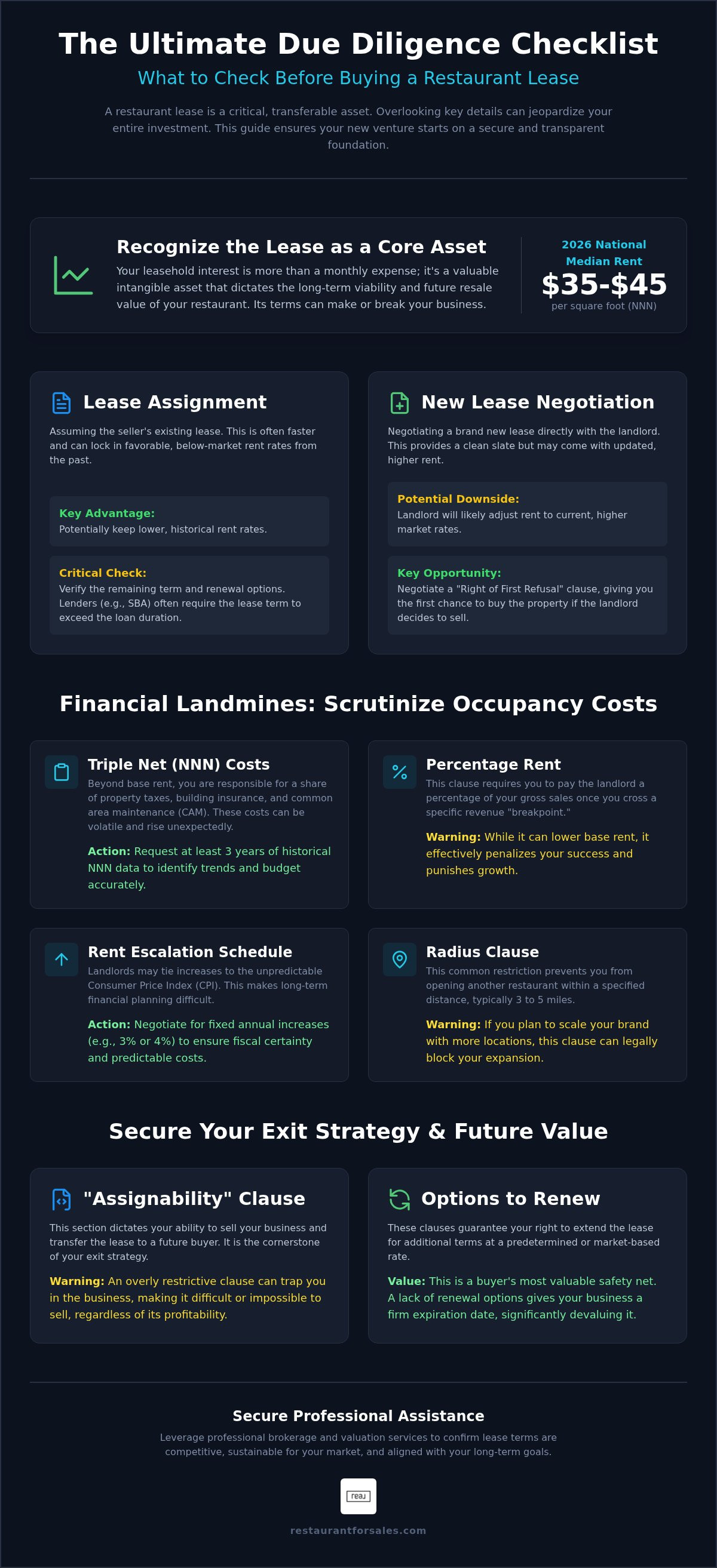
When you take over a location, you'll either assume the existing agreement through a lease assignment or negotiate a fresh contract. Assuming a lease often allows you to keep lower historical rent rates. This is a significant advantage in 2026, as national median restaurant rents have climbed to $35 to $45 per square foot for NNN spaces. However, you must evaluate the remaining term. If you're seeking an SBA 504 loan with rates currently starting at 6.03%, lenders typically require the lease term to meet or exceed the loan's duration.
Negotiating a new lease provides a clean slate but often results in the landlord adjusting the rent to current market values. It's also the ideal time to request a "Right of First Refusal." This clause ensures that if the landlord decides to sell the property, you have the first opportunity to purchase it. This effectively secures your interest and can turn a leasehold into a permanent real estate asset.
Why Your Exit Strategy Starts with the Current Lease Audit
A primary consideration in what to check before buying a restaurant lease is the "Assignability" clause. This section dictates whether you can sell your business to a future buyer. If the clause is overly restrictive, you may find yourself trapped in a business you can no longer operate or sell. The presence of remaining options to renew is another pillar of business valuation. An Option to Renew is a buyer’s most valuable safety net because it guarantees future occupancy rights at a predetermined or market-based rate. Without these options, your business has a definitive expiration date, which significantly devalues the company during a professional valuation.
Analyzing the Financial Landmines in Occupancy Costs
The base rent is rarely the final number you'll pay each month. Most commercial restaurant agreements operate under a Triple Net (NNN) structure. This means you're responsible for your pro-rata share of property taxes, building insurance, and common area maintenance. These costs are volatile. If property taxes are reassessed or insurance premiums spike, your occupancy costs can rise sharply without warning. When considering what to check before buying a restaurant lease, you must request at least three years of historical NNN data to identify trends and avoid budgeting based on an outlier year.
Percentage rent clauses represent another potential financial trap. These provisions require you to pay a percentage of your gross sales to the landlord once you cross a specific revenue "breakpoint." While this can lower your base rent during slow periods, it effectively penalizes your success as your business grows. You should also scrutinize the rent escalation schedule. Landlords typically prefer increases tied to the Consumer Price Index (CPI), but these can be unpredictable. Negotiating fixed annual increases, such as 3% or 4%, provides the fiscal certainty needed for accurate long-term planning. Performing thorough due diligence when buying a business includes modeling these escalations against your projected revenue.
Finally, look for a "Radius Clause." This restriction prevents you from opening another restaurant within a specific distance, often three to five miles, of the leased premises. If you plan to scale your brand or open a second location, this clause can legally block your expansion. If you find these terms overly restrictive, seeking professional restaurant brokerage services can help you negotiate more favorable boundaries before the deal is finalized.
Common Area Maintenance (CAM) and Audit Rights
Landlords often use Common Area Maintenance (CAM) charges to pass through a wide variety of operating expenses, from parking lot lighting to administrative fees. Without specific protections, these costs can be inflated with capital improvements that should be the landlord's responsibility. You must negotiate a "CAM Cap" that limits annual increases to a set percentage. Crucially, ensure the lease includes "Audit Rights." This legal entitlement allows you to inspect the landlord’s books to verify that every dollar charged to you was actually spent on legitimate building operations.
Utility Infrastructure and Capacity Requirements
A restaurant’s operational capacity is limited by its physical infrastructure. You must verify who is responsible for high-cost items like grease trap pumping and HVAC repairs. Many leases shift the entire burden of replacement to the tenant, which can result in a surprise $15,000 expense in your first year. Additionally, check for "Exclusive Use" clauses. These protect your investment by preventing the landlord from leasing a neighboring unit to a direct competitor. Before signing, have a contractor verify that the electrical amperage and gas line capacity can support your specific kitchen line. Upgrading these systems after taking possession is prohibitively expensive and often requires landlord approval that may not be granted.
Navigating the Landlord Consent and Assignment Process
Securing the keys to a new location requires more than a handshake with the seller. In nearly every commercial agreement, the landlord must provide formal written consent before a lease assignment can proceed. This isn't a mere formality. The landlord will conduct their own financial due diligence on you, the buyer, to ensure you're a low-risk tenant. As you evaluate what to check before buying a restaurant lease, prepare to submit a comprehensive personal financial statement, a detailed business plan, and proof of previous operational experience. The landlord’s goal is to verify that you're as creditworthy and capable as the current tenant.
One of the most dangerous provisions to watch for is the "Recapture Clause." This allows a landlord to terminate the lease and take back the property the moment a tenant requests an assignment. Instead of approving you as the new owner, the landlord could simply seize the space to lease it to someone else at a higher market rate. Additionally, check for a "Transfer Fee." This is a non-refundable charge, often ranging from $1,000 to over $5,000, that the landlord collects to cover legal and administrative costs associated with the assignment paperwork. These costs are often negotiable, but they must be identified early in the transaction.
The "Unreasonably Withheld" Legal Standard
Most modern leases state that a landlord’s consent "shall not be unreasonably withheld, conditioned, or delayed." This creates a legal baseline for your entry into the space. A landlord can reasonably deny your application if your credit score is significantly lower than the current tenant's or if you lack the industry experience to run the business successfully. However, they're generally bound by this standard to act fairly. A landlord cannot usually deny a transfer based on wanting higher rent or simply to force a new lease negotiation. Understanding this standard is a vital part of what to check before buying a restaurant lease to ensure you aren't blocked by arbitrary demands.
Personal Guarantees and the "Good Guy" Clause
Landlords often demand a personal guarantee, making you personally liable for the rent if the business fails. This puts your personal assets, including your home and savings, at risk for the entire remaining lease term. To mitigate this, look for a "Good Guy Clause." This limited guarantee releases you from future liability if you provide proper notice and surrender the space in "broom clean" condition. You should also negotiate "Burn-off" provisions. These clauses cause your personal liability to decrease or disappear entirely after a set period of successful operation, such as 36 months of on-time payments. This transition from personal to corporate liability is a critical step in protecting your long-term financial health.
The Essential Restaurant Lease Due Diligence Checklist
Once you understand the assignment process, you must scrutinize the specific operational clauses that govern your daily business. When evaluating what to check before buying a restaurant lease, start with the "Permitted Use" clause. This defines exactly what you can sell. If your concept evolves from a cafe to a full-service bistro, a restrictive use clause could legally block your menu expansion. You must also confirm the ownership of Furniture, Fixtures, and Equipment (FF&E). In many cases, the landlord retains ownership of the hood system, grease traps, and even walk-in coolers once the lease terminates. This significantly impacts your business valuation and your ability to use these assets as collateral.
Review the "Default and Cure" periods carefully. These terms dictate how much time you have to fix a lease violation, such as a late payment or a maintenance issue, before the landlord can initiate eviction. A short cure period of only three to five days offers little protection during a temporary cash flow crunch. Additionally, audit the building for ADA compliance. If the restrooms or entrances don't meet current standards, local municipalities may require expensive upgrades during the permit transfer process. You should also watch for "Demolition Clauses." These allow a landlord to terminate your lease with limited notice if they decide to redevelop the entire property. This risk is particularly high in 2026 as urban centers continue to see high rates of commercial-to-residential conversions.
Physical Premises and Maintenance Obligations
Don't assume the landlord is responsible for the building's exterior. Many commercial agreements shift the cost of roof repairs, foundation work, and structural wall maintenance to the tenant through capital improvement requirements. You must verify these boundaries before signing. If your business relies on outdoor dining, check for specific sidewalk cafe rights within the lease. These rights are often subject to separate municipal permits that do not automatically transfer with the leasehold interest. Identifying these physical liabilities is a core part of what to check before buying a restaurant lease.
Modern Lease Considerations for 2026
Modern leases in 2026 must account for evolving regulatory and technological needs. Analyze the "Force Majeure" clause to ensure it specifically covers government-mandated shutdowns or health emergencies. You should also verify your rights to install the necessary data infrastructure for third-party delivery integration. Finally, check for energy efficiency (ESG) requirements. New green building standards may mandate specific utility-saving equipment that increases your initial operational costs. To ensure you haven't missed a critical detail, consider using our restaurant valuation services to see how these lease terms affect your bottom line.
Securing Professional Assistance for Lease Transfers
Navigating the transition from a seller to a new tenant is a high-stakes negotiation that extends far beyond the purchase price of the business. While understanding what to check before buying a restaurant lease is a prerequisite, executing the transfer requires a specialized set of skills. A professional restaurant broker acts as a critical buffer between the buyer, seller, and landlord. They manage the flow of sensitive financial information and ensure that all parties remain focused on a successful closing. This professional layer is particularly valuable when dealing with institutional landlords who require a high level of transactional competence before they'll even consider a new applicant.
A central part of this process is determining if the current lease is "at market." If you're assuming a lease with rent significantly higher than local competitors, your profit margins will be permanently suppressed. Utilizing Restaurant Valuation Services allows you to benchmark occupancy costs against current regional data. Beyond valuation, you'll also need legal counsel to review the final assignment documentation. While a broker identifies business red flags, an attorney ensures that the specific language in the assignment protects you from the seller’s past liabilities. Relying on the Restaurant For Sale Marketplace provides you with access to vetted listings where these lease details have already undergone a preliminary professional review.
Why Brokerage Expertise Matters in Lease Assignments
Brokers possess deep knowledge of local market "comps," which are essential for negotiating better lease terms during an assignment. If a landlord demands an unreasonable rent increase as a condition of consent, a broker provides data-driven pushback to keep the deal viable. This professional representation immediately improves your credibility. Landlords are often skeptical of new owners or unproven concepts. Having a seasoned facilitator present your business plan and financial strength can be the difference between a rejection and an approval. A broker also identifies high-risk clauses, such as hidden recapture rights or predatory CAM structures, before you incur the costs of an attorney.
Final Steps: Closing the Transaction and Taking Possession
The final phase of the acquisition involves coordinating the "Lease Assignment and Assumption Agreement" with the broader asset sale. This document must be executed simultaneously with the closing to ensure you don't own a business without a place to operate. You must also manage the security deposit transfer. In most cases, the buyer pays the seller an amount equal to the existing security deposit held by the landlord, or a new deposit is placed in escrow. Ensuring these funds are handled correctly is vital for a smooth transition. To begin your search for a secure location, view our active restaurant listings and lease opportunities today.
Secure Your Investment Through Rigorous Lease Due Diligence
A restaurant’s success is inextricably linked to the strength of its lease. By prioritizing the verification of assignment clauses and auditing Triple Net expenses, you transform a potential liability into a secure business asset. Knowing exactly what to check before buying a restaurant lease allows you to mitigate personal risk and ensure your concept has the physical and legal room to grow. Don't leave these complex details to chance. A single overlooked "Recapture Clause" or "Radius Clause" can end your venture before it truly begins.
Our national network of experienced restaurant brokers provides the steady hand you need to navigate high-stakes lease transfers. We offer comprehensive business valuation services to ensure your occupancy costs align with current market standards. Our team specializes in the intricacies of lease assignments, acting as your professional advocate during landlord negotiations to ensure a smooth transition of possession. Success in the competitive 2026 hospitality industry starts with a legally sound and financially sustainable foundation.
Browse Verified Restaurant Listings with Favorable Lease Terms and take the first step toward a secure acquisition today. Your future as a restaurant owner depends on the details you verify now.
Frequently Asked Questions
What is a restaurant lease assignment?
A restaurant lease assignment is the legal process of transferring an existing lease contract from the current owner to a new buyer. The buyer steps into the shoes of the seller, assuming all existing terms, rent schedules, and obligations. This transfer is a fundamental part of what to check before buying a restaurant lease to ensure the remaining duration and rent rates align with your long-term business goals.
Can a landlord refuse to transfer a restaurant lease to a new owner?
Landlords can refuse a transfer only if they have a valid, commercially reasonable justification for doing so. Typical reasons for denial include the buyer’s insufficient net worth, a lack of restaurant management experience, or a low credit score. Most commercial agreements prevent landlords from withholding consent arbitrarily or simply to demand higher rent from the new owner during the assignment process.
How much time should be left on a lease when buying a restaurant?
Aim for a lease that offers at least 10 years of total coverage through the remaining term and available renewal options. Lenders generally won't approve financing unless the lease term is at least as long as the loan's amortization period. Understanding what to check before buying a restaurant lease includes verifying these dates, as a short lease without renewal options creates an "expiration date" that ruins your resale value.
What is a personal guarantee in a commercial restaurant lease?
A personal guarantee is a legal provision that holds the business owner personally liable for the financial obligations of the lease. If the restaurant fails to pay rent, the landlord can legally pursue your personal assets, such as your home or savings, to cover the debt. It's vital to negotiate "Good Guy" clauses or liability burn-offs to protect your personal financial health after a few years of successful operation.
What is the difference between a gross lease and a NNN lease for a restaurant?
In a gross lease, the tenant pays one fixed price that covers rent and all building operating costs. A NNN lease separates the base rent from the property’s "nets," which include taxes, insurance, and common area maintenance. Most restaurant spaces use NNN structures. This means your monthly payment will fluctuate as property taxes and insurance premiums change each year, requiring careful annual budgeting.
Who is responsible for HVAC repairs in a typical restaurant lease?
The tenant is usually responsible for the maintenance and repair of the HVAC units serving their specific space. Some leases even require the tenant to replace the entire system if it fails during the term. You should verify if the landlord provides any warranty or if there's a dollar-limit cap on your annual repair obligations for older units before you finalize the acquisition.
What happens to the security deposit during a restaurant sale?
The security deposit usually stays with the landlord to cover the entire duration of the lease term. In a standard business sale, the buyer pays the seller an amount equal to the deposit at the closing table. The landlord then updates their records to reflect that the deposit now belongs to the new tenant. This ensures the seller is made whole while the landlord maintains their financial security.
What is a "Right of First Refusal" in a restaurant lease?
This clause requires the landlord to offer the property to you for purchase before selling it to any third party. If the landlord receives a legitimate offer to buy the building, you have the legal right to match that offer and purchase the property yourself. This term is a powerful tool for securing your location permanently and turning a leasehold into a real estate asset.


