

Your restaurant's value isn't found in the menu or the decor; it's hidden in the quality of your earnings and the strength of your lease. It's common to feel a sense of dread when trying to price a business that represents years of sacrifice. You might worry about underpricing your life's work or feel confused by the technical differences between EBITDA and SDE. Mastering specific restaurant valuation methods is the only way to move past guesswork and secure a deal that reflects actual market conditions.
We understand that you want a realistic price range and the confidence to stand your ground during negotiations. This guide provides the financial frameworks and market metrics you need to determine fair market value in the 2026 landscape. We'll break down how to value brand equity and explain why having a general manager in place can drastically increase your multiple. You'll gain a clear understanding of current formulas, including how the permanent 100% bonus depreciation and new tax thresholds affect your business's desirability to buyers. By the end of this article, you'll have the tools to evaluate any restaurant or bar with professional precision.
Key Takeaways
- Learn why traditional "rules of thumb" often lead to inaccurate pricing and how to transition toward a data-backed assessment of your business's true economic value.
- Master the three primary restaurant valuation methods-Income, Market, and Asset-based-to establish a weighted and realistic price range for any facility.
- Identify whether to use Seller’s Discretionary Earnings (SDE) or EBITDA based on your specific management structure to ensure the correct cash flow multiple is applied.
- Evaluate how critical intangible factors, particularly remaining lease terms and brand goodwill, can significantly swing the final fair market value of a restaurant.
- Understand the strategic differences between a Broker Opinion of Value (BOV) and a Certified Business Appraisal (CBA) to choose the right report for your transaction or legal needs.
The Fundamentals of Restaurant Valuation in 2026
Restaurant valuation is the technical process of determining the economic value of a specific business unit. It isn't a subjective estimate based on how much an owner "thinks" their brand is worth. Instead, it relies on verifiable data and standardized business valuation methods to establish a price that both buyers and lenders will accept. Whether you're preparing to sell, looking to acquire a new location, or seeking to secure expansion financing, an accurate valuation is your most critical tool in any transaction.
Professional brokers distinguish between two primary figures: Fair Market Value and Investment Value. Fair Market Value is the price at which the property would change hands between a willing buyer and a willing seller in an open market. Investment Value, however, is the value to a specific buyer who might see unique synergies, such as a multi-unit operator who can reduce overhead by integrating your location into their existing infrastructure. Understanding these restaurant valuation methods helps you identify which figure applies to your specific negotiation.
Why Traditional "Rules of Thumb" Fail
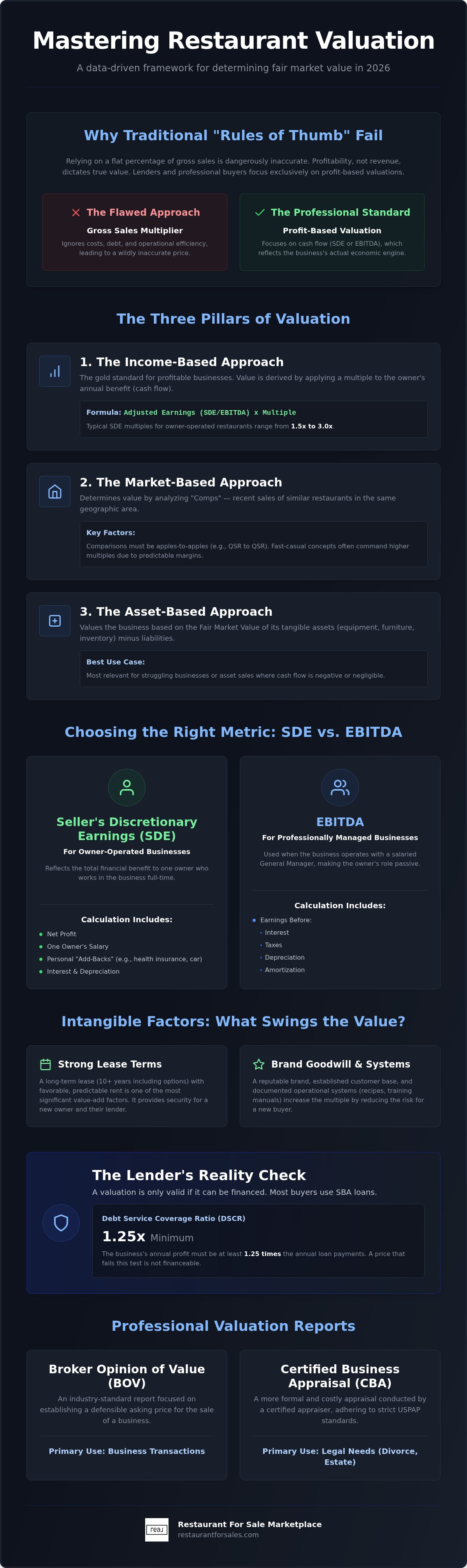
Many owners still rely on outdated "rules of thumb," such as pricing a business at a flat percentage of gross annual sales. This approach is dangerously inaccurate because it completely ignores profitability. A full-service restaurant with $2 million in sales but only 3% to 5% profit margins is worth significantly less than a quick-service restaurant (QSR) with the same revenue and 9% margins. High volume doesn't equate to high value if the labor and food costs are unmanaged. In 2026, profit-based valuation is the only industry standard that professional buyers and institutional lenders recognize as valid.
The Role of the SBA in Business Pricing
Bank lending requirements often dictate the absolute "ceiling" of a restaurant's price. Most acquisitions in this sector utilize SBA 7(a) loans, where lenders typically expect a 20% down payment from the buyer. If a restaurant is priced beyond what the cash flow can support after paying the mortgage and a reasonable manager's salary, the deal will fail the debt service coverage ratio (DSCR) test. Lenders want to see that the business generates enough profit to cover the debt at least 1.25 times over. A valuation that can't be financed is essentially a "dead" price that will prevent you from reaching the closing table.
The Three Pillars of Restaurant Valuation Methods
Determining a restaurant's worth requires a multifaceted approach. Professional brokers rarely rely on a single formula. Instead, they use a weighted combination of three distinct restaurant valuation methods. To begin this process, you must gather three years of federal tax returns, year-to-date profit and loss statements, and a detailed equipment list. This data provides the foundation for an objective analysis. The "best" method often depends on the specific nature of the business; a highly profitable franchise requires a different lens than a struggling independent shop with valuable real estate.
The Income-Based Approach: Valuing Cash Flow
This approach is the gold standard for profitable businesses. It focuses on the "Capitalization of Earnings" by applying a multiple to the owner's annual benefit. A crucial part of this calculation involves identifying "add-backs." These are expenses that benefit the owner personally or won't recur for a new buyer. Common add-backs include the owner’s salary, personal health insurance, and one-time equipment repairs. For owner-operated independent restaurants in 2026, multiples typically range from 1.5x to 3.0x of these adjusted earnings. If the business is managed by a general manager, the multiple may shift to an EBITDA basis, which often yields a higher valuation because the business isn't dependent on the owner's daily labor.
The Market-Based Approach: Comparable Sales
This method relies on "Comps," or comparable sales of similar businesses. Brokers analyze recent transactions of similar concepts within the same geographic region. Comparing a high-volume pizza shop to a fine-dining bistro is ineffective; the risk profiles and operational models are too divergent. In 2026, market trends show that quick-service and fast-casual concepts often command higher multiples due to more predictable margins and lower labor intensity. Referencing a comprehensive restaurant valuation guide can help you understand how current buyer demand for off-premise revenue capabilities shifts these market multiples.
The Asset-Based Approach: Sum of the Parts
When a business is underperforming or the real estate is the primary value driver, brokers turn to the asset-based approach. This method calculates the sum of all tangible parts. It distinguishes between "Liquidation Value," which is what the equipment would sell for at a quick auction, and "Fair Market Value," which accounts for the equipment being in place and functional. Leasehold improvements, such as specialized venting, plumbing, and installed grease traps, add significant value to the total asset base. The permanent 100% bonus depreciation introduced by the One Big Beautiful Bill Act (OBBBA) makes these tangible assets even more attractive to buyers in 2026, as they can fully expense qualifying equipment in the first year. For those navigating a complex exit, seeking professional restaurant valuation services ensures that no tangible or intangible asset is overlooked during the calculation.
EBITDA vs. SDE: Choosing the Right Metric
Selecting the correct financial metric is the most important step in applying restaurant valuation methods. You must decide whether to use Seller’s Discretionary Earnings (SDE) or EBITDA. This choice depends entirely on how the business operates. SDE represents the total financial benefit to a single owner-operator, while EBITDA measures the earnings of a larger, managed entity before interest, taxes, depreciation, and amortization. Using the wrong metric can lead to a valuation that is either laughably low or unrealistically high.
The transition from SDE to EBITDA usually happens when a restaurant outgrows its owner's daily involvement. This "pivot point" often occurs when revenues exceed $5 million or when the operation expands to multiple units run by a general manager. Institutional buyers and private equity firms almost exclusively use EBITDA. They aren't buying a job; they're buying a return on investment. If your restaurant requires you to be on the line every Friday night, you're looking at an SDE-based valuation.
| Feature | SDE (Seller’s Discretionary Earnings) | EBITDA (Earnings Before Interest, etc.) |
|---|---|---|
| Target Business | Owner-operated, single unit | Managed, multi-unit, or absentee-owned |
| Typical Multiples | 1.5x to 3.0x (up to 5.0x for high growth) | 4.0x to 7.0x |
| Buyer Profile | Individual entrepreneurs | Private equity, strategic groups |
Calculating SDE for Owner-Operated Restaurants
Calculating SDE is a step-by-step process that starts with the net income on your tax return. From there, you add back non-cash expenses like depreciation and non-operating costs like interest. You also include "discretionary" expenses that benefit the owner, such as personal vehicle leases, family cell phone plans, or health insurance. SDE is the gold standard for small-to-mid-market restaurant sales because it shows the "total take-home pay" available to a new owner. This restaurant valuation guide highlights how these adjustments provide a clearer picture of actual cash flow than a simple bottom-line profit figure.
Using EBITDA for Multi-Unit or Managed Venues
For larger operations, EBITDA provides a cleaner look at operational efficiency across different markets. Institutional buyers focus on this metric to compare different investment opportunities. When calculating EBITDA, you must account for the "management load." If you're currently performing duties that a hired manager would otherwise handle, that market-rate salary must be subtracted from the earnings. While EBITDA multiples are typically higher, ranging from 5.0x to 7.0x for groups with five or more units, they're harder to achieve. Buyers scrutinize these numbers to ensure the profit margins, which average 3% to 9% in 2026, are sustainable without the original founder's presence.
Intangible Factors: What Swings the Value?
Financial formulas establish the baseline, but intangible assets often serve as the final multiplier in restaurant valuation methods. These non-financial elements can either justify a premium price or trigger a significant discount during due diligence. Buyers in 2026 are increasingly selective, placing higher value on operational stability and long-term viability rather than just past performance. Factors such as a trained staff, modern equipment, and a robust social media presence provide the "goodwill" that elevates a business above its peers.
The Critical Importance of the Lease Agreement
The lease is the most common "deal killer" in restaurant transactions. If your current agreement has only 2 years remaining without guaranteed options to renew, the business value effectively drops to nearly zero for most buyers. Lenders require the lease term to meet or exceed the length of the loan, which is typically 10 years for SBA 7(a) financing. You must ensure your lease includes clear assignment clauses and a "right of first refusal" to protect the buyer's future. A high rent-to-sales ratio can also depress a valuation; if your rent consumes more than 10% of gross sales, even high profits might not satisfy a savvy investor. Research indicates that unfavorable lease terms can negatively impact a restaurant's valuation by 20% to 40%.
Beyond the lease, the condition of your Furniture, Fixtures, and Equipment (FF&E) dictates how much immediate capital a buyer must inject. A 10-year-old kitchen requires constant maintenance, whereas a 2-year-old "turnkey" setup allows for immediate profitability. Under the One Big Beautiful Bill Act (OBBBA), the permanent 100% bonus depreciation allows buyers to fully expense these improvements in the first year. Additionally, the 2026 Section 179 deduction limit of $2,560,000 provides a massive incentive for buyers to target well-equipped venues. If you need assistance navigating these complexities, consider our restaurant lease assignment services to secure your exit strategy.
Location and Concept Longevity
Buyers distinguish between "legacy" concepts and "fad" restaurants. A legacy brand with decades of recurring customers and high manager retention commands a higher multiple because it offers lower risk. In contrast, a concept tied to a passing trend may see its valuation slashed if same-store sales growth isn't sustainable. Geographic factors like demographics and foot traffic are already baked into the market multiples we discussed earlier, but the specific value of a turnkey operation remains high for first-time buyers who want to avoid the 12-month lead time of a new build-out. A stable, trained team further increases value, as it reduces the "management load" and helps transition the business toward a more lucrative EBITDA-based valuation.
From Calculation to Closing: Getting a Professional Valuation
A formal calculation is only as strong as the professional oversight behind it. While owners can use restaurant valuation methods to estimate their business's worth, the transition from a spreadsheet to a signed contract requires a market-validated approach. You must decide between a Certified Business Appraisal (CBA) and a Broker Opinion of Value (BOV). A CBA is a formal document required for legal disputes, partner buyouts, or estate planning. For most owners looking to enter the market, a BOV is the more practical choice. It provides a realistic listing price based on current buyer demand and recent comparable sales rather than just theoretical accounting principles.
Confidentiality remains the most critical element during this phase. If employees, vendors, or competitors learn a restaurant is for sale before a deal is struck, the business value can plummet due to staff turnover or lost customer confidence. Professional valuations are conducted discreetly to protect the integrity of the operation. This ensures that the daily flow of the business remains stable while you prepare for a transition.
Why Professional Brokerage Services Matter
Experienced brokers identify "hidden" add-backs that owners often miss, such as non-recurring repairs or specific personal expenses buried in the P&L. Identifying these items correctly can significantly increase the final SDE or EBITDA figure. Beyond the math, a broker acts as a neutral third party when defending a price to a buyer. It's much easier for a professional to justify a high multiple based on market data than for an owner to do so based on personal sentiment. Restaurant For Sale Marketplace serves as an expert partner in this process, ensuring your pricing is accurate enough to attract serious buyers while high enough to reward your hard work.
Preparing Your Financials for Scrutiny
Clean books result in higher multiples and faster closings. Buyers and SBA lenders will scrutinize your records to ensure the cash flow is verifiable. You must prepare a specific package of documents to facilitate an accurate valuation:
- Three years of federal tax returns.
- A current year-to-date profit and loss (P&L) statement.
- A comprehensive list of Furniture, Fixtures, and Equipment (FF&E).
- A copy of the current lease and any renewal options.
Accuracy is more important in 2026 than ever before. With the 1099-NEC reporting threshold increasing to $2,000 as of January 1, 2026, your payroll and contractor records must be impeccable. Discrepancies in these areas can lead a buyer to question the entire financial health of the restaurant, often resulting in "price chipping" or a cancelled deal. By organizing these documents early, you demonstrate professional competence and operational discipline. Don't leave your exit to chance. Get a professional valuation of your restaurant today.
Secure Your Financial Future with an Accurate Valuation
Success in the 2026 marketplace requires moving beyond "rules of thumb" to embrace data-driven restaurant valuation methods. Whether you're identifying the correct cash flow metric or negotiating a lease assignment, having a precise understanding of your business's worth is the only way to protect your investment. We've examined how verifiable cash flow and operational stability serve as the primary drivers of your sale multiple. These frameworks ensure you enter any transaction with the professional confidence needed to defend your price.
Our team provides specialized expertise in bar and restaurant transactions, utilizing comprehensive market data from active national listings to deliver accurate results. We prioritize confidential and professional brokerage services to protect your staff and brand reputation during the transition. Ready to see what your restaurant is worth? Contact our expert brokers for a professional valuation. Taking this step now positions you for a successful and profitable exit.
Frequently Asked Questions
What is the most common valuation multiple for a restaurant?
The most common multiple for a small, owner-operated restaurant is between 1.5x and 3.0x Seller’s Discretionary Earnings (SDE). Profitable independent locations with strong margins can reach 3.0x to 5.0x SDE. For larger operations or multi-unit groups, the industry shifts to EBITDA multiples, which typically range from 4.0x to 7.0x depending on the stability of the management team and current market demand.
How do I value a restaurant that is not currently profitable?
You should use the asset-based approach for an underperforming business. This method calculates the value of the Furniture, Fixtures, and Equipment (FF&E) along with leasehold improvements like hoods and grease traps. The remaining term and transferability of the lease also play a major role. While the business may not have "goodwill," a turnkey facility saves a buyer months of build-out time and significant capital.
Does the value of the real estate get included in the business valuation?
Real estate is typically valued separately from the business operations using commercial appraisals. While they are often sold together, the property value is based on comparable sales and cap rates, while the business value relies on cash flow. Combining these assets can simplify financing, as lenders often offer longer terms and lower interest rates for acquisitions that include the underlying real property.
How does a liquor license affect the value of my bar or restaurant?
A liquor license adds substantial value, particularly in "quota" states where licenses are limited and expensive. The license is often valued at its current market resale price in addition to the business's cash flow value. Beyond the asset price, a license increases the overall multiple because alcohol sales typically carry higher profit margins and lower labor intensity than food sales.
What is the difference between SDE and EBITDA in simple terms?
SDE represents the total financial benefit to a single owner who works in the business; it includes the profit plus the owner's salary and personal perks. EBITDA measures the profit of a business that is run by a manager. If you are an absentee owner, you use EBITDA. If you are the head chef or manager, you use SDE to show a new owner their total potential take-home pay.
Can I value my restaurant myself using a spreadsheet?
While you can use a spreadsheet to get a rough estimate, a self-calculated valuation lacks the credibility needed for a successful sale. Professional brokers use specialized restaurant valuation methods to identify hidden add-backs and compare your data against actual closed sales in your region. Buyers and SBA lenders require an objective analysis to approve financing and move toward a closing.
How long does a professional restaurant valuation take?
A professional valuation typically takes between one and two weeks to complete once you provide all the necessary financial documents. The timeline depends on the complexity of your records and how quickly you can produce three years of tax returns and current profit and loss statements. A thorough analysis ensures that no discretionary expenses are overlooked, which directly impacts your final asking price.
Why do lenders care about my discretionary income?
Lenders focus on discretionary income to calculate the Debt Service Coverage Ratio (DSCR), which determines if the business can afford the loan payments. They want to see that the cash flow covers the debt at least 1.25 times after paying a manager's salary. High discretionary earnings prove that the business is healthy enough to support a new owner while meeting its financial obligations to the bank.


