

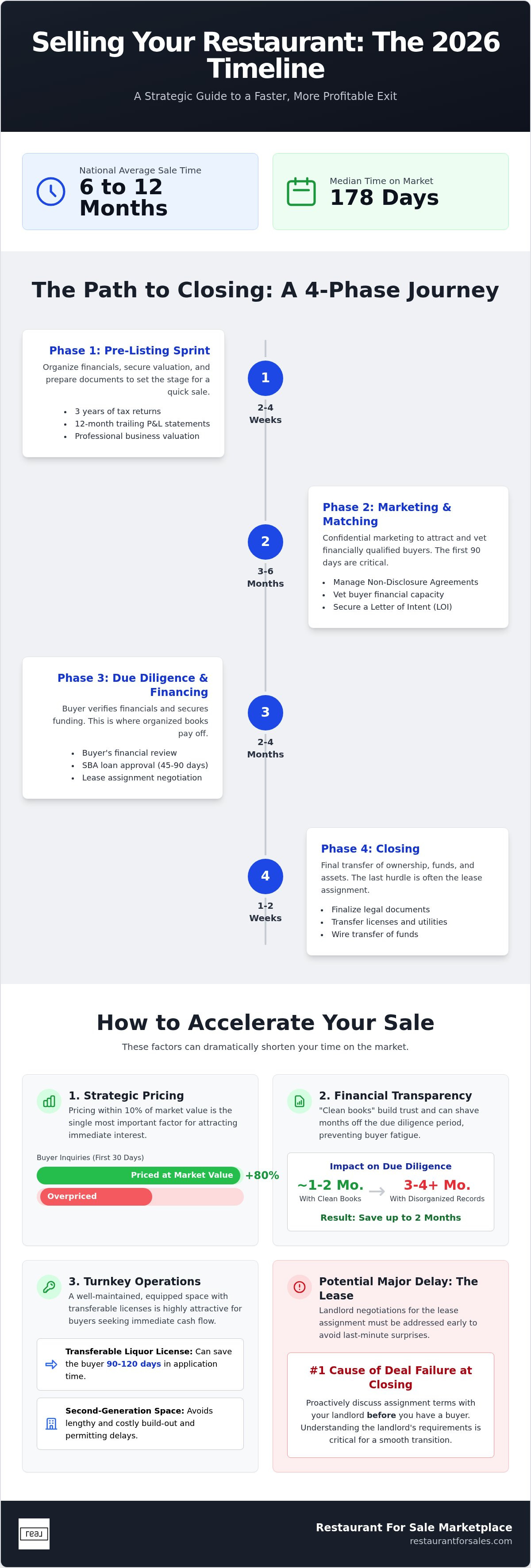
Did you know that the median time a restaurant spends on the market is 178 days? While the average sale typically spans six to twelve months, the uncertainty of that timeframe often causes more stress than the sale itself. You likely worry about how long you can keep the listing confidential from employees or whether a complex lease transfer will stall your closing at the finish line. When you ask how long does it take to sell a restaurant, you aren't just looking for a statistic; you're looking for a predictable exit strategy that protects your investment.
We've developed this 2026 timeline checklist to help you move through the process with professional precision. You'll discover the realistic phases of a restaurant sale and how to use a strategic approach to shorten your time on the market. We will preview the critical milestones from the initial valuation to the final lease assignment, ensuring you remain the driver of your timeline rather than the cause of its delays.
Key Takeaways
- Understand that while the national average is 6 to 12 months, knowing how long does it take to sell a restaurant depends heavily on the efficiency of your preparation phase.
- Reduce your due diligence period by up to two months by organizing clean financial records, including tax returns and trailing 12-month P&L statements, before listing.
- Identify potential lease assignment hurdles early to prevent landlord-related delays, which remain the primary cause of deal failure at the closing stage.
- Account for the 45-90 day window required for SBA buyer loan approvals and learn how pre-qualifying your business can attract serious investors faster.
- Leverage professional valuation and brokerage services to ensure your asking price aligns with market reality, preventing the stagnation caused by overpricing.
Understanding the Average Timeline for a Restaurant Sale
Selling a restaurant isn't an overnight transaction. For most owners in 2026, the national average ranges between six and twelve months from the initial listing to the final wire transfer. While some data points to a median of 178 days on the market, your specific experience depends on how well you manage the transition phases. Unlike manufacturing or specialized service firms, restaurants are relatively liquid assets. They offer immediate cash flow and established footprints that appeal to a broad pool of owner-operators and investment groups. This high demand often accelerates the process, provided the business is positioned correctly from day one.
Success starts with understanding the fundamentals of a business sale, specifically the "First 90 Days" rule. This is the window where you'll encounter your most qualified leads. These are active buyers who've already vetted the market and are waiting for a listing that meets their criteria. If you don't secure a letter of intent during this period, it often indicates a misalignment in pricing or presentation. When asking how long does it take to sell a restaurant, you must account for the fact that the highest quality interest arrives early.
Phase 1: The Pre-Listing Sprint (2-4 Weeks)
Before the public sees your listing, you must complete a heavy lift of administrative work. You need at least three years of federal tax returns and 12-month trailing P&L statements. Buyers and lenders in 2026 are meticulous; any gap in your financial narrative can add weeks of delays. This is also when you should secure a professional valuation. Overpricing is the primary reason listings stagnate. By grounding your asking price in Seller's Discretionary Earnings (SDE) or EBITDA multiples, you create a defensible position that survives the scrutiny of an Offering Memorandum.
Phase 2: The Marketing and Matching Period (3-6 Months)
Once listed, the focus shifts to finding a qualified match. This phase isn't just about volume; it's about vetting. We prioritize buyers who can prove their financial capacity before they ever step foot in your kitchen. Managing the flow of Non-Disclosure Agreements (NDAs) is vital here to ensure your staff remains unaware of the impending sale. The speed of this phase often fluctuates based on your concept. For instance, Quick-Service Restaurants (QSRs) and pizza shops often move faster than high-end fine dining establishments because they represent a more accessible entry point for a wider range of buyers.
Key Factors That Influence Your Time on the Market
While the industry average suggests a six to twelve month window, several internal variables can drastically alter your specific timeline. Pricing strategy is the most significant factor. Data indicates that restaurants priced within 10% of their fair market value receive 80% more inquiries within the first 30 days. Conversely, overpricing leads to listing fatigue, where potential buyers ignore the business even after future price drops. Establishing a defensible price through professional restaurant valuation services is the fastest way to ensure your listing doesn't stagnate.
Financial transparency serves as a second major accelerator. "Clean books" can shave up to two months off the due diligence process. When a buyer's accountant or an SBA lender can easily verify your Seller's Discretionary Earnings (SDE), trust is built quickly. If your records are disorganized, expect the buyer to request more time or even walk away. Providing three years of clear tax returns and monthly P&L statements from the start signals that the business is a professional operation rather than a hobby.
The Impact of Concept and Equipment
The physical state of your business also dictates how long does it take to sell a restaurant in 2026. Fully equipped, "turnkey" kitchens are in high demand because they allow buyers to bypass the long wait times for new equipment and permitting. Second-generation spaces often sell faster than asset sales because the infrastructure, such as hoods, grease traps, and plumbing, is already in place. Additionally, having a transferable liquor license can be a massive timeline accelerator, as new applications in some jurisdictions can take 90 to 120 days. Providing modern POS data for real-time verification further streamlines the buyer's evaluation process.
Confidentiality vs. Exposure
Many owners face the "Silent Sale" challenge. You want to keep the sale secret to prevent spooking employees and customers, but this naturally limits your exposure. Balancing this requires a strategic approach. Broad marketplace exposure under a "blind profile" generates leads without revealing the location, while targeted outreach to known investors moves the needle behind the scenes. Using a broker provides a necessary buffer. It allows you to maintain total confidentiality while we vet "tire-kickers" and ensure only financially qualified buyers see your sensitive data. Offering owner financing, such as a 10% to 20% seller note, can also double your buyer pool and help bridge the gap for SBA-backed transactions.
The Pre-Sale Preparation Checklist to Accelerate Your Exit
Your exit velocity is determined before you ever list. While many owners ask how long does it take to sell a restaurant only after they hit the market, the answer is often found in the weeks of preparation preceding the launch. A disorganized seller is a slow seller. By completing a "pre-flight" audit of your business, you eliminate the friction that typically stalls due diligence. Use this five-step checklist to ensure your operation is transaction-ready.
Step 1 involves a rigorous financial audit. You must organize three years of federal tax returns and 12-month trailing P&Ls. Buyers in 2026 expect to see a balance sheet that reflects current assets and liabilities without ambiguity. Step 2 requires a deep dive into your lease. Locate the original document and all amendments. Specifically, look for clauses regarding lease assignments and landlord consent requirements. If your lease has less than three years remaining, you should initiate negotiations for an extension or a new option period immediately.
Step 3 is the creation of a detailed Furniture, Fixture, and Equipment (FF&E) inventory. List every item included in the sale, from the walk-in cooler to the POS terminals. Step 4 focuses on transferability. Document your Standard Operating Procedures (SOPs) in a comprehensive operations manual. This proves to a buyer that the restaurant can function without your daily presence. Finally, Step 5 is the physical clean-up. Address minor repairs, deep-clean the kitchen, and enhance curb appeal. First impressions during the initial walkthrough can make or break a deal's momentum.
Essential Documentation for 2026 Sellers
Beyond financials, you need a "deal room" of operational paperwork. This includes proof of valid health department permits and recent fire inspections. Maintain an updated employee roster and copies of any key management contracts. You should also centralize your vendor contracts and recurring service agreements, such as linen services or grease trap maintenance. Providing these up front prevents the back-and-forth emails that often extend the closing process by several weeks.
Financial "Red Flag" Removal
Clean up your P&L by identifying and "adding back" owner discretionary expenses. This process reveals your true EBITDA by isolating personal costs like travel or health insurance that a new owner might not incur. Ensure all sales tax filings are current; unpaid tax liabilities are a common cause of escrow delays. Pro-forma projections must always be backed by historical data to maintain credibility with sophisticated investors. By removing these red flags early, you protect the integrity of your valuation and keep the sale moving toward the finish line.
Managing External Delays: Leases, Licenses, and Financing
Even with a perfect listing, external entities often dictate the final pace. When considering how long does it take to sell a restaurant, you must account for the "third-party lag." Landlords, lenders, and government agencies don't share your sense of urgency. These external bottlenecks are where most deals lose momentum. Preparation is your only defense against these delays. You can't control their schedules, but you can control the quality and speed of the data you provide to them.
Landlord approval is the most volatile variable in the closing process. It's the primary cause of deal failure at the eleventh hour. Many landlords see a business sale as an opportunity to renegotiate terms or demand "key money" for the assignment. If you don't manage this relationship proactively, a simple lease transfer can stall for 30 to 60 days. In some cases, a landlord may even refuse the assignment if they feel the buyer lacks sufficient experience or financial backing.
The Landlord Hurdle
Minimize delays by preparing a professional "Buyer Package" before you even approach the property manager. This package should include the buyer's financial statement, a resume of their restaurant experience, and a clear business plan. Providing this data up front makes it easier for the landlord to say yes quickly. Understand the difference between a restaurant lease assignment and a new lease negotiation. An assignment usually keeps existing terms, while a new lease might trigger rent increases that could kill the buyer's pro-forma projections. Always check your original lease for specific assignment fees or "profit-sharing" clauses that might apply upon sale.
Financing Deadlines
Financing adds a predictable but lengthy window to your timeline. In 2026, SBA 7(a) loans typically require 45 to 90 days for full approval. Cash deals can close in as little as 30 days, but they often come with lower purchase prices. If your buyer is financing, expect delays during the appraisal phase. Appraisers often struggle to find comparable restaurant sales data. You can accelerate this by providing the appraiser with your professional valuation report and a list of local industry comps. For franchise resales, remember that the franchisor has its own 30 to 120-day approval process, which runs parallel to the bank's timeline.
Liquor license transfers and health inspections represent the final hurdles. When you analyze how long does it take to sell a restaurant, the answer is often hidden in the state's liquor board processing times. Depending on your state, a liquor license transfer can take anywhere from 90 days to six months. Similarly, a failed health or fire inspection during the escrow period can reset your timeline entirely. Buyers will often refuse to close until all "high priority" violations are cured. Schedule a pre-inspection yourself to identify and fix these issues before the buyer's inspector arrives.
Strategic Steps to Shorten Your Path to Closing
While external factors like landlord approvals are significant, your internal strategy determines the ultimate speed of the transaction. Engaging a specialized restaurant broker is the most effective way to eliminate "tire-kickers" who consume your time without the intent or capital to close. Brokers act as a filter, ensuring that only buyers with signed NDAs and verified proof of funds gain access to your sensitive operational data. This proactive vetting prevents you from wasting weeks on non-viable leads and answers the practical question of how long does it take to sell a restaurant by removing unnecessary friction.
Pre-qualifying your business for SBA lending is another critical accelerator. By having a lender review your financials before you find a buyer, you confirm that the business is "bankable." This removes much of the 45-90 day uncertainty regarding whether a buyer can actually secure the funds, as the bank has already approved the business itself for financing. Additionally, you should commit to a structured training period of two to four weeks in your offer. This reduces buyer anxiety and prevents cold feet during the final stages of escrow by showing a clear path to operational success.
Throughout the sales process, you must maintain "business as usual." It's common for owners to lose focus as they approach the finish line, but letting sales dip can be fatal. If your revenue numbers drop during the due diligence period, the buyer's lender may pull the funding or demand a price reduction. Keeping your staff motivated and your food costs in check ensures that the business the buyer saw on day one is the same business they receive at closing.
Why a Professional Valuation is Your Best Time-Saver
A professional valuation is your best defense against a stagnant listing. Many owners attempt to "test the market" with an inflated price, but this strategy almost always backfires. In the selective market of 2026, buyers are focused on stable margins and digital readiness. They'll quickly skip over listings that don't align with current EBITDA multiples. Using a Broker Opinion of Value to set a realistic "strike price" ensures you capture the interest of the highest-quality leads during the first 90 days, which is when you have the most leverage. When you understand how long does it take to sell a restaurant, you realize that an accurate price is the fastest way to a signed Letter of Intent.
The Role of the Restaurant For Sale Marketplace
The Restaurant For Sale Marketplace provides the infrastructure needed to reach a national database of active, qualified restaurant buyers. This platform streamlines the complex escrow and lease assignment processes by providing expert facilitation at every milestone. By leveraging a marketplace specifically designed for food service assets, you bypass the noise of general business boards and connect directly with serious investors who understand the industry. This targeted exposure, combined with professional oversight, reduces your total days on market and ensures a smoother transition for all parties involved.
Get a professional valuation to start your exit today
Secure Your Exit Strategy for 2026
Selling a restaurant is a high-stakes transaction. Your preparation dictates your speed. By following a structured checklist and addressing potential roadblocks like lease assignments and financial audits before listing, you significantly reduce the risk of deal fatigue. Understanding how long does it take to sell a restaurant is the first step toward building a realistic and successful exit plan. Efficiency in these early stages ensures you don't lose momentum when it matters most.
You don't have to navigate this complex process alone. Our team provides the expertise needed to manage every phase of the transaction, from the initial valuation to the final closing. We offer no-cost business valuations for sellers and operate on success-based commissions; we only get paid when you close. You'll gain immediate access to our national network of qualified hospitality buyers, ensuring your listing reaches the right audience from day one. List your restaurant with the experts at Restaurant For Sale Marketplace and move forward with confidence. Your successful exit is within reach.
Frequently Asked Questions
Can I sell my restaurant in less than 90 days?
Selling a restaurant in under 90 days is possible but typically requires a cash buyer and an asset-only structure. This accelerated timeline bypasses SBA loan processing, which often takes 45 to 90 days on its own. For a deal to close this quickly, you must have all permits, financial records, and lease documents ready for immediate review. Most owners find that how long does it take to sell a restaurant depends heavily on the buyer's financing method.
How does a liquor license transfer impact the closing date?
A liquor license transfer is a primary external delay in a transaction. Depending on your local jurisdiction, the process can take between 90 and 120 days. Some states allow for temporary permits that let the buyer operate while the permanent transfer is pending. Without these, the closing date is often tethered to the state liquor board's approval schedule, making it a critical path item in your timeline.
What is the most common reason restaurant sales fall through?
Deal failure most frequently occurs during the lease assignment phase or due to buyer financing issues. Landlords may reject a buyer based on their financial history or lack of experience, effectively killing the deal at the finish line. Additionally, if a buyer's SBA loan is denied after 60 days of due diligence, the seller must restart the marketing process. This highlights why pre-qualifying both the buyer and the business is essential for a successful exit.
Should I tell my landlord I am selling before I find a buyer?
You should generally wait until you have a signed Letter of Intent (LOI) before formally notifying your landlord. Early disclosure can lead to lease complications or unwanted rumors before a deal is certain. However, you should review your lease early to understand your assignment rights. Once a qualified buyer is secured, professional brokers facilitate the introduction to ensure the landlord views the transition as a benefit rather than a risk.
How much does it cost to hire a restaurant broker in 2026?
Most specialized restaurant brokers operate on a success-based commission structure. This means the broker only receives payment once the transaction successfully closes at the escrow office. While industry averages for commissions exist, the specific fee structure is determined by the complexity of the deal and the services provided, such as valuation and lease assignment assistance. This alignment of interests ensures the broker is motivated to find a qualified buyer efficiently.
Does a franchise restaurant sell faster than an independent one?
Franchise restaurants often attract buyers faster due to established brand recognition and proven systems. However, the closing process can take longer than an independent sale. You must account for the franchisor's mandatory approval process, which typically adds 30 to 120 days to the schedule. While the pool of interested buyers is often larger, the extra layer of corporate vetting creates a more rigid timeline for the final transfer.
What happens to my employees when the restaurant is sold?
In most asset sales, the buyer chooses which employees to retain as part of the new operation. Maintaining confidentiality until the deal is nearly closed prevents staff turnover during the sensitive marketing phase. Once the sale is finalized, most buyers prefer to keep existing staff to ensure operational continuity. Clear communication during the transition period helps retain key management and kitchen personnel who are vital to the restaurant's ongoing value.
Is owner financing required to sell a restaurant quickly?
Owner financing isn't required, but it's a powerful tool to accelerate the sale. By carrying a small percentage of the purchase price, usually 10% to 20%, you show confidence in the business and help the buyer bridge the gap for SBA lending. This can significantly reduce how long does it take to sell a restaurant by attracting a wider range of buyers who might otherwise struggle to secure 100% external financing in a tight credit market.


