

In 2026, the true market value of a restaurant for sale is no longer defined by its physical footprint, but by its digital integration and operational efficiency. You likely feel the pressure of fluctuating interest rates and the logistical complexity of lease assignments. It's natural to worry about overpaying when SBA 7(a) fixed rates currently sit between 9.5% and 13.5%. This guide provides the expert insights you need to identify a turnkey investment and secure a successful lease transfer without the typical friction. We'll break down current EBITDA multiples for both independent and franchise models to ensure your valuation is accurate. We also examine the impact of new 2026 regulations, such as California’s allergen disclosure requirements and New Jersey’s "Skip the Stuff" law, and outline the strategic steps to acquiring a profitable establishment. Whether you're targeting a single-unit operation at 1.5 to 3x SDE or a multi-unit group valued at up to 7x EBITDA, understanding these specific market dynamics is the first step toward a successful acquisition.
Key Takeaways
- Understand the 2026 shift toward turnkey hospitality investments and why operational efficiency now dictates market demand.
- Learn how to accurately value a restaurant for sale by analyzing Seller’s Discretionary Earnings (SDE) and verified POS data instead of relying on outdated revenue-based metrics.
- Evaluate the financial trade-offs between franchise resales and independent operations to find the model that best supports your long-term growth strategy.
- Execute a thorough due diligence plan that identifies red flags in lease assignments and ensures a smooth transition of all necessary permits and licenses.
- Discover the strategic advantages of using expert brokerage services to manage confidentiality and professional valuations during the acquisition process.
2026 National Landscape for Restaurants for Sale
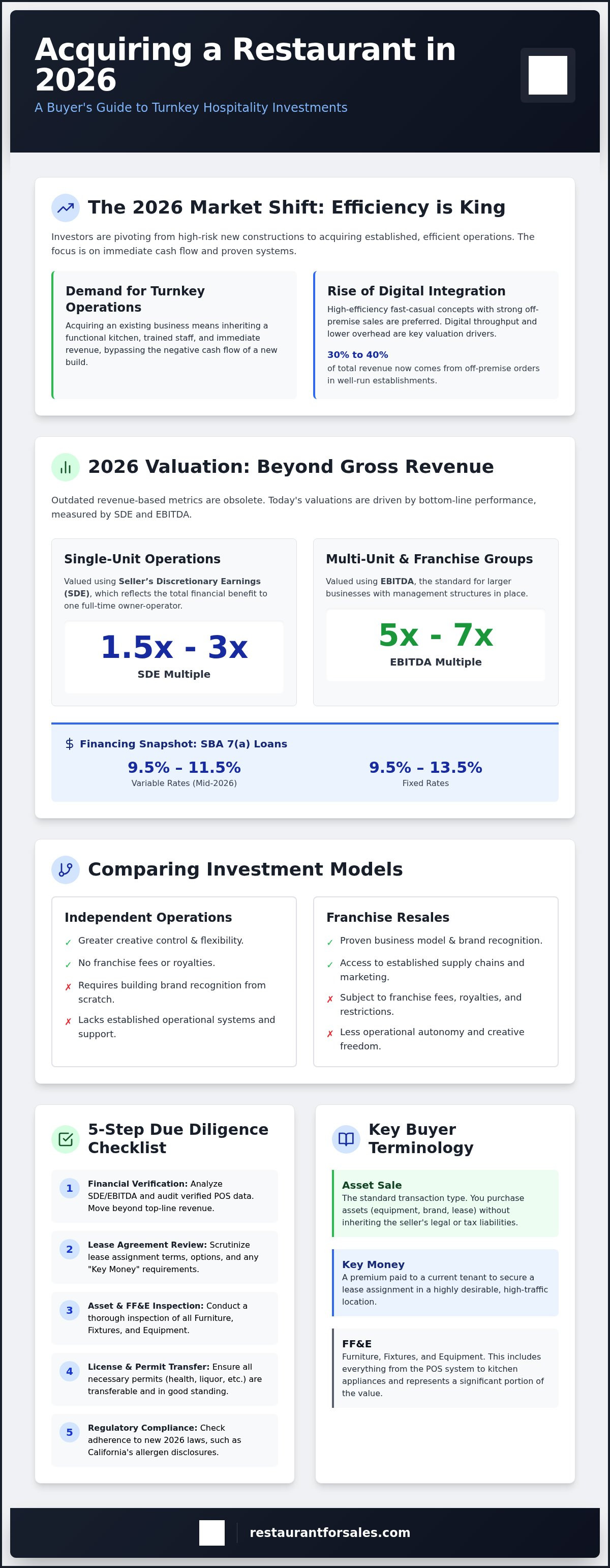
The secondary market for hospitality businesses represents the exchange of established operations, leasehold interests, and physical assets between private parties. In 2026, the demand for a turnkey restaurant for sale has reached a new peak. Investors are increasingly avoiding the risks associated with ground-up construction, which often faces supply chain volatility and high labor costs. By acquiring an existing business, you inherit a functional kitchen, a trained staff, and an immediate cash flow stream, bypassing the months of negative cash flow typical of a new build.
Acquisition volume is currently driven by the stabilization of financing costs. With SBA 7(a) variable rates holding between 9.5% and 11.5% as of mid-2026, the uncertainty that plagued previous years has diminished. This environment favors high-efficiency fast-casual concepts. Consumer habits have shifted, and well-run establishments now see off-premise orders accounting for 30% to 40% of their total revenue. As a result, buyers are moving away from capital-intensive fine dining in favor of smaller footprints with high digital throughput and lower overhead.
Macro-Economic Drivers in the Hospitality Sector
Labor market pressures and new regulatory requirements are reshaping the list of available businesses. For instance, California’s SB 68 food allergen disclosures and AB 660 date labeling laws have increased compliance costs for many independent operators. These burdens often prompt owners to exit the market, leading to a rise in "absentee owner" listings. Investors actively seek these opportunities because they offer proven systems that don't require the buyer to manage daily line shifts. This trend aligns with the broader U.S. restaurant industry overview, which highlights a move toward systematized, scalable operations over individual chef-driven models.
Key Terminology for Modern Buyers
Success in the 2026 market requires a firm grasp of transactional language. Most acquisitions are structured as asset sales rather than stock sales. In an asset sale, you acquire the restaurant for sale assets like equipment and branding without inheriting the seller's legal liabilities or tax debts. Understanding these distinctions is vital for risk mitigation during the transfer process.
- Asset Sale: A purchase of specific items like name, equipment, and lease rights. This is the standard for most small to mid-sized acquisitions.
- Key Money: A premium paid to a current tenant to secure a lease assignment in a high-traffic or "A-list" location.
- FF&E: Furniture, Fixtures, and Equipment. This includes everything from the POS system to the walk-in cooler and represents a significant portion of the asking price.
Understanding Restaurant Valuation and EBITDA in 2026
In the current market, relying on gross revenue to value a restaurant for sale is a strategic error. Revenue doesn't account for the 65% prime cost targets or the rising utility and insurance expenses seen in 2026. Professional buyers now prioritize bottom-line performance over top-line volume. EBITDA stands for Earnings Before Interest, Taxes, Depreciation, and Amortization, and it serves as the primary metric for 2026 restaurant profitability.
For owner-operators, Seller’s Discretionary Earnings (SDE) remains the benchmark. This calculation adds back non-essential expenses like personal travel or one-time repairs to show the true earning potential of the business. Single-unit operations typically trade at 1.5 to 3x SDE, while multi-unit franchise groups can reach 5 to 7x EBITDA. A "tech stack efficiency" audit is now a core part of this assessment. Systems that integrate AI-driven ordering and robust loyalty programs add significant value by lowering labor costs and increasing customer retention. According to the State of the Restaurant Industry report, technology adoption is a primary differentiator between top-performing assets and those struggling with margin compression.
Before listing or bidding, you must decide between a Broker Opinion of Value (BOV) and a formal appraisal. A BOV provides a fast, market-based estimate suitable for determining a realistic listing price. A formal appraisal is a deeper, document-heavy process often required by lenders for SBA financing. If you're unsure where your business stands, obtaining professional restaurant valuation services is the first step toward a successful transaction.
Common Valuation Methods Used by Professional Brokers
- The Income Approach: This method calculates value based on the projected future cash flow of the business, discounted for risk and inflation.
- The Market Approach: Brokers compare the subject property against recent national sales of similar concepts to establish a fair market multiple.
- The Asset-Based Approach: This is used primarily for underperforming businesses where the value of the physical equipment and leasehold improvements exceeds the business's earning power.
Factors That Artificially Inflate or Deflate Asking Prices
The "deferred maintenance" trap is a common reason for price reductions during due diligence. If a restaurant for sale has outdated HVAC systems or walk-in coolers near the end of their lifecycle, buyers will deduct these replacement costs from the final offer. Lease stability also dictates value. A listing with only two years remaining on the lease and no options to renew is worth significantly less than one with a ten-year term, regardless of its current profitability. Ensure your lease assignments are clear and long-term before entering the market.
Comparing Investment Models: Independent vs. Franchise Resale
Choosing between an independent concept and a franchise resale is the most significant decision you will face when evaluating a restaurant for sale. In 2026, the market has seen a distinct shift toward franchise resales, particularly for first-time buyers and institutional investors. This trend is driven by the desire for predictable cash flows in a higher-interest-rate environment. While independent restaurants offer creative freedom, franchises provide a structured pathway to profitability that many lenders find more attractive for SBA 7(a) financing.
Data from the 2026 State of the Restaurant Industry report indicates that franchised locations generate 1.4 times higher average sales than their independent counterparts, often reaching $3.5 million annually compared to $2.3 million for independents. This revenue gap often compensates for the royalty and marketing fees that characterize the franchise model. However, buyers must account for "Franchise Transfer Fees" in their initial acquisition budget, which are separate from the purchase price and cover the costs of training and administrative processing by the franchisor.
The Pros and Cons of Franchise Resales
The primary advantage of a franchise resale is risk mitigation. Approximately 70% of franchised restaurants achieve profitability within two years, a significantly higher rate than the 45% seen in independent startups. You gain access to proven supply chains and national marketing campaigns that an independent owner simply cannot replicate. However, you must be aware of the "First Right of Refusal" clause. This allows the franchisor to step in and purchase the unit themselves under the same terms you negotiated with the seller, potentially halting your acquisition at the final stage. Expert franchise resale listings services can help you navigate these specific contractual hurdles.
The Appeal of Independent Restaurant Acquisitions
Independent acquisitions remain the preferred choice for operators who prioritize creative control and higher potential net margins. Without the 4% to 8% royalty fees and 2% to 4% marketing fund contributions required by franchises, a well-run independent restaurant for sale can achieve net profit margins that exceed the 4% to 9% franchise average.
- Operational Flexibility: Independent owners can pivot their menus instantly to account for local trends or new regulations, such as New Jersey’s "Skip the Stuff" law, without seeking corporate approval.
- Lower Fixed Overhead: The absence of monthly franchise fees allows for more aggressive reinvestment into local staff or facility upgrades.
- Brand Equity: You own the intellectual property entirely, meaning any brand growth directly increases your exit valuation without sharing the upside with a franchisor.
Ultimately, the choice depends on your management style. If you value a "playbook" and established systems, a franchise resale is the logical path. If you prefer to build a unique local legacy and keep 100% of the profit after expenses, an independent acquisition offers the better long-term ROI.
A 5-Step Due Diligence Checklist for Modern Buyers
Due diligence is the most critical phase of the acquisition process. It's where you verify that the restaurant for sale actually matches the seller's claims. In a market where prime costs should ideally remain under 65 percent of revenue, even small discrepancies in food or labor expenses can derail your projected ROI. You must move beyond surface-level tax returns and perform a deep dive into the operational DNA of the business to protect your investment.
Financial verification now centers on digital transparency. While tax returns provide a historical view, they often lack the granularity needed to assess current performance. You should request a full audit of the Point of Sale (POS) system for the last 24 months. This allow you to track hourly sales trends, voids, and inventory depletion rates. These metrics are far more indicative of daily health than a year-end summary. Digital POS systems provide unalterable, real-time records of transaction volume and labor costs, making them the most reliable source of financial truth in 2026.
Operational audits and asset inspections must be equally rigorous. Review all existing vendor contracts to ensure pricing isn't tied to the previous owner's personal credit or specific volume tiers you can't maintain. Inspect every piece of Furniture, Fixtures, and Equipment (FF&E). If a walk-in cooler or professional range is nearing the end of its lifecycle, the cost of replacement should be a primary point of negotiation in your final offer.
Navigating Restaurant Lease Assignments
The lease is often more valuable than the equipment itself. Verify the remaining term and all renewal options. Landlords have significant leverage during a transfer, and they frequently require a "Personal Guarantee" from the new tenant. If the landlord refuses the assignment or demands a significant rent hike as a condition of the transfer, the deal is effectively dead. Identifying these red flags early prevents wasted legal fees and provides a clear picture of your long-term occupancy costs.
Permits, Licenses, and the 'Paperwork Trail'
Transferring a liquor license is a complex administrative hurdle that typically takes 30 to 90 days, depending on your jurisdiction. You must also schedule a "Change of Ownership" inspection with the local health department to ensure the facility meets current 2026 codes. Failure to account for these timelines can result in a dark period where you own the business but cannot legally serve customers. Before you sign a purchase agreement, ensure you have a clear path to legal operation. If you need assistance managing these complex transfers, explore our professional restaurant lease assignments services to secure your location.
Finding and Closing Your Restaurant Opportunity
Identifying the right restaurant for sale requires a disciplined approach to digital market filters. You shouldn't waste time on listings that don't meet your specific EBITDA or geographic criteria. Effective search strategies involve setting strict parameters for 'Owner-Operated' vs. 'Manager-Run' models to ensure the opportunity aligns with your intended management style. High-traffic marketplaces offer the most efficient way to compare multiple units simultaneously without the need for manual outreach to individual owners.
Confidentiality remains the cornerstone of every professional hospitality transaction. Sellers almost always keep their listings private to prevent staff turnover, competitor interference, or landlord friction. A specialized restaurant broker acts as a professional buffer. They ensure that sensitive financial data and location details are only released after a non-disclosure agreement (NDA) is fully executed. This protects the business's current operational value while you conduct your preliminary evaluation.
To be taken seriously by sellers and their representatives, you must prepare a comprehensive 'Buyer Profile' before making an inquiry. This document should include your professional resume, relevant hospitality experience, and a 'Proof of Funds' statement from your financial institution. Sellers in 2026 prioritize buyers who demonstrate they can close quickly and have the liquidity required to secure complex lease assignments and SBA 7(a) financing approvals.
The closing process follows a methodical sequence designed to mitigate risk for both parties. It begins with a Letter of Intent (LOI), which outlines the purchase price, earnest money deposit, and key contingencies. Once the LOI is accepted, you move into the formal due diligence phase, finalize the lease assignment, and secure your funding. The transaction concludes in Escrow, where all assets are legally transferred and the purchase price is disbursed only after all closing conditions are met.
Working with Professional Restaurant Brokers
Professional restaurant brokers provide more than just a list of available businesses. They facilitate complex lease negotiations and help you navigate the 'First Right of Refusal' clauses that often appear in franchise agreements. Because most brokerage commissions are success-based, the broker’s interests are directly aligned with your goal of a successful, efficient closing. They also provide exclusive access to 'Off-Market' listings that aren't visible on public commercial real estate websites, giving you a competitive edge in high-demand markets.
Next Steps: Moving from Search to Ownership
A typical acquisition timeline should target a 90-day close. You should use the first 30 days for discovery and the LOI, followed by 45 days for due diligence and financing, and the final 15 days for the formal lease transfer and escrow finalization. During this period, you must finalize a robust business plan to present to the landlord and your lender for final approval. Browse active restaurant listings and start your acquisition journey today to find the restaurant for sale that fits your 2026 investment goals.
Secure Your Future in the 2026 Hospitality Market
The 2026 hospitality landscape rewards buyers who prioritize operational transparency and data-driven valuations. Success in this high-stakes environment requires moving beyond surface-level metrics to understand the true cash flow of an asset. By focusing on verified EBITDA and ensuring your target's tech stack is fully optimized, you position yourself for sustainable growth. It's essential to remember that navigating the complexities of lease assignments and franchise transfers is more efficient with professional guidance.
Identifying a viable restaurant for sale is just the beginning of a methodical acquisition journey. You need a partner that provides professional valuation services to ensure your offer is competitive and accurate. Our marketplace offers access to exclusive franchise resale listings and dedicated support for managing intricate leasehold transfers. These resources allow you to transition from the search phase to final ownership with absolute confidence. Start your journey today by utilizing the tools designed for serious investors.
Search Active Restaurant Listings Across the Country
Your path to a profitable restaurant investment is clear. Take the next step toward ownership and build your legacy in the evolving 2026 market.
Frequently Asked Questions
How do I determine if a restaurant for sale is actually profitable?
You must verify profitability by auditing the Point of Sale (POS) system and reviewing the Seller’s Discretionary Earnings (SDE). Look for a prime cost target below 65 percent of gross revenue. Match tax returns to bank statements to ensure recorded revenue aligns with actual deposits. Profitability in 2026 is also measured by digital sales volume and labor efficiency, so review these specific metrics during your financial due diligence.
What is the typical down payment required for a restaurant acquisition?
Most lenders require a down payment between 10 percent and 20 percent of the total purchase price for SBA-backed loans. If the transaction includes real estate, the SBA 504 loan program might offer lower down payment options for the property portion. Buyers with significant industry experience or existing successful units can occasionally negotiate lower equity requirements. Always ensure you have additional working capital reserved for the first six months of operation.
Can I buy a restaurant without the employees knowing?
Maintaining confidentiality is a standard practice managed through non-disclosure agreements (NDAs) and professional brokerage services. Sellers often keep a restaurant for sale private to prevent staff turnover or landlord concerns. Most site visits are conducted as a secret shopper or after hours to protect the operational value of the business. Employee notification typically occurs only after the deal reaches the final escrow stage or immediately after closing.
What is the difference between buying the business and buying the real estate?
Buying the business involves acquiring the brand, FF&E, and leasehold interests, whereas buying the real estate involves taking ownership of the land and building. Most transactions are asset sales of the business only, requiring a lease assignment from the landlord. Purchasing the real estate provides more long-term stability and eliminates rent increases. However, it requires a much higher initial capital investment and different financing structures like the SBA 504 loan.
How long does the average restaurant sale take to close in 2026?
The average closing timeline in 2026 is approximately 90 days from the signing of a Letter of Intent (LOI). This period accounts for 30 to 45 days of financial due diligence and an additional 30 to 60 days for lease assignments or liquor license transfers. Transactions involving SBA financing or complex franchise approvals may extend this timeline. Setting a realistic schedule prevents operational gaps and ensures all permits are transferred before you take over.
Are liquor licenses included in the asking price of a restaurant for sale?
Liquor licenses are typically included in the asking price of a restaurant for sale, but the transfer process is handled as a separate administrative step. In states with quota licenses, the value of the permit can be a significant portion of the total asset price. Buyers must verify that the license is in good standing and free of violations before closing. Transfer fees and legal costs associated with the liquor board are usually the buyer's responsibility.
What should I look for in a restaurant lease before signing an assignment?
Prioritize the remaining lease term and the availability of renewal options to ensure long-term stability. Check for assignment clauses that might allow the landlord to increase rent or claim a percentage of the sale price. You should also identify any personal guarantee requirements or demolition clauses that could force an early exit. A lease with at least 10 years of total term remaining is generally preferred by lenders when you're seeking acquisition financing.
Is it better to buy a franchise or an independent restaurant in the current market?
The choice depends on your risk tolerance and management style. Franchise resales offer higher sales averages and proven systems, which lenders often favor for SBA 7(a) loans. Independent restaurants provide more creative control and eliminate the 4 percent to 8 percent royalty fees, potentially leading to higher net profit margins. In 2026, many first-time buyers choose franchises for the built-in digital infrastructure and national supply chain support they provide during economic shifts.


