

Buying a brand-new franchise location is often marketed as the gold standard, but in 2026, acquiring an existing unit is the most efficient path to immediate cash flow in a $1.55 trillion industry. When you search for a franchise restaurant for sale, you aren't just buying equipment; you're purchasing an established market presence and a trained team. It's a strategic move, yet the process involves more than just a simple handshake.
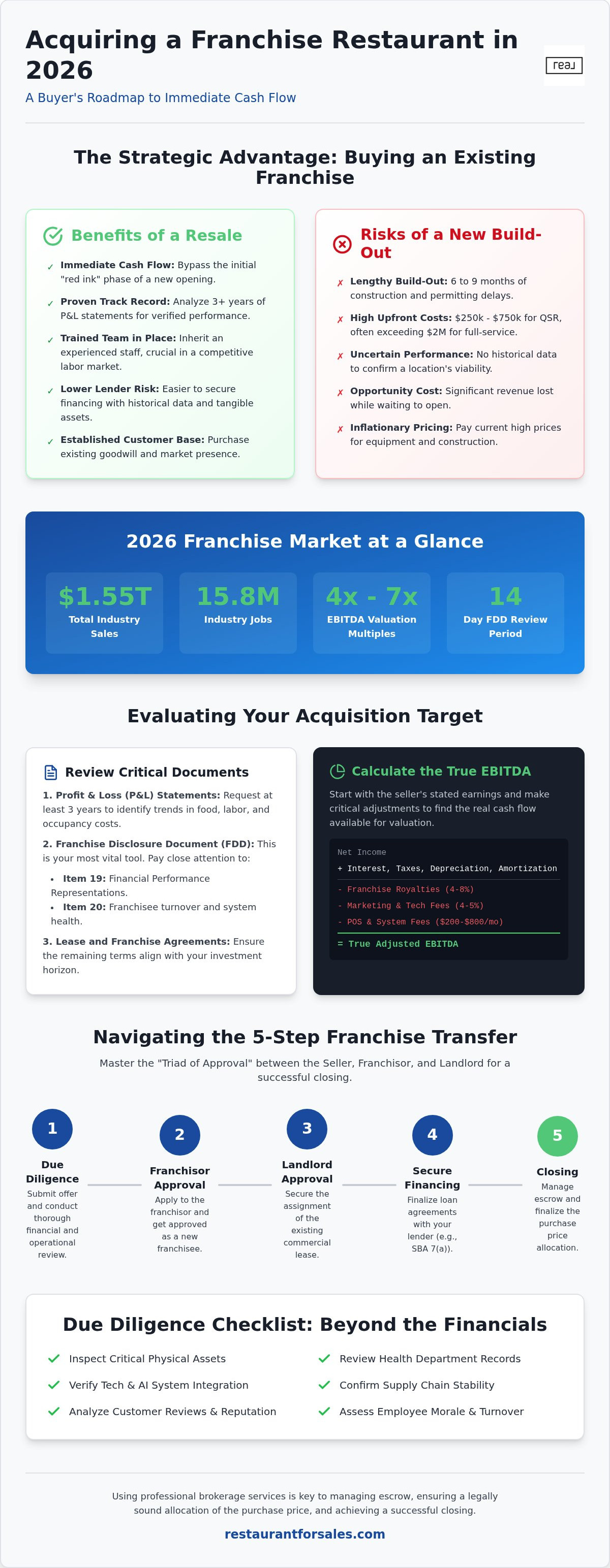
You likely understand that a turnkey operation offers a head start, but you're probably concerned about hidden liabilities or the complexities of the franchisor transfer fee. This guide will help you master the acquisition of a profitable unit while ensuring you don't overpay for brand goodwill. We'll examine current 2026 valuation multiples, which typically range from 4x to 7x EBITDA, and walk you through the critical 14-day FDD review period required by the FTC. By the end, you'll have a clear roadmap for navigating the seller, franchisor, and landlord approvals necessary for a successful closing.
Key Takeaways
- Identify the strategic benefits of acquiring an existing unit to secure immediate cash flow and avoid the risks of a lengthy build-out period.
- Learn the professional methods for valuing a franchise restaurant for sale, including how to properly adjust EBITDA for royalties and add-backs.
- Master the five-step transfer process required to navigate the complex "Triad of Approval" between the seller, franchisor, and landlord.
- Conduct thorough due diligence by inspecting critical physical assets and reviewing historical health department compliance records.
- Understand the role of professional brokerage services in managing escrow and ensuring a legally sound allocation of the purchase price.
The Strategic Advantage of Buying a Franchise Resale
A franchise resale occurs when you acquire an existing, operating unit directly from a current franchisee. This differs from a "start-up" franchise where you sign a lease for a vacant shell and manage the build-out yourself. When you evaluate a franchise restaurant for sale, you're looking at a business with a track record, established customer habits, and immediate revenue. You aren't just buying a brand; you're buying a history of performance.
The primary advantage is cash flow. In a 2026 market where total industry sales are projected to reach $1.55 trillion, waiting six to nine months for construction and permitting is a significant opportunity cost. A resale allows you to bypass the "red ink" phase of a new opening. You inherit a trained team, which is vital as the industry expands to 15.8 million jobs this year. Lenders also favor these transactions. With SBA 7(a) interest rates currently ranging between 6.39% and 8.39%, securing financing is often more straightforward for a business with three years of proven P&L statements than for a speculative startup. The risk profile is lower because the numbers are already verified.
Resale vs. New Development: A Comparative Analysis
The financial landscape of 2026 makes the resale path particularly attractive. New QSR investments now range from $250,000 to over $750,000, while full-service units often exceed $2,000,000. By choosing an existing franchise restaurant for sale, you often acquire equipment and infrastructure at a depreciated cost compared to current inflationary build-out prices. You also gain site certainty. Instead of guessing if a corner lot will attract diners, you have historical data confirming the location's performance. You skip the permitting and construction phase entirely, allowing you to focus on operations from day one.
The Value of Brand Equity and Corporate Support
Entering the Franchising business model through a resale doesn't mean you lose out on corporate benefits. You still leverage national marketing engines and established supply chains. You also inherit the technology stack already in place. Since 70% of operators are now using AI for loyalty programs and workflows, taking over a unit that has already integrated these systems saves you the technical hurdle of implementation. The "goodwill" you pay for represents the value of this brand recognition and the established customer base, which is often more stable than an independent startup's reputation. This corporate framework provides a safety net that independent owners simply don't have.
How to Evaluate a Franchise Restaurant for Sale
Evaluating a franchise restaurant for sale requires a transition from surface-level interest to granular financial analysis. You must request at least three years of Profit & Loss (P&L) statements to identify trends in food costs, labor, and occupancy. In the 2026 market, where industry growth is projected at 1.3% after adjusting for inflation, understanding a unit's specific trajectory is more important than national brand hype. The numbers must prove that the location can sustain itself despite rising labor costs and shifting consumer budgets.
The Franchise Disclosure Document (FDD) is your most vital tool during this phase. Pay close attention to Item 19, which provides financial performance representations, and Item 20, which reveals the health of the system through franchisee turnover rates. The Consumer's Guide to Buying a Franchise from the FTC offers a comprehensive framework for interpreting these mandatory disclosures. Comparing the specific unit’s performance against the national averages found in Item 19 helps you determine if the location is an overperformer or a struggling outlier within the brand.
Analyzing the True EBITDA of a Franchise Unit
In the context of restaurant brokerage, EBITDA is defined as the business's net income before accounting for interest, taxes, depreciation, and amortization, serving as the primary metric for determining operational cash flow. To find the "true" number, you must account for non-discretionary expenses. For most U.S. food franchises in 2026, royalty fees range from 4% to 8% of gross sales, while combined marketing and tech fees often add another 4% to 5%. You must also factor in technology and POS fees, which currently average between $200 and $800 per month. If you need assistance deciphering these complex financial layers, our restaurant valuation services can clarify the unit's actual market value.
Assessing the Remaining Lease and Franchise Term
Your investment horizon must align with two separate contracts: the franchise agreement and the commercial lease. If the franchise agreement has only three years remaining, you must confirm the renewal terms and any associated transfer fees. Be wary of "Remodel Requirements." Franchisors often mandate expensive unit upgrades every seven to ten years. If a mandatory refresh is due in 2027, you must factor that capital expenditure into your purchase price negotiation. Finally, review the lease assignment terms. A landlord's refusal to approve a transfer can derail a deal even if the franchisor gives the green light. Ensure the remaining lease options provide enough runway to realize your expected ROI.
Navigating the 5-Step Franchise Transfer Process
The transfer of a franchise restaurant for sale is a sophisticated legal and operational maneuver. Unlike an independent business sale, this transaction requires the explicit consent of a third party: the franchisor. You must manage three distinct interests simultaneously to reach a successful closing. The process follows a methodical sequence designed to protect the brand's integrity and ensure the new operator is capable of maintaining corporate standards.
- Step 1: Execute the Letter of Intent (LOI). This document outlines the purchase price and key terms. It serves as the foundation for the formal purchase agreement and triggers the start of the due diligence period.
- Step 2: Submit the Buyer Application. Once the price is settled, you must apply to the franchisor. They will conduct a rigorous vetting process, including background checks and credit reviews.
- Step 3: Satisfy Financial and Training Requirements. You must prove you meet the brand's minimum net worth and liquidity standards. Following financial approval, you'll attend corporate training to master the brand’s operational systems.
- Step 4: Secure Landlord Consent. A successful restaurant lease assignment is critical. The landlord must approve you as the new tenant, often requiring a review of your financial standing and restaurant experience.
- Step 5: Execute the Transfer and Close. The final step involves signing the new franchise agreement, paying the transfer fees, and finalizing the bill of sale.
Securing Franchisor Approval
Franchisors often hold a "Right of First Refusal" (ROFR). This allows the corporate entity to purchase the unit themselves at the price you've negotiated with the seller. While rarely exercised, it's a hurdle you must clear before the deal can proceed. Following the $17 million FTC settlement in March 2026 regarding Franchise Rule violations, corporate entities have increased their scrutiny of new applicants. You must demonstrate professional competence and a clear understanding of the brand's 2026 technology mandates during your Discovery Day interview.
The Role of the Transfer Fee
The transfer fee covers the administrative and training costs incurred by the franchisor during the change of ownership. In 2026, these fees typically range from $25,000 to $50,000 for Quick-Service Restaurants (QSR) and between $35,000 and $55,000 for full-service models. Don't assume the seller will pay this cost. It's a major point of negotiation that should be addressed early in the LOI stage. Whether paid by the buyer, the seller, or split between both, the fee is a non-negotiable requirement for the franchisor to draft your new agreement and provide the necessary onboarding support.
Due Diligence: Beyond the Financials
While the financial analysis covered in previous sections confirms a unit's profitability, physical and operational due diligence reveals its long-term viability. When you acquire a franchise restaurant for sale, you're taking on the responsibility for a physical facility that must meet both corporate standards and local regulations. A "clean" P&L won't protect you if the HVAC system fails or the grease trap requires a major replacement shortly after closing. You're buying the infrastructure as much as the income stream.
Start by reviewing historical health department records. These documents provide an unvarnished look at how the current owner manages food safety and facility maintenance over time. Following this, perform anonymous "secret shopping" visits. Observe the speed of service, food consistency, and staff morale without the owner or manager present. This allows you to verify if the 2026 AI-driven loyalty programs and automated ordering systems are actually being used by the team or if they're causing operational friction that isn't visible in the numbers.
Equipment and Facility Audit
Identify potential capital expenditures by auditing high-value assets. Kitchen lines and refrigeration units have finite lifespans. Request maintenance logs to see if equipment has been serviced regularly or merely patched together. You must also verify ADA compliance and local building codes. If the municipality has updated patio regulations or grease interceptor requirements for 2026, you might be forced to fund expensive upgrades immediately upon transfer. Don't assume that because the current owner is operating, the facility is fully compliant with the latest codes.
Staffing and Operational Culture
Inheriting a trained team is a major asset, but it's also a significant risk during a transition. Review employee turnover rates and any existing management contracts. With the restaurant industry reaching 15.8 million employees in 2026, retaining top talent is a competitive necessity. You need a plan for a confidential transition to prevent staff attrition during the sale process. If key managers leave because they're uncertain about new ownership, the unit's value can drop instantly. Understand the local labor laws and how they impact your specific unit's profitability before you sign the final bill of sale.
Before you finalize your offer, ensure all permits and licenses are transferable. Liquor licenses and outdoor seating permits often require separate applications and background checks through local municipalities. To ensure you aren't overlooking critical facility risks, register for our professional restaurant brokerage services to gain access to our comprehensive due diligence checklists and expert guidance.
Closing the Deal with Professional Brokerage Support
Finalizing the acquisition of a franchise restaurant for sale requires a level of coordination that extends beyond simple price negotiation. A specialized restaurant broker acts as the essential facilitator, managing the friction between the seller, the franchisor, and the landlord. This "Triad of Approval" is where most deals fail without expert oversight. The broker ensures that escrow is managed correctly and that the Asset Purchase Agreement (APA) includes the necessary contingencies for franchisor approval and lease assignment.
The allocation of the purchase price is a critical step in the APA. You must decide how much of the investment is attributed to tangible assets like kitchen equipment versus intangible brand goodwill. This decision has significant tax implications for your first year of operation. A professional broker helps structure this allocation to satisfy both IRS requirements and lender expectations, ensuring the transaction remains transparent and legally sound. They also manage the timeline to ensure that training requirements and lease assignments align with the targeted closing date.
The Importance of Professional Valuation
In 2026, franchised restaurants are typically valued at 4x to 7x EBITDA. However, these multiples vary based on the brand's strength and the unit's specific location. You must use market-based data to justify your offer to lenders, especially with current SBA 7(a) rates requiring strict financial scrutiny. Relying on the seller's estimate often leads to overpaying for goodwill. Utilizing Restaurant Valuation Services provides you with an objective, data-driven appraisal that clarifies the true market value of the franchise assets and ensures you don't over-leverage your new business.
Finalizing the Transition
The closing process culminates in the "Inventory Count," usually conducted on the final night before ownership transfers. You and the seller must physically verify the value of food, liquor, and paper supplies to adjust the final payout. Simultaneously, you must coordinate the transfer of merchant processing accounts, utility services, and POS systems. Since 70% of operators now pilot AI for loyalty and workflows, ensuring a seamless digital transition is mandatory to avoid disrupting the guest experience on your first day. Your first 90 days should focus on staff retention and maintaining the operational standards you mastered during corporate training. If you're ready to begin your search, explore active franchise restaurant listings today to find your next investment opportunity.
Securing Your Future in the 2026 Restaurant Industry
Navigating the acquisition of a franchise restaurant for sale requires balancing financial precision with operational due diligence. By mastering the "Triad of Approval" between the seller, franchisor, and landlord, you bypass the risks of new development and secure immediate cash flow. Success in this marketplace depends on using data-driven insights to verify profitability and ensuring that every physical asset meets modern compliance standards.
Our national brokerage expertise provides the steady hand you need to manage these high-stakes transactions. We utilize formal business valuation tools to ensure you don't overpay for brand goodwill, while our success-based commissions guarantee that our interests remain perfectly aligned with your goals. Don't leave your investment to chance when professional support is available to streamline the transfer process. Take the first step toward ownership and View Active Franchise Resale Listings to find a profitable opportunity that matches your vision. Your path to a turnkey business starts with the right information and a pragmatic partner.
Frequently Asked Questions
How long does it typically take to buy an existing franchise restaurant?
The acquisition process typically spans 90 to 180 days from the initial offer to the final transfer of keys. This timeline accounts for the negotiation period, the mandatory 14 day FDD review, corporate vetting, and the landlord's lease assignment process. While an independent business might close faster, a franchise resale requires third party approvals that dictate the pace. Your specific closing date often depends on the franchisor's training schedule and the complexity of the financing.
Do I need previous restaurant experience to be approved by a franchisor?
Previous restaurant experience is highly valued but not always a strict requirement for approval. Franchisors primarily look for strong management backgrounds and the financial liquidity necessary to sustain operations. Since most brands provide comprehensive training programs, they're often willing to approve candidates with transferable leadership skills. However, you must demonstrate a clear understanding of the brand's operational systems and a commitment to following the corporate framework during your interview.
What is a Right of First Refusal (ROFR) in a franchise sale?
A Right of First Refusal is a clause in the franchise agreement that allows the franchisor to match any purchase offer and acquire the unit themselves. If the corporate entity exercises this right, they step into your position as the buyer under the same terms you negotiated with the seller. While this rarely occurs, it remains a standard contingency in most franchise transactions that must be cleared before the deal can proceed to a formal closing.
Can I negotiate the franchise royalties when I buy a resale?
Franchise royalties and marketing fund contributions are almost never negotiable during a resale. These fees are established at the corporate level to ensure consistency across the entire system. When you buy an existing unit, you either assume the remaining term of the current agreement or sign the latest version of the brand's contract. In 2026, you should expect combined royalty and marketing fees to range between 8% and 12% of gross sales.
What are the most common reasons a franchisor denies a buyer?
The most common reasons for denial include insufficient liquid capital, a low credit score, or a perceived lack of operational capability. Franchisors have become increasingly selective following the record breaking FTC settlement in March 2026 regarding Franchise Rule violations. If a candidate cannot meet the minimum net worth requirements or fails to impress during the Discovery Day interview, the franchisor will likely exercise their right to veto the transfer to protect the brand's reputation.
Is financing easier to obtain for a franchise resale than an independent restaurant?
Financing is generally easier to secure for a franchise restaurant for sale than for an independent startup. Lenders find comfort in the proven P&L statements of an existing unit and the established support system of a national brand. With SBA 7(a) interest rates currently between 6.39% and 8.39%, having three years of historical financial data significantly improves your chances of loan approval compared to an independent business with no track record.
What happens to the existing employees when a franchise changes owners?
Existing employees typically remain with the business to ensure operational continuity, but they aren't legally required to stay. Most Asset Purchase Agreements specify that the seller will terminate the staff at closing and the buyer will immediately rehire them. This process allows for a clean transition regarding payroll and benefits. Maintaining a confidential approach during the sale is essential to prevent key staff members from seeking other employment due to uncertainty about the ownership change.
Who is responsible for the franchise transfer fee?
The responsibility for the franchise transfer fee is a negotiable point between the buyer and the seller. In 2026, these fees usually range from $25,000 to $50,000 for quick service models and up to $55,000 for full service restaurants. While many sellers expect the buyer to cover this cost as part of the acquisition, it's common to see the fee split or paid entirely by the seller in a motivated franchise restaurant for sale transaction.


