

What if a restaurant that looks profitable on paper depends on sales, staffing, or equipment you can’t verify? A buying a restaurant checklist helps you test the opportunity against records and observable conditions, rather than relying on the seller’s claims alone.
Before committing to a major purchase, build a clear picture of the business. Financial statements may not tell the whole story, and a busy dining room doesn’t prove sustainable performance. Verify the evidence, identify problems that could be addressed, and flag risks that might change the deal.
This checklist breaks the review into practical stages: financial records, day-to-day operations, equipment and other assets, the lease, and transaction terms. You’ll learn what to compare, where to look for inconsistencies, and how to weigh the findings. The goal is to decide whether to move forward, renegotiate based on what you uncover, or walk away.
Key Takeaways
- Set your acquisition priorities and non-negotiable requirements before evaluating a listing.
- Use a buying a restaurant checklist to compare reported revenue with source records and flag gaps that need explanation.
- Assess whether the restaurant’s actual operations, equipment, and staffing match the information provided.
- Review what the deal includes and examine lease terms that could affect your ability to take over.
- Classify findings by significance and use documented evidence to decide whether to proceed, renegotiate, or walk away.
Start Your Buying a Restaurant Checklist With the Opportunity and Seller
Before deciding whether a restaurant is attractive, define what you’re evaluating and what would make the acquisition workable. Start your buying a restaurant checklist with your acquisition criteria, not the asking price or the appeal of the dining room. Clarify the role you expect to play, the concept you want, the level of day-to-day complexity you can manage, and your non-negotiable requirements. These criteria give you a consistent basis for comparing the opportunity with your objectives.
Record the asking terms and stated deal scope. Is the seller offering a business, a lease assignment, real estate, a franchise interest, or a combination? List the assets described, such as equipment and furnishings, but don’t assume they’re included until the proposed transaction documents say so. Due diligence is a crucial step in any acquisition, and an organized record helps separate confirmed information from items that still need investigation.
Clarify the Restaurant and Acquisition You’re Evaluating
Create a short profile using the information provided: concept, service model, operating schedule, and customer base. Compare it with your requirements. For example, if you want a limited owner role, flag a listing that describes the business as requiring a hands-on operator. That mismatch matters even before you assess financial performance.
Write down your practical boundaries: how involved you can be, how much operational complexity you’re prepared to manage, and how you intend to use the business or property. Separate firm requirements from preferences. This helps you avoid treating a negotiable feature as a deal-breaker or overlooking a real constraint because the listing looks appealing.
Establish the Seller’s Rationale and Information Trail
Ask the seller to explain the reason for selling and record the explanation in their own terms. Note what supporting context is available, such as documented ownership or business history. Compare the explanation with the listing and other information provided about the restaurant. A difference is a reason to clarify and document, not proof of wrongdoing.
Maintain a diligence log with four categories: documented facts, seller representations, your assumptions, and unanswered questions. For each entry, record its source, date, and any evidence received. This makes follow-up specific and prevents an unverified statement from quietly becoming part of your financial or operational assumptions.
- Documented fact: Supported by a record or other evidence you’ve reviewed.
- Seller representation: Stated by the seller but not yet independently supported.
- Assumption: Your interpretation that still needs testing.
- Open question: Information needed to assess the opportunity.
Rule to keep visible: Treat every material seller statement as a claim to verify. Track missing answers without drawing conclusions from an incomplete response alone. A precise information trail gives you a stronger starting point for the financial, operational, asset, and transaction reviews that follow.
Verify Restaurant Financials Before Accepting the Asking Story
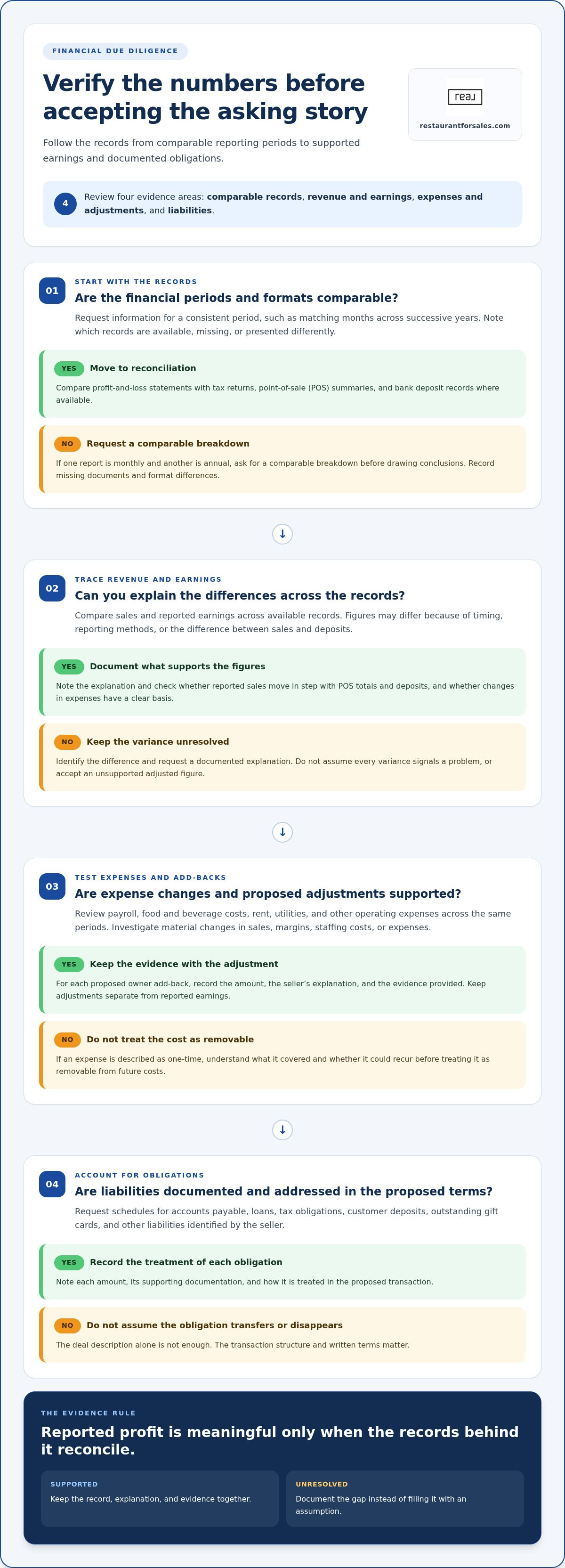
A seller’s asking price may reflect expected future performance, but your decision should be grounded in verifiable records. Request financial information for a consistent period, such as matching months across successive years. Record which documents are available, missing, or presented in different formats. If one report is monthly and another is annual, request a comparable breakdown before drawing conclusions. The U.S. Small Business Administration’s guidance on buying an existing business also emphasizes evaluating the business and its records before proceeding.
Reconcile Revenue, Expenses, and Reported Earnings
Compare profit-and-loss statements with tax returns, point-of-sale (POS) summaries, and bank deposit records where available. The figures may not match exactly because of timing, reporting methods, or the difference between sales and deposits. Identify variances and request a documented explanation rather than assuming every difference signals a problem. Look for patterns: do reported sales move in step with POS totals and deposits, and do changes in expenses have a clear basis?
Review payroll, food and beverage costs, rent, utilities, and other operating expenses across the same periods. Investigate material changes in sales, margins, staffing costs, or expenses, and note whether supporting records explain them. Keep proposed owner add-backs separate from reported earnings. For each adjustment, record the amount, the seller’s explanation, and the evidence provided. If an expense is described as one-time, for example, don’t treat it as removable from future costs without understanding what it covered and whether it could recur.
Reported profit is meaningful only when the records behind it reconcile. If a gap remains, document it as unresolved instead of accepting an adjusted figure without support. The 2026 restaurant valuation guide explains how valuation methods interpret earnings, but reliable inputs still matter.
Identify Obligations That Could Affect the Deal
Request schedules of accounts payable, loans, tax obligations, customer deposits, outstanding gift cards, and other liabilities the seller identifies. Record each amount, its supporting documentation, and how it is treated in the proposed transaction. Don’t assume an obligation transfers or disappears simply because the deal is described as an asset purchase or an entity purchase. The transaction structure and written terms matter.
Use your buying a restaurant checklist to keep the financial review organized:
- Match each reported figure to its available source record.
- Log unexplained variances and request the records or explanation needed to assess them.
- Separate stated earnings from proposed add-backs and document the basis for each.
- List obligations for transaction-specific review instead of assuming who will bear them.
Keep the review tied to the opportunity you’re evaluating. If you’re comparing options, explore restaurant listings using your financial criteria.
Check Restaurant Operations, Equipment, and Staff Against the Records
Paperwork describes how a restaurant is supposed to operate. An on-site review lets you compare that description with the business in practice. Check stated opening hours, service model, staffing patterns, and sales mix against what you observe. For example, consider a claimed lunch service alongside the posted schedule and the actual operating setup. Record when and how you made each observation, and treat one visit as a snapshot rather than a complete picture.
Use a comparison log to turn observations into specific follow-up items. Keep the seller’s statement separate from what you saw and from your interpretation. This makes discrepancies easier to investigate without overstating what a single observation proves.
| Seller representation | Observed evidence | Discrepancy | Follow-up action |
|---|---|---|---|
| Service runs through dinner | Visit occurred during stated dinner hours | Record whether service matched the description | Compare with schedules and operating records |
| Listed equipment is included | Item is present on site | Presence alone doesn’t prove ownership or inclusion | Request ownership or lease documentation |
Inspect Equipment, Inventory, and Included Assets
Walk through the premises with the asset list. For each item, note its description, location, apparent condition, and visible issues. Match the inventory to the deal description, but don’t assign a value based on appearance alone. Presence is not proof of ownership: use available records to mark each item as owned, leased, financed, shared, or excluded. Record maintenance history and reported repair needs for transaction review.
Look beyond major kitchen equipment. Include furnishings, POS hardware, and other assets identified as part of the offer. For records connected to reported income and expenses, the IRS emphasizes the importance of accurate business recordkeeping. Apply the same discipline to asset documentation by noting the source, date, and any remaining gaps.
Assess Operating Continuity and Staff Dependencies
Identify which tasks rely on the seller, a manager, or a particular employee. A process known by only one person may require transition planning. Compare staffing patterns and service routines with the seller’s description, and note differences without assuming they reflect the usual operation. Ask what written procedures exist for opening, closing, ordering, and routine service.
Record key suppliers, ordering processes, operating systems, and any stated arrangements that support daily service. The goal is to understand what the business depends on and what information may be needed for continuity after a change in ownership. Keep this review separate from assumptions about whether employees, supplier relationships, or other arrangements will continue.
A thorough buying a restaurant checklist should leave you with traceable observations, not impressions alone. For every material difference, identify the evidence needed to explain it, who can provide that information, and whether it could affect the deal. This record helps you assess operational readiness alongside the financial and transaction reviews.
Review the Restaurant Lease, Property, and Deal Terms Before Commitment
A restaurant’s listing, lease, and proposed purchase documents may describe different versions of the deal. Compare them before making a commitment. Confirm whether the offer covers business assets, lease rights, real estate, franchise interests, or a combination. A restaurant business sale does not automatically include the premises, and a listing description is not a substitute for written transaction terms.
Assess Lease and Property Continuity
Record the remaining lease term, renewal options, rent structure, assignment provisions, and any stated landlord approval requirements. Distinguish the right to occupy the premises from ownership of the property. If real estate is part of the proposed transaction, identify it separately and compare the description with the deal documents. Treat consent, renewal, and other stated conditions as open items until their status is documented.
The restaurant lease assignment guide provides context on lease-transfer considerations. When reviewing the actual terms, note questions about timing, rent obligations, options, or assignment language for transaction-specific review. Don’t assume the lease will continue unchanged.
Compare Proposed Terms With Diligence Findings
Bring the listing, records, and proposed transaction documents together in one deal matrix. This makes mismatches visible and gives each item a clear follow-up path. Include the stated scope, supporting document, discrepancy, condition or deadline, and person responsible for resolution.
- Purchase scope: Business assets, lease rights, real estate, franchise interests, or a combination.
- Included and excluded items: Compare the written terms with the listing and asset records.
- Conditions and deadlines: Record contingencies, approvals, document dates, and required milestones.
- Open reviews: Flag permits, licenses, contracts, and other items for jurisdiction-specific or qualified legal, tax, or transaction review.
For example, if the listing describes equipment as included but the proposed agreement excludes certain items, log the difference and identify which document governs the current proposal. Don’t resolve a discrepancy by relying on an earlier verbal description. Similarly, record permits, licenses, or contracts that may need review in light of the transaction and location. Don’t presume they transfer or remain usable.
A disciplined buying a restaurant checklist keeps deal scope distinct from diligence findings. Before commitment, make sure each material term has a source, each unresolved issue has an owner and next step, and deadlines are visible. Restaurant buyers and sellers can explore restaurant brokerage and lease assignment opportunities as they assess a potential transaction.
Turn Your Buying a Restaurant Checklist Into a Clear Next Step
Due diligence is useful only when it informs a decision. Bring the evidence together, classify each finding, and compare it with the requirements you set before evaluating the opportunity. A buying a restaurant checklist should clarify your next step, not simply produce a longer list of documents.
Make a Documented Go, Renegotiate, or Pause Decision
Assign each material finding a status and attach the supporting record, observation, or correspondence. Use consistent categories across financial, operational, asset, lease, and transaction reviews:
- Verified: Supported by evidence that matches the claim.
- Explainable: A difference has a documented explanation you can assess.
- Unresolved: Information or evidence needed to reach a conclusion is still outstanding.
- Material concern: A documented issue conflicts with a non-negotiable requirement or changes the opportunity’s fundamentals.
Summarize the evidence, open questions, potential impact, and person responsible for each follow-up. Separate items that could be addressed through revised terms or conditions from those that undermine the acquisition’s fit. Set your decision thresholds before negotiations: identify which facts you need to proceed, which terms you’re prepared to revisit, and which findings would lead you to pause or walk away.
Urgency isn’t evidence. A deadline or the seller’s preferred timetable shouldn’t replace verification of an issue that matters to your decision. If a key document remains unavailable, request it and pause that part of the review rather than treating the gap as resolved. Your next step may be to proceed, renegotiate based on documented findings, request missing evidence, or pause the opportunity.
Move From Diligence Findings to a Practical Opportunity Search
Use the completed review to sharpen your acquisition criteria. Compare restaurant and bar opportunities against the concept, operating role, deal scope, and requirements you’ve already defined. Keep valuation, lease, financing, and transaction questions tied to the information for each listing. A promising headline is no substitute for the evidence you need to assess fit.
If you decide to continue, carry the same documented approach into the next stage. The complete guide to buying a restaurant provides a broader view of the acquisition process, while valuation tools and brokerage resources can help organize questions about a potential transaction. Use these resources to support your evaluation, while grounding your decision in the records and terms you’ve reviewed.
To compare current opportunities against your criteria, explore restaurant listings and buyer resources.
Use Your Findings to Choose the Right Opportunity
A disciplined buying a restaurant checklist does more than evaluate one deal. It helps define what a suitable opportunity looks like, so you can move forward with purpose rather than feeling pressured to accept an imperfect fit. Carry your criteria into each new conversation and use documented information to guide your decision.
When you’re ready to compare opportunities, Restaurant For Sale Marketplace connects restaurant and bar buyers with sellers through active listings, brokerage services, and valuation tools. Use these resources to continue your search with a clearer understanding of what you’re looking for and which questions matter most.
Explore restaurant listings and buyer resources to compare opportunities and take your next step with a clear view of what fits.
Frequently Asked Questions
Can I review a restaurant’s financial records before making an offer?
Buyers can often request financial information during discussions, subject to the seller’s access terms and any confidentiality arrangements. Start by identifying what you need to assess the opportunity, such as earnings reports and supporting records for a defined period. Keep a list of documents received and outstanding. In your buying a restaurant checklist, mark preliminary figures as unverified until you can compare and review the records in context.
What should a restaurant purchase letter of intent include?
A letter of intent commonly outlines proposed deal points, including what is being purchased, price, timing, and conditions. It should also identify diligence items or other open issues that could affect the transaction. The wording and legal effect depend on how the document is drafted, so don’t assume every provision is binding or nonbinding based on its label. Have qualified counsel review the language before relying on it.
Can a restaurant buyer negotiate after finding problems during due diligence?
Yes. A buyer may use documented diligence findings to request clarification, propose revised terms, add suitable conditions, or pause discussions. The right response depends on the issue and the transaction documents. Be specific: explain what you found, cite the supporting record, and state what resolution you’re seeking. For example, if an identified asset is unavailable, clarify in writing whether the parties will revise the included-asset schedule or address the discrepancy another way.
Does buying a restaurant include its equipment?
Not automatically. Equipment may be included, excluded, leased, financed, or owned by another party, so its presence at the restaurant doesn’t establish that it’s part of the sale. Compare the proposed asset schedule with the items on site, and note identifying details such as make, model, or serial number where available. If a piece of equipment is essential to your plans, make its treatment explicit in the written deal documents.
Can a restaurant purchase include seller financing?
Seller financing may be considered if the parties agree, but it isn’t an automatic feature of a restaurant sale. Before evaluating a proposal, clarify the repayment schedule, interest terms, security, default provisions, and any conditions. Consider how the arrangement fits with other funding and the overall purchase structure. Keep preliminary discussions distinct from agreed terms, and have qualified professionals review the final documents before relying on them.
How long does due diligence take when buying a restaurant?
There’s no fixed timeline for every purchase. The review may take longer if records arrive in stages, the transaction includes property or franchise interests, or key questions depend on other parties’ responses. Track requested, received, and outstanding items, and note which tasks depend on earlier information. Use the deadlines in the written transaction terms to plan the review rather than relying on a general estimate.
What happens to gift cards and customer deposits when a restaurant is sold?
Their treatment depends on the transaction structure, the records, and the parties’ written agreement. Request a current schedule of outstanding balances and compare it with available sales or redemption records. Then make clear in the deal documents who will honor each obligation after closing and how any related balance will be handled. Don’t assume the buyer or seller takes responsibility simply because the restaurant changes ownership.


