

What if restaurant experience isn’t the only thing that determines whether you’re ready to own one? Buying a restaurant with no experience can be a responsible step, but enthusiasm alone won’t prepare you for staffing, purchasing, service standards, cash flow, and the pace of daily operations. The key is to understand the learning curve before taking on the business.
If you’re unsure whether an experience gap is manageable or a reason to pause, that’s a sensible concern. Restaurant ownership demands practical operating knowledge, and a listing’s sales or established customer base won’t tell you everything you need to know. Preparation can help you see what you’re equipped to manage, where you need support, and which risks deserve closer review before closing.
This guide explains the responsibilities to expect, ways to build your readiness, and how to assess a restaurant opportunity before making a commitment. You’ll also learn how to look beyond the asking price and choose a measured next step. Restaurant For Sale Marketplace’s restaurant listings, buyer registration, and How To Buy guidance can help you apply that preparation to your search.
Key Takeaways
- Buying a restaurant with no experience can be manageable when you understand the operating demands and prepare for the responsibilities you’ll take on.
- Identify the core skills involved in people, service, food and beverage, purchasing, and financial oversight.
- Compare an owner-operator role with delegated management by considering your time, comfort with decision-making, and available support.
- Assess your personal readiness separately from the business’s records and potential. Both matter before you commit.
- Use your readiness criteria to evaluate listings, and explore Real Broker’s restaurant listings, advanced search tools, and buyer registration at restaurantforsales.com.
Can You Buy a Restaurant With No Experience? Start With the Real Demands
Yes, buying a restaurant with no experience can be a reasonable path, but prior experience helps reveal the realities behind the menu and dining room. Preparation matters because ownership requires more than choosing a concept or taking over an established business. You need to understand how the operation works, recognize when something needs attention, and make informed decisions or involve people with the right expertise.
Owning a restaurant doesn’t mean personally cooking every dish, serving every table, or handling every shift. It does mean remaining accountable for the business as a whole. Delegation can assign tasks, but it doesn’t remove the owner’s need to understand what is being delegated or how operational decisions affect the restaurant.
Restaurant ownership readiness means having enough operational understanding, time, and support to make informed decisions and address gaps before they become larger business risks. That standard doesn’t guarantee success. It gives you a practical basis for judging whether you’re prepared to take responsibility.
What does a restaurant owner actually need to understand?
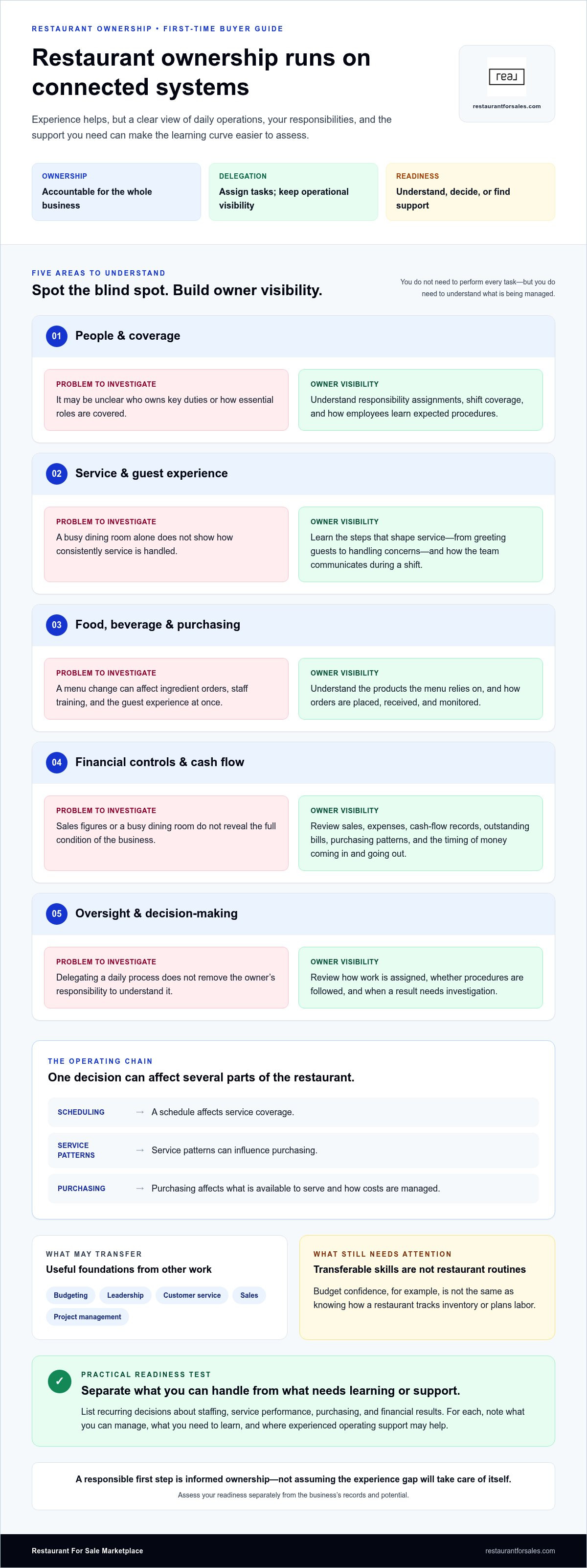
A restaurant connects staffing, service, inventory, customer experience, and financial oversight. A schedule affects service coverage; service patterns can influence purchasing; and purchasing decisions affect what’s available to serve and how the business manages its costs. The details vary by concept, but no area operates entirely on its own.
For a general overview of restaurant formats and operations, see Restaurant. Use that context to frame questions about a specific business, not as a substitute for understanding its operating model. For example, a menu change may affect ingredient orders, staff training, and the guest experience at the same time.
Which skills can transfer from another career?
Experience in budgeting, leadership, customer service, sales, or project management can provide a useful foundation. A manager accustomed to setting expectations and following up may be comfortable overseeing a team. A finance professional may be practiced at reviewing budgets and identifying variances. These capabilities can support ownership, but they don’t automatically teach restaurant-specific routines.
Make an honest inventory of what you’ve done and what you still need to learn. Separate proven strengths from assumptions: confidence with budgets, for instance, isn’t the same as knowing how a restaurant tracks inventory or plans labor. Identify where hands-on exposure, focused learning, or experienced operating support could help close the gap.
Before assessing a particular opportunity, write down the decisions you expect to make regularly: how to respond to staffing issues, review service performance, monitor purchasing, and follow financial results. Then mark which decisions you can handle, which require more knowledge, and which depend on support. This turns a general concern about inexperience into specific questions to investigate during the buying process.
Restaurant Ownership Explained: The Operating Skills a First-Time Buyer Must Build
A restaurant runs through connected systems, not isolated tasks. People deliver service; service shapes the guest experience; food and beverage purchasing determines what the team can prepare; and financial controls help the owner understand how those activities affect the business. The mix varies by concept, but an owner needs enough visibility across these areas to ask useful questions and respond to issues.
- People: Understand who is responsible for key duties and how coverage is organized.
- Service: Know the steps that shape a consistent experience, from greeting guests to handling concerns.
- Food and beverage: Understand the menu and the products the business relies on to serve it.
- Purchasing: Follow how orders are placed, received, and monitored.
- Financial controls: Review sales, expenses, and cash-flow records rather than relying on impressions.
Owners don’t have to personally complete every task on this list. Routine oversight means reviewing how work is assigned, checking whether procedures are followed, and understanding when a result needs investigation. A manager or team member may handle a daily process, while the owner remains responsible for understanding its purpose and monitoring the outcome.
Consistent operating controls give owners a clearer basis for decisions about staffing, purchasing, service, and financial performance. This matters especially when buying a restaurant with no experience. A busy dining room or strong sales figure may look reassuring, but sales alone don’t show the full condition of a business. For example, sales can be substantial while outstanding bills, purchasing patterns, or the timing of cash coming in and going out still need close review.
How do staffing and service affect daily management?
Staffing oversight includes understanding how shifts are scheduled, which roles cover essential duties, and how employees learn the expected procedures. Clear communication helps the team know who handles a guest concern or a change during service. A buyer should learn how these responsibilities are covered in ordinary operations, not just during a walkthrough or busy period.
Ask how information moves between shifts and how managers identify service issues. Consistency depends on shared expectations, clear handoffs, and follow-through. The owner’s role is to understand whether those routines exist and how concerns are raised, even if someone else leads the shift.
Why do inventory and cash-flow controls matter?
Purchasing records show what the restaurant orders and receives; inventory monitoring helps compare those records with what is on hand and what is used. Tracking waste can point to questions that need investigation, while sales records show what customers bought. Each record is more useful when reviewed alongside the others, rather than treated as a standalone sign of performance.
Cash-flow awareness is different from judging a business by its sales. Receipts may come in at a different time than bills are due, so a buyer needs to understand the records, payment obligations, and timing. The Escoffier School of Culinary Arts outlines broader planning considerations, including funding and permits. You can apply your operating questions to actual opportunities by comparing them with Real Broker’s restaurant listings.
How to Judge Your Readiness: Owner-Operator, Delegation, and Risk
There’s no single ownership model that fits every buyer. An owner-operator may be directly involved in daily decisions, while an owner who delegates relies more on managers and established processes. Neither approach guarantees success. The right fit depends on the time you can commit, the decisions you’re prepared to make, and whether capable operating support is available.
A common misconception is that buying a restaurant with no experience means you must already know every detail of restaurant operations. You don’t. But you do need a plan for what you haven’t learned yet. Unassigned responsibilities, unclear decision authority, and no process for reviewing results can turn a knowledge gap into an operational risk.
| Ownership role | Learning needs | Questions to resolve before proceeding |
|---|---|---|
| Owner-operator | Day-to-day service, staff coordination, purchasing, and business records | How much time can you commit? Which daily decisions will be yours? |
| Delegating owner | Performance oversight, financial review, and clear reporting routines | Who will lead operations? How will you review results and address problems? |
| Shared involvement | Defined responsibilities, communication, and decision boundaries | Which tasks belong to you, and which require operating support? |
Is hands-on ownership the right fit for you?
Start by defining the role you actually want, not the role you assume a buyer should take. Estimate the time you can devote, the responsibilities you’re willing to own, and how comfortable you are making frequent decisions as issues arise. Strategic oversight involves reviewing performance and setting priorities; routine involvement may mean coordinating the day’s work or responding to immediate operational needs.
Delegating routine work doesn’t make ownership effortless or risk-free. You still need a dependable way to understand what is happening and act when performance or service raises concerns. Be realistic about how involved you can be, including during periods when the business needs more attention than expected.
How can a buyer cover restaurant-specific knowledge gaps?
Use a deliberate learning plan. Observe operations where possible, study the records and procedures relevant to the business, and identify where experienced operating support is needed. Focus on specific questions, such as how responsibilities are assigned, how purchasing is reviewed, and how issues are escalated. General confidence is not a substitute for understanding how this restaurant functions.
Before proceeding, document who will handle essential decisions, what information they’ll use, and how you’ll review outcomes. For example, identify who is responsible for daily operational decisions and how you, as owner, will receive updates and monitor performance. If you can’t identify who owns a critical responsibility or how you’ll know whether it’s being handled, treat that as a gap to resolve before committing.
Prepare Before You Buy: A First-Time Restaurant Buyer Readiness Checklist
Before assessing a particular restaurant, separate two questions: Is this business a sound opportunity, and are you prepared for the role you intend to take? A promising business doesn’t automatically fit your skills or capacity. Likewise, strong transferable skills don’t replace a careful review of the business itself. When buying a restaurant with no experience, keeping these assessments distinct can help you identify concerns before they get lost in the appeal of a listing.
Work through this checklist in order. Keep notes as you go, especially when an answer depends on an assumption rather than a record or a defined plan.
- Assess your skills. List the experience you can apply immediately, such as budgeting, team leadership, customer service, or project coordination. Separately note restaurant-specific areas where you need learning or support.
- Define your involvement. Describe the time you can commit, the duties you expect to own, and the decisions you’re prepared to make. Identify who could cover essential responsibilities when you’re unavailable.
- Review the records. Examine available financial information, lease terms, operating processes, and relevant business documentation. Compare the records with the seller’s descriptions and the assumptions behind the asking price.
- Identify the gaps. Record missing information, unclear responsibilities, and questions about how the business operates. Decide what needs an answer or a workable plan before you proceed.
- Compare opportunities. Use your role, capacity, and learning needs as criteria when assessing businesses. A concept that depends on skills or time you don’t have may be a poor fit, even if its headline details look attractive.
What should you clarify about your role and capacity?
Write down your intended responsibilities and decision authority. Will you oversee daily operations, focus on financial and strategic review, or share responsibilities with an operating lead? Consider what happens if the person covering a key duty is unavailable. Then mark which skills you can contribute now and where you need support. Put unresolved assumptions on paper before evaluating a specific opportunity, so your answers don’t shift to match a business you already want to buy.
Which business records and operating details deserve attention?
Review financial records alongside the business’s operating processes, and understand the lease terms and other relevant documentation in context. Don’t rely on a seller’s summary or a first impression as a substitute for supporting records. The documents available and relevant can vary by transaction, so note what each one establishes and what remains unclear. For valuation-specific learning, use this restaurant valuation guide to better understand how valuation considerations inform a review.
Once you’ve defined your criteria, use Real Broker’s restaurant listings to compare available opportunities with your intended role and readiness. A structured search makes it easier to focus on fit, not just the appeal of a particular concept.
Find a Restaurant Opportunity That Fits Your Experience and Next Steps
A listing is worth exploring when its demands align with the role you want and the capabilities you can bring. Use your readiness criteria to assess each opportunity, not just its concept or headline details. Consider what the operation requires, how involved you expect to be, and which responsibilities would need support. This makes buying a restaurant with no experience a more structured search, while keeping fit and due diligence ahead of assumptions about profitability.
How can you match a listing to your readiness?
Compare opportunities using the same questions each time. A simple worksheet can help you see where a restaurant fits your intended role and where unanswered questions remain.
- Intended role: Does the business need a hands-on owner, delegated oversight, or a shared approach?
- Operating strengths: Which responsibilities align with your current skills, such as leadership, customer service, or financial review?
- Knowledge gaps: What restaurant-specific processes would you need to learn or cover with operating support?
- Available capacity: Can you realistically meet the time and decision-making demands you expect to take on?
- Open questions: What information about the operation, records, or responsibilities still needs to be understood?
Write down unknowns for each listing instead of filling gaps with assumptions. For example, a business may appear to suit your experience, but the role could depend on operational responsibilities you haven’t planned to manage. Keep those questions visible as you review records and assess the opportunity. A good fit is not a promise of financial performance; it is a business whose demands you can evaluate with care.
For a fuller view of the acquisition process, consult the complete restaurant buying guide. If a potential purchase includes a lease transfer, the restaurant lease assignment guide can help you understand that part of the transaction.
What is a practical next step for a first-time buyer?
Turn your criteria into a focused search. Real Broker provides restaurant listings and advanced search tools to help you explore opportunities, along with buyer registration and How To Buy guidance. Financing assistance is also available as a resource for buyers considering how to approach an acquisition. These tools can support your research, but each opportunity still needs to be assessed against your role, capacity, and due diligence questions.
Real Broker’s restaurant listings and buyer guidance bring together resources for exploring opportunities and learning about the buying process. Use them to narrow your search and keep track of questions as they arise.
Take Your Next Step With a Clear Buying Plan
Make your next move a focused one, not a rushed commitment. Choose the type of opportunity you want to explore and write down the evidence you’ll need to decide whether it fits your plans. That gives you a practical starting point for conversations and keeps your search anchored to your priorities.
Buying a restaurant with no experience doesn’t require pretending every uncertainty is solved. It calls for a disciplined way to investigate what you don’t yet know, weigh the trade-offs, and decide whether the opportunity matches your appetite for responsibility. If a listing raises questions, treat them as part of the decision rather than relying on assumptions.
Real Broker brings restaurant buyers and sellers together and provides buyer resources to support the search. Explore restaurant listings and buyer guidance from Real Broker to take a structured next step toward finding an opportunity that fits your readiness.
Frequently Asked Questions
Can I buy a restaurant with no experience?
Yes, you can consider buying a restaurant with no experience, but treat the learning curve as a real part of the decision. For example, if you’ve managed budgets but never worked with food purchasing, identify how you’ll learn to interpret ordering and inventory records. Assess your transferable skills, intended involvement, and available operating support, then examine the specific business closely. Preparation can reduce avoidable uncertainty, but it can’t guarantee a successful outcome.
Is owning a restaurant harder than working in one?
Ownership usually means being accountable for a wider set of decisions than those involved in a single restaurant job. An employee may focus on service or kitchen duties; an owner also needs to consider how issues are escalated, who has authority to resolve them, and how decisions affect the business. Restaurant work can provide valuable familiarity, but it doesn’t automatically prepare someone for the broader responsibilities and risks of ownership.
What should a first-time restaurant buyer learn before buying?
Learn enough to understand the business’s operating language and evaluate its records. That includes how the restaurant tracks sales, purchasing, staffing responsibilities, and customer concerns, as well as what its lease requires. For instance, if a seller describes a process as “handled by the team,” clarify who owns it and how it’s documented. Then apply those questions to the specific opportunity rather than assuming every restaurant follows the same model.
Can I hire someone to manage a restaurant if I have no experience?
Yes, a buyer may delegate daily management, but still needs a clear oversight plan. Define who can make routine decisions, which issues need the owner’s approval, and what information the manager will report. For example, agree on how operational concerns and financial updates will be communicated, then review them consistently. The arrangement should fit the business and the owner’s capacity; hiring a manager doesn’t remove responsibility or guarantee lower risk.
How do I know if I am ready to buy a restaurant?
You’re better positioned to assess readiness when you can explain the role you intend to take and identify how you’ll address its demands. Try walking through a realistic scenario, such as a key employee being unavailable or a discrepancy appearing in the business records. Can you identify who responds, what information is needed, and how you’ll follow up? If important decisions still depend on guesswork, pause and develop a plan before advancing.
What documents should I review before buying a restaurant?
Review the available financial records, operating information, lease terms, and other documentation relevant to the transaction. Compare records with the seller’s descriptions, and note where periods, categories, or assumptions don’t align. The exact documents and their significance depend on the business and transaction. This educational overview isn’t legal or accounting advice; for broader acquisition context, consult the complete restaurant buying guide.


