

The most valuable restaurant in any market isn't the one with the most famous chef; it's the one that functions perfectly when the owner isn't in the building. If your business relies on your daily presence to survive, you don't own an asset, you own a high-pressure job. Developing a professional restaurant exit strategy is the only way to transition from a hands-on operator to a seller who can command a 7-figure valuation. You likely worry that your staff will quit if they sense a change, or that you'll lose the "goodwill" you've spent years building. These are valid concerns, but they shouldn't stop you from securing your financial future.
We understand that navigating lease transfers and business valuations feels like a second full-time job. This article provides a clear roadmap to maximize your business value while maintaining total confidentiality. You'll learn how to leverage 2026 tax regulations, including the $2,560,000 Section 179 deduction limit and permanent 100% bonus depreciation, to make your business more attractive to investors. We'll show you how to depersonalize your operations to ensure a smooth transition and find a qualified buyer quickly. By the end of this guide, you'll have the tools to protect your legacy and exit on your own terms.
Key Takeaways
- Learn why the "Exit Paradox" means the best time to implement a restaurant exit strategy is while your business is thriving, not when you are ready to walk away.
- Understand the differences between Asset Purchase Agreements and stock transfers to select the most efficient structure for your ownership transition.
- Master the financial metrics that drive valuation, specifically the distinction between EBITDA and Seller’s Discretionary Earnings (SDE).
- Discover how to maintain operational confidentiality by using blind profiles to attract qualified buyers without identifying your location.
- Identify why professional brokerage services act as a vital buffer to manage negotiations and navigate complex lease assignment requirements.
What is a Restaurant Exit Strategy and Why Do You Need One Now?
A professional restaurant exit strategy is more than just a "for sale" sign. It is a formal, documented roadmap for transferring ownership and withdrawing the maximum amount of equity from your business. While the term business exit strategy is often used in corporate finance, in the hospitality world, it means ensuring your years of sweat equity translate into a liquid asset. This plan dictates how you will handle everything from financial disclosures to the final lease assignment, ensuring the transition is profitable and legally sound.
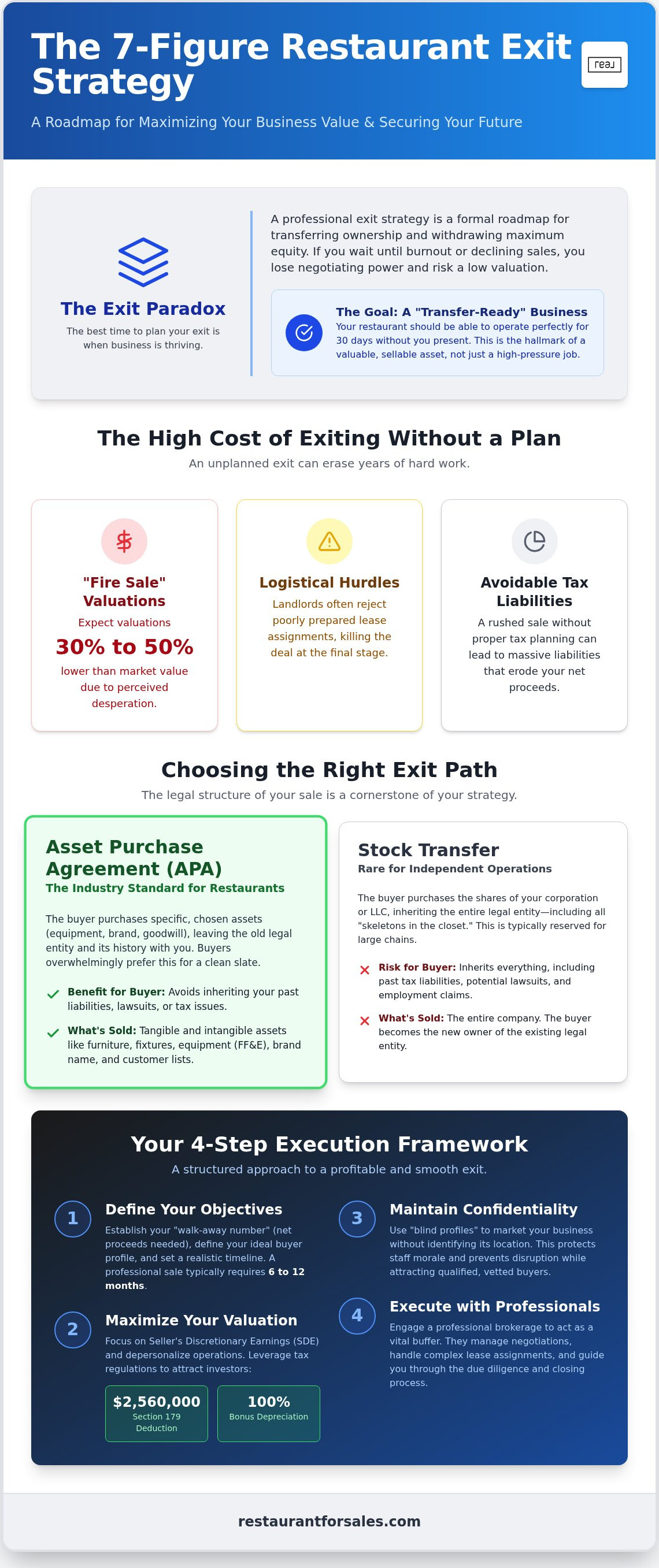
Most owners wait until they are exhausted or the books are in the red to think about selling. This creates the "Exit Paradox." The best time to plan your departure is when your restaurant is thriving. When sales are up, operations are streamlined, and staff is stable, you have maximum leverage with buyers. If you wait for a decline in revenue or an impending lease expiration to start the process, you lose your negotiating power and risk walking away with significantly less than the business is worth.
Owners typically pursue an exit for three primary reasons. Financial drivers focus on achieving a high Return on Investment (ROI) after years of growth. Lifestyle drivers involve transitions like retirement or avoiding the physical and mental toll of burnout. Strategic drivers occur when an owner wants to pivot to a new concept or capitalize on a high-value market trend. Regardless of the motivation, the goal is to make the business "transfer-ready." A transfer-ready restaurant is one that can operate for 30 days without the owner present.
The Consequences of Exiting Without a Plan
Exiting on a whim leads to "fire sales." These rushed transactions often result in valuations that are 30% to 50% lower than market value because the seller appears desperate and the business lacks organized records. Beyond the price, you face significant logistical hurdles. Landlords often reject lease assignments if the buyer's financials or the transfer paperwork aren't handled with precision, which can effectively kill the deal at the eleventh hour. Additionally, unplanned exits often lead to massive, avoidable tax liabilities that eat into your hard-earned proceeds.
Setting Your Exit Objectives
Success starts with determining your "walk-away number." This represents the specific net amount you need after paying taxes, legal fees, and brokerage commissions to meet your post-sale requirements. You must also identify your ideal buyer profile. Decide if you want an individual operator who will maintain your day-to-day culture or a strategic investment group looking for a turnkey acquisition. Establishing a realistic timeline is also vital. A professional sale typically requires 6 to 12 months to execute properly, allowing for valuation, marketing, and the complex due diligence process.
Choosing the Right Exit Path: Asset Sales vs. Stock Transfers
The legal structure of your transaction is a cornerstone of a successful restaurant exit strategy. Most owners assume they are simply selling "the business," but the technical distinction between an asset sale and a stock transfer drastically changes your tax liability and legal exposure. Understanding How to Create an Exit Plan requires a deep dive into these two paths. In the hospitality industry, the Asset Purchase Agreement (APA) is the standard. Conversely, stock sales are generally reserved for large multi-unit groups or corporations where the entity itself holds significant permits or contracts that are difficult to move.
The primary difference lies in what the buyer actually acquires. In a stock sale, the buyer purchases the shares of your corporation or the membership interests of your LLC. This means they inherit everything, including your past tax liabilities, potential lawsuits, and employment claims. In an asset sale, the buyer only purchases specific items, such as the equipment and the brand name, leaving the old legal entity and its "skeletons" with the seller. For most independent restaurants, an asset sale is the only way to attract a buyer who wants a clean slate.
The Asset Sale: Why Buyers Prefer It
Buyers overwhelmingly prefer asset sales due to the concept of successor liability. By purchasing assets rather than the company itself, they avoid being held responsible for your past mistakes. This structure also provides significant tax advantages for the buyer. Under the One Big Beautiful Bill Act (OBBBA), buyers can utilize 100% bonus depreciation for qualified property, allowing them to fully expense kitchen equipment and buildouts in the first year. This makes your restaurant a more attractive investment. A typical APA includes:
- FF&E: Furniture, Fixtures, and Equipment.
- Inventory: Food, beverage, and liquor stocks, usually valued at cost at the time of closing.
- Goodwill: The value of your brand, reputation, and customer base.
- Excluded Assets: Items like personal vehicles or family heirlooms that are not part of the deal.
Franchise Resales and Leasehold Interests
If you are selling a franchise, the process involves a third party: the franchisor. You must account for the Franchise Transfer Fee and secure their approval for the new operator. Even for non-franchised businesses, the "Leasehold Interest" is often the most valuable asset. If your restaurant is currently break-even but sits in a prime location with a below-market rent, the lease itself has significant value. The landlord acts as the final gatekeeper. They must approve the "Assignee" based on their financial strength and operational experience. Securing a professional restaurant valuation early helps you understand how much of your asking price is tied to tangible assets versus the value of your lease and location.
Lease assignments are the pivot point of nearly every deal. If the landlord refuses to transfer the lease or demands unreasonable changes to the terms, the sale will likely fail. You must ensure your restaurant exit strategy includes a thorough review of your "Assignment and Subletting" clause long before you enter escrow. A clean lease transfer ensures you are released from future personal guarantees, allowing for a total break from the business.
Maximizing Valuation: The Financial and Operational Levers
Valuation is not a guessing game; it's a calculation of risk and reward. To execute a successful restaurant exit strategy, you must understand how buyers view your profit. While corporate buyers look at EBITDA (Earnings Before Interest, Taxes, Depreciation, and Amortization), most independent restaurant sales rely on Seller’s Discretionary Earnings (SDE). SDE calculates the total cash flow available to a single owner, including your salary, benefits, and non-essential business expenses. Identifying these "add-backs" is critical to showing the true earning potential of the business.
Common add-backs include personal health insurance, vehicle leases, and non-recurring repairs. You should also account for the FICA tip credit, which can save a mid-size restaurant $40,000 to $80,000 annually. Highlighting these savings demonstrates a sophisticated handle on your finances. Clean books are the only way to secure SBA financing for your buyer. Most lenders require three years of consistent tax returns. If your profits are hidden in "cash" transactions that don't appear on your returns, they don't exist in the eyes of a bank or a qualified buyer. Transparency directly correlates to a higher sales price.
Normalizing Your Financial Statements
Normalization is the process of stripping away one-time events to show a "typical" year of operation. If you replaced a walk-in cooler this year for $25,000, that expense should be categorized as a capital expenditure rather than a standard maintenance cost. This prevents a temporary dip in profit from lowering your overall valuation multiple. Always remember that a buyer is purchasing future cash flow, not your past hard work. They want to see a stable trajectory of earnings that will continue after the keys change hands.
The Operational Multiplier
Your financial profit is the "base" of your value, but your operations provide the "multiplier." A restaurant with documented Standard Operating Procedures (SOPs) is worth significantly more than one where the owner keeps all the recipes and vendor contacts in their head. You must avoid the "Chef-Dependent" trap. If your business relies entirely on a single head chef who might leave after the sale, the buyer sees massive risk. Mitigate this by training sous-chefs and systematizing the kitchen. Technology also acts as a value-add; integrated POS data and loyalty programs provide the "proof of concept" and customer data that modern investors crave. Since labor typically accounts for 30-35% of revenue, showing a buyer that you have automated scheduling and inventory systems can justify a premium price.
The Confidentiality Framework: Selling Without Disruption
Maintaining secrecy is the most challenging component of a restaurant exit strategy. A public listing is often the "kiss of death" for an active operation. If employees, vendors, or competitors discover a sale is pending, the resulting instability can erode the very value you are trying to protect. Staff may preemptively quit, vendors might tighten credit terms, and competitors often use the uncertainty to poach your regular customers. To prevent this, professional brokers utilize a "Blind Profile." This document highlights the financial performance and general location without revealing the specific name or address of the business.
Before any sensitive data is shared, every prospect must sign an ironclad Non-Disclosure Agreement (NDA). This legal shield ensures that the details of your operations remain private. However, an NDA is only the first layer of defense. You must also vet buyers for their financial capability and operational experience before disclosing your identity. Requesting a "Proof of Funds" or a professional resume ensures you aren't wasting time or risking exposure with unqualified looky-loos. You can access pre-vetted buyers through professional Restaurant Brokerage Services that specialize in keeping transactions under the radar.
Managing Staff and Customer Perception
Information should follow a strict "Need-to-Know" hierarchy. Your general manager might need to know once a Letter of Intent (LOI) is signed, but line staff shouldn't be informed until the deal is nearly closed. To ensure transition stability, consider drafting a "Stay Bonus" for key managers. Since labor costs typically account for 30-35% of revenue, losing a manager during a sale can be a catastrophic financial hit. A bonus paid out 90 days post-closing incentivizes them to support the new owner. When buyers request "Secret Shop" visits, instruct them to act as regular customers. They should never ask staff questions or take photos during service hours.
Professional Marketing of Your Listing
Generic business listing sites are often too broad and lack the nuance required for hospitality. Use specialized marketplaces that cater specifically to restaurant investors. Professional photography is essential, but it must be strategic. Capture the quality of the buildout, the kitchen's cleanliness, and the dining room's atmosphere without including identifiable signage or local landmarks. These images populate your Offering Memorandum (OM), a comprehensive document that presents the full financial and operational picture of your restaurant to serious, vetted buyers. This methodical approach ensures you find the right match without disrupting your current cash flow.
Executing the Exit: Professional Brokerage and Closing
Executing the final phase of a restaurant exit strategy requires a high degree of technical precision. Many owners consider a "For Sale By Owner" (FSBO) approach to avoid commissions, yet these transactions frequently collapse during the complex due diligence or lease assignment stages. A restaurant sale is an emotionally charged event. A professional broker acts as a pragmatic buffer, managing the friction between a buyer’s scrutiny and a seller’s years of personal investment. This mediation keeps the transaction focused on objective financial data and legal requirements rather than personal sentiment.
The transition begins in earnest once a Letter of Intent (LOI) is signed. This document outlines the price and terms but is followed by a rigorous due diligence period. During this window, the buyer verifies every financial claim, inspects kitchen equipment, and reviews the historical labor and food costs. Once the buyer is satisfied, the deal moves to the closing table. This stage involves an escrow company that facilitates the secure transfer of funds. You must coordinate the proration of utilities, taxes, and rent, alongside a final physical inventory count of food and beverage stock on the day of the handover to finalize the closing statement.
The Value of a Specialized Restaurant Broker
A specialized broker provides more than just a listing; they offer access to a proprietary database of pre-vetted buyers who have already demonstrated financial capability. They also possess the specific expertise required to navigate Alcoholic Beverage Control (ABC) license transfers, which can be the most significant bottleneck in a transaction. Before you list your business, it's essential to engage professional Restaurant Valuation Services. This ensures your asking price is grounded in market reality and can withstand the scrutiny of a buyer’s lender during the financing process.
Final Steps: Post-Closing and Handover
The transaction isn't complete the moment the funds clear. A standard handover typically includes a training period of 2 to 4 weeks. During this time, you'll introduce the buyer to key vendors and walk them through your documented Standard Operating Procedures (SOPs). You also need to transfer all digital assets, such as social media handles, Google My Business profiles, and domain names. This professional transition preserves the "goodwill" you've worked hard to build and ensures the business continues to thrive under new ownership. If you're ready to start the process, it's time to take the first step toward your next venture.
Get a Professional Opinion of Value for Your Restaurant
Secure Your Financial Future and Legacy
A profitable exit is the culmination of years of hard work, but it requires a disciplined approach to be successful. By shifting your focus from daily operations to building a transfer-ready asset, you ensure that your restaurant exit strategy delivers the maximum possible return. Value is rooted in clean financial records, documented systems, and a carefully managed confidentiality framework that protects your current cash flow. Managing the technical complexities of lease assignments and ABC transfers is not something you should handle alone. Professional guidance ensures you avoid the common pitfalls that lead to deal fatigue or collapsed escrows.
Ready to exit? List your business with the experts at Restaurant For Sale Marketplace. We provide national reach combined with local expertise, operating on success-based commissions to align our goals with yours. Our team specializes in the intricate details of restaurant transactions, from professional valuations to complex regulatory transfers. You've built a legacy; now it's time to secure the reward you deserve.
Frequently Asked Questions
How long does it typically take to sell a restaurant?
A professional sale typically requires 6 to 12 months from the initial listing to the final closing table. This timeline accounts for the valuation phase, marketing the blind profile, vetting potential buyers, and navigating the due diligence period. External factors like landlord approval for lease assignments or ABC license transfers can extend this duration. Maintaining consistent operations during this window is vital to preserving your valuation.
Can I sell my restaurant if I don't own the real estate?
Yes, the majority of restaurant transactions involve the sale of the business and its leasehold interest rather than the physical real estate. In these cases, the value lies in the equipment, the brand's goodwill, and the rights to a favorable lease in a prime location. You must ensure your restaurant exit strategy includes a review of your assignment clauses to facilitate a smooth transfer of the existing lease to the new owner.
What is the average valuation multiple for a profitable restaurant?
Profitable independent restaurants generally trade at a multiple of 2 to 4 times their Seller’s Discretionary Earnings (SDE). Larger groups or franchised operations may command higher multiples based on EBITDA. Several factors influence this number, including your lease terms, the condition of your FF&E, and how much the business depends on your daily presence. Stronger systems and documented SOPs typically push the multiple toward the higher end of the range.
Should I tell my employees I am planning an exit strategy?
Confidentiality is paramount to prevent staff turnover and maintain customer loyalty. You shouldn't inform your general staff about your restaurant exit strategy until a deal is nearly finalized. Only key management personnel should be notified, and often only after a Letter of Intent is signed. Using stay bonuses can help retain these essential employees during the transition period without disrupting the daily flow of the business.
What documents do I need to prepare for a restaurant due diligence?
You must compile three years of profit and loss statements, balance sheets, and federal tax returns. Additionally, have your current lease agreement, health department permits, and any equipment maintenance records ready for review. Buyers will also scrutinize your labor reports and food cost percentages. Organized records instill confidence in the buyer and their lenders, often accelerating the closing process and reducing the risk of the deal falling through.
How do I handle a lease assignment with a difficult landlord?
Approach the landlord with a professional package that includes the buyer's financial statement and operational resume. Difficult landlords often respond better to a neutral third party, such as a broker, who can present the new tenant as a lower risk than an empty storefront. Ensure the buyer meets the financial requirements specified in your original lease. If the landlord remains uncooperative, legal counsel may be necessary to enforce the "reasonableness" clause found in most commercial agreements.
Is a professional valuation worth the cost before listing?
A professional valuation is a critical first step that prevents you from underpricing your business or scaring away buyers with an unrealistic asking price. It provides an objective baseline for negotiations and identifies specific areas where you can improve operations to increase your final take-home pay. Most lenders require a formal valuation to approve buyer financing, so having this data prepared early streamlines the entire transaction process.
What happens to my liquor license when I sell the business?
In an asset sale, the liquor license is typically transferred from the seller to the buyer through the state’s Alcoholic Beverage Control (ABC) agency. This process involves an escrow account to hold the license and funds while the state conducts its investigation. The transfer can take 60 to 90 days depending on the jurisdiction. You must ensure all taxes and fines are paid in full, as any outstanding liabilities will block the transfer.


