

The moment your staff hears a whisper that the business is for sale, your restaurant's valuation begins to erode. It's a harsh reality in an industry where morale and consistency drive the bottom line. You likely feel significant anxiety about managing secret buyer tours or the risk of a mass resignation. Learning how to sell a restaurant without employees knowing is not just about privacy; it's a critical asset protection strategy designed to preserve your EBITDA and business stability until the deal is finalized.
You've worked hard to build a loyal team, and we agree that protecting their morale is paramount during a transition. This guide provides the exact steps to maintain total confidentiality throughout your sale to ensure a successful closing without operational disruption. We will preview the professional protocols of blind listings, the strategic use of non-disclosure agreements, and how to leverage expert brokerage to keep your transition under wraps until the final handover. By following this methodical approach, you can protect the reputation of your establishment and maintain high service standards until the moment of the official announcement.
Key Takeaways
- Protect your business valuation by preventing staff turnover through a structured, confidential sales process.
- Utilize blind listings and ironclad non-disclosure agreements to master how to sell a restaurant without employees knowing.
- Schedule discreet property tours during off-hours or utilize professional cover stories to maintain operational normalcy during due diligence.
- Identify the specific "point of no return" to determine exactly when to inform your team and ensure a seamless handover to the new owner.
- Leverage a professional restaurant broker to act as a secure buffer, vetting potential buyers and managing inquiries to keep your identity private.
Why Confidentiality is Critical When Selling a Restaurant
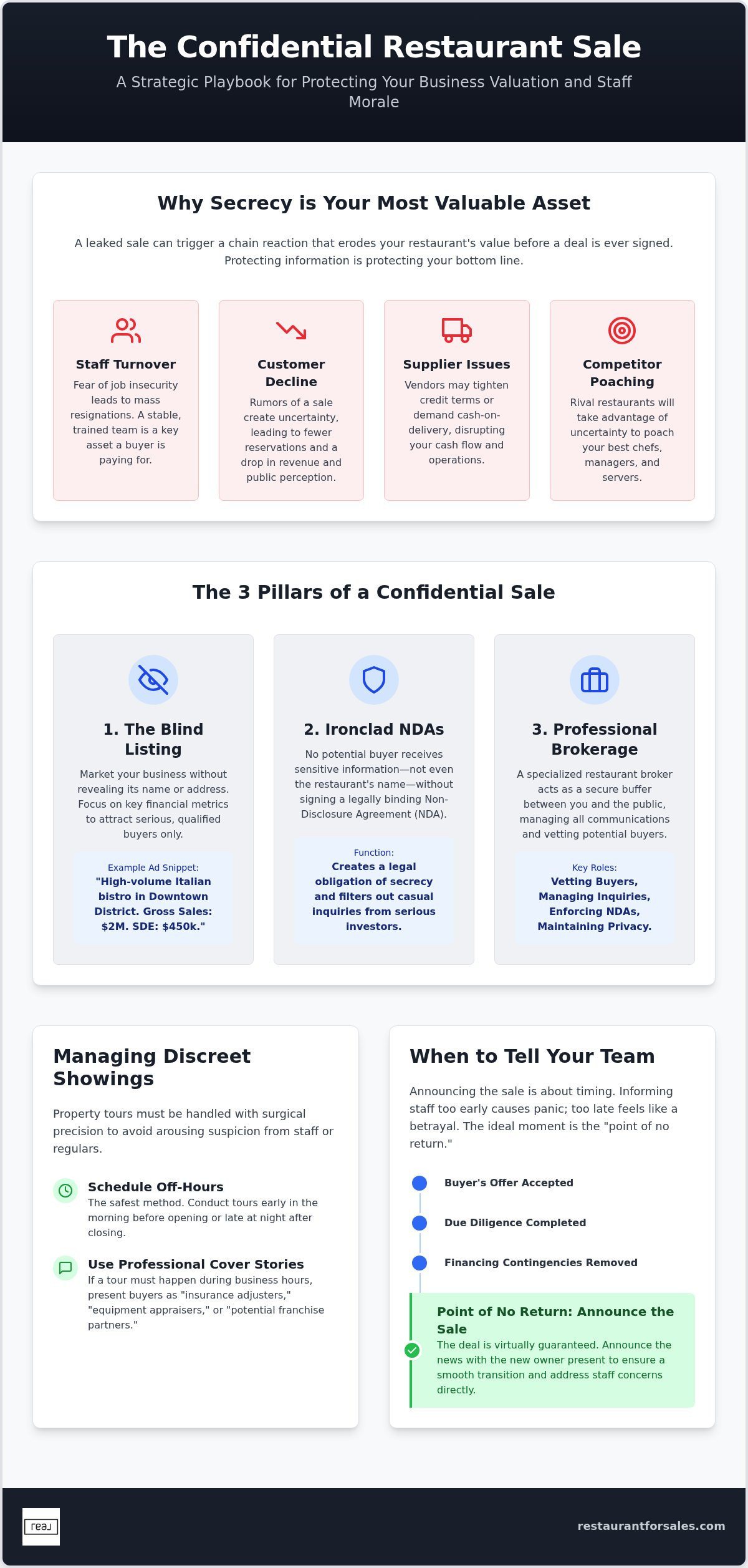
Selling a restaurant is a high-stakes transaction where information is your most valuable currency. A confidential sale involves identifying and vetting buyers without ever listing the business name on public platforms or social media. This strategic approach is essential for anyone researching how to sell a restaurant without employees knowing because it prevents the immediate destabilization of your daily operations. By keeping the listing "blind," you ensure that only qualified, serious parties gain access to sensitive details while your competitors and staff remain unaware of the pending transition.
Protecting staff morale is perhaps the most urgent reason for secrecy. When employees sense a change in ownership, a "sinking ship" mentality often takes hold. They may worry about job security, potential changes to their shifts, or new management styles, leading them to seek alternative employment immediately. A stable, trained workforce is one of your most significant assets during an asset transfer. If your head chef or lead manager leaves during the listing period, your business valuation drops instantly because the buyer is no longer inheriting a turnkey operation.
Vendor and supplier relationships also require careful management. If news of a sale leaks prematurely, suppliers might tighten credit terms or demand COD payments out of caution. Maintaining these professional relationships requires keeping the transaction private until the final stages. A professional Business Broker acts as a necessary intermediary in this process, managing inquiries and ensuring that no one discovers the owner's identity without first proving their financial capability and signing a binding agreement.
The Financial Risk of a Leaked Sale
Staff turnover is more than an HR headache; it's a direct hit to your bottom line. Hiring and training new staff during a sale process is expensive and distracting. Competitors are often the first to hear rumors, and they won't hesitate to poach your best talent during a period of uncertainty. When a buyer sees a revolving door of employees, they'll likely demand price concessions to offset the risk of operational failure. Confidentiality ensures you maintain the high service standards that justified your original valuation.
Protecting Your Customer Base
Customers value consistency and reliability. Rumors of a sale can lead to a decline in reservations as diners fear a drop in food quality or service standards under new ownership. You must ensure the brand reputation remains intact throughout the entire transaction to prevent a dip in revenue. If the community perceives the business is in flux, the resulting drop in foot traffic will negatively impact your trailing twelve months (TTM) of earnings. The final sale price of your establishment is directly tied to the public's perception of its ongoing stability and future growth potential.
Core Strategies for Selling a Restaurant Without Employees Knowing
Mastering how to sell a restaurant without employees knowing requires a multi-layered approach to information security. It isn't enough to just keep a secret; you need a system that filters out curiosity seekers while attracting serious investors. This begins with the way you present the opportunity to the market. By controlling the flow of data, you protect your operation's integrity while building a competitive bidding environment. Effective strategies ensure that your staff remains focused on service while you manage the complexities of the transfer behind the scenes.
The Power of the Blind Listing
A blind listing is your first line of defense. It describes the business without revealing its name or specific street address. Instead of identifying your brand, your ad should highlight the Importance Of Confidentiality by using generic but descriptive terms like "High-volume Italian bistro in Downtown District." Focus on the financial metrics that matter to buyers, such as the Seller’s Discretionary Earnings (SDE) and gross annual sales. Between 2021 and 2025, restaurants sold for an average revenue multiple of 0.39x, and highlighting these figures attracts serious professionals. Professional marketplaces host these listings securely, ensuring your brand identity remains hidden from casual browsers and current staff members.
Enforcing Non-Disclosure Agreements (NDAs)
Before a buyer sees a single financial statement or the restaurant's name, they must sign a binding Non-Disclosure Agreement. Verbal promises are insufficient in commercial transactions. A standard restaurant sale NDA should include specific clauses to protect your interests:
- Non-solicitation clauses to prevent buyers from poaching your trained staff.
- Communication prohibitions that forbid contacting employees, vendors, or the landlord directly.
- Strict penalties and legal remedies for any breach of confidentiality protocols.
Legal ramifications for breaching these protocols are severe. If a buyer leaks the sale, they can be held liable for any subsequent drop in business value. This legal framework ensures that only those with a genuine intent to purchase move forward.
Vetting potential buyers is the next critical step. You should confirm their liquid capital and industry experience before sharing the full Offering Memorandum. This document contains everything from tax returns to lease details. By limiting the distribution of this sensitive information to only a handful of qualified leads, you minimize the risk of a leak. Obtaining a professional restaurant valuation can help you determine the right price point to attract these high-caliber buyers without overexposing your business to the general public. When you control the narrative, you maintain the leverage needed for a successful closing.
Managing Discreet Property Showings and Due Diligence
Transitioning from signed non-disclosure agreements to physical site visits is the most vulnerable phase of a confidential sale. This is where the abstract process of how to sell a restaurant without employees knowing becomes a logistical challenge. You must coordinate buyer walkthroughs without disrupting the flow of service or triggering suspicion among your most observant staff. Maintaining this facade requires a disciplined schedule and a clear narrative for any outsider presence on the property.
Scheduling Covert Tours
Timing is the most critical factor when planning a walkthrough. Early morning tours, typically between 6:00 AM and 9:00 AM, are often superior to late-night visits. While late-night tours avoid the lunch rush, closing shifts often involve lingering staff and deep-cleaning routines that make privacy difficult. Early morning allows the buyer to see the facility in natural light while the building is empty. If your managers typically hold the keys or alarm codes, you should personally handle the opening and closing for these appointments to avoid questions about why a supervisor's access was bypassed.
When staff members are present during a visit, you need a pre-planned explanation. A highly effective tip is to introduce the buyer and broker as "insurance auditors" or "equipment appraisers" conducting a routine valuation for a policy renewal. This aligns with standard business operations and explains why a stranger is taking notes or inspecting the kitchen line. If the buyer needs a more in-depth look, schedule a secondary meeting at a neutral off-site location, such as a quiet coffee shop or a professional office, to discuss sensitive financial details away from the restaurant floor.
Handling the Due Diligence Phase
The due diligence period involves a deep dive into your financial records, health department reports, and lease agreements. To keep this information secure, utilize a digital data room rather than keeping physical files in the restaurant's back office. This ensures that no curious employee accidentally discovers a profit and loss statement or a draft of the purchase agreement. Your broker facilitates this exchange, acting as a buffer so you don't have to spend hours on the phone or in meetings that might look suspicious to your team.
Involving the landlord is another sensitive but necessary step. Most transactions require a lease assignment, meaning the landlord must eventually enter the "confidentiality circle." Secure their cooperation early by emphasizing that a quiet transition protects their rental income and the stability of the property. While it's difficult to keep the secret forever, your goal is to delay the announcement until the deal is fully funded. You can find more expert guidance on how to eventually Tell Employees You're Selling The Business once the contingencies are removed. Until that moment, every interaction must be calculated to preserve the status quo.
When and How to Tell Employees About the Sale
The successful execution of a confidential sale culminates in the final announcement to your team. Up to this point, your primary focus has been on how to sell a restaurant without employees knowing to protect the business valuation and operational flow. However, once you reach the "Point of No Return," the strategy shifts from secrecy to transparency. This point occurs only when the deal is fully funded, all contingencies are removed, and the purchase agreement is executed. Announcing the transition any earlier risks a "lame duck" period where staff performance drops or key talent departs before the new owner can secure their loyalty.
For most small to mid-sized establishments, the ideal window for this announcement is 24 to 48 hours before the official handover or public press release. This brief period prevents the rumor mill from distorting the facts while giving your staff enough time to process the news before their next shift. If your business is larger, you must also consider federal mandates like the Worker Adjustment and Retraining Notification (WARN) Act, which requires a 60 day advance notice for mass layoffs or site closings in businesses with 50 or more employees. For standard ownership transfers where the staff remains in place, a shorter, more controlled window is usually the most professional approach.
The Timing of the Announcement
Prematurely revealing a sale is the most common mistake sellers make. It creates immediate anxiety that can lead to a decline in service standards during the final, critical days of the transaction. You should coordinate the talk specifically with the buyer to show a united front. This demonstrates to the staff that the transition is a planned, professional evolution rather than a sudden abandonment. When you stand alongside the new owner, it reinforces the message that the business is stable and their roles are valued by both the outgoing and incoming leadership.
Managing the Emotional Transition
When breaking the news, focus the conversation on the "New Chapter" and the growth opportunities the buyer brings to the table. Employees will have immediate concerns regarding their payroll, schedules, and specific management changes. Address these points directly with clear, documented answers. To ensure your most critical personnel remain through the transition, consider offering "stay bonuses" that are paid out after a successful 30 or 60 day period under the new ownership. This provides a financial incentive for them to maintain high standards during the sensitive handover period.
You can use this template sentence as a starting point for the meeting: "I have decided to transition the business to a new owner who shares our commitment to quality, and I want to personally assure you that your roles remain a vital part of this establishment's future success." Providing this level of clarity helps settle nerves and preserves the reputation you've spent years building. If you are ready to begin this process with a professional partner, you can list your restaurant for sale today to ensure every step of your exit is handled with the highest level of confidentiality.
How a Professional Restaurant Broker Protects Your Privacy
Engaging a specialist is the most effective way to manage the high-stakes complexities of a confidential transaction. When you are determining how to sell a restaurant without employees knowing, a broker serves as your primary defense against accidental disclosure. They manage the entire outreach process, ensuring your name and location stay hidden until a buyer is fully vetted. This professional distance allows you to focus on daily operations while the broker handles the high-pressure environment of the marketplace. You don't have to manage the stress of direct inquiries. Such interactions often lead to slips in confidentiality during casual conversation.
The Broker as a Shield
Brokers act as a filter for "tire kickers," which are individuals who lack the capital or genuine intent to purchase. These are often curious locals or direct competitors seeking insider information about your margins or labor costs. A broker requires a signed NDA and a verified financial statement before releasing any identifying details. By using a national platform like Restaurant For Sale Marketplace, you reach a broader audience beyond your immediate geographic circle. It's a strategic advantage. Buyers from different regions are less likely to leak news locally since they have no existing ties to your staff or the local community. Professional mediation ensures that the first time your employees hear about a change is when you choose to tell them, not through a rumor started by an unvetted visitor.
Valuation and Strategy
A precise valuation is essential for a swift, quiet exit. If a listing lingers on the market too long, the risk of a confidentiality breach increases exponentially. Between 2021 and 2025, restaurants sold for a median price range of $220,000 to $225,000, typically at an average of 2.15 times the Seller's Discretionary Earnings (SDE). An expert broker uses these benchmarks to set a realistic price that attracts serious investors quickly. This efficiency reduces the "time on market" and narrows the window for potential leaks.
Beyond the listing, brokers handle the technical hurdles of lease assignments and franchise transfers. These stages often involve multiple third parties where secrecy is difficult to maintain. A seasoned facilitator knows how to navigate these conversations with landlords and franchisors without alerting the general public. They use secure digital systems to manage the paper trail. This ensures that sensitive financial records and NDAs are never stored where an employee might find them. To begin your transition with a tailored, secure strategy, consult with a professional broker to plan your confidential exit. This ensures your legacy, staff morale, and business valuation remain protected until the final handover is complete.
Secure Your Successful Exit Today
Protecting your business valuation and staff morale depends entirely on your ability to maintain total discretion throughout the sales process. By utilizing blind listings and strict non-disclosure agreements, you prevent the operational instability that often follows a leaked sale. Mastering how to sell a restaurant without employees knowing is a calculated strategy that preserves your legacy while you seek the right successor. Partnering with a specialist allows you to focus on daily service while an expert handles the high-stakes negotiations behind the scenes.
Our team provides expert restaurant brokerage services and professional valuation to maximize your exit price while keeping your identity private. We leverage a national network of qualified buyers to find the perfect match for your establishment without alerting local competitors or your workforce. You deserve a transition that is as efficient as it is profitable. List your restaurant confidentially on our marketplace today to take the first step toward a successful closing. Your professional exit starts with the right partner.
Frequently Asked Questions
Is it legal to sell a business without telling the employees first?
It's entirely legal for most restaurant owners to sell without prior notification to staff. Federal law, specifically the WARN Act, only mandates a 60 day notice for mass layoffs at sites with 50 or more employees. For smaller operations where jobs are preserved, you have no legal obligation to disclose the transaction until it's finalized. Always consult with legal counsel to ensure compliance with specific state labor laws that may have stricter requirements.
What is a blind listing in the context of a restaurant sale?
A blind listing is a marketing technique where you advertise the business's financial performance and assets without revealing its name or exact location. This is a primary tool for anyone looking for how to sell a restaurant without employees knowing. It allows you to attract serious investors based on profitability and equipment while keeping your brand and identity hidden from casual browsers and current staff.
How do I handle a buyer who wants to talk to my manager before buying?
You should strictly prohibit direct communication with managers until after a Letter of Intent is signed and due diligence is nearly complete. Allowing a buyer to speak with staff too early creates unnecessary panic and risks a leak. If a buyer insists, explain that protecting the workforce is essential for the business's valuation. Arrange for a meeting only after the deal is essentially guaranteed and contingencies are removed.
What happens if an employee finds out about the sale prematurely?
If a leak occurs, you must address it immediately with a prepared statement to prevent rumors from spiraling. Confirm that you're exploring options to ensure the restaurant's long term success but emphasize that it's business as usual. Focus on the fact that any potential new owner would value their expertise. Swift communication helps stabilize the environment and prevents a mass resignation that could kill the deal.
Should I have my employees sign stay-on bonuses or contracts?
Stay bonuses are effective tools for retaining key personnel during a transition. These are typically structured as a one time payment given after the employee remains with the new owner for a set period, such as 90 days. While you can't force an employee to stay, these financial incentives provide the stability buyers look for during an asset transfer. Contracts should be drafted by a professional to ensure the terms are clear and enforceable.
How can I keep the landlord from telling the staff about the sale?
You should include a confidentiality requirement in your initial discussions regarding a lease assignment. Landlords generally want a stable tenant, so explain that a secret sale protects the rent flow by preventing a drop in business. Ensure they understand that any leak to the staff could jeopardize the entire transaction. Most professional landlords will respect this to avoid the risk of a vacant space.
Can I sell my restaurant to my employees if they find out and want to buy it?
Selling to employees is a viable option, but you must treat them like any other buyer. They must sign a non-disclosure agreement and provide proof of funds or a pre-approval letter from a lender. If they can't meet the financial requirements, you need to be firm about continuing with third party buyers. It's vital to keep the professional relationship separate from the potential transaction.
What is the most common way confidentiality is breached in a sale?
The most frequent breach occurs through unvetted "tire kickers" who visit the restaurant and ask suspicious questions to the staff. This is why using a professional broker is critical. Another common slip happens when owners discuss the sale in public areas or leave sensitive documents on office computers. Maintaining a strict "need to know" basis is the only way to ensure total privacy until the handover.


