

A restaurant's profit and loss statement tells you how the business performed, but it rarely explains why it might fail under new ownership. Without a rigorous restaurant due diligence checklist, you risk inheriting hidden tax liabilities, expiring permits, or a lease that isn't actually transferable. It's natural to feel anxious about whether the reported cash flow matches reality or if you're walking into a financial trap.
You deserve certainty that your investment is protected and that the purchase price is backed by hard evidence. We understand the high stakes of commercial asset transfers and the need for a steady hand during the investigation period. This article provides a comprehensive framework to audit every corner of the operation; we cover everything from payroll records to equipment liens.
We'll walk you through a step by step roadmap to verify financial claims, confirm legal compliance, and evaluate operational health. You'll gain the confidence to move forward with the sale or walk away from a bad deal before it's too late. This guide ensures you have the tools for a smooth transition of ownership without any legal surprises.
Key Takeaways
- Understand why the 15 to 30 day investigation window is the industry standard for verifying a seller's operational and financial claims.
- Use a comprehensive restaurant due diligence checklist to reconcile financial statements with tax returns and verify daily sales trends via POS reports.
- Evaluate lease renewal options and navigate the lease assignment process to secure landlord approval before the transaction closes.
- Conduct a physical asset inspection including a full equipment inventory and professional assessments of HVAC, refrigeration, and grease traps.
- Coordinate the final transfer through an experienced broker to manage document exchange and ensure funds are handled via a secure escrow service.
What is Restaurant Due Diligence and Why is it Critical?
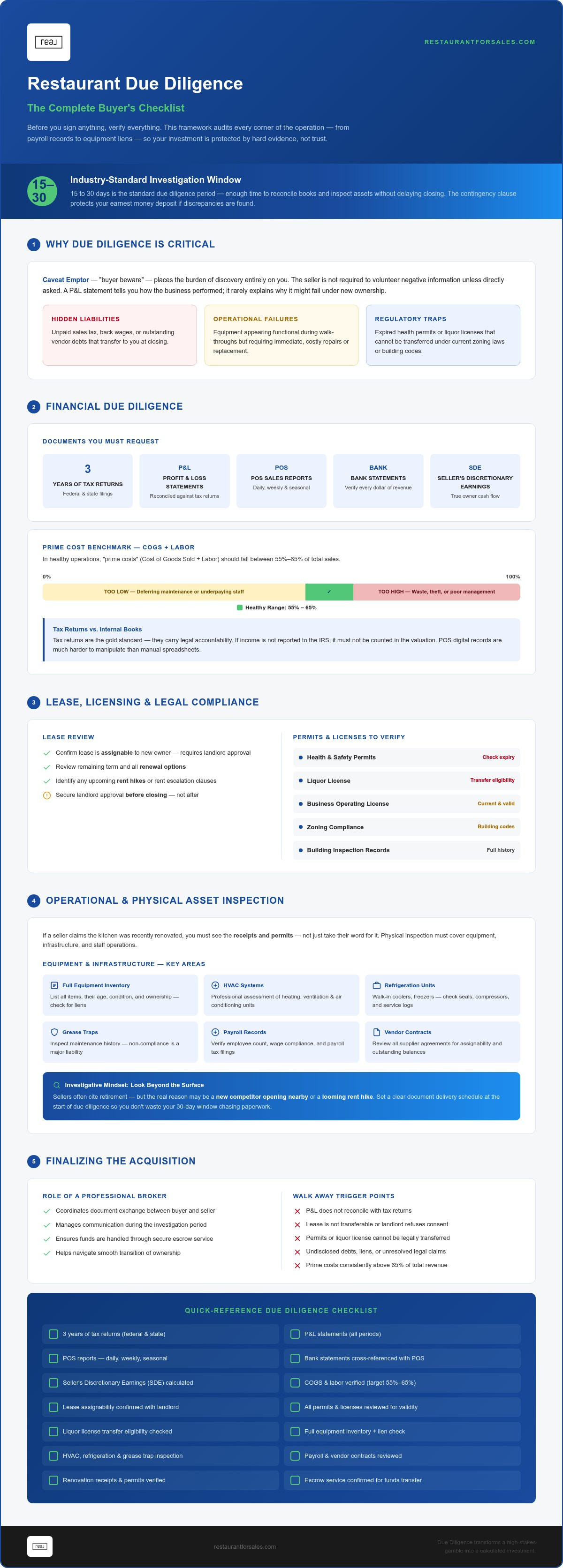
Due diligence is the formal investigative phase of a business acquisition. During this period, a buyer scrutinizes the financial, legal, and operational claims made by the seller. It's the time to move beyond the marketing brochure and analyze the raw data. In the restaurant industry, the standard timeline for this process is typically 15 to 30 days. This window provides enough time to reconcile books and inspect physical assets without causing unnecessary delays to the closing.
Commercial transactions operate under the principle of "caveat emptor," or buyer beware. The burden of discovery lies with you. The seller is generally not required to volunteer negative information unless you specifically ask for it or it constitutes a material misrepresentation. Using a restaurant due diligence checklist ensures you ask the right questions and verify every claim before the deal becomes binding. This period also protects your earnest money deposit. If your investigation reveals discrepancies that can't be resolved, the contingency clause allows you to withdraw from the sale with your deposit intact.
The Investigative Mindset: Beyond the Surface
Approach this period with a tactical mindset. You aren't just looking for errors; you're looking for the real reason behind the sale. Sellers often cite retirement or other interests, but the data might reveal a new competitor opening nearby or a looming rent hike. Differentiate between anecdotal claims and verifiable business records. If a seller says the kitchen was recently renovated, you must see the receipts and permits. Establish a clear schedule for document delivery at the start of the period to avoid wasting your 30 day window.
The Risks of an Incomplete Review
Skipping steps in your restaurant due diligence checklist can lead to catastrophic financial losses. We've seen buyers inherit significant hidden liabilities that weren't disclosed upfront. A thorough review prevents you from falling into these common traps:
- Hidden liabilities: Unpaid sales tax, back wages, or outstanding vendor debts that become your responsibility after closing.
- Operational failures: Equipment that appears functional during a walk-through but requires immediate, costly repairs or replacement.
- Regulatory traps: Expired health permits or liquor licenses that cannot be transferred under current zoning laws or building codes.
A professional investigation ensures the price you pay is justified by the actual health of the business. It transforms a high-stakes gamble into a calculated investment.
Financial Due Diligence: Verifying Profitability and Cash Flow
Financial due diligence is the process of proving that the numbers on the sales listing are accurate. While a seller might present a clean Profit and Loss (P&L) statement, you must verify these figures against external records. A professional restaurant due diligence checklist begins with a line by line reconciliation of internal books against federal and state tax returns. If the income isn't reported to the IRS, it shouldn't be included in the valuation. You need to see at least three years of filings to identify long term performance trends and ensure the business isn't on a downward trajectory.
Analyze Point of Sale (POS) reports to verify daily, weekly, and seasonal sales patterns. These digital records are much harder to manipulate than a manual spreadsheet. Cross reference these reports with bank statements to ensure that every dollar claimed as revenue actually made it into the business account. This is also the time to calculate the Seller's Discretionary Earnings (SDE). This metric adds back non-essential expenses, such as the owner's salary or one time repairs, to show the true cash flow available to a new operator. If you need an objective baseline for these figures, utilizing professional restaurant valuation services can provide the clarity required to justify the asking price.
Efficiency is measured through industry benchmarks. Audit the Cost of Goods Sold (COGS) and labor percentages. In most successful operations, these "prime costs" should consume between 55% and 65% of total sales. If these numbers are significantly higher, the business may be suffering from waste or theft. If they're unusually low, the seller might be deferring necessary maintenance or underpaying staff.
Tax Returns vs. Internal Books
Tax returns are the gold standard because they carry the weight of legal accountability. Discrepancies between internal spreadsheets and official filings are red flags. Many independent restaurants are cash-heavy, but you should never pay for "unrecorded" revenue. If the seller can't prove the income through bank deposits or tax records, it doesn't exist for the purposes of the sale. Accepting unverified cash claims puts your investment at extreme risk.
Labor and Payroll Analysis
Labor is often a restaurant's largest variable expense. Review payroll records to identify true costs, including overtime patterns that might not appear on a standard P&L. Verify the status of every worker. Misclassifying employees as 1099 contractors instead of W2 staff is a common regulatory trap that can lead to massive back-tax penalties. Additionally, assess staff turnover rates. High turnover suggests cultural issues or poor management that you'll have to fix immediately after taking over.
Lease, Licensing, and Legal Compliance Review
The lease is often the most valuable asset in a restaurant acquisition. Even a highly profitable operation will fail if the landlord refuses to transfer the lease or if the remaining term is too short to recoup your investment. Your restaurant due diligence checklist must prioritize a granular review of the current lease agreement. You need to identify the remaining term, any available options to renew, and the specific structure of Common Area Maintenance (CAM) charges. Look for hidden escalations that could erode your margins over the next three to five years.
Beyond the physical space, you must verify the legal standing of the business entity. This includes checking for any outstanding litigation, labor board complaints, or unpaid judgments. Review the Health Department inspection history for the past 24 months. While a single "B" grade might be fixable, a pattern of critical violations related to sewage or refrigeration suggests deep operational neglect. If the sale includes a liquor license, confirm its current status with the local ABC or liquor control board. Some licenses are tied to the individual, while others stay with the location; knowing the difference is vital for a smooth transition.
The Critical Lease Assignment
Securing a lease assignment is frequently the most difficult part of the closing process. Landlords are not obligated to accept a new tenant simply because the old one is selling. They will typically require a full financial package from the buyer, including a personal financial statement and a business plan. Watch out for "demolition clauses" that allow a landlord to terminate your lease if they decide to redevelop the building. We often assist clients with restaurant lease assignments to ensure the landlord's requirements are met without compromising the buyer's interests. Ensure the lease term and renewal options align with your projected ROI before waiving your contingencies.
Permits and Regulatory Standing
Regulatory compliance extends into every corner of the facility. Verify that the business holds a valid Certificate of Occupancy that matches its current use. Many older restaurants operate under "grandfathered" status, but this protection often disappears during an ownership transfer. You must also check for ADA compliance. If the bathrooms or entrances don't meet current accessibility standards, you could be liable for expensive renovations shortly after taking over. Confirm that all fire safety permits, grease trap maintenance records, and business licenses are current and in good standing with the municipality.
Operational and Physical Asset Inspection
While the books provide a financial map, the physical assets are the engine of the business. You've already scrutinized the P&L statements and the lease terms; now you must ensure the hardware matches the software. An exhaustive restaurant due diligence checklist must include a verified equipment inventory. Don't take a verbal list at face value. You must distinguish between assets owned outright and those held under lease or "loan" agreements. Common examples of third party equipment include soda dispensing systems, commercial dishwashers, and POS hardware. If you purchase a business thinking you own the $10,000 espresso machine only to find it belongs to the coffee roaster, your ROI calculations will suffer immediately.
Hire specialized contractors for the heavy lifting. A general inspector isn't enough for a commercial kitchen. You need a commercial HVAC technician to check the roof units and a refrigeration specialist for the walk-ins. Grease traps are another critical point. If they haven't been pumped or maintained according to municipal code, you could face fines or plumbing backups within weeks of taking over. If you are unsure about the value of the equipment being transferred, our restaurant valuation services can help benchmark the fair market value of used commercial assets.
Equipment and Facility Health
Prioritize the "Big Three": the hood system, refrigeration, and plumbing. The hood system is the heart of the kitchen; it must be clean, permitted, and fire-compliant. Refrigeration units must hold steady temperatures even during the hottest shifts. Finally, check the plumbing, specifically the floor drains and grease interceptors. Inspect the structural integrity of both the front and back of house. Look for signs of pests, water damage, or mold that could trigger a Health Department shutdown. Verifying that specialized gear like pizza ovens or espresso machines are fully functional prevents unexpected capital expenditures on day one.
Inventory and Supply Chain Assessment
Review every service contract. You might inherit a high-priced contract for trash removal, pest control, or linen services that you can't easily cancel. Evaluate current vendor agreements to see if there is potential for better pricing under new management. Determine the value of "dead stock" versus usable inventory. You shouldn't pay full price for slow-moving liquor or outdated seasonal ingredients. Standardize the inventory valuation method, usually landed cost, for the final inventory count performed just before the bill of sale is signed. This ensures the final purchase price reflects the actual goods on hand.
Finalizing the Acquisition: The Role of a Professional Broker
A professional broker serves as the essential coordinator during the final stages of a business transfer. While the buyer and seller focus on the details of the restaurant due diligence checklist, the broker acts as the central hub for document exchange. This management ensures that sensitive financial records, lease agreements, and permit histories move securely between parties without stalling the timeline. Brokers maintain the momentum of the deal; they prevent the "information fatigue" that often leads to friction between buyers and sellers just before closing.
Security is paramount when transferring large sums of capital. We always recommend using a neutral third party escrow service to manage the transfer of funds. Escrow ensures that the purchase price remains protected until every condition of the sale is met. Funds are only released once the buyer has verified the assets and the seller has delivered a clean title. This structure protects the buyer's investment and guarantees the seller receives payment once the legal requirements are satisfied. Trust is built on verification, but it's secured through professional escrow management.
Your investigation might reveal discrepancies, such as equipment that needs immediate replacement or sales figures that don't quite match the tax returns. This is where a broker's valuation expertise becomes a tactical advantage. If the due diligence process uncovers material issues, the broker can facilitate a renegotiation of the purchase price or terms. Instead of the deal collapsing, the broker uses the data from your findings to reach a fair adjustment that reflects the true state of the business. They act as a pragmatic buffer, keeping the transaction on track while ensuring the price remains justified by the verified data.
Coordinating the Closing Process
The closing process requires meticulous attention to detail to protect your earnest money deposit. You must ensure that all contingencies are signed off in writing before the deposit becomes non-refundable. The broker manages the "Statement of Information" and other critical closing documents required by escrow officers and state agencies. They also serve as the primary liaison with the landlord to confirm that the lease assignment is fully executed. This coordination ensures that the official "changing of the keys" happens only after every legal and financial box is checked.
Post-Closing Transition Planning
A successful acquisition doesn't end at the closing table; it requires a structured transition plan. Establish a clear schedule for the seller's training period to learn proprietary recipes, vendor relationships, and staff management nuances. You must also coordinate the transfer of utilities, merchant processing accounts, and digital assets like the website and social media profiles. Managing these logistics early prevents operational downtime during your first week of ownership. If you are ready to begin your search, browse our active restaurant listings to find your next opportunity and start the process with a professional partner by your side.
Securing Your Investment with Data-Driven Decisions
Successful restaurant acquisitions rely on moving past surface-level claims and diving into the hard data. By following a structured restaurant due diligence checklist, you transform a high-stakes transaction into a manageable, professional process. You've learned how to reconcile financial records, navigate complex lease assignments, and audit physical assets to ensure the purchase price matches the operational reality. This methodical approach is the only way to avoid hidden liabilities and secure a sustainable return on investment.
Before you finalize your next move, ensure your offer is backed by accurate data. We provide specialized market valuations and expert brokerage services for restaurant and bar sales across the country. Our team combines national reach with localized market expertise to facilitate transparent and successful closings. We act as your pragmatic partner to ensure every detail of the transfer is handled with professional integrity. Get a Professional Restaurant Valuation Before You Buy or Sell to proceed with total confidence. Your future as a restaurant owner starts with a solid foundation of verified facts.
Frequently Asked Questions
How long does restaurant due diligence typically take?
Restaurant due diligence typically takes between 15 and 30 days. This window is the industry standard for commercial acquisitions; it provides enough time to execute a restaurant due diligence checklist while ensuring the transaction moves toward a timely closing. Larger deals involving real estate or complex franchise agreements may require an extension to accommodate environmental reports or corporate approvals.
What are the most common red flags found during restaurant due diligence?
The most frequent red flags include discrepancies between internal Profit and Loss statements and official tax returns. You should also watch for declining year over year sales, a lease with less than five years remaining, or a lack of documented maintenance for expensive kitchen equipment. High staff turnover and undisclosed vendor liens are also signs of operational instability that require further investigation.
Can I back out of a restaurant purchase after starting due diligence?
You can back out of the purchase if your contract includes a due diligence contingency. This clause allows you to terminate the deal and recover your earnest money deposit if your investigation reveals material issues that weren't disclosed. It's vital to ensure these contingencies are clearly defined in the initial purchase agreement before the investigation period begins.
Should I hire a CPA for restaurant due diligence?
Hiring a CPA who specializes in the hospitality industry is highly recommended. An accountant can audit the "prime costs" of the business and verify the accuracy of the Seller's Discretionary Earnings (SDE). Their expertise adds a layer of financial security by identifying potential tax liabilities or accounting errors that a general business owner might overlook during the restaurant due diligence checklist process.
Is a liquor license always transferable to a new owner?
Liquor licenses are not always transferable; the process depends entirely on local municipal laws and the buyer's background. Some jurisdictions allow for a simple transfer of the existing license, while others require the buyer to submit a completely new application. You must verify the specific requirements with the local liquor control board early in the investigation period to avoid delays.
What happens if equipment breaks during the due diligence period?
The seller is generally responsible for maintaining all equipment in "good working order" until the closing date. If a refrigeration unit or oven fails before the sale is finalized, the seller must repair the item or provide a financial credit at closing. Always conduct a final walkthrough on the day of closing to verify that every asset is still functioning as expected.
How do I verify a restaurant's cash sales?
Verify cash sales by reconciling Point of Sale (POS) records with bank deposit slips and state sales tax filings. If the cash revenue isn't deposited into a business account or reported on a tax return, it cannot be verified for the purposes of the valuation. Never pay for "under the table" income that lacks a verifiable paper trail or bank record.
What is a 'Quality of Earnings' report and do I need one?
A Quality of Earnings report is a professional analysis that validates the sustainability and accuracy of a business's historical income. While not always necessary for small independent cafes, it's often required for larger acquisitions or when securing SBA financing. It provides a higher level of assurance than a standard P&L review by looking at the specific sources and consistency of the revenue.


