

What makes an opportunity worth investigating: the asking price, or what the deal actually includes? Active restaurant listings can be difficult to compare when details are limited, and a status label alone doesn’t confirm that an opportunity is still available. Lease assignments, asset sales, real estate, and franchise resales can also involve very different terms.
That uncertainty is common when you’re narrowing down acquisition options. Treat a listing as a starting point for verification, not a substitute for it. This guide explains how to assess active restaurant listings, compare deal structures, and identify opportunities that fit your acquisition criteria. You’ll learn what to check in the available details, what to confirm before contacting a seller or broker, and how to separate advertised information from verified facts. Restaurant For Sale Marketplace connects buyers and sellers nationwide, with listings that may include restaurants with real estate, lease assignments, and franchise resales. Broker support can also help you work through listing questions and transaction steps.
Key Takeaways
- Learn what an advertised listing can indicate, and why availability still needs direct confirmation.
- Compare business-only sales, lease assignments, real estate, and franchise resales by what’s included and what responsibilities may come with each.
- Use your experience, preferred concept, desired involvement, and available resources to assess buyer fit.
- Screen active restaurant listings by separating confirmed details from seller statements, estimates, and unanswered questions.
- Build a focused shortlist that records each opportunity’s fit, missing information, and follow-up questions before you inquire.
What active restaurant listings show, and what buyers still need to confirm
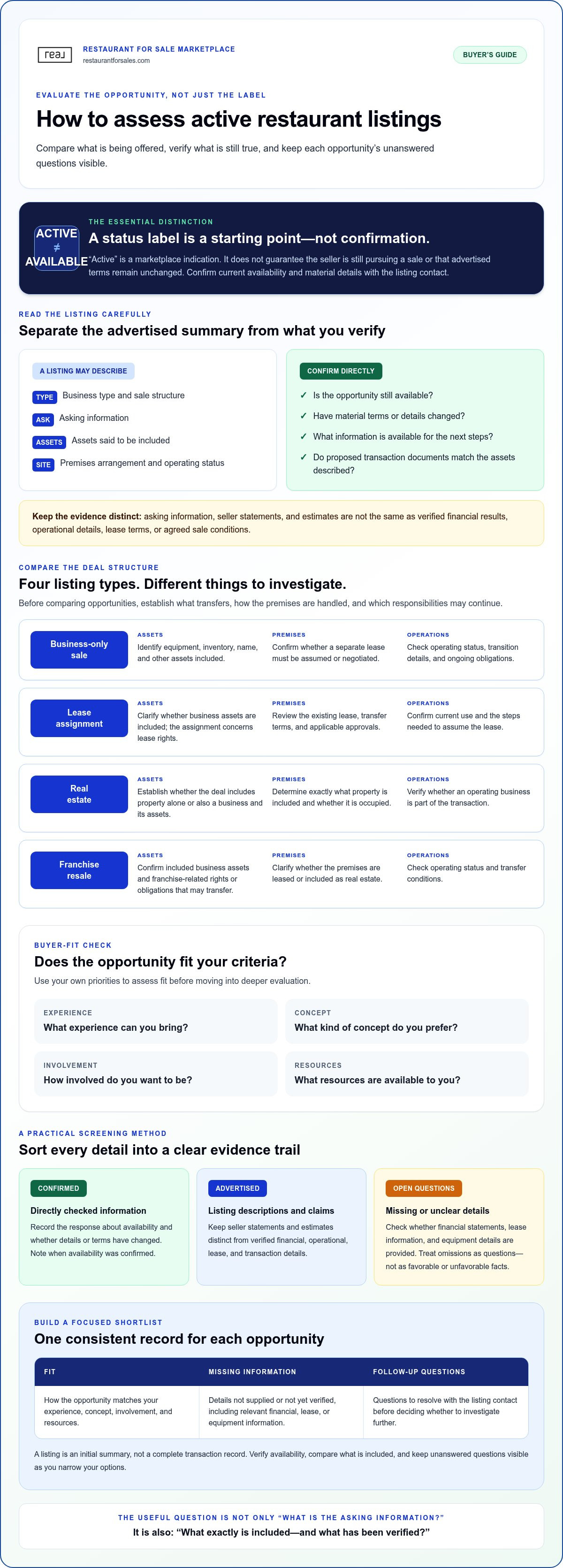
An active restaurant listing is an advertised business opportunity whose current availability still needs to be confirmed with the listing contact. The word “active” can help buyers find opportunities to review, but it doesn’t confirm that the seller is still pursuing a sale or that the advertised terms remain unchanged.
Listings can describe operating restaurants or bars, franchise resales, lease assignments, or restaurant real estate. These are different deal types. A listing for an operating business may focus on the business and its assets, while a lease assignment concerns premises and lease terms. A real estate opportunity may include property, and a franchise resale may carry obligations that buyers need to understand before assessing fit.
Treat the listing as an initial summary, not a complete transaction record. Advertised asking information, seller statements, and estimates are not the same as verified financial results, operational details, lease terms, or agreed sale conditions. Check any description of included assets against the proposed transaction documents.
What information does a restaurant-for-sale listing usually include?
Depending on the opportunity, a listing may identify the business type, asking information, sale structure, and assets said to be included. It may also describe the premises arrangement or whether the business is operating. The amount of detail varies, so don’t assume an omitted fact is favorable or unfavorable. Record it as an open question.
Check whether the listing provides financial statements, lease information, and equipment details. If it doesn’t, note what’s missing before comparing the opportunity with others. For context, business valuation methodologies offer a foundation for understanding how business value may be assessed, but a listing’s asking information alone doesn’t establish value.
What does active mean when browsing restaurant listings?
A displayed status is an indication provided by the marketplace, not a guarantee that the opportunity remains available. Status labels may be used differently across platforms, so don’t assume they have a standardized legal meaning. Before spending time on a detailed evaluation, contact the listing representative to confirm availability and ask whether material terms or details have changed.
Ask whether the seller is still considering inquiries and what information is available for the next steps. Record the answer and when it was confirmed. This gives you a clearer basis for deciding whether to investigate further, while keeping advertised details separate from facts confirmed directly. Apply the same verification process to all active restaurant listings you’re considering.
Compare restaurant listings by deal structure, assets, and operating fit
Two listings can describe similar restaurants yet represent very different transactions. One may offer an operating business and specified assets, while another may concern only lease rights or include the property. Before weighing one opportunity against another, compare what’s being transferred, how the premises are handled, and what responsibilities may carry forward.
| Listing structure | Assets to clarify | Premises arrangement | Operating status and buyer responsibilities |
|---|---|---|---|
| Business-only sale | Identify which equipment, inventory, name, and other assets are included in the proposed sale. | Confirm whether the buyer would assume or negotiate a separate lease. | Check whether the business is operating and determine what transition or ongoing obligations are part of the deal. |
| Lease assignment | Clarify whether any business assets are included; the assignment itself concerns lease rights. | Review the existing lease and the terms and approvals that apply to a transfer. | Confirm the premises’ current use and what steps the buyer must take to assume the lease. |
| Real estate | Establish whether the transaction includes only property or also a restaurant business and its assets. | Determine exactly what property is included and whether the business premises are occupied. | Verify whether an operating business is part of the transaction or whether the buyer is acquiring property alone. |
| Franchise resale | Confirm which business assets are included and what franchise-related rights or obligations may transfer. | Clarify whether the premises are leased or included as real estate. | Check operating status, transfer conditions, and any required approvals with the relevant parties. |
How do lease assignments and real estate listings differ?
A lease assignment concerns transferring lease rights, subject to the agreement’s terms and any applicable approvals. It doesn’t, by itself, mean the buyer is purchasing the property or the restaurant business. A restaurant opportunity that includes real estate is a different transaction, so confirm whether the sale covers the operating business, the property, or both. For more detail, review this restaurant lease assignment guide.
How should buyers compare franchise resales with independent restaurants?
A franchise resale involves franchise obligations that an independent restaurant listing may not describe. Don’t assume a transfer is automatic. Verify the applicable conditions and required approvals with the appropriate parties. Compare these obligations with the operating arrangements stated for an independent business, then assess which structure fits your experience and plans. This franchise resale buying guide offers further context. A guide to buying a business can also help frame research and due diligence.
Use these distinctions to narrow your search, then browse restaurant listings by category to explore opportunities. Confirm each listing’s structure and details with its contact before treating them as established facts.
Assess restaurant listings with a practical buyer-fit checklist
A listing is a screening tool, not proof of business performance. Use it to decide what deserves follow-up, then compare the opportunity with your operating experience, preferred concept, desired level of involvement, and available resources. A restaurant that looks appealing on paper may still be a poor fit if its operating model, assets, or premises don’t support your plan.
Before advancing an opportunity, sort what you know into three groups: confirmed facts supported by documentation, seller statements or estimates that need substantiation, and unanswered questions. This distinction helps prevent an asking figure or promotional description from being mistaken for a confirmed fact.
- Experience: Does the concept and day-to-day operating model match your background or the expertise you can bring?
- Concept and involvement: Does the restaurant fit your intended format, and does the expected role align with how closely you want to be involved?
- Resources: Can your available resources support the proposed transaction and the responsibilities described?
- Assets and premises: Do the stated equipment, inventory, and premises arrangement fit your operating plan?
Which listing details should buyers verify first?
Start with the basics: confirm the opportunity is still available and identify the right contact for further information. Then request support for any financial figures. Ask what period the figures cover, how they were prepared, and whether they represent actual results, an estimate, or another basis. Keep the response and supporting records separate from the listing’s claims.
Clarify what the proposed transaction includes. Check the condition and inclusion of equipment and inventory, and ask which licenses or other assets are represented as part of the opportunity. Don’t infer inclusion or transferability from a brief description. Record each answer and note any details that still need confirmation.
How can buyers evaluate a restaurant's asking information?
Asking information is a seller’s stated position, not an independently established business valuation. Consider it alongside supportable financial records and the scope of the transaction. For example, a figure attached to a business-only sale should not be compared as though it covers the same assets or premises arrangement as an opportunity that includes real estate. Headline figures alone can hide those differences.
For a deeper framework, review restaurant valuation methods for buyers and owners. As you screen active restaurant listings, use valuation questions to identify what evidence you still need, not to treat an advertised figure as confirmed value.
Turn active restaurant listings into a focused shortlist
A shortlist keeps browsing tied to your acquisition criteria. Use the same screening steps for each opportunity so you can compare fit and evidence, not just the appeal of a listing description.
- Define your criteria. Set your preferred concept, operating role, deal structure, premises needs, and practical requirements.
- Filter opportunities. Remove listings that clearly fall outside those criteria, while marking unclear details for follow-up.
- Compare the evidence. Separate documented information from seller statements, estimates, and missing facts.
- Confirm availability. Ask the listing contact whether the opportunity is still available and whether material details have changed.
- Make a focused inquiry. Send concise questions about the remaining gaps and ask what the appropriate next step is.
Track each opportunity in a simple shortlist with three fields: fit (why it meets your criteria), missing facts (what remains unverified), and follow-up questions (what you need answered to decide whether to proceed). This makes it easier to pause or remove an opportunity if new information changes the fit.
What should buyers prepare before contacting a listing representative?
Prepare a brief introduction covering your relevant operating experience, acquisition goals, and practical requirements. Keep questions specific: Is the opportunity available? What sale structure is being considered? Which assets are included? How are the premises handled? If you need confidential information, follow the seller’s stated process rather than requesting sensitive records without authorization.
When should a buyer move from browsing to due diligence?
Move forward when the listing contact confirms that your interest can be considered, confirms the opportunity’s availability, and identifies an appropriate next step. Initial screening helps establish whether deeper review makes sense; it doesn’t replace due diligence. Detailed verification may involve professional advisers. For a broader view of the acquisition process, see how to buy a restaurant in 2026.
A broker may help clarify listing questions, explain transaction steps, or coordinate information requests, depending on the opportunity and process. Once your criteria and questions are ready, explore restaurant opportunities through Restaurant For Sale Marketplace, which connects restaurant and bar buyers and sellers nationwide. Confirm each listing’s details directly before deciding whether it belongs on your shortlist.
Explore active restaurant listings and take the next step
A focused search starts with the kind of opportunity you want to pursue. Use listing categories to distinguish business sales, lease assignments, restaurants with real estate, and franchise resales. Then apply screening questions that match your acquisition goals: What’s included? How are the premises arranged? What information supports the advertised details? Is the opportunity still available?
Restaurant For Sale Marketplace connects restaurant and bar buyers and sellers nationwide. Its role is to help people discover opportunities and connect, not to guarantee that a listing is suitable or that a transaction will proceed. Buyers remain responsible for confirming current details and assessing whether an opportunity fits their circumstances. Categories and displayed status labels can help organize a search, but confirm what they mean for each specific listing.
What can buyers expect from a restaurant-sale marketplace?
A marketplace can make it easier to review different types of opportunities in one place. It doesn’t replace direct confirmation of availability, supporting records, lease terms, or transaction conditions. Restaurant For Sale Marketplace also offers brokerage and valuation services, which are separate from marketplace listings and may be relevant depending on a buyer’s needs. These services are not lending or restaurant management.
How can buyers start reviewing opportunities?
Before opening listing results, write down your preferred deal structure, concept, operating role, premises requirements, and other practical criteria. As you review active restaurant listings, note the questions each promising business or bar raises. Keep the notes specific, such as whether the stated assets are included, what premises arrangement is proposed, or which financial details need support. This gives you a clear basis for deciding which contacts to approach first.
Once a listing appears aligned with your criteria, confirm its availability and ask the relevant contact about the next appropriate step. If you need help understanding listing questions or transaction steps, broker support may be an option. Take a measured approach: identify the opportunity, clarify what is known, and decide whether further review makes sense.
Review the available restaurant and bar listings, compare them with your acquisition criteria, and confirm current details directly with the relevant contact before proceeding.
Move Forward With a Clearer Search
A strong acquisition search starts with knowing what a listing does and doesn’t establish. Compare opportunities by deal structure, included assets, premises, and fit with your operating goals. Then separate documented facts from seller statements and open questions before deciding which opportunities merit further review.
Active restaurant listings can help you discover possibilities, but confirm each opportunity’s current availability and details with the relevant contact. A focused shortlist, supported by clear questions, makes that next conversation more productive.
Restaurant For Sale Marketplace connects restaurant and bar buyers and sellers nationwide. Brokerage and valuation services are also offered alongside listings, providing additional support for buyers who need help understanding a listing or evaluating an opportunity.
Browse active restaurant listings and review your options, then verify the details that matter to your acquisition criteria. With a disciplined approach, you can move from browsing toward a more informed next step.
Frequently Asked Questions
How do I find active restaurant listings?
Search a restaurant-sale marketplace and filter opportunities by the type of deal and restaurant that fit your goals. Restaurant For Sale Marketplace connects restaurant and bar buyers and sellers nationwide, with listings that may include business sales, lease assignments, restaurants with real estate, and franchise resales. Before browsing, define your preferred concept, operating role, and premises needs. Then compare listings and confirm details with the relevant contact.
What does active mean on a restaurant-for-sale listing?
“Active” generally indicates that an opportunity is advertised, but it doesn’t confirm that the seller is still considering a sale or that the terms remain current. Marketplace status labels may vary, so don’t assume they have a standardized meaning. Treat the listing as a starting point. Contact the representative to ask whether it’s available, whether material details have changed, and what the appropriate next step is.
Can I trust the financial information in a restaurant listing?
Don’t treat listing financial information as verified until you’ve reviewed supporting documentation. Ask what period the figures cover, how they were prepared, and whether they represent actual results or estimates. Compare the information with appropriate financial records and clarify the scope of the proposed transaction. An advertised figure is not, by itself, proof of performance or an independently established business valuation.
What should I check before contacting a seller about a restaurant listing?
Review the sale structure, stated asking information, included assets, and premises arrangement, then note what’s unclear. Prepare a short introduction describing your relevant experience, acquisition goals, and practical requirements. Ask focused questions about availability and the next step. If you’re seeking confidential information, follow the seller’s stated process rather than requesting sensitive materials without authorization.
How do restaurant lease assignment listings differ from listings with real estate?
A lease assignment concerns transferring lease rights, subject to the agreement’s terms and any applicable approvals. It doesn’t necessarily include the restaurant business or the property itself. A listing with real estate may include the premises, but confirm whether the operating business and its assets are also part of the proposed transaction. Ask the listing contact to clarify exactly what is being offered.
Are franchise restaurant resale listings different from independent restaurant listings?
Yes. A franchise resale involves franchise-related obligations and may have transfer conditions or approval requirements that don’t apply to an independent restaurant in the same way. Verify those requirements with the appropriate parties, and ask which business assets and premises arrangements are included. Compare the operating arrangements described in each listing with your experience and plans before deciding which opportunity merits further review.
How can I tell whether a restaurant listing is still available?
Contact the listing representative directly and ask whether the opportunity is currently available and whether its terms or details have changed. A displayed status or recent-looking description isn’t confirmation that the seller is still considering inquiries. Record when availability was confirmed and what the contact says about next steps. Reconfirm before relying on listing information to make decisions or begin a more detailed review.


