

Your restaurant sale isn't actually final until a person who isn't even part of the transaction gives their approval. Most owners spend months perfecting their financial statements and finding the right buyer, only to see the deal stall at the landlord's desk. It's a high-stakes moment where confusion over a restaurant lease assignment can lead to rejected transfers or, worse, sellers remaining financially liable for a business they no longer own.
We understand that the transition of a physical space is just as critical as the sale of the brand itself. This guide provides the strategic framework you need to manage the landlord's expectations and ensure a successful closing without unnecessary interference. You'll learn how to master the complexities of lease transfers to protect your interests and your capital. We will break down the essential steps for a smooth transfer, explain how to secure a full release from personal guarantees, and clarify why an assignment is often superior to a sublease for your long-term financial security.
Key Takeaways
- Identify why the physical location is the primary value driver in an asset sale and how to protect that value during a transfer.
- Understand why a restaurant lease assignment is often the preferred legal path to release a seller from future financial liability.
- Learn the "reasonableness" standards landlords must follow when evaluating a buyer's financial stability and operational experience.
- Prepare for the standard 30 to 60 day timeline required to navigate the chronological steps from an accepted offer to a final lease signature.
- Discover how a professional broker serves as a neutral facilitator to manage landlord expectations and prevent friction that could stall the deal.
What is a Restaurant Lease Assignment and Why is it Critical?
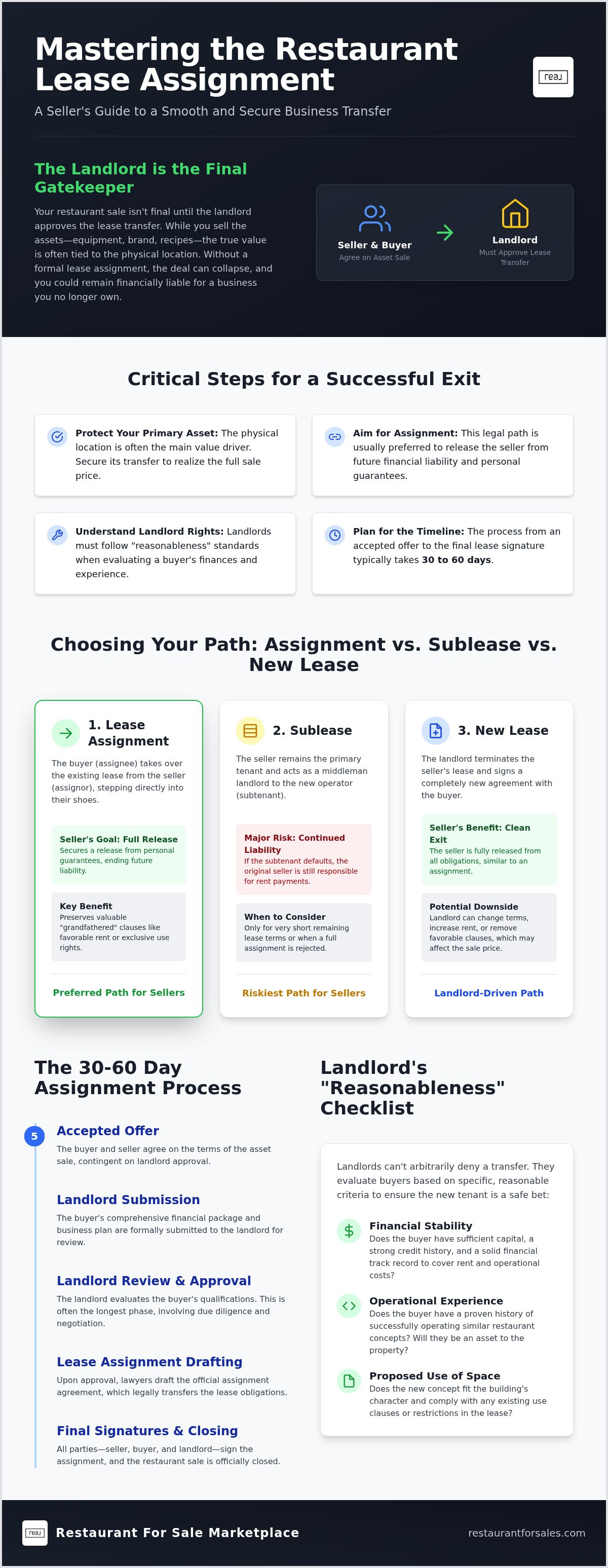
A restaurant lease assignment is the formal legal mechanism used to transfer a lease agreement from one entity to another. In this transaction, the current tenant, known as the assignor, hands over all rights, interests, and obligations to the incoming buyer, known as the assignee. This isn't a casual handoff. It's a binding shift in the contractual relationship with the property owner. When you assign a lease, the new owner steps directly into your shoes, taking on the existing terms, rent schedule, and responsibilities defined in the original document.
Why is this step so vital? Most restaurant transactions are structured as asset sales. While you're technically selling the ovens, the furniture, and the recipes, the true value of a restaurant often lies in its location and the "going concern" value of the operating business. If the lease doesn't transfer, the business effectively ceases to exist. A simple handshake or a private agreement between a buyer and seller doesn't bind the landlord. Without a formal assignment, the seller remains legally responsible for every dollar of rent until the original lease term ends, even if they've already moved out.
The Role of the Assignment Clause
Every commercial lease contains an "Assignment and Subletting" clause. This section acts as the rulebook for your exit strategy. It determines if you have the right to sell your business to a third party and under what conditions the landlord can say no. Some leases include "recapture" provisions, which give the landlord the power to terminate your lease entirely if you request an assignment. Others might require you to pay an assignment fee or share a portion of your sale profits. Understanding these restrictions is the first step in a successful brokerage process. If the clause is too restrictive, it can significantly lower the market value of your business because it makes the sale harder to close.
The Difference Between an Asset Sale and a Lease Transfer
Distinguishing between selling the business assets and transferring the space is essential for any successful closing. An asset sale covers the physical property like kitchen equipment and the brand's intellectual property. A restaurant lease assignment covers the legal right to occupy the premises. You can't have a functional restaurant without both. If you finalize an asset sale without a formal lease transfer, the buyer could be evicted immediately. The landlord's written consent is the only bridge that connects these two separate legal actions. Without that formal document, the buyer has no security, and the seller has no release from their financial commitment.
Assignment vs. Sublease vs. New Lease: Which Path is Best?
Transitioning a restaurant space involves choosing between three distinct legal paths. Each option carries different implications for your financial liability, the speed of the transaction, and the long-term stability of the business. While a restaurant lease assignment is often the most balanced approach, market conditions and landlord preferences frequently dictate the final strategy. Understanding the nuances of each method ensures that you don't leave yourself exposed to unnecessary risk after the keys change hands.
The Mechanics of a Sublease
A sublease creates a "sandwich" relationship where the seller remains the primary tenant. You effectively become a middleman landlord. While this can be a faster way to get a new operator into the space, it's the riskiest path for a seller. If the new buyer fails to pay rent or violates the lease, the landlord will look to you for payment. Subleasing usually only makes sense when the remaining lease term is very short or when the landlord refuses a full assignment. Most buyers avoid this because they lack a direct contractual relationship with the property owner.
The Benefits of a Clean Assignment
In most professional transactions, a restaurant lease assignment is the preferred standard. It allows the buyer to take over the existing terms, including favorable rent escalations and renewal options that might not be available in a new agreement today. For the seller, the goal of an assignment is to secure a release from the personal guarantee. This method preserves "grandfathered" clauses, such as exclusive use rights or specific parking allocations, which add significant value to the business sale. If you're unsure how your current agreement stacks up, reviewing restaurant valuation services can provide clarity on how your lease terms impact your asking price.
When a New Lease is Required
Sometimes, a landlord will refuse an assignment and insist on a fresh agreement. This typically happens if the original lease is near expiration or if the current rent is significantly below market rates. For a buyer, a new lease provides the most long-term security but often comes at a higher cost. Sellers should be cautious here; a landlord's demand for a new lease can lead to higher rent for the buyer, which might reduce the amount they're willing to pay for your business assets. Negotiating these terms requires a proactive facilitator who can balance the landlord's desire for higher revenue with the seller's need to close the deal.
Navigating Landlord Approval: The 'Reasonableness' Standard
Most commercial leases contain a provision stating that the landlord's consent to a restaurant lease assignment shall not be "unreasonably withheld." This phrase is the seller's strongest legal protection, yet its definition is often misunderstood. In a commercial context, reasonableness refers to the landlord's right to protect their investment. They can't deny a transfer based on personal preference or arbitrary whims. Instead, any rejection must be rooted in objective concerns regarding the buyer's ability to fulfill the lease's financial and operational obligations.
Viewing the landlord as a partner rather than an obstacle is a strategic advantage. When a seller presents a buyer who is better capitalized or more experienced than themselves, the landlord's risk decreases. Rejections typically occur when the proposed transition threatens the property's stability. By understanding the specific criteria landlords use to judge "reasonableness," you can prepare a package that makes an approval the only logical choice.
The Buyer’s Financial Qualification
Landlords prioritize financial stability above all else. They typically require a comprehensive financial package that includes tax returns, a current balance sheet showing liquid assets, and a credit report. A buyer with a high net worth but low liquidity might still face rejection because they can't cover emergency repairs or payroll during a downturn. We recommend including a detailed pro forma that outlines the buyer's projected revenue and expenses. This document proves the new owner has a realistic plan for maintaining rent payments throughout the remaining lease term.
Operational Experience Requirements
Financial strength is only half the battle. Landlords fear "first-time" owners who lack a proven track record. If a buyer has never managed a kitchen or handled restaurant labor costs, they're a high-risk tenant. Proving concept-specific experience is essential for a successful restaurant lease assignment. For instance, a landlord might reasonably reject a buyer who has only managed fast-food franchises if the space is a high-end, full-service steakhouse. A professional resume highlighting past successes, industry certifications, and longevity can often bridge the gap and secure the necessary consent.
The Step-by-Step Restaurant Lease Assignment Process
A successful restaurant lease assignment follows a methodical, chronological timeline. It doesn't happen the moment an asset purchase agreement is signed. Instead, it initiates a 30 to 60 day period of intense coordination. Managing this schedule requires a synchronized effort between the buyer, seller, landlord, and escrow officers. While it's tempting to notify the landlord immediately, we recommend waiting until the buyer's qualifications are fully vetted to avoid unnecessary deal fatigue or premature interference.
Timing is everything in a commercial transaction. If you approach the landlord too early without a complete financial package, you risk an immediate rejection. If you wait too long, you might miss your closing date. A professional broker acts as a buffer, ensuring the landlord receives exactly what they need at the precise moment they need it to keep the momentum moving forward.
Preparing the Assignment Package
The "Assignment Package" serves as the buyer's professional resume to the property owner. It must be comprehensive and bulletproof to survive the landlord's scrutiny. You'll need to gather two years of the buyer's tax returns, a current balance sheet, and a credit report. Include a professional business plan and a sample menu to prove the new concept's viability within the existing tenant mix. Before drafting the formal "Request for Consent" letter, ensure all past-due rent and Common Area Maintenance (CAM) charges are settled. Landlords will rarely entertain a transfer request if the current tenant account is in arrears.
Negotiating the Consent to Assignment Agreement
Once the landlord approves the buyer, their legal counsel will draft a "Consent to Assignment" document. This is where many deals stall if "gotcha" clauses aren't identified early. Sellers must prioritize securing a formal release of liability. Without this release, the seller remains financially responsible if the buyer defaults years later. The new buyer will also be required to sign a personal guarantee. Negotiating these terms requires a balanced approach to ensure the landlord feels secure while the seller achieves a clean exit.
Closing and Execution
The final stage involves the execution of the "Assumption of Lease" by the buyer. This document legally binds the new owner to every term of the original agreement. Coordination with escrow is vital here to handle the security deposit. In most cases, the landlord retains the seller's original deposit, and the buyer reimburses the seller for that amount as part of the closing costs. Complete a final walkthrough of the premises to document the physical condition of the space before the keys change hands. If you need assistance managing these complex moving parts, our restaurant brokerage services provide the end-to-end management required for a successful transaction.
Securing Your Exit: How a Broker Manages the Lease Assignment
Direct negotiations between a restaurant owner and their landlord frequently encounter friction. Sellers are often emotionally invested, while landlords are focused solely on risk mitigation. A professional broker serves as a neutral facilitator, translating the needs of both parties into a structured business case. By leveraging market data, a broker can demonstrate that the incoming buyer represents the most stable financial future for the property. This data-driven approach is essential to ensure that a restaurant lease assignment doesn't accidentally trigger a renegotiation of rent prices or a loss of favorable lease terms.
A broker's presence changes the dynamic from a confrontation to a professional consultation. Landlords are more likely to approve a transfer when the request is presented by a market insider who understands the local commercial landscape. This buffer protects the seller from being pressured into unfavorable exit terms while ensuring the buyer receives the security they need to move forward with the acquisition.
Vetting Buyers Before They Reach the Landlord
Presenting an unqualified buyer to a landlord is a fast way to damage a deal. Landlords have long memories, and "landlord fatigue" sets in quickly if they're forced to review multiple candidates who lack the necessary capital or experience. We protect the seller's reputation by conducting preliminary credit and financial checks before any introduction occurs. This pre-qualification process ensures that only candidates who meet or exceed the "reasonableness" standards discussed earlier are presented for approval. By the time a candidate reaches the landlord's desk, their viability is already documented, which streamlines the consent process and maintains the seller's professional standing.
Managing the Legal and Administrative Burden
The final stages of a transaction involve a heavy administrative load. A broker coordinates communication between the landlord's attorney and the buyer's counsel to ensure everyone remains aligned on the closing timeline. We track critical deadlines to ensure the original lease doesn't expire or hit a renewal window during the sale process. This oversight prevents the transaction from stalling due to missed paperwork or slow legal reviews. Managing these complex legal interactions is a core part of our restaurant lease assignment services. For those ready to begin the process, you can get a professional valuation and lease review today to determine your best path forward.
Finalizing Your Restaurant Transition with Confidence
A successful business transfer requires more than just an agreement between a buyer and a seller. It demands a strategic approach to the landlord relationship and a deep understanding of the legal requirements involved. By mastering the restaurant lease assignment, you ensure your exit is final and your financial liability is fully released. Remember that the landlord's reasonableness standard is your primary protection, but it must be supported by a professional financial and operational package.
Our team provides the specialized expertise in commercial restaurant real estate assignments needed to navigate these high-stakes negotiations. With success-based commissions, our goals align directly with yours to ensure a smooth closing. We leverage a national marketplace with thousands of active buyers to find the right candidate for your specific space. Don't leave your closing to chance. List Your Restaurant or Find Your Next Investment with Our Expert Brokers. Taking the right steps today protects your investment and sets the stage for your next professional chapter.
Frequently Asked Questions
Can a landlord refuse a lease assignment for a restaurant?
Yes, a landlord can refuse a lease assignment, but their reasoning must meet the "reasonableness" standard defined in the contract. Common grounds for rejection include the buyer's inadequate financial liquidity, low credit scores, or a lack of concept-specific operational experience. If the proposed buyer is as qualified as the current tenant, the landlord generally cannot withhold consent without risking legal repercussions for interfering with the business sale.
Does a lease assignment release the original tenant from liability?
A lease assignment does not automatically release the original tenant from future financial obligations. Unless the landlord signs a specific "Release of Liability" or "Novation," the original tenant remains secondarily liable if the buyer defaults. It's essential for sellers to negotiate this release during the transfer process to ensure they aren't held responsible for rent or damages after the keys have changed hands.
What is the difference between a lease assignment and a lease assumption?
An assignment refers to the transfer of the right to occupy the space, while an assumption is the buyer's legal promise to fulfill the lease's duties. In a standard restaurant lease assignment, the two concepts work together. The seller assigns their interest, and the buyer assumes the responsibility for rent, repairs, and insurance. Both actions are typically documented in a single "Assignment and Assumption of Lease" agreement.
Who pays the landlord's legal fees during a restaurant lease transfer?
The seller is almost always responsible for the landlord's legal and administrative fees. Most commercial lease agreements specify that the tenant requesting the transfer must cover all costs the landlord incurs during the review process. These fees cover the time spent by the landlord's attorney to vet the buyer and draft the consent documents. Sellers should budget for these expenses as part of their total closing costs.
What happens to the security deposit in a lease assignment?
The landlord usually keeps the original security deposit on file to protect the property throughout the remaining term. To settle this, the buyer typically pays the seller an amount equal to the deposit as part of the transaction's closing costs. This arrangement allows the landlord to maintain their security interest without the administrative burden of issuing a refund and collecting a new deposit from the incoming tenant.
Can the landlord increase the rent during an assignment?
Landlords usually cannot increase the rent during an assignment because the existing contract terms must be honored. The buyer simply steps into the seller's shoes under the current rent schedule and escalations. However, if the lease is close to its expiration date, a landlord might refuse the restaurant lease assignment and instead require the buyer to sign a brand new lease at current market rates, which often results in higher monthly costs.
How long does it typically take to get landlord consent for a restaurant sale?
The process for obtaining landlord consent typically takes between 30 and 60 days. This duration allows the property owner to conduct a thorough review of the buyer's financial history, experience level, and business concept. Delays often occur if the initial application package is incomplete. Working with a broker to present a professional, finalized package from the first day can help move the timeline toward the shorter end of this range.
What documents does a buyer need to provide for a lease assignment?
Buyers need to provide a complete financial and professional profile to win landlord approval. This package usually includes two years of personal tax returns, a current balance sheet, a credit report, and a detailed business plan. Additionally, providing a professional resume that highlights past restaurant management experience is critical. Landlords want to see proof that the new operator has both the capital and the skills to keep the business profitable.


