

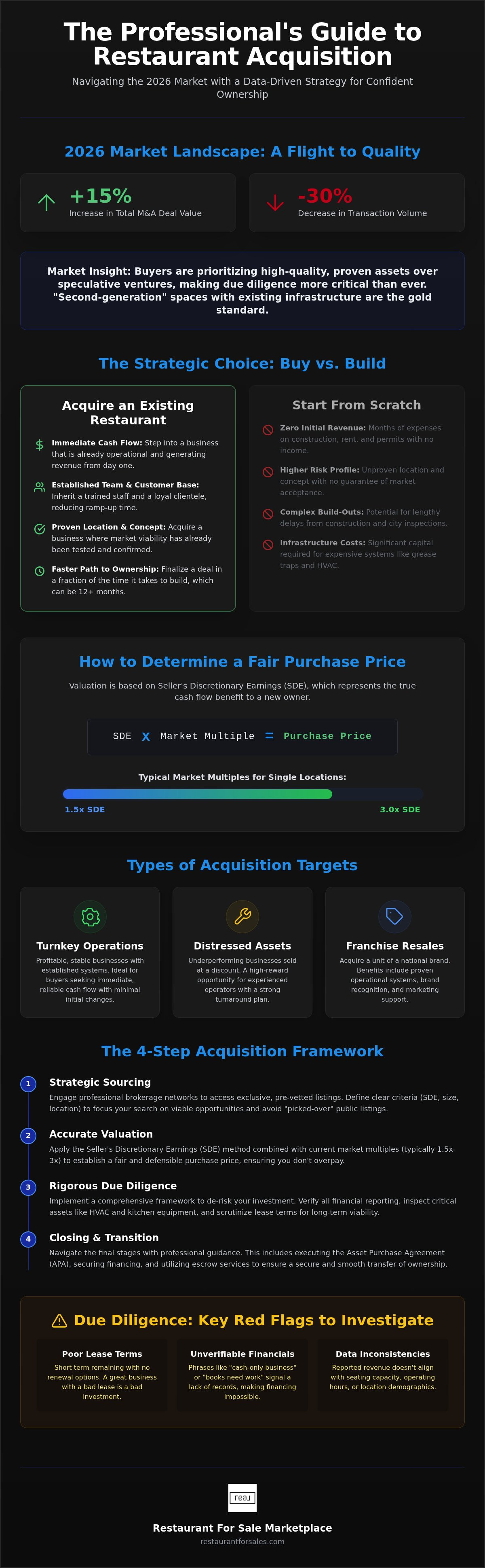
In 2026, the total value of restaurant M&A deals climbed by 15% even as the volume of transactions fell by 30%, signaling a market that now prioritizes high-quality assets over speculative growth. For many entrepreneurs, the prospect of a restaurant acquisition feels like a high-stakes gamble where hidden equipment failures or inaccurate financial reporting could derail years of planning. You've likely realized that identifying a potential location is only the first step. Accuracy is your best defense. The real difficulty lies in navigating the complexities of lease assignments and verifying that the seller's discretionary earnings actually reflect the bankable reality of the business.
This guide provides a professional roadmap to master the methodical process of identifying, valuing, and acquiring a profitable restaurant business. By applying seasoned brokerage insights, you'll learn how to mitigate risks through rigorous due diligence and accurate valuation methods. We'll examine current market multiples, which typically range from 1.5x to 3x SDE for single locations, and look at how recent regulatory changes like the elimination of corporate meal deductibility affect bottom-line projections. From sourcing the right franchise resale to the final closing, this article equips you with the tools to transition from an interested buyer to a confident owner.
Key Takeaways
- Understand the strategic advantages of purchasing an existing entity to secure immediate infrastructure and established cash flow.
- Learn how to access exclusive listings through professional brokerage networks to ensure a confidential and secure restaurant acquisition process.
- Master the application of Seller’s Discretionary Earnings (SDE) and current market multiples to establish an accurate and fair purchase price.
- Implement a rigorous due diligence framework to verify financial reporting and inspect critical physical assets like HVAC systems and equipment.
- Navigate the complexities of the closing process with professional insights into Asset Purchase Agreements and the vital role of escrow services.
What is Restaurant Acquisition? Defining the Strategic Buy
A restaurant acquisition is the purchase of a hospitality business that is already operational. This process involves the transfer of ownership of an existing entity, including its physical assets, permits, and brand reputation. Unlike a new startup, an acquisition allows you to step into a functioning ecosystem. It's a strategic move within the wider world of Mergers and acquisitions that prioritizes existing infrastructure over the uncertainty of a new build-out.
The "Buy vs. Build" debate usually ends in favor of restaurant acquisition for one reason: immediate cash flow. Starting from scratch means months of zero revenue while paying for construction and permits. When you acquire, the doors are already open. You inherit a functional kitchen, vendor contracts, and a staff that understands the daily workflow. A professional marketplace acts as a proactive facilitator in this process, connecting vetted buyers with sellers who have already organized their financial records for professional review.
Buyers generally look for three types of targets. Turnkey operations are profitable and require little change. Distressed assets are underperforming businesses sold at a discount, offering a high-reward opportunity for those with a turnaround plan. Franchise resales provide the added benefit of a national brand's support and proven operational systems.
Acquisition vs. Starting from Scratch
Speed to market is the most significant advantage. A typical build-out can take 12 months or longer due to construction delays and city inspections. An acquisition can often be finalized in a fraction of that time. You don't just get the keys; you get an existing customer base and a trained team. This established presence reduces the risk profile, as the location's viability has already been tested by the market.
The 2026 Market Landscape for Buyers
Market data from early 2026 indicates a 15% increase in the total value of restaurant deals, despite a 30% drop in transaction volume. This suggests a flight to quality. Buyers are focusing on high-performing assets rather than speculative ventures. Macroeconomic shifts, including an SBA interest rate environment where the base WSJ Prime Rate is 6.75%, have made buyers more selective. "Second-generation" spaces are now the gold standard. These locations already have expensive infrastructure like grease traps and HVAC systems in place, making them the most cost-effective path to ownership.
Strategic Sourcing: Finding the Right Restaurant Listing
Finding a restaurant isn't just about browsing a website. Public portals often feature picked-over listings or "mom and pop" shops that lack professional financial records. Sourcing the right opportunity is a critical phase of any restaurant acquisition. It requires access to specialized marketplaces where listings are pre-vetted for accuracy and operational health. Successful buyers look for platforms that prioritize the mid-market, where businesses have established systems and verifiable cash flows.
Engaging with a broker provides a layer of professional facilitation that individual buyers often lack. They help you define specific criteria: minimum square footage, required seating capacity, and target Seller’s Discretionary Earnings (SDE). This focus prevents you from wasting time on concepts that don't match your financial goals. A broker acts as a filter, presenting only the opportunities that align with your experience and capital. They also assist in interpreting the initial data package, ensuring you understand the true potential of a listing before signing an NDA.
Vetting Potential Acquisition Targets
Don't be distracted by "curb appeal." A beautiful dining room is worthless if the lease expires in two years with no options to renew. Prioritize the lease terms and location demographics over the current menu. Menu items can be changed in a week; a bad lease or a declining neighborhood can't. Red flags in initial descriptions include phrases like "cash-only business" or "books need work." These often indicate a lack of verifiable financial history, which makes securing financing nearly impossible. You should also look for inconsistencies between the listed revenue and the reported number of seats or operating hours. A successful restaurant acquisition depends on spotting these discrepancies early.
The Role of Confidentiality in Sourcing
Confidentiality is the cornerstone of mid-market transactions. Sellers require Non-Disclosure Agreements (NDAs) to prevent "leakage" that could alarm staff or vendors. If employees find out a sale is pending, they might leave for more stable positions, which devalues the very asset you're trying to buy. When touring a potential site, maintain professional etiquette. Act as a regular customer and avoid asking staff questions about the sale. This discretion protects the business's value during the transition and ensures a smoother handover. For those ready to begin their search, exploring a dedicated restaurant listing marketplace is the first step toward finding a viable opportunity.
Restaurant Valuation: Determining the Real Purchase Price
Valuing a business is a disciplined exercise in financial verification. In a professional restaurant acquisition, the purchase price is rarely a round number based on gut feeling. Instead, it's derived from specific earnings metrics that reflect the actual cash flow available to a new owner. For small to mid-market establishments, Seller’s Discretionary Earnings (SDE) serves as the primary benchmark. This differs from EBITDA, which is typically reserved for larger, multi-unit operations where the owner isn't involved in daily management. SDE provides a clearer picture of the total financial benefit by including the owner's salary and other discretionary expenses.
Current data for 2026 shows that single-location, owner-operated restaurants typically trade at multiples between 1.5x and 3x SDE. Larger operations often command 3x to 5x EBITDA. Revenue multiples also play a role in the valuation landscape. Quick Service (QSR) concepts are often valued at 40-60% of annual revenue, while fine dining can reach 80-120%. While these multiples provide a baseline, the final offer price must also account for the depreciated value of Furniture, Fixtures, and Equipment (FF&E). Inventory is usually handled as a separate line item. It's valued at cost on the day of closing to ensure you don't pay for stale or unusable stock.
Understanding the Valuation Process
A professional valuation ensures you don't overpay for "goodwill" or emotional value that doesn't translate to profit. The core of this process involves identifying "add-backs." These are non-recurring or personal expenses, such as one-time repairs or the owner's health insurance, that are added back to the net income to reveal the true profitability. Because SBA 7(a) loan rates in August 2026 range from 9.75% to 14.75%, lenders require a formal appraisal to justify the loan amount. Using a professional valuation service protects your capital by grounding the transaction in market reality.
Key Financial Documents Every Buyer Needs
Due diligence begins with a review of three years of Profit & Loss (P&L) statements and matching tax returns. Discrepancies between internal bookkeeping and tax filings are common but must be explained. You'll need to analyze the prime cost, which is the sum of Cost of Goods Sold (COGS) and labor. In 2026, successful operators aim for a prime cost below 65% to maintain healthy margins. Reviewing these documents allows you to assess the burn rate and identify if the business is trending toward growth or decline before you commit to the restaurant acquisition.
The Due Diligence Framework: De-Risking Your Investment
Due diligence is the critical verification phase that follows the acceptance of an offer. It's your window to confirm that the financial and operational claims made by the seller are accurate. In a professional restaurant acquisition, this period typically lasts 14 to 30 days. You aren't just looking for profits; you're looking for liabilities that could impact future cash flow. This phase requires a structured approach to ensure no detail is overlooked.
A physical inspection is the first priority. You must verify the condition of the HVAC system, refrigeration units, and grease traps. These are high-cost items that often fail shortly after a transfer if they haven't been maintained. Beyond the hardware, you must check for regulatory compliance. As of January 1, 2026, several states implemented new PFAS disclosure requirements for food packaging. You need to ensure the current inventory and vendor contracts meet these standards to avoid immediate fines. Similarly, if the restaurant does significant takeout in New Jersey, verify compliance with the "Skip the Stuff" law that went into effect on August 1, 2026.
Operational audits involve cross-referencing Point of Sale (POS) data with bank deposits. Don't rely solely on the Profit and Loss statements provided in the valuation phase. Review the last 12 months of daily sales reports to identify seasonal trends or unusual spikes. You should also examine vendor contracts to see if current pricing is locked in or if you'll face immediate cost increases upon taking ownership.
The Critical Lease Assignment Process
The lease is often the most valuable asset in the transaction. Without a secure place to operate, the business has no value. Most commercial leases contain an "assignment of lease" clause that requires landlord approval for a transfer. This is where many deals stall. You must present a professional "buyer profile" to the landlord, often including a financial statement and a business plan. Use this period to negotiate for new options or lease extensions. Securing a ten-year horizon is standard for protecting your investment. If you need assistance navigating these negotiations, our team provides expert lease assignment services to bridge the gap between buyers and landlords.
Verifying Financial and Legal Standing
Legal due diligence prevents you from inheriting the seller's old debts. Conduct a UCC lien search to ensure all kitchen equipment is owned outright and not used as collateral for other loans. You must also review the employment history. Check for any pending worker’s compensation claims or labor disputes that could follow the entity. Finally, cross-reference sales tax filings with internal records. Discrepancies here are a major red flag. If the seller hasn't been honest with the state, they likely haven't been honest with you. Verifying these documents ensures the business's legal standing is as clean as its kitchen.
Closing the Deal and Managing the Transition
The final stage of a restaurant acquisition is the execution of the Asset Purchase Agreement (APA). This legal document outlines exactly which assets are being transferred, from physical equipment to digital intellectual property. Unlike a stock sale, an APA allows the buyer to acquire the business's assets while leaving behind the seller's corporate liabilities. To ensure a secure transfer, funds are held in a neutral escrow account. Escrow only releases payment once all contract contingencies, such as the lease assignment or liquor license transfer, are fully satisfied.
Brokers serve as proactive facilitators during this high-pressure window. Because they operate on success-based commissions, they're deeply motivated to resolve the final-mile friction that often threatens a deal. Whether it's a last-minute landlord dispute or a delay in health permit processing, a seasoned broker manages the communication between attorneys, accountants, and the seller. This professional oversight provides the stability needed to move from a signed offer to a successful closing. Planning for "Day One" begins here, as you prepare to take the keys and assume leadership of the existing team.
Finalizing the Transaction
Closing day requires precise logistical coordination. You must conduct a final inventory count on the morning of the transfer to determine the exact value of food and beverage stock. This value is paid at cost and settled through escrow. Simultaneously, you must manage the transfer of utilities and set up new merchant processing accounts to ensure credit card transactions flow to your bank immediately. All prorations, including monthly rent and property taxes, are calculated to the day of closing so that neither party overpays for shared expenses. These financial details are essential for a clean break between the two ownership regimes.
The Seller Training and Handover Period
The deal doesn't end at the signature; the human transition is just beginning. Most successful acquisitions include a negotiated 2-4 week post-close training period. During this time, the seller introduces you to key staff members and regular customers, acting as an endorsement of your new leadership. This is the time to observe existing workflows and begin updating the Standard Operating Procedures (SOPs) for your regime. A structured handover ensures the team remains stable and the customer experience stays consistent while you implement your long-term vision for the restaurant acquisition.
Securing Your Future in the 2026 Hospitality Market
A successful restaurant acquisition requires a transition from emotional interest to disciplined execution. You've learned that verifying Seller’s Discretionary Earnings and navigating the complexities of lease assignments are the primary safeguards for your capital. In a market where transaction volume has shifted toward high-quality, second-generation spaces, professional oversight is no longer optional. It's the bridge between identifying an opportunity and successfully managing a profitable enterprise.
Our team acts as a proactive facilitator throughout this process. We provide expert restaurant valuation services and maintain a confidential marketplace for serious buyers. With success-based brokerage commissions, we ensure a seamless closing that protects your interests until the keys are in your hand. Browse our national restaurant listings and start your acquisition journey today. We look forward to helping you execute a strategic buy that delivers long-term value.
Frequently Asked Questions
What is the difference between an asset sale and a stock sale in restaurant acquisition?
An asset sale involves purchasing specific items like equipment, inventory, and the trade name without taking on the seller's corporate entity. This structure is preferred in a restaurant acquisition because it allows the buyer to avoid inheriting undisclosed liabilities or legal debts. In contrast, a stock sale transfers the entire corporation, which includes its full financial and legal history, making it a higher-risk option for most independent buyers.
How long does the typical restaurant acquisition process take from start to finish?
The typical timeline for a restaurant acquisition ranges from three to six months. The initial phase of sourcing and signing a letter of intent usually takes 30 to 60 days. Following this, the due diligence period and the complex lease assignment process require another 45 to 60 days. Finalizing the transfer through escrow and securing any necessary permits or licenses often accounts for the remaining time before the official handover.
Can I buy a restaurant with no previous experience in the hospitality industry?
You can purchase a restaurant without experience, but it creates challenges for securing traditional financing. SBA lenders generally require a resume that demonstrates management capability within the industry. If you don't have a hospitality background, consider looking at franchise resales where corporate training is mandatory. Alternatively, you can hire an experienced general manager to oversee operations, which provides comfort to both lenders and landlords during the approval process.
How much cash down payment is typically required for a restaurant purchase?
Most transactions require a cash down payment between 10% and 25% of the total purchase price. For buyers utilizing SBA 7(a) loans in 2026, a 10% injection is often the minimum requirement for those with strong credit and relevant experience. If the purchase is entirely seller-financed, the down payment amount is negotiated directly based on the seller's confidence in your ability to maintain the business's cash flow over time.
What happens to the existing liquor license during a restaurant acquisition?
Liquor licenses don't automatically transfer with the business; you must follow a formal application process with the state liquor authority. During a restaurant acquisition, the buyer typically applies for a transfer of the existing license or a new one entirely. This process involves background checks and site inspections. Some jurisdictions allow for temporary operating permits, ensuring that alcohol sales can continue while the permanent license transfer is being reviewed and finalized.
Should I hire a restaurant broker if I have already found a listing I like?
Hiring a broker for a specific listing is a strategic move that provides professional facilitation during the most difficult stages of the deal. A broker manages the restaurant acquisition by overseeing the valuation to ensure you don't overpay for the assets. They also lead the lease assignment negotiations with the landlord and coordinate with escrow officers, which prevents the transaction from stalling due to administrative errors or missed deadlines.
What are the most common reasons restaurant deals fall through in escrow?
Landlord rejection of the lease assignment is the primary reason deals fail during the escrow period. If a landlord doesn't approve the buyer's financial standing or experience, the transaction cannot proceed. Other common issues include undisclosed equipment failures identified during the physical inspection or significant discrepancies in financial records. If the seller's reported earnings cannot be verified through bank deposits and tax returns, buyers or lenders will often withdraw from the deal.
How is "goodwill" calculated in a restaurant business valuation?
Goodwill is calculated as the portion of the purchase price that exceeds the fair market value of the business's tangible assets. In a restaurant acquisition, this figure represents the value of the brand's reputation, its location, and its established customer base. A professional valuation justifies the goodwill amount by analyzing the business's ability to generate consistent discretionary earnings that are significantly higher than the standard return on the physical equipment and inventory alone.


