

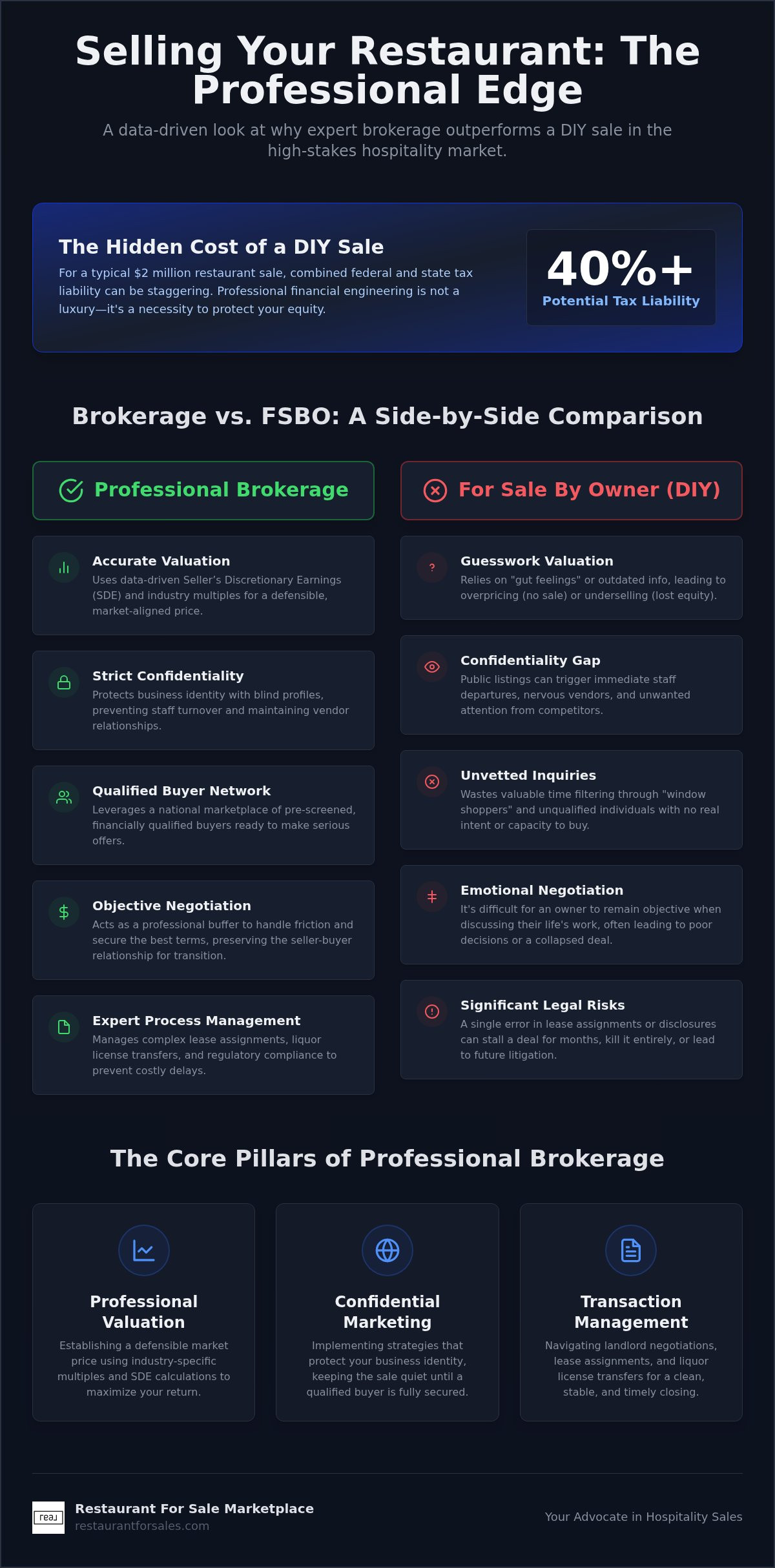
Did you know that for a $2 million restaurant sale, the combined federal and state tax liability can exceed 40%? This staggering figure highlights why a DIY approach often leads to significant financial loss. Selling a business is not just about finding a buyer; it's about structured financial engineering. When you partner with a specialized restaurant broker, such as those at Restaurant For Sale Marketplace, you gain an advocate who understands how to mitigate these liabilities while protecting your brand's reputation and bottom line.
It's understandable to feel overwhelmed by the prospect of managing a sale while running daily operations. You've worked hard to build your legacy, and the fear of competitors finding out or lease hurdles stalling the deal is a valid concern. This article outlines how expert brokerage services secure the highest possible price through professional valuations and pre-screened buyer networks. We'll explore the critical steps of maintaining strict confidentiality, managing complex lease assignments, and streamlining the transfer of liquor licenses. You'll learn how a methodical, results-driven process ensures your exit is both profitable and discreet, allowing for a smooth transition to your next professional chapter.
Key Takeaways
- Understand how specialized intermediaries navigate the unique operational and financial complexities of the hospitality industry to protect your equity.
- Learn to protect your business reputation by utilizing professional protocols that maintain strict confidentiality throughout the entire marketing phase.
- Discover how accurate Seller’s Discretionary Earnings (SDE) calculations and high-impact marketing packages drive higher offers from qualified buyers.
- Identify the essential qualifications for selecting a California restaurant broker, focusing on their knowledge of labor ratios and health code compliance.
- Explore how leveraging a national marketplace and a success-based commission model ensures a secure, profitable, and low-risk exit for entrepreneurs.
What Are Restaurant Brokerage Services?
A restaurant broker acts as a specialized intermediary dedicated exclusively to the hospitality sector. While an entrepreneur might research what is a business broker to understand the general concept of selling a company, the restaurant niche requires a much higher level of technical expertise. These professionals facilitate transactions for a diverse range of businesses, including bars, nightclubs, fast-casual concepts, and full-service dining establishments. They bridge the gap between daily operational reality and high-level financial execution.
Choosing a specialized California restaurant broker over a generalist is a strategic decision that impacts the final sale price. General brokers often lack the depth to analyze specific industry metrics like food cost volatility or complex labor ratios. A specialist understands the significant value difference between various liquor license types and can accurately assess the remaining lifespan of commercial kitchen equipment. This industry-specific knowledge ensures that every asset, from the hood system to the goodwill of a loyal customer base, is valued correctly.
The Core Pillars of Professional Brokerage
Professional brokerage is built on three essential functions that protect the seller's interests. First is the professional business valuation. Brokers use industry-specific multiples and Seller’s Discretionary Earnings (SDE) to establish a defensible market price. Second is the implementation of confidential marketing strategies. This prevents employee turnover and maintains vendor relationships by keeping the sale quiet until a qualified buyer is secured. Finally, brokers manage lease assignments. They negotiate directly with landlords to ensure a clean exit for the seller and a stable, long-term foundation for the new owner.
Specialized Services for Unique Hospitality Assets
The hospitality market often involves complex assets that require precise handling. Franchise resales are a primary example, as they require a California restaurant broker to navigate corporate approval processes and mandatory training requirements. When a transaction involves real estate rather than a leased space, the broker coordinates between business valuation and commercial property appraisal. Additionally, they manage the coordination of liquor license transfers and regulatory compliance. This comprehensive support ensures that all local and state requirements are met, preventing legal delays that could jeopardize the closing.
Brokerage vs. FSBO: Why Professional Representation Matters
Attempting to sell a restaurant independently often exposes the business to operational risks before a single offer arrives. This is known as the confidentiality gap. Unlike residential real estate, where a "For Sale" sign attracts interest, a public listing for a restaurant can trigger immediate staff turnover and a tightening of vendor credit terms. A professional California restaurant broker eliminates this risk by using blind profiles that protect the identity of the establishment until a buyer is fully vetted.
Valuation accuracy is another critical area where For Sale By Owner (FSBO) listings typically fail. Owners frequently rely on "gut feelings" or outdated multiples, leading to businesses that either languish on the market or sell for far less than their true worth. Professionals use a cold, data-driven approach to calculate Seller’s Discretionary Earnings (SDE). This ensures the price reflects current market conditions, such as the 12% increase in independent restaurant closures seen between 2022 and 2024, which has shifted the market toward a buyer-heavy environment.
Negotiation leverage is maintained through third-party representation. It's difficult for an owner to remain objective when discussing the value of their life's work. A broker acts as a buffer, allowing the seller to maintain a positive relationship with the buyer for the post-sale transition while the broker handles the friction of price and term negotiations.
The Risks of For Sale By Owner in Hospitality
The time drain of managing inquiries is often underestimated. Owners must filter out "window shoppers" from serious investors while still managing a high-intensity business. Legal pitfalls are equally dangerous. Without a deep understanding of California broker license requirements and state-specific disclosure laws, an owner risks litigation over lease transfers or asset purchase agreements. A single error in a lease assignment can stall a deal for months or kill it entirely.
The Broker Advantage: Success-Based Commissions
Reputable firms like Restaurant For Sale Marketplace operate on a success-based model. This means the firm only receives a commission when the transaction successfully closes. This structure creates perfect incentive alignment; the broker only wins when the seller achieves a successful exit at the highest possible price. You don't have to worry about upfront fees that offer no guarantee of results. If you're considering an exit, you can review active listings to see how professional presentation attracts a higher caliber of investor.
The Restaurant Sales Process: From Valuation to Closing
A professional sale follows a disciplined five-phase roadmap designed to convert operational success into maximum exit value. Precision is paramount. A seasoned California restaurant broker oversees this process to ensure that the transition from owner to investor is both legally sound and financially optimized. This structured approach prevents the common errors that lead to deal fatigue or collapsed escrows.
- Phase 1: Financial Analysis. The broker performs a rigorous "recasting" of financials to determine the true earning power of the business.
- Phase 2: The Marketing Package. Creation of a Confidential Information Memorandum (CIM) that highlights the strengths and growth potential of the asset.
- Phase 3: Targeted Outreach. Leveraging a national marketplace to present the opportunity to pre-screened, qualified buyers.
- Phase 4: Negotiation and Due Diligence. managing the Letter of Intent (LOI) process and overseeing the buyer's inspection of books, records, and equipment.
- Phase 5: Closing and Transition. Coordination of escrow, lease assignments, and the final transfer of licenses and inventory.
Calculating Your Restaurants True Worth
Valuation in the hospitality industry relies heavily on Seller’s Discretionary Earnings (SDE). Seller’s Discretionary Earnings (SDE) is the total cash flow available to a single owner-operator after accounting for all essential business expenses. In major California markets, restaurants typically sell for 2.0x to 3.5x SDE. However, these multiples are heavily influenced by lease terms. A long-term, transferable, below-market-rate lease can increase a restaurant's value by 20% to 40%. The broker analyzes these variables to set a price that attracts serious offers without leaving money on the table.
Maintaining Strict Confidentiality During Marketing
Protecting the ongoing operation is the highest priority during the marketing phase. Brokers use "blind listings" that describe the business's features, such as its concept and square footage, without revealing the name or exact location. This prevents employees or competitors from discovering the sale prematurely. Every inquiry must go through a mandatory Non-Disclosure Agreement (NDA) process. Furthermore, the broker vets the buyer’s financial capacity before releasing sensitive tax returns or lease documents. This gatekeeping ensures that only serious investors with the capital to close gain access to your proprietary information.
How to Evaluate and Choose a Restaurant Broker
Selecting a partner to represent your business is a high-stakes decision. The right California restaurant broker does more than list a business; they act as a financial strategist and lead negotiator. You need a representative who understands the technical nuances of the hospitality industry. This includes a deep familiarity with labor ratios, food cost fluctuations, and local health code requirements. If a broker cannot speak the language of your kitchen, they cannot effectively sell the value of your operations to a sophisticated buyer.
Database reach is the next critical factor. A broker with only a local network limits your pool of potential buyers. In contrast, leveraging a national marketplace ensures your listing is seen by thousands of pre-screened investors looking for specific opportunities. Your broker should also employ a multi-channel marketing strategy. This includes targeted digital platforms, social media outreach, and direct communication with active buyer databases. Finally, prioritize a firm that values transparent communication. You should receive regular updates on lead volume, buyer feedback, and market sentiment throughout the process.
Questions to Ask During Your Initial Consultation
Before signing a listing agreement, conduct a thorough interview. Ask about their recent track record with your specific concept, whether it's a Quick Service Restaurant (QSR) or a fine dining establishment. Inquire about their strategy for lease assignments. Dealing with difficult landlords is a common hurdle; your broker must have a proven method for navigating these negotiations. Additionally, demand a detailed explanation of their confidentiality protocols. You must be certain that your staff and competitors won't discover the sale through a poorly managed marketing effort.
Red Flags to Watch Out For
Be wary of brokers who demand significant upfront marketing fees. Reputable firms typically operate on a success-based commission model, meaning they only get paid when you do. Another major red flag is a lack of specialized knowledge regarding local liquor license laws. These transfers are complex and highly regulated; an inexperienced broker can cause months of delays. Finally, avoid "valuation fluff." If a broker promises a sale price that seems significantly higher than market averages without data to back it up, they may just be trying to secure your listing. You can evaluate professional brokerage services that prioritize accuracy and results over empty promises.
The Restaurant For Sale Marketplace Difference
Restaurant For Sale Marketplace, a specialized firm under BBMT, Inc., provides a level of scale and precision that local boutiques often cannot match. While a regional California restaurant broker might rely on a limited local network, our firm utilizes a national platform to connect sellers with high-value investors from across the country. We don't just list businesses; we execute a methodical financial engineering process that integrates valuation, brokerage, and lease expertise into a single, seamless service. This holistic approach ensures that no value is left on the table during the transaction.
Our approach is disciplined and results-driven. By focusing exclusively on bars, restaurants, and franchise resales, we've developed a deep understanding of the specific operational metrics that drive value in the hospitality sector. This specialization allows us to provide professional valuation services that are grounded in real-market data rather than speculation. We act as a proactive facilitator, bridging the gap between your operational success and a buyer's investment goals. This creates a sense of stability and reliability that is essential for high-value commercial transactions.
A National Platform for Maximum Exposure
Local market limitations often cap the potential sale price of a business by restricting the buyer pool. Our national reach transcends these boundaries by targeting out-of-state buyers who are actively looking for relocation or investment opportunities. A specialized marketplace is far more effective than general business listing sites because it attracts a pre-screened audience specifically interested in hospitality assets. This broad exposure creates a competitive environment among buyers, which is the most effective way to maximize your final exit value. You aren't just reaching the buyer next door; you're reaching the best buyer in the country.
Start Your Exit Strategy Today
The most successful transactions are planned well in advance. We recommend that owners begin their exit strategy 6 to 12 months before they intend to go to market. This lead time allows for the optimization of financial statements and the resolution of any potential lease or licensing issues. Getting a confidential valuation today provides the benchmark you need to understand your business's current worth and identify areas for improvement. When you're ready to take the next step, you can Schedule a confidential consultation with a Restaurant For Sale Marketplace broker to begin your journey toward a successful, high-value exit.
Secure Your Legacy with Expert Representation
A successful exit requires more than just finding a buyer; it demands a structured approach that prioritizes confidentiality and financial precision. Partnering with a specialized California restaurant broker protects your operation from the risks of public exposure while ensuring your business is valued according to its true earning potential. We've outlined how a methodical process and national reach can significantly increase your final sale price while managing complex lease and licensing hurdles.
Restaurant For Sale Marketplace provides a results-driven model built on specialized hospitality expertise. Our success-based commission structure ensures that our interests are perfectly aligned with your goal of a high-value closing. You gain immediate access to a national buyer network designed to find the ideal investor for your specific concept. Taking the first step now allows for the strategic planning necessary to maximize the return on your professional investment.
Ready to discover the true market value of your business? Get a Professional Valuation for Your Restaurant and start your journey toward a seamless, profitable transition today.
Frequently Asked Questions
How much do restaurant brokerage services typically cost?
Most professional firms operate on a success-based commission model, meaning you only pay a fee upon the successful closing of the transaction. For businesses sold under $1 million, industry averages in 2026 typically range between 8% and 12% of the final sale price. This structure aligns the interests of the seller and the broker. It ensures the broker is motivated to secure the highest possible valuation while mitigating the financial risk for the business owner.
How long does it take to sell a restaurant through a broker?
The timeline for a successful sale generally ranges from six to twelve months, depending on the complexity of the asset and market demand. While a well-priced listing in a high-traffic area may attract offers quickly, the due diligence and lease assignment phases often require several months to complete. Utilizing a national marketplace can accelerate this timeline by exposing the listing to a wider pool of qualified buyers who are ready to move forward with a transaction.
Do I need a broker if I already have a potential buyer?
Yes, professional representation is critical even when a buyer is already identified to ensure the transaction reaches the finish line. A broker vets the buyer’s financial capability and manages the complex paperwork involved in lease transfers and liquor license compliance. They also act as a buffer during price negotiations, preventing emotional decisions that could leave money on the table. This oversight ensures the deal is legally sound and that the final terms reflect the true market value.
What documents do I need to provide for a restaurant valuation?
To perform an accurate valuation, you must provide three years of profit and loss statements, recent tax returns, and your current lease agreement. Additionally, a detailed equipment list and inventory breakdown are essential for calculating the tangible asset value. Providing clear, organized financial records allows a California restaurant broker to recast your earnings accurately. This transparency builds buyer confidence and supports a higher valuation multiple during the marketing phase of the sale process.
Can a broker help with a restaurant lease assignment if I do not own the building?
Facilitating lease assignments is a core component of professional brokerage services. Most restaurant sales involve leased spaces, and securing landlord consent is often the most challenging hurdle in a transaction. A broker manages the communication with the landlord, presents the buyer’s financial qualifications, and negotiates terms to ensure a clean exit for the seller. This specialized expertise prevents lease-related delays that could otherwise jeopardize the entire business transfer or lead to unfavorable post-sale liabilities.
Is my information kept confidential during the entire sales process?
Maintaining strict confidentiality is a top priority throughout the sales cycle to protect your staff morale and vendor relationships. Brokers use blind listings that highlight the business’s strengths without revealing its name or specific location to the public. Every potential buyer must sign a binding Non-Disclosure Agreement (NDA) before receiving sensitive financial data or operational details. This disciplined approach ensures that your intent to sell remains private until the transaction is finalized and ready for transition.
What is the difference between a general business broker and a restaurant broker?
A specialized California restaurant broker possesses technical knowledge that generalists lack, particularly regarding food costs, labor ratios, and health department regulations. They understand the specific value of various liquor licenses and the nuances of commercial kitchen equipment lifespans. This expertise allows for more accurate recastings of Seller’s Discretionary Earnings (SDE). While a general broker might treat a restaurant like any other retail business, a specialist understands the unique operational pressures and financial drivers of the hospitality industry.
Can you help me sell a franchise restaurant resale?
Yes, managing franchise resales is a specialized service that requires navigating complex corporate approval processes. A broker coordinates between the seller, the buyer, and the franchisor to ensure all transfer requirements and training protocols are met. This includes managing the disclosure of the Franchise Disclosure Document (FDD) and ensuring compliance with the California Franchise Broker Law. Professional oversight ensures that the corporate entity approves the new operator, allowing for a smooth transition of the branded asset.


