

Your restaurant's greatest long-term threat isn't a bad review or a slow week; it's a landlord who decides to hike your rent or refuse a lease renewal. For many savvy entrepreneurs, the search for a restaurant with real estate for sale is the most effective way to protect their livelihood. You likely already know that commercial leases can be volatile. They often eat into thin margins and leave you with no tangible property assets after years of hard work.
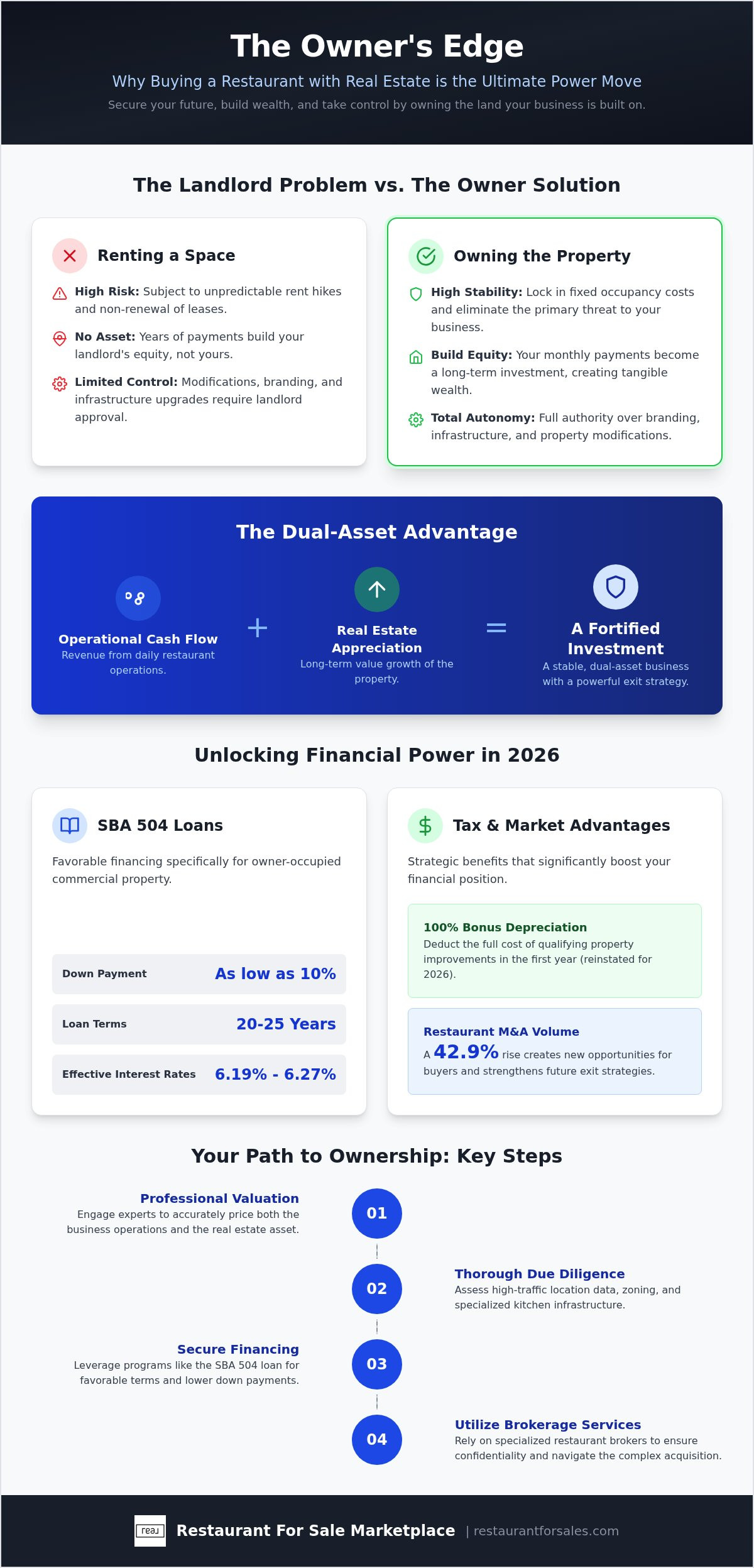
Transitioning from a tenant to an owner transforms your business from a high-risk operational venture into a stable, dual-asset investment. This guide explores the financial advantages of owning the dirt beneath your kitchen, including how to build long-term equity and eliminate the risk of rent escalations. You'll learn the procedural steps of these complex transactions, from professional valuations to navigating current 2026 financing options. We'll also examine how current market trends, such as the 42.9 percent rise in restaurant M&A volume, are creating new opportunities for buyers to secure a more valuable exit strategy. By the end of this article, you'll understand how to leverage real estate to solidify your professional future.
Key Takeaways
- Secure your business's operational future by eliminating the volatility of commercial leases and the risk of unexpected non-renewal.
- Maximize your financial position by utilizing 2026 tax advantages, including bonus depreciation and interest deductions that offset business income.
- Conduct thorough due diligence on a restaurant with real estate for sale by assessing both high-traffic location data and specialized kitchen infrastructure.
- Create a more lucrative exit strategy by positioning your business as a dual-asset investment that appeals to both operators and real estate investors.
- Leverage professional valuation and brokerage services to ensure accurate pricing and maintain confidentiality throughout the complex acquisition process.
The Strategic Advantages of Buying a Restaurant with Real Estate
The 2026 hospitality sector is increasingly defined by a shift toward ownership. While leasing was once the standard for startups, current market conditions favor those who secure their physical location. Investing in a restaurant with real estate for sale allows an entrepreneur to capture two distinct value streams: the operational cash flow of the business and the long-term appreciation of the property. This dual-asset model provides a level of financial insulation that a traditional lease simply cannot match.
Owning the building eliminates the most common deal-killer in the industry: the commercial lease. In a market where corporate-guaranteed QSR cap rates averaged 5.82 percent in early 2026, landlords are constantly seeking higher yields. This often leads to aggressive rent escalations or the refusal to renew a lease if a higher-paying tenant emerges. By becoming your own landlord, you remove this external threat entirely. This provides a level of psychological security that is vital in a volatile economy.
A foundational grasp of Understanding Commercial Property is vital here. Unlike residential assets, restaurant real estate is highly specialized infrastructure. Ownership grants you total authority over branding, exterior modifications, and significant infrastructure upgrades. You don't have to wait for landlord approval or navigate complex build-out negotiations to improve your customer experience.
Control vs. Flexibility: The Owner-User Model
Owning the dirt acts as a financial safety net. If a specific restaurant concept fails to meet expectations, the owner-user retains the ability to repurpose the space or sell the building to another operator. You aren't tied to a specific lease agreement that dictates how you use the square footage. This flexibility is critical for multi-generational businesses that need to adapt to changing consumer tastes over decades rather than years. It ensures that the value of your investment isn't solely dependent on your current menu.
Asset Diversification for Restaurant Groups
For larger restaurant groups, real estate ownership is a tool for asset diversification. It balances the high-octane risk of daily operations with the stability of tangible equity. A property-backed portfolio is significantly more attractive to institutional investors and lenders. It strengthens the company balance sheet, providing collateral that can be used to fund future expansions. In a market where serious buyers are focused on value, having a real estate component often justifies a higher valuation multiple during a transition or exit.
Financial Benefits: Equity, Tax Strategy, and Financing
Ownership converts a monthly liability into a long-term asset. When you find a restaurant with real estate for sale, you're redirecting capital from a landlord's pocket into your own balance sheet. This build-up of equity provides a buffer against the hospitality industry's inherent volatility. Real estate ownership also acts as a natural stabilizer for your profit and loss statement. While consumer prices and supply chain costs rise, your occupancy cost remains predictable. This predictability is a key factor in lowering your weighted average cost of capital. Lenders view property-backed businesses as lower-risk profiles, which often translates to more competitive interest rates on secondary lines of credit.
Unlocking Favorable Financing via SBA Loans
The Small Business Administration (SBA) offers loan programs that specifically favor owner-occupied commercial property. The SBA 504 program is particularly effective for these acquisitions. In August 2026, the effective interest rates for the CDC portion of 504 loans are between 6.19 percent and 6.27 percent for 20-year and 25-year terms. These loans often require lower down payments than business-only debt, sometimes as low as 10 percent. The longer amortization schedules significantly improve monthly cash flow compared to short-term commercial business loans. If you're ready to evaluate your options, you can browse current listings for a restaurant with real estate for sale to see how these numbers apply to active opportunities.
Depreciation and the "Triple Net" Advantage
Tax strategy is where ownership truly shines. For 2026, 100% bonus depreciation has been reinstated for qualifying property improvements. This allows you to deduct the full cost of certain assets in the first year. Many owners choose to separate their business and property interests by Setting up a Real Estate LLC to hold the deed. This structure allows the business to pay rent to the LLC, creating a favorable tax environment and protecting the property from business liabilities. In a traditional Triple Net (NNN) lease, the tenant bears all the operational burdens of ownership without any of the upside. You already pay the property taxes, insurance, and maintenance; ownership ensures those payments contribute to your own net worth. Cost segregation is a strategic tax tool that reclassifies portions of real estate as personal property to accelerate depreciation deductions and improve immediate cash flow.
Evaluating Restaurant Real Estate Listings: Due Diligence
Acquiring a restaurant with real estate for sale requires a more rigorous due diligence process than a business-only purchase. You aren't just buying a kitchen and a brand; you're acquiring a physical asset that must meet strict municipal standards. Evaluating the site involves analyzing traffic counts and visibility metrics. A "destination" location might survive with lower visibility, but high-volume concepts depend on easy ingress and egress. Zoning and permitting are the foundations of your operational legality. You must ensure the current real estate supports your specific concept, especially if you plan to add a drive-thru or outdoor seating. Some zones have strict noise ordinances or alcohol service restrictions that could stifle a bar-heavy model.
A professional appraisal is non-negotiable for dual-asset transactions. You need a valuation that bifurcates the business value from the underlying land and improvements. This ensures you aren't overpaying for either asset. The appraisal process should involve a specialist who understands both commercial real estate and the hospitality industry. This allows the land to be valued based on comparable commercial sales while the business is valued on its cash flow multiples, which averaged 2.41 in the first half of 2026.
Physical Inspections and Infrastructure
Inspecting specialized infrastructure is critical because replacement costs are high. In 2026, national construction costs for full-service restaurants average $380 per square foot. This makes existing grease traps, venting systems, and high-capacity electrical panels extremely valuable. Identifying deferred maintenance during the inspection phase allows for price adjustments before the deal closes. You must also verify ADA compliance and local 2026 building codes. Non-compliant dining room layouts or restroom configurations can lead to costly post-acquisition renovations that eat into your startup capital.
Environmental and Title Considerations
Lenders typically require a Phase I environmental report for commercial property transactions. This study rules out soil or groundwater contamination, which is a common requirement for SBA-backed loans. You must also clear any title encumbrances, liens, or old leasehold interests before the close of escrow. Easements and parking requirements are equally vital. A lack of dedicated parking can severely limit your operational capacity. Ensure the title search confirms that no third-party agreements restrict your ability to modify the building's exterior or signage, as these elements are vital for your restaurant with real estate for sale investment.
Exit Strategy: How Real Estate Impacts Future Valuation
Owning the physical property fundamentally changes the math of your eventual exit. When you list a restaurant with real estate for sale, you're appealing to two distinct groups of buyers. The first is the traditional operator looking for a turnkey business. The second is the real estate investor seeking yield-bearing commercial assets. This expanded buyer pool creates a competitive bidding environment that often results in a higher final sale price. You're no longer just selling an operational concept; you're selling a high-margin cash flow backed by tangible collateral.
Removing the rent expense from your profit and loss statement drastically increases your Seller’s Discretionary Earnings (SDE). Since business valuations are typically based on a multiple of SDE, which averaged 2.41 in the first half of 2026, every dollar saved on rent is multiplied in the final sale price. This "rent-free" earnings profile makes the business significantly more attractive to lenders, as the debt coverage ratio is much healthier. It transforms the business from a high-risk service venture into a stable investment class.
Calculating the Combined Market Value
In a dual-asset sale, professional brokers use two distinct valuation methodologies to capture total value. The real estate component is valued using a capitalization (Cap) rate. For casual dining assets, these rates averaged 6.55 percent in the first quarter of 2026. The business is valued separately using a multiple of its earnings without the burden of rent. Marketing these assets together allows you to highlight the total return on investment. This transparency builds trust with sophisticated buyers who are looking for documented value. If you want to see how these valuations manifest in the current market, you can view available restaurant with real estate for sale listings to compare asset-to-earnings ratios.
The Sale-Leaseback Exit Strategy
A sale-leaseback is a powerful tool for owners who want to unlock capital without stopping operations. You sell the real estate to an investor and simultaneously sign a long-term lease to remain as the tenant. This move converts illiquid equity into cash that can be used for retirement or to fund a multi-unit expansion. For the strategy to work, the post-sale lease must be structured carefully to ensure the business remains profitable. A lease that is too expensive will crush the business's resale value; one that is too low leaves real estate money on the table. Balancing these figures requires the precision of a specialist who understands the interplay between property yields and restaurant margins.
Navigating the Acquisition with a Restaurant Broker
Acquiring a restaurant with real estate for sale is a multi-layered process that exceeds the scope of a standard business transaction. You are essentially closing two deals simultaneously: the purchase of an operational company and the acquisition of commercial property. This complexity requires specialized commercial brokerage expertise to ensure both assets are protected. A broker acts as the central coordinator between lenders, appraisers, and attorneys; they ensure that the timelines for the business transfer align perfectly with the real estate closing. Without this oversight, a delay in property financing could jeopardize the operational liquor license transfer or the business's opening date.
Confidentiality is a critical component of the broker's role. Publicly listing a business can cause immediate staff turnover or a drop in customer confidence. A professional broker manages the flow of sensitive information, requiring signed non-disclosure agreements before revealing any details about the property or the books. Restaurant For Sale Marketplace facilitates these complex closings by providing a secure platform where serious buyers can evaluate dual-asset opportunities without compromising the seller's ongoing operations. This structured approach builds the trust necessary to move from an initial inquiry to a successful closing.
Expert Valuation and Market Analysis
Formal appraisals are the backbone of the financing stage. Lenders in 2026 require documented proof that the business cash flow can support the debt service of the property. A broker assists by analyzing comparable sales (Comps) for both the restaurant's earnings and the building's square footage. This dual-track analysis ensures the asking price is justified by current market data. In an environment where conventional commercial mortgage rates range from 5.55 percent to 8.93 percent, accurate valuation is the only way to secure the necessary loan-to-value ratios from institutional lenders. The broker ensures that the business's Seller's Discretionary Earnings are properly adjusted to reflect the new ownership structure.
Closing the Deal: From LOI to Escrow
The transition begins with a comprehensive Letter of Intent (LOI). This document must clearly outline the contingencies for both the business and the real estate, including physical inspections and financing approvals. Managing the timeline for due diligence is vital; you don't want to finalize the business purchase agreement until the environmental Phase I report for the land is cleared. The broker oversees the escrow process, ensuring that all title encumbrances are removed and that the final purchase agreement reflects a seamless ownership transition. This methodical approach ensures that you step into your new role as an owner-operator with a clear title and a stable financial foundation.
Building a Legacy Through Ownership
Acquiring a restaurant with real estate for sale is a strategic move that shifts your business's financial trajectory. Ownership secures your operational future by eliminating the volatility of commercial landlords and predatory rent hikes. It allows you to build tangible equity while leveraging 2026 tax advantages like 100% bonus depreciation. This dual-asset model simplifies your exit strategy and increases your business's market value by attracting a broader range of investors. It's a proven path to long-term wealth and stability.
Successfully navigating these high-value transactions requires precision and a deep understanding of both hospitality and commercial property markets. Our national marketplace for bars and restaurants provides the specialized resources you need to move from consultation to closing. We offer access to professional business valuation experts and operate on success-based brokerage commissions to ensure our interests align with your professional goals. This ensures you have the support needed to manage due diligence and confidentiality effectively.
Take the first step toward securing your professional legacy today. Browse National Restaurant Listings with Real Estate to discover opportunities that match your investment criteria. Your journey toward long-term stability and asset growth starts with the right partner.
Frequently Asked Questions
Is it better to buy a restaurant with real estate or lease the space?
Buying is generally superior for long-term wealth because it builds equity and eliminates rent escalations. While leasing offers lower upfront costs and more flexibility to move, owning a restaurant with real estate for sale provides operational security. You aren't at the mercy of a landlord's decision to sell or repurpose the building. This stability is vital for businesses looking to control their physical environment and branding permanently without the risk of lease non-renewal.
What kind of financing is available for buying a restaurant with real estate?
Financing options include SBA 7(a) and 504 loans, conventional commercial mortgages, and occasionally seller financing. SBA 504 loans are specifically designed for fixed assets like real estate, offering long-term, fixed-rate financing. Conventional loans may offer faster closing times but often require higher credit scores and larger down payments. In August 2026, many operators are choosing SBA programs to capitalize on lower down payment requirements and favorable amortization schedules that preserve monthly cash flow.
How do I value a restaurant business when the real estate is included?
You must use a bifurcated valuation approach that separates the business's operational value from the property's fair market value. The business is typically valued on a multiple of Seller's Discretionary Earnings, while the real estate is valued based on comparable commercial sales or a capitalization rate. A professional broker ensures the business earnings are adjusted to remove rent expenses. This provides a clear picture of the total investment's return and its ability to service property debt.
What are the main tax benefits of owning restaurant real estate?
Owners benefit from depreciation deductions, interest expense write-offs, and 100 percent bonus depreciation for qualifying improvements in 2026. These non-cash expenses significantly reduce your taxable income compared to a tenant who can only deduct rent. Additionally, using a cost segregation study allows you to accelerate depreciation on specific components like kitchen equipment and specialized lighting. These strategies improve immediate cash flow, allowing you to reinvest profits back into your restaurant operations or future expansions.
Do I need a separate broker for the business and the real estate?
It's more efficient to use a single specialized broker who understands the complexities of dual-asset transactions. Managing two different brokers often leads to communication gaps and conflicting timelines between the business transfer and the property closing. A specialist from a firm like Restaurant For Sale Marketplace coordinates with lenders, attorneys, and appraisers on both fronts. This unified approach ensures confidentiality is maintained and that the deal structure satisfies the requirements for both assets simultaneously.
What happens if the restaurant fails but I own the building?
Owning the building provides a significant safety net because the real estate retains value independent of the restaurant's success. You have the option to lease the space to a new operator, effectively becoming the landlord, or sell the property to a developer. This flexibility prevents the total loss often associated with business-only failures where the lease is canceled. Tangible property equity acts as collateral that can be liquidated to settle debts or fund a new venture.
Are SBA loans better than conventional loans for restaurant property?
SBA loans are often preferred because they offer lower down payments and longer repayment terms, which improves monthly cash flow. Conventional loans may have more restrictive loan-to-value limits and shorter balloon payments. However, conventional financing can be better for buyers with exceptionally strong balance sheets who want to avoid SBA fees and strict owner-occupancy requirements. Choosing between them depends on your available capital and whether you intend to operate the business yourself or lease it out.
How much of a down payment is typically required for a restaurant with real estate?
Down payments typically range from 10 percent for SBA 504 loans to 25 or 30 percent for conventional commercial mortgages. The specific requirement depends on the lender's assessment of the business's cash flow and the borrower's credit profile. In the 2026 market, SBA programs remain the most accessible route for owner-operators. Securing a restaurant with real estate for sale with a lower down payment allows you to keep more working capital available for initial marketing, inventory, and staff training.


