

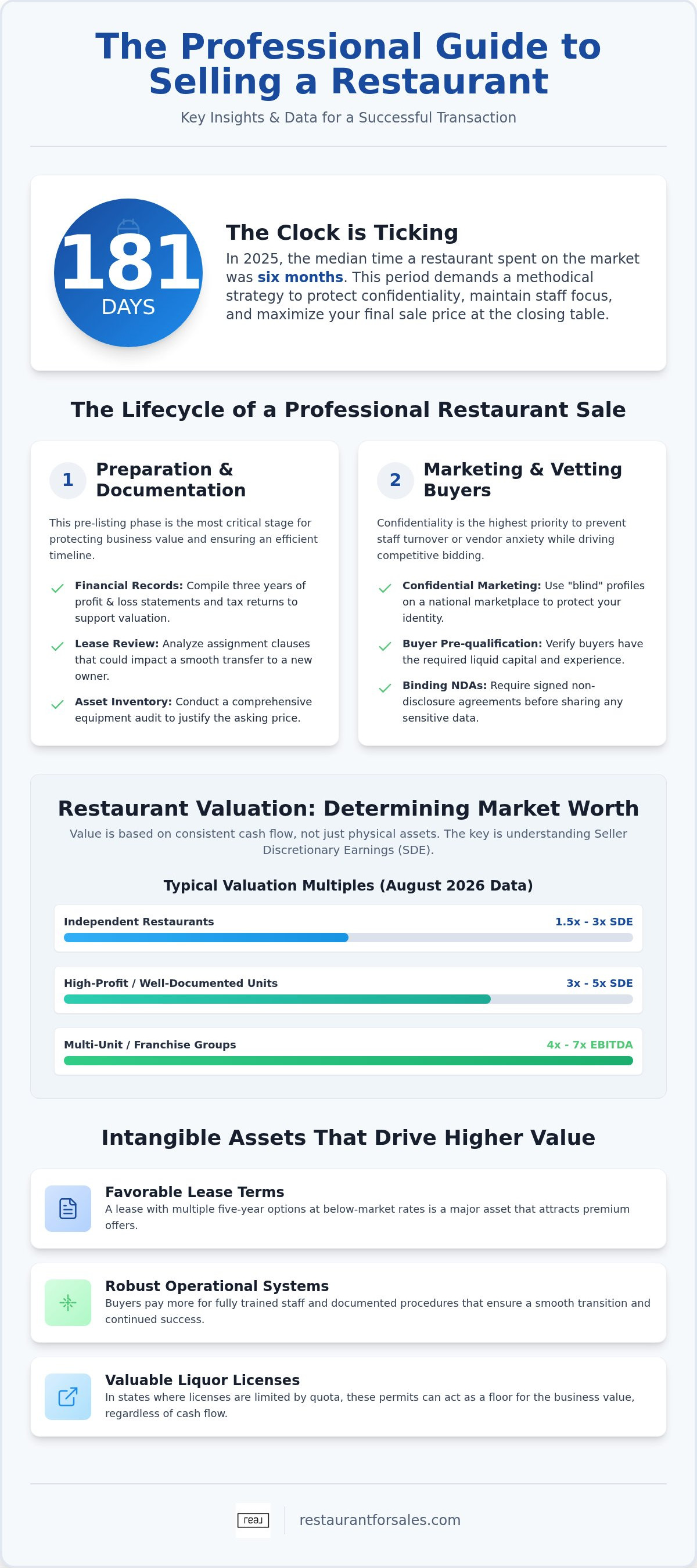
Did you know that in 2025, the median time a restaurant spent on the market before closing a deal was 181 days? This six-month window represents a period of high pressure where confidentiality and financial precision are paramount. If you are considering a restaurant sale, you likely feel the weight of these stakes. You want to ensure your staff remains focused, your lease transfers smoothly, and your hard-earned equity is fully realized at the closing table.
We understand that the transition of a high-value commercial asset requires more than just a listing; it requires a methodical strategy. This article provides professional insights into the complexities of the current market, from understanding valuation multiples to managing legal safeguards. We will guide you through the essential stages of the process, including brokerage selection, lease assignments, and the steps necessary to secure a legally sound transaction that maximizes your final sale price.
Key Takeaways
- Learn why the pre-listing phase is the most critical stage for protecting business value and ensuring an efficient transaction timeline.
- Understand the specific role of Seller Discretionary Earnings (SDE) in a restaurant sale and how it differs from traditional commercial real estate metrics.
- Discover how professional brokerage services mitigate the risks of buyer fatigue and maintain the momentum necessary to close complex deals.
- Identify the landlord's critical role in the transfer process and the legal nuances between executing a new lease versus a lease assignment.
- Explore the strategic advantages of blind marketing within a national marketplace to protect daily operations while driving competitive bidding.
The Lifecycle of a Professional Restaurant Sale
Executing a successful restaurant sale requires a disciplined sequence of events. While every transaction is unique, data from 2025 shows a median time of 181 days on the market. This timeline accommodates the rigorous vetting and legal transitions required for high-value commercial assets. Rushing this process usually leads to price erosion or legal complications during the closing phase.
Professional brokerage services act as the central hub for this lifecycle. Brokers coordinate with attorneys to draft secure agreements and accountants to verify financial health. The most critical phase occurs before the business ever reaches the public eye. Proper preparation ensures that once a listing is live, it withstands the scrutiny of qualified buyers and their lenders.
Phase 1: Preparation and Documentation
Clean documentation is the foundation of a high-value sale. Buyers and lenders require a transparent view of the business's financial history and operational stability. It's essential to prepare the following items before engaging the market:
- Financial Records: Compile three years of profit and loss statements and federal tax returns to support your valuation.
- Lease Review: Analyze your current lease for assignment clauses or "right of first refusal" language that could impact a transfer.
- Asset Inventory: Conduct a comprehensive equipment audit. Functional, well-maintained assets support the asking price and prevent last-minute negotiations.
Phase 2: Marketing and Vetting Buyers
Confidentiality is the highest priority during the marketing phase. A public announcement of a restaurant sale can trigger staff turnover or vendor anxiety. To mitigate this risk, brokers use "blind" profiles that highlight the opportunity's value without revealing the specific location or name.
Financial pre-qualification is equally vital. The process ensures that potential buyers possess the liquid capital and experience required by both the seller and the landlord. It's a standard requirement that every interested party sign a binding non-disclosure agreement (NDA) before viewing sensitive operational data. This structured vetting process prevents buyer fatigue and keeps the transaction on a steady path toward a successful closing.
Restaurant Valuation: How to Determine Market Worth
Unlike standard commercial real estate, a restaurant sale is valued primarily on its ability to generate consistent cash flow rather than just its physical footprint. While a building's value relies on market comparables and square footage, a restaurant's worth depends on profitability, concept stability, and operational systems. Owners who treat their business as a real estate play often leave money on the table by ignoring the "goodwill" generated by their brand. For a deep dive into these technical methodologies, consult our 2026 Restaurant Valuation Guide for Owners and Buyers.
SDE vs. EBITDA: Which Metric Matters Most?
Seller’s Discretionary Earnings (SDE) is the standard for independent, single-location establishments. It calculates the total financial benefit to a single owner by adding back their salary, health insurance, and non-recurring expenses to the net profit. For larger operations with revenues exceeding $5 million, EBITDA (Earnings Before Interest, Taxes, Depreciation, and Amortization) becomes the benchmark. SDE is the primary metric for owner-operated restaurants because it reflects the actual take-home cash available to a working proprietor.
Current market data from August 2026 indicates that independent restaurants typically trade at 1.5x to 3x SDE. Highly profitable, well-documented units can reach multiples of 3x to 5x. Conversely, multi-unit or franchise groups often command higher multiples between 4x and 7x EBITDA. Understanding these ranges is essential for setting a price that attracts qualified buyers without sacrificing equity.
Intangible Assets That Drive Sales Price
Financial statements tell only part of the story. Several off-book assets significantly influence where a business falls within those valuation multiples. Buyers are often willing to pay a premium for stability and ease of transition.
- Lease Terms: A lease with multiple five-year options at below-market rates is a major asset. In high-demand markets, the lease itself can sometimes be worth more than the kitchen equipment.
- Operational Systems: A restaurant that runs smoothly without the owner present is more valuable. Buyers pay more for fully trained staff and documented standard operating procedures.
- Liquor Licenses: In states where licenses are limited by quota, these permits act as a floor for the business value, regardless of cash flow.
Securing professional restaurant valuation services ensures these nuances are captured correctly. This prevents the common mistake of underpricing a business that has significant intangible value beyond its annual profit.
Brokerage vs. FSBO: Choosing Your Sales Strategy
Deciding whether to manage a restaurant sale independently or through a professional firm is a pivotal choice. While "For Sale By Owner" (FSBO) might seem like a way to save on costs, the complexities of the niche industry often lead to significant financial leakage for solo sellers. A professional broker doesn't just list a business; they manage the entire lifecycle. They act as a disciplined buffer between the seller and the buyer. This separation is crucial during negotiations, where emotional attachment can cloud logical decision-making and lead to stalled deals.
Professional firms utilize a success-based commission model. This structure ensures that the broker's interests are perfectly aligned with your own. They only succeed when you achieve a closed transaction at an acceptable price. This partnership provides a level of stability and reliability that is difficult to replicate when attempting to navigate the market alone.
The Hidden Costs of Selling Alone
Selling alone carries risks that aren't immediately obvious. Confidentiality is the most fragile part of any restaurant sale. If news of a potential transfer leaks to your staff or vendors, you risk losing key personnel or having credit terms tightened overnight. FSBO listings also tend to attract "tire kickers"—individuals who lack the liquid capital to close but consume hours of your time. Without a professional to vet these prospects, you lose focus on daily operations. This often results in a decline in revenue just when you need your financial statements to look their best. Furthermore, legal exposure is a constant threat when dealing with improperly drafted letters of intent (LOI) or disclosure documents.
Why Professional Representation Wins
Professional brokerage services provide access to proprietary databases of active, qualified buyers that aren't reachable through public listing sites. These firms specialize in navigating high-value restaurant sales commissions and ensuring that every party at the table is prepared for the closing. Brokers also handle the heavy lifting of lease assignments and landlord negotiations, which are the most common points of failure in a deal. By leveraging a national reach, a specialized firm creates a competitive environment that drives up the final offer price, often more than offsetting the cost of the commission through a higher net return at the closing table.
Critical Legal and Lease Considerations
Landlords are the silent partners in every restaurant sale. They hold the ultimate power to veto a buyer even if the financial terms between the parties are perfect. Understanding the distinction between a new lease and a lease assignment is vital for a smooth transition. A new lease typically involves renegotiating terms and rates, while an assignment allows the buyer to step into the seller's existing contractual shoes. For a complete checklist of these steps, see our guide on Understanding Restaurant Lease Assignments.
The Lease Assignment Process
Landlords require absolute financial transparency from any incoming buyer. They'll scrutinize credit scores, liquid assets, and previous industry experience before granting approval. One common pitfall is the failure to negotiate a release from personal guarantees. Without a formal release, a seller might remain financially liable if the new owner defaults months after the closing. Managing landlord consent timelines is equally important. These approvals often take 30 to 60 days. Delays here are the most frequent cause of deal fatigue and can jeopardize the entire transaction.
Real Estate and Licensing
If the transaction includes the physical property, the complexity increases significantly. You aren't just selling a business; you're executing a commercial real estate transfer that requires its own set of disclosures and appraisals. For those looking at this specific path, our resource on investing in a restaurant with real estate for sale provides a targeted strategy for the current market.
Licensing transfers also require meticulous timing and coordination with local municipalities. Liquor licenses, in particular, often have strict "change of ownership" windows and background check requirements that can stall a restaurant sale. You must also verify that all kitchen equipment is free and clear of debt. Any outstanding UCC filings or equipment liens will prevent a clean title transfer and may complicate the buyer's ability to secure financing. Clearing these hurdles early prevents the deal from collapsing during the final week of escrow. If you need assistance navigating these requirements, our team provides expert restaurant brokerage services to manage every legal detail of your transition.
Executing a Confidential Sale with a Professional Marketplace
Utilizing a national marketplace transforms a localized listing into a high-visibility asset. This reach creates a competitive bidding environment where multiple qualified parties vie for the acquisition. For sellers, this competition is the most effective way to maximize the final price. National restaurant industry sales are projected to reach $1.55 trillion in 2026, and a broad marketplace ensures your business captures its share of that massive investment pool. However, visibility doesn't have to come at the cost of operational security. Blind marketing ensures that the specific identity of the business remains protected until a buyer is fully vetted and an NDA is signed. This approach allows for a defensible asking price based on professional valuation without alerting competitors or customers.
Protecting Your Brand During the Transition
Confidentiality is a strategic requirement for maintaining business value. Informing staff too early can lead to unnecessary turnover that weakens the operation. Professional brokers manage all initial inquiries and coordinate site visits during off-hours to prevent suspicion among employees. They also ensure the seamless transition of digital assets, including social media accounts, POS system credentials, and online ordering platforms. These details are vital for maintaining customer continuity from the first day of new ownership. A disciplined transition plan prevents the loss of proprietary knowledge and keeps the brand's reputation intact through the closing.
Getting Started with Restaurant For Sale Marketplace
Our firm operates as a specialized commercial brokerage under BBMT, Inc., providing national reach across all major US markets. We offer end-to-end management that guides you from the initial valuation through the final closing documents. Our success-based commission structure ensures that our interests remain perfectly aligned with yours. We only succeed when you achieve a closed transaction that meets your financial goals. This model provides a level of accountability that is essential for high-value commercial transfers.
If you are looking to enter the market from the other side, learn how to buy a restaurant in 2026 through our comprehensive guide on vetted listings and acquisition strategies. To initiate a confidential consultation, contact our team to review your goals and start the professional valuation process. We provide the stability and expertise needed to turn a complex transaction into a successful exit.
Securing Your Professional Exit Strategy
A successful restaurant sale is the culmination of years of operational discipline and strategic planning. We've established that accurate valuation based on Seller’s Discretionary Earnings is the foundation of a defensible asking price. We also addressed the necessity of professional brokerage to manage the delicate balance of confidentiality while navigating complex lease assignments. These steps ensure that your hard-earned equity isn't lost to legal pitfalls or unvetted buyers.
Our firm provides the end-to-end support required for high-value commercial transactions. By utilizing our success-based brokerage commissions and professional valuation services, you gain a partner dedicated to your financial outcome. We specialize in coordinating every detail, from the initial blind listing to the final landlord consent. This methodical approach provides the stability and reliability needed to move from opportunity to execution with confidence.
Ready to take the next step in your professional journey? List your business or find your next opportunity on the Restaurant For Sale Marketplace today. We look forward to facilitating your smooth transition of ownership and helping you achieve a maximized sales price.
Frequently Asked Questions
How long does a typical restaurant sale take to close?
A typical restaurant sale takes approximately six months to close, with a median of 181 days on the market in 2025. This timeline includes valuation, marketing, vetting buyers, and the escrow process. Factors like financing approval and landlord consent can extend this duration. Maintaining operational consistency during this half-year window is vital for preserving the business's value until the final transfer of ownership.
What is the average commission for a restaurant broker in 2026?
Commissions for specialized brokerage services are typically success-based and reflect the complexity of high-value commercial transactions. While rates vary based on the size and type of the establishment, they generally align with the intensive work required for valuation, marketing, and lease negotiations. A success-based model ensures that the broker's primary objective is to achieve the highest possible net return for the seller at the closing table.
Can I sell my restaurant without my employees finding out?
Yes, professional brokers utilize "blind" marketing techniques to maintain total confidentiality during a restaurant sale. This process involves creating a business profile that highlights financial performance and concept type without revealing the name or specific location. Potential buyers must sign a binding non-disclosure agreement (NDA) before receiving sensitive details. This strategy protects your current operations from staff turnover and vendor concerns while you identify a qualified successor.
What documents do I need to prepare for a restaurant valuation?
To conduct an accurate valuation, you must provide three years of federal tax returns and detailed profit and loss statements. You should also prepare a copy of your current lease, a comprehensive equipment inventory, and any relevant liquor license or health permit documentation. These records allow a broker to calculate your Seller’s Discretionary Earnings (SDE). Clear documentation is the most effective way to justify your asking price to sophisticated buyers.
Is it better to sell a restaurant with the real estate or just the business?
Selling a restaurant with real estate often increases the total transaction value and provides the buyer with greater long-term security. However, selling only the business is a common path for owners who operate in leased spaces. Including real estate can simplify the process by removing the need for landlord consent. Your choice should depend on your investment goals and whether the property’s market value exceeds the potential gain from a business transfer.
How do I handle a lease assignment if the landlord is uncooperative?
Managing an uncooperative landlord requires a proactive approach that emphasizes the financial strength and experience of the incoming tenant. If a lease assignment is met with resistance, a broker can act as a facilitator to demonstrate that the new owner meets all contractual requirements. Providing a comprehensive package with strong credit scores and a solid business plan often mitigates landlord concerns. Professional representation is essential for navigating these high-stakes negotiations effectively.
What happens to the liquor license during a restaurant sale?
Liquor licenses are typically transferred to the new owner through a formal application process with local and state authorities. This transition must be timed precisely to avoid operational gaps after the deal closes. In states where licenses are limited by quota, the permit itself holds significant market value and must be appraised as an asset. New owners must undergo background checks and meet specific regulatory requirements to ensure the license remains in good standing.
Do I need a lawyer if I am already using a restaurant broker?
While a broker manages the transaction process and valuation, an attorney provides essential legal oversight for drafting and reviewing final contracts. A lawyer ensures that all letters of intent and purchase agreements are legally sound and protect your interests. Using both professionals provides a comprehensive safety net. The broker handles the marketplace strategy and negotiations, while the attorney focuses on mitigating legal risks and ensuring a secure transfer of assets.


