

What if the purchase price of a restaurant is the least important number in your acquisition strategy? Many entrepreneurs focus on the total cost while ignoring the actual liquidity requirements needed for a down payment for buying a restaurant business. It's natural to feel concerned about being rejected by lenders because of a perceived lack of cash. You might also feel confused by the difference between the purchase price and the total cash-to-close.
Securing the right financing is about more than just meeting a minimum threshold; it's about demonstrating your ability to sustain the operation. This 2026 guide provides the clarity you need to move forward with confidence. You'll learn the exact percentage ranges required for various deal structures and how to use professional valuations to ensure you aren't overpaying. We'll also break down how to leverage seller financing to reduce your initial outlay and provide a checklist of hidden cash requirements. By the end of this article, you'll have a clear roadmap for financing your acquisition while maintaining the cash flow your new business requires.
Key Takeaways
- Understand that a typical down payment for buying a restaurant business ranges from 10% to 30%, depending on the specific deal structure and lender requirements.
- Leverage your professional industry experience and the business's Seller's Discretionary Earnings (SDE) to secure higher leverage and more favorable loan terms.
- Evaluate the differences between SBA 7(a) loans and conventional commercial financing to identify the best path for your specific timeline and capital constraints.
- Plan for total liquidity requirements by including working capital reserves and lease security deposits in your initial cash-to-close calculations.
- Explore strategic structuring options like seller financing or 401(k) rollovers to reduce your immediate out-of-pocket cash requirements during the acquisition.
Typical Down Payment Ranges for Restaurant Acquisitions
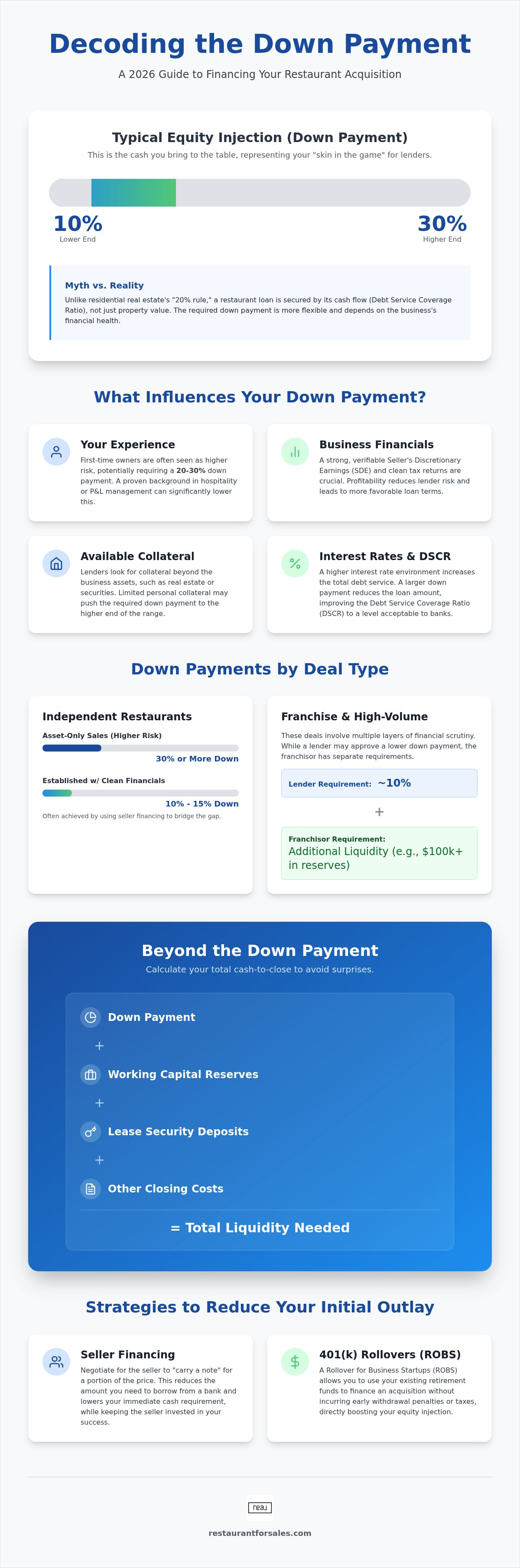
Determining the correct down payment for buying a restaurant business requires an understanding of both lender expectations and current market conditions. In 2026, standard industry benchmarks for a cash down payment typically range between 10% and 30% of the total purchase price. This figure isn't arbitrary; it reflects the risk profile of the hospitality industry and the specific requirements of commercial lenders.
Many first-time buyers mistakenly apply the "20% rule" common in residential real estate to these transactions. Commercial acquisitions are fundamentally different. While a home loan is secured by the underlying value of the property, a business loan is secured primarily by the cash flow of the operation. Consequently, lenders focus more on the debt service coverage ratio than on a static percentage. You'll often hear the term "equity injection" used interchangeably with down payment. This represents the actual cash you bring to the closing table to satisfy the lender's requirement for "skin in the game."
The size of the deal significantly shifts these percentages. For acquisitions under $500,000, buyers often rely on a mix of personal cash and seller financing. Larger deals exceeding $1 million usually involve formal SBA 7(a) or conventional financing, where the structure becomes more rigid. Utilizing professional valuation services ensures that your down payment is based on an accurate assessment of the business's worth, preventing you from over-leveraging at the start of your tenure.
Small to Mid-Sized Independent Restaurants
In the "mom and pop" segment, the down payment structure is often more flexible but can be more cash-intensive if the business lacks strong financial records. For asset-only sales, where you are purchasing equipment and a lease rather than a profitable ongoing concern, lenders may demand 30% or more because the risk is higher. Conversely, established independent restaurants with clean tax returns often qualify for 10% to 15% down payments when seller-carry notes are used to bridge the gap. A broker helps negotiate these seller notes, which can effectively reduce your immediate out-of-pocket cash while keeping the seller invested in your success.
Franchise Resales and High-Volume Establishments
Acquiring a franchise or a high-volume location involves additional layers of financial scrutiny. Beyond the lender's down payment, franchisors often have their own strict liquidity and net worth requirements. A lender might be satisfied with 10% down, but the franchisor may require you to have an additional $100,000 in liquid reserves for future upgrades or operational stability. For more detail on these specific requirements, consult our complete guide to franchise resale. High-volume establishments with proven EBITDA (Earnings Before Interest, Taxes, Depreciation, and Amortization) provide the best leverage, as consistent profitability reduces lender risk and can lead to lower cash-to-close requirements.
Factors Determining Your Down Payment Requirement
Lenders prioritize risk mitigation above all else when evaluating a loan application. In the 2026 lending environment, the specific down payment for buying a restaurant business depends on a combination of your personal profile and the target's financial health. While cash is the primary requirement, lenders also look for collateral beyond the restaurant's assets, such as real estate or marketable securities, to secure the debt. If your collateral is limited, you should expect the cash requirement to sit at the higher end of the standard range.
Interest rates play a critical role in determining your required equity. Lenders use the Debt Service Coverage Ratio (DSCR) to ensure the business can comfortably afford its monthly payments. Because 2026 interest rates influence the cost of capital, a higher rate environment often forces a larger down payment. By putting more money down, you reduce the total loan amount and improve the DSCR, making the deal more attractive to a bank. Reviewing current restaurant listings can help you understand how different price points and earnings impact these leverage calculations.
Operational History and Management Experience
Your professional resume is a financial asset in the eyes of a lender. Banks view first-time owners as high-risk prospects, often demanding a 20% to 30% down payment to offset the lack of industry-specific history. However, if you can demonstrate a background in hospitality management or show a team with transferable skills in P&L management and staff leadership, you may qualify for lower cash requirements. A strong management team provides the lender with confidence that the business will remain stable during the ownership transition, effectively acting as a substitute for a portion of the cash injection.
Financial Performance and Valuation Accuracy
The accuracy of the business's asking price directly impacts your cash-to-close. If a seller's price is inflated beyond what an appraisal supports, you'll face an "appraisal gap." Lenders only finance based on the appraised value, so any amount paid over that value must come directly from your pocket as additional down payment. Utilizing professional restaurant valuation methods before you sign a Letter of Intent is the best way to avoid this trap. Furthermore, lenders prefer businesses with clean, verifiable tax returns. If a seller cannot prove their earnings through official documentation, the lender will likely reduce the loan amount, forcing you to increase your down payment to bridge the difference.
Financing Vehicles and Their Cash-to-Close Requirements
Selecting the right loan structure is the most effective way to manage your initial capital outlay. The vehicle you choose doesn't just determine your interest rate; it sets the floor for the down payment for buying a restaurant business. While some buyers focus solely on the interest expense, the structure of the equity injection often has a greater impact on your day-one liquidity and long-term operational success.
SBA 7(a) vs. Conventional Financing
SBA 7(a) loans remain the gold standard for restaurant acquisitions in 2026. While the SBA guidelines technically allow for a 10% minimum equity injection, many lenders currently require 15% to 20% for hospitality ventures to mitigate industry-specific risks. These loans are fully amortized over 10 years, which prevents the "payment shock" often associated with shorter-term commercial debt.
Conventional commercial loans offer a faster path to closing because they bypass federal oversight, but they demand significantly more liquidity. Expect a requirement of 25% to 35% down for conventional deals. While the closing costs might be lower, the higher down payment requirement makes these less accessible for buyers looking to maximize their leverage. When comparing the total cost of capital over a decade, the SBA's longer amortization and lower down payment usually provide superior cash flow for the operator.
The Power of Seller Financing
Seller financing is the most flexible tool available to bridge a capital gap. A "seller carry" note involves the seller acting as the lender for a portion of the purchase price. In many 2026 transactions, a bank will allow a 10% to 20% seller note to count toward your total equity requirement. This is a critical strategy: if a lender requires a 20% down payment, you might only need to provide 10% in cash if the seller carries the remaining 10% on a standby note.
Negotiating these terms requires precision. You should aim for interest-only periods or balloon payments scheduled for three to five years out, giving the business time to stabilize under your management. Sellers often agree to these arrangements because they provide steady interest income and significant tax benefits through installment sale treatment. It's a win-win that facilitates a faster sale while reducing the buyer's immediate out-of-pocket burden.
Equity Partners and Silent Investors
If your personal liquidity doesn't meet the lender's threshold, trading ownership for capital is a viable path. "Silent" investors provide the necessary down payment in exchange for a percentage of the profits or a preferred return. This structure is common for experienced chefs or managers who have the operational expertise but lack the full cash-to-close for a high-volume establishment. It allows you to acquire a larger, more profitable business than you could afford on your own, provided you have a clear operating agreement that defines roles and exit strategies.
Beyond the Down Payment: Total Liquidity Requirements
Focusing solely on the down payment for buying a restaurant business is a common oversight that can derail a transaction in the final stages. While the loan equity injection is the largest single expense, your "total cash-to-close" includes several other significant line items. Lenders and landlords alike will examine your post-closing liquidity to ensure you aren't "buying the job" with your last dollar. You must budget for these ancillary costs to maintain operational stability from the moment you take the keys.
Landlord and Lease Requirements
The landlord acts as the "fourth party" in your acquisition, and their approval is just as critical as the lender's. When you undergo a restaurant lease assignment, the landlord will evaluate your personal financial statement. They often require a security deposit equivalent to two or three months of rent, regardless of what the previous owner had on file. Additionally, most commercial leases in 2026 require a personal guarantee. This means your personal assets remain at risk if the business fails to meet its lease obligations, making it vital to keep a liquidity buffer for emergencies.
Post-Closing Reserves and Day 1 Costs
Lenders usually insist on seeing three to six months of operating expenses in reserve before they approve your financing. This working capital covers "Day 1" needs such as your initial payroll, marketing launch, and any immediate equipment repairs. You also need to account for inventory adjustments. At the time of closing, a physical count is conducted, and you must pay the seller, at cost, for all food and liquor on hand. This is a separate cash payment that is not typically included in the financed purchase price. Other immediate expenses include:
- Closing Costs: Legal fees, escrow fees, and prorated property taxes or utilities.
- Licensing and Permits: Fees for transferring health department permits and liquor licenses.
- Insurance Premiums: Many policies require the full annual premium or a significant down payment upfront.
Accounting for these hidden costs alongside your down payment for buying a restaurant business prevents surprises at the closing table. If you are unsure how to calculate these reserves for a specific location, our team can provide a detailed breakdown through our restaurant brokerage services to ensure your offer is financially sound.
Strategic Ways to Structure a Lower Down Payment
While the standard down payment for buying a restaurant business often falls between 10% and 30%, you don't always have to provide this entire amount from your personal savings. Successful acquisitions in 2026 frequently rely on creative financial engineering to bridge the gap between available cash and lender requirements. By combining multiple capital sources, you can preserve your liquidity for future growth or operational emergencies.
One of the most effective methods involves layering an SBA 7(a) loan with a seller-carry note. In many cases, a lender will accept a 10% cash injection from the buyer if the seller agrees to carry another 10% of the purchase price on a "standby" basis. This strategy effectively cuts your personal cash requirement in half while still meeting the bank's 20% equity threshold. Identifying motivated sellers who are open to these terms is a primary function of professional brokerage services.
Another path is the "Asset Sale" strategy. Instead of purchasing the entire business entity, you buy only the physical assets and the lease rights. This often results in a lower total purchase price, which proportionally reduces the necessary down payment. It's an ideal approach for turnaround projects where the value lies in the location and equipment rather than the current owner's brand.
Leveraging Retirement Funds (ROBS)
The Rollover for Business Startups (ROBS) structure allows you to use your 401(k) or traditional IRA to fund the down payment for buying a restaurant business without incurring early withdrawal penalties or tax hits. You essentially create a C-corporation that sponsors a new retirement plan, which then invests in the business's stock. While this provides immediate access to capital, it carries significant risk as your retirement security is directly tied to the restaurant's performance. Maintaining strict IRS and ERISA compliance is mandatory for this structure, so professional guidance is essential.
Partnering for Capital
If you have the operational expertise but lack the liquid funds, an equity partnership can facilitate the deal. In a "Sweat Equity" model, a capital partner provides the down payment while you serve as the managing partner responsible for daily operations. This arrangement requires a well-drafted operating agreement that clearly defines profit distributions and decision-making authority. For a step-by-step breakdown of how to move from the planning phase to the closing table, see our complete guide on how to buy a restaurant in 2026. This resource covers the entire lifecycle of an acquisition, ensuring you're prepared for every stage of the process.
Securing Your Future in the Restaurant Industry
Navigating the financial complexities of an acquisition requires a disciplined approach to capital management. Successful buyers in 2026 understand that the down payment for buying a restaurant business is only the starting point of their financial strategy. By integrating strategic financing structures, such as combining SBA loans with seller notes, you can preserve the liquidity needed for long-term growth. It's equally important to account for the total cash-to-close, including lease security deposits and working capital reserves, to ensure a smooth transition of ownership.
Our national network of experienced restaurant brokers provides the professional valuation services and market insights necessary to execute high-value transactions with confidence. We offer exclusive access to turnkey and franchise resale opportunities that align with your professional goals. Browse current restaurant listings and find your next acquisition today. With the right preparation and professional support, your transition into restaurant ownership can be both efficient and rewarding.
Frequently Asked Questions
Can I buy a restaurant with no money down in 2026?
You cannot realistically acquire a restaurant with zero cash in 2026. While creative structures like seller financing exist, lenders and landlords almost always require a minimum equity injection to mitigate risk. Even if you negotiate a deal where the seller carries a large portion of the debt, you'll still need liquid funds for the lease security deposit, inventory adjustments, and initial working capital reserves.
What is the minimum credit score needed for a restaurant acquisition loan?
Most lenders require a minimum credit score of 680 for an SBA 7(a) loan. If you're pursuing conventional commercial financing, you should aim for a score above 720. While your credit score is vital, lenders also weigh your industry experience and the business's debt service coverage ratio. A lower score might be overlooked if you provide a larger down payment for buying a restaurant business or offer additional collateral.
How much working capital should I have after paying the down payment?
You should maintain a reserve of three to six months of operating expenses after closing. This capital covers payroll, marketing, and unforeseen repairs during the transition period. Lenders often include a specific working capital requirement as a condition of the loan approval. Having this buffer ensures you don't exhaust your liquidity on the initial acquisition cost, allowing the business to survive the typical post-closing fluctuations in revenue.
Will a seller accept a lower down payment if I have extensive experience?
Sellers are often more flexible with down payment requirements when the buyer has a proven track record. If your resume demonstrates successful management of similar establishments, the seller may feel more comfortable carrying a larger portion of the purchase price. This reduces their risk of a default on a seller note. Your experience acts as a form of intangible collateral, potentially lowering the immediate cash needed at the closing table.
Can I use a personal loan for the down payment on a business?
Lenders typically prohibit using borrowed funds for the required equity injection. They want to see that the down payment comes from your personal assets, such as savings, 401(k) rollovers, or gifted funds with a proper gift letter. Using a personal loan creates additional debt that negatively impacts your debt service coverage ratio. Lenders will carefully vet the source of all funds during the underwriting process to ensure stability.
What happens to the down payment if the restaurant lease isn't approved?
Your down payment is typically held in a third-party escrow account during the transaction. If the landlord denies the lease assignment, and your purchase agreement includes a lease contingency, the funds are generally returned to you. It's essential to ensure your contract explicitly states that the deal is contingent upon landlord approval. This protection prevents you from losing your capital if the landlord rejects your application.
Is the down payment refundable if due diligence reveals issues?
The refundability of your earnest money deposit depends on the specific terms of your purchase agreement. Most contracts include a due diligence period where you can withdraw for any reason and receive a full refund. Once this period expires and contingencies are removed, the deposit often becomes non-refundable. Working with a professional broker ensures your contract includes the necessary protections to safeguard your down payment for buying a restaurant business during the investigation phase.
How do franchise down payments differ from independent restaurant sales?
Franchise acquisitions often require higher total liquidity than independent sales. While a lender might accept a 15% down payment, the franchisor may mandate that you have a specific net worth and additional liquid cash for future brand mandates or remodels. You're effectively satisfying two different sets of financial criteria. Independent sales are generally more flexible, as you only need to meet the requirements of the lender, the landlord, and the seller.


