

A brewery’s most valuable asset may not be its brewhouse. When evaluating a brewery for sale, polished tanks and promising financial statements can draw attention, but neither tells you on its own whether the business can operate reliably after closing.
Revenue, equipment, and asking terms are reasonable places to start. The more consequential questions are what assets and inventory are included, how the premises are secured, whether licenses and permits support your plans, and how staff, suppliers, and customer relationships will transition. A transaction can look sound on paper while still carrying operational or handoff risks that affect your decision.
This guide explains how to assess a brewery’s operating model, financial records, equipment and inventory, property, and transition needs before deciding whether to pursue a purchase. You’ll find practical questions to raise with the seller and professional advisers, along with information to gather early. The aim is to help you evaluate the operating system behind the beer, not just the equipment.
Key Takeaways
- Confirm exactly which business assets, inventory, premises, and obligations are included before comparing opportunities.
- Check financial statements against tax records, bank activity, point-of-sale reports, and inventory documentation.
- Compare a brewery for sale by operating continuity, premises arrangements, included assets, and fit with your acquisition goals.
- Organize due diligence across financial, operational, personnel, property, and compliance records, and track gaps for follow-up.
- Prepare an acquisition profile with your budget, experience, preferred operations, and timing. Then confirm any marketplace’s brewery listings and transaction experience.
What Does a Brewery for Sale Include Beyond the Brewing Equipment?
A brewery acquisition covers an agreed set of business assets and obligations. A listing description is only a starting point: confirm what transfers, what stays with the seller, and which responsibilities may continue after closing. A brewery can involve far more than production equipment, so assess the operation and its supporting assets, not just the brewhouse.
A brewery business purchase transfers an agreed operating business and its specified assets; buying brewing equipment alone transfers only the equipment identified in the sale. A going concern may include elements that support continued operations, while an equipment-only transaction may not. Don’t assume either structure is available, or that an asset shown on site is included in the sale.
Inventory, intellectual property, contracts, and premises may be negotiated or documented separately. The purchase agreement and related transaction documents should identify what is included and any obligations the buyer may assume.
Which business assets and operations may transfer?
Ask the seller for an itemized schedule that separates equipment, inventory, and other included assets. Clarify whether listed production machinery includes accessories and whether packaged or in-process inventory is part of the transaction. Verify the condition, ownership, and proposed treatment of each item rather than relying on a general asset description.
Ask specifically about recipes, brand assets, customer relationships, and supplier arrangements. These may affect continuity, but don’t presume they are included or transferable. Confirm ownership and transfer terms in the transaction documents, and ask qualified advisers to review any relevant contracts or intellectual property.
Is the brewery property included or leased?
Ownership of the operating business and the right to occupy its premises are separate questions. Determine whether the opportunity includes real estate, requires a lease assignment, or involves another occupancy arrangement. If the brewery operates from leased space, review the proposed terms and confirm whether you can continue using the site and facilities under an agreed arrangement.
For a related overview of premises transfers, see this restaurant lease assignment guide. Treat the property arrangement as a core part of evaluating a brewery for sale. An attractive equipment package may not support your plans if the premises aren’t included or suitable. Confirm the details with the seller and qualified legal and real estate advisers.
How to Evaluate a Brewery for Sale: Financials, Production, and Demand
A useful comparison goes beyond top-line sales. Review financial statements from multiple periods alongside tax records and supporting documents. Then check whether the reported results align with how the brewery produces and sells beer. A brewery for sale with strong revenue may still warrant closer scrutiny if earnings, operating records, or demand patterns are difficult to verify.
Verified earnings and operating records matter more than headline revenue because they show whether sales translate into supportable business performance. Compare reported revenue and earnings with bank records, point-of-sale data, and inventory records. If figures don’t reconcile, ask for source records and an explanation of possible timing differences, adjustments, or documentation gaps. Don’t treat an explanation as confirmed until you’ve reviewed the supporting information.
Which financial records should a brewery buyer request?
Request profit-and-loss statements, tax filings, balance sheets, and relevant supporting records. Compare periods consistently, and ask how unusual expenses, owner-related items, or changes in accounting treatment affect reported results. Investigate inconsistencies instead of relying on a summary prepared for the listing. For general valuation concepts, review this 2026 restaurant valuation guide, then work with qualified advisers to assess how those concepts apply to a brewery.
The U.S. Small Business Administration’s guidance on business planning and buying an existing business can also help frame your research and financial planning as you assess an opportunity.
How can buyers assess production and customer demand?
Review production volumes alongside the facility’s stated capacity. Compare actual output with practical capacity, noting constraints, downtime, and maintenance needs that could affect consistent production. Request equipment maintenance documentation and clarify whether repairs or deferred work could limit the output you’re counting on.
Then examine sales by product, channel, and customer type where records are available. A taproom-led business and a distribution-led business may rely on different customer patterns and operating requirements. Ask how seasonality affects sales, which distribution arrangements support ongoing revenue, and whether a small number of customers account for a substantial share of sales. Compare these factors across opportunities, not just total revenue.
Keep a comparison record for each opportunity: documented earnings, production capacity and utilization, maintenance concerns, product mix, sales channels, and demand risks. This makes missing information easier to spot before moving forward. Restaurant For Sale Marketplace connects restaurant and bar buyers with sellers, but brewery coverage isn’t confirmed. Review the restaurant and bar marketplace and ask whether its current listings or brokerage services apply to your brewery search.
Brewery for Sale Comparisons: Asset Purchase, Lease, and Operating Fit
Two listings can describe similar brewing operations but represent very different transactions. Compare each brewery for sale by what transfers, how the premises are secured, whether operations can continue smoothly, and how the opportunity fits your objectives. An asset purchase, lease arrangement, or property-inclusive transaction isn’t automatically better than another. The right fit depends on your plans, resources, and tolerance for transition risk.
What should buyers compare between brewery listings?
Build a side-by-side comparison of production capacity, equipment condition, customer base, staffing, and documented financial performance. Label each detail as confirmed, seller-reported, assumed, or awaiting verification. This separates evidence from estimates and helps prevent an appealing listing from obscuring unanswered questions.
| Comparison area | What to assess | Question to resolve |
|---|---|---|
| Assets | Included equipment, inventory, and other identified business assets | What is specifically included, and what needs separate verification? |
| Premises | Lease, assignment, other occupancy arrangement, or real estate | Can the buyer secure the site on terms that support the intended operation? |
| Records | Financial, production, maintenance, and sales documentation | Which claims are supported by source records? |
| Transition | Staffing, supplier arrangements, customer continuity, and operating handoff | What needs to be agreed for operations to continue, and by whom? |
| Open items | Missing documents, unclear ownership, and potential liabilities | What evidence or professional advice is needed before advancing? |
Track open questions for each opportunity and identify the document or confirmation needed to resolve each one. Before deciding, have qualified legal, accounting, and other relevant advisers review the proposed transaction structure and any liabilities you may assume. A listing description alone cannot establish those terms.
How do lease and real-estate arrangements affect fit?
For leased premises, review the remaining term, assignment process, renewal options, and responsibilities tied to the space. Consider whether the arrangement supports your operating timeline and whether required approvals or changed terms could affect continuity. If real estate is included, assess whether owning the property fits your acquisition plan rather than treating it as an automatic advantage.
For related considerations, see this restaurant purchase with real estate guide. Apply the same disciplined comparison to every opportunity: record confirmed terms, note unresolved issues, and weigh each structure against your operating goals before proceeding.
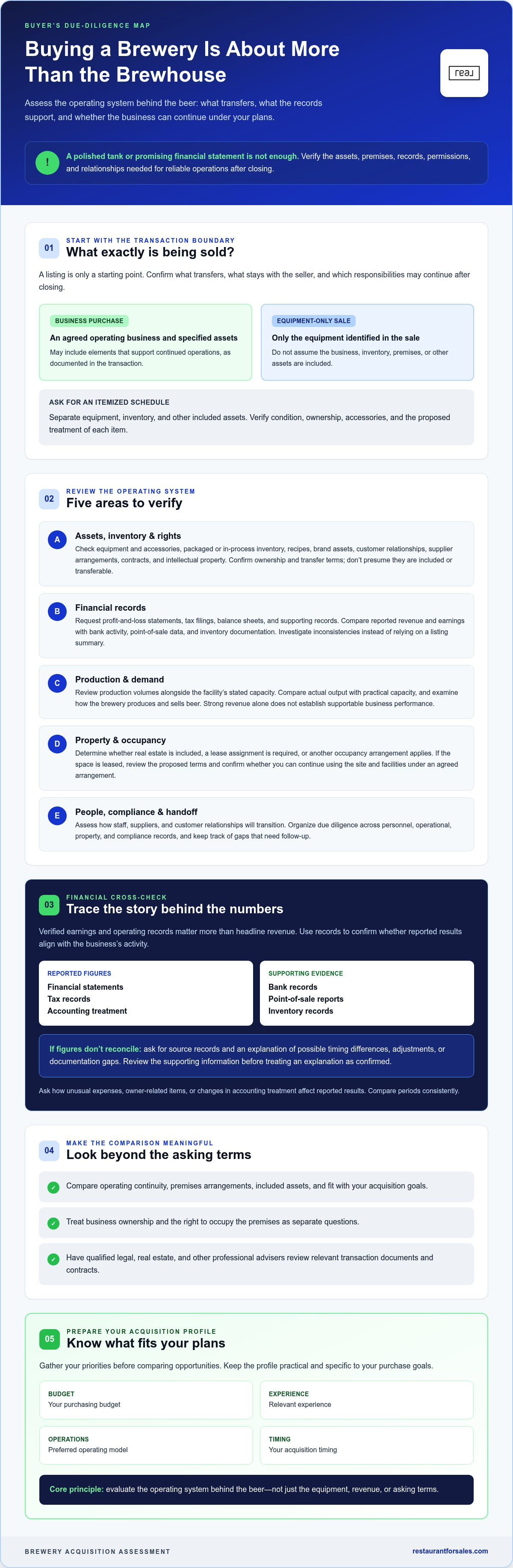
Brewery Acquisition Due Diligence: Questions to Resolve Before an Offer
Before making an offer, organize due diligence into clear workstreams. This helps you assign questions, track evidence, and identify issues that could affect the transaction or handover. Request source documents from the seller, not just summaries, and keep a log of missing, inconsistent, or unverified information.
- Financial: Can reported results be supported by underlying records?
- Operational: What could affect production, maintenance, or continuity?
- Assets: Does the seller own the equipment and other assets proposed for transfer?
- Personnel: Which roles, employment arrangements, or key-person relationships matter to continued operations?
- Premises: What occupancy terms, property responsibilities, or approvals need review?
- Compliance: Which licenses, permits, approvals, contracts, and transfer requirements may apply?
For each item, record the documents reviewed, who is responsible for follow-up, and what questions remain. A missing record isn’t proof of a problem, but it is an unresolved point to address before relying on the seller’s representation.
What operational and compliance questions should buyers ask?
Ask for equipment ownership records, maintenance history, and condition details. Have appropriate advisers check for recorded liens or other claims affecting assets. Review employment, supplier, distribution, and customer agreements for transfer terms or provisions that could be triggered by a change in ownership.
Ask which permits, licenses, and approvals apply to the current operation, and whether a change in ownership or operating plan could affect them. Requirements vary by transaction and jurisdiction. Have qualified counsel and other relevant advisers verify applicable requirements with the relevant authorities. Don’t assume an existing approval automatically transfers or covers your intended operation.
How should buyers prepare an offer and transition plan?
Shape offer terms around verified records, unresolved risks, and a transaction structure reviewed by qualified advisers. If key information remains unavailable, clarify how that uncertainty will be addressed before committing. The right approach depends on the documents and circumstances of the specific transaction.
Plan the handover alongside the transaction. Consider how staff will be informed and trained, how supplier relationships will continue, and how customers will be introduced to new ownership. For a broader acquisition framework, review restaurant acquisition guidance.
As you evaluate a brewery for sale, use a marketplace only after confirming it handles brewery opportunities and that its brokers have relevant experience. Explore restaurant and bar listings and ask whether the marketplace’s current listings and brokerage services cover your brewery search.
Find a Brewery for Sale and Plan Your Next Buying Steps
A focused search starts before you contact a seller or broker. Define what you want to acquire, organize your funding information, compare opportunities against your criteria, and verify fit before advancing. This sequence helps you focus on businesses that match your goals instead of reacting to a listing’s headline features.
Prepare a concise acquisition profile that a broker or seller can understand quickly. Include your relevant experience, preferred operating model, decision timeline, and funding readiness. Separate essential requirements from features you’d simply prefer. For example, identify whether you need a taproom, a particular production setup, or a specific premises arrangement, then note which preferences could be flexible.
What should a buyer prepare before contacting a broker?
Bring a clear summary of your objectives and what you know about your ability to pursue an acquisition. Funding readiness may include details you can share about available resources, potential financing discussions, and steps you still need to complete. This can make an initial conversation more focused, but it doesn’t establish funding approval or guarantee availability.
Use your must-have list to screen opportunities, then revisit preferences as you learn more. Keep notes on questions that need seller documentation or professional review. A well-prepared profile can help you recognize early when an opportunity doesn’t fit.
How can a marketplace or broker support the search?
Depending on the transaction and their role, brokers may help coordinate listing discussions, information exchange, and transaction steps. For general context, see this guide to the role of a restaurant broker. Confirm a broker’s experience with brewery transactions and clarify what support is within scope before relying on it.
Restaurant For Sale Marketplace connects restaurant and bar buyers and sellers nationally and offers brokerage and valuation services. Brewery-specific listings and brokerage expertise aren’t confirmed, so ask whether the marketplace currently accepts or lists brewery businesses and whether its brokers have relevant transaction experience.
Use a practical search sequence:
- Write down your acquisition goals, must-haves, and preferences.
- Gather funding-readiness information and identify what remains unresolved.
- Review available opportunities against your operating and premises criteria.
- Verify listing details and confirm that the marketplace or broker covers brewery transactions.
When you’re ready to explore, review listings and ask about brewery opportunities. This is a straightforward way to start a conversation without assuming brewery inventory or specialized transaction support is available.
Move Forward With a Clear Acquisition Plan
A sound purchase decision depends on more than the brewing equipment. Confirm exactly which assets and obligations are included, test financial claims against source records, and assess production, customer demand, premises, and operating continuity. Keep unresolved questions visible, and ask qualified advisers to review transaction terms and applicable requirements before you commit.
As you consider a brewery for sale, use your acquisition criteria to compare opportunities consistently. A concise profile of your experience, preferred operations, funding readiness, and timeline can help focus discussions and show whether a listing fits your plans.
Restaurant For Sale Marketplace connects restaurant and bar buyers with sellers and offers brokerage and valuation services. Brewery-specific listing availability and transaction experience aren’t confirmed, so ask whether the marketplace can support your search before relying on it. Explore listings and ask about brewery opportunities as a possible next step. Careful verification and a clear plan can help you approach the search with greater confidence.
Frequently Asked Questions
What should I look for when buying a brewery?
Look beyond the brewing equipment to understand the full business and transaction. Confirm which assets, inventory, recipes, brand assets, contracts, and premises arrangements are included. Review financial and tax records, production capacity, equipment condition, sales channels, staffing, and customer demand. Ask the seller to support key claims with source documents, track unanswered questions, and have qualified advisers review transaction terms and potential obligations before you proceed.
How do I know if a brewery for sale is profitable?
Assess profitability by verifying earnings across multiple periods, not by relying on headline revenue or seller summaries. Compare profit-and-loss statements and tax filings with bank records, point-of-sale reports, and inventory information. Ask how expenses, owner-related items, seasonality, and sales channels affect reported results. Review production and maintenance records too, since downtime or repair needs can affect ongoing performance. Have an accounting professional review the records and explain inconsistencies.
Can I buy a brewery without buying the property?
Yes, a brewery business and its premises can be separate parts of a transaction. The buyer may acquire the business while leasing the space or pursuing a lease assignment, depending on the seller’s arrangements and the landlord’s requirements. Confirm the remaining term, assignment process, renewal options, and responsibilities for the premises. If real estate is included, assess whether owning it fits your operating and acquisition plans.
What licenses or permits are needed to buy a brewery?
Requirements depend on the brewery’s activities, location, transaction structure, and planned operations. In the United States, a federal Brewer’s Notice from the Alcohol and Tobacco Tax and Trade Bureau is required to produce beer for commercial sale. State and local requirements may also apply. Ask qualified counsel to identify applicable licenses, permits, and approvals, check whether ownership changes affect them, and confirm transfer requirements with relevant authorities.
How much does it cost to buy a brewery?
There isn’t one reliable purchase figure because transaction scope and business condition vary. Agreed terms may depend on verified earnings, included equipment and inventory, brand assets, premises arrangements, and liabilities. Ask the seller for an itemized description of what’s included, then have qualified financial and legal advisers review the records and proposed structure. Avoid comparing opportunities using asking terms alone; assess documented performance and obligations as well.
Can a restaurant broker help me buy a brewery?
A broker may help coordinate listing discussions, information exchange, and transaction steps, but confirm their experience and service scope. Restaurant For Sale Marketplace connects restaurant and bar buyers with sellers and offers brokerage and valuation services. Its brewery-specific listings and transaction expertise aren’t confirmed. Before relying on the marketplace or a broker, ask whether brewery opportunities are available and whether the broker has relevant experience with brewery acquisitions.


