

What if the first conversation about selling your business didn’t have to end in a decision? If you’re working out how to tell your business partner you want to sell, it’s understandable to worry they’ll feel blindsided or betrayed. The way you raise the subject matters, but so does making clear that you’re opening a discussion, not demanding an immediate deal.
A calm, well-prepared conversation can help you explain what’s changed, hear your partner’s perspective, and identify what needs to be reviewed before either of you commits. This guide will help you plan what to say, compare possible exit paths, and agree on practical next steps. You’ll also learn how to approach questions about timing and business value, review your ownership agreement, and decide when legal, tax, valuation, or brokerage support may be appropriate. The goal is to leave the first discussion with a clearer process, not a final sale agreement.
Key Takeaways
- Clarify whether you want a full exit, reduced involvement, or to explore a buyout before raising the subject.
- Review your ownership agreement and gather current business information, while keeping informal estimates separate from a professional valuation.
- Learn how to tell your business partner you want to sell by framing the first conversation as an invitation to discuss options, not a demand for a deal.
- Compare a partner buyout, outside sale, and staged transition based on decision rights, financing questions, confidentiality, and process complexity.
- End with written questions, responsibilities, and a follow-up date, then involve appropriate professional support as discussions advance.
Before You Tell Your Business Partner You Want to Sell, Define Your Goal
Raising the possibility of a sale can feel difficult, especially when your partner’s livelihood, plans, and sense of commitment may be affected too. Before deciding how to tell your business partner you want to sell, get clear on what you’re asking them to consider. A business partnership involves shared interests, so a constructive opening starts with your own intentions rather than assumptions about what your partner should do.
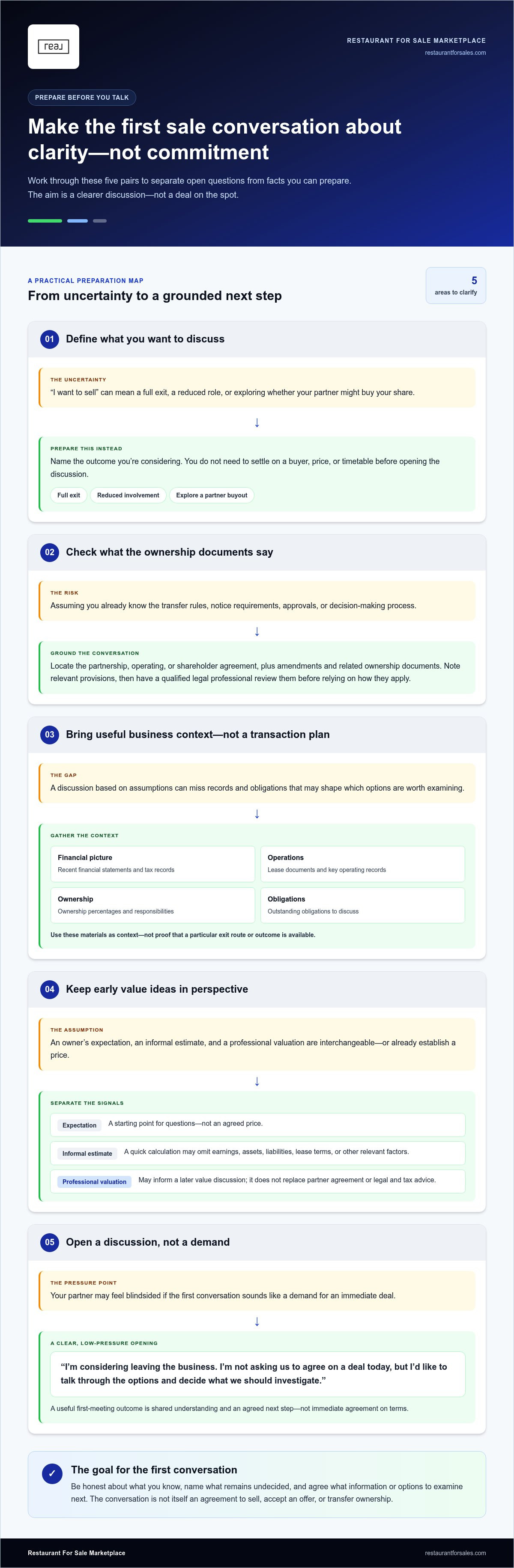
Be specific about the outcome you’re considering. Do you want to leave the business entirely, reduce your role, or explore whether your partner might buy your share? These are different goals, and each could lead to a different discussion. You don’t need to settle on a buyer, price, or timetable before bringing up the subject. The first meeting can simply establish that you’re considering a change and agree on what information or options to examine next.
Is this a decision to sell or a request to explore options?
That distinction can reduce pressure. A settled decision means you’re communicating your intention to pursue an exit; a request to explore options invites your partner to consider possible paths with you. Before the conversation, ask yourself what prompted it and whether the reason is temporary or likely to last. Reflect on your preferred timing, how involved you want to remain, and what your personal priorities require.
For example, if your concern is workload, you may want to explore reducing your responsibilities before proposing a sale. If your long-term plans have changed, a full exit may be closer to your goal. You can be clear about what you know while acknowledging what you haven’t decided.
What do you want your partner to understand first?
Prepare a plain-language explanation of your position. Keep personal reasons separate from criticism of your partner or the business. “My priorities have changed, and I’d like us to discuss what an ownership transition could look like” is more constructive than presenting untested assumptions about business value or your partner’s willingness to buy.
Write one concise opening statement and one specific request for discussion. For instance: “I’m considering leaving the business. I’m not asking us to agree on a deal today, but I’d like to talk through the options and decide what we should investigate.” A useful first-meeting outcome is shared understanding, plus an agreed next step, not immediate agreement on terms.
Prepare for the Conversation: Agreements, Value, and Exit Options
Preparation helps keep the discussion grounded in facts instead of assumptions. Before deciding how to tell your business partner you want to sell, gather the documents and questions that can clarify what options are available. You don’t need to arrive with a complete transaction plan. The goal is to understand what needs review before you and your partner discuss terms.
Which agreements and records should you review first?
Locate any partnership, operating, or shareholder agreement, along with amendments or related ownership documents. Note provisions that appear to address transfers, notice, approvals, or decision-making, but don’t assume how they apply. Requirements and rights depend on the governing documents and applicable law, so have a qualified legal professional review relevant language before relying on it.
Collect records that could help frame the conversation, such as:
- Recent financial statements and tax records
- Lease documents and key operating records
- Information about ownership percentages, responsibilities, and outstanding obligations
Use these materials as context, not as proof that a particular exit route or outcome is available. Keep a separate list of questions to discuss with your partner and the appropriate advisers.
How should you approach business value before agreeing on a price?
An owner’s expectation, an informal estimate, and a professional valuation are not interchangeable. A number based on a quick calculation may omit assumptions about earnings, assets, liabilities, lease terms, or other factors relevant to a restaurant. Treat early figures as questions to investigate, not as an agreed asking price or offer.
A restaurant valuation guide can help you identify factors to discuss, but it can’t settle what you and your partner should accept. A professional restaurant valuation may inform a later conversation about value, without replacing partner agreement or legal and tax advice.
Before the meeting, list the exit paths you want to explore: a purchase by your partner, a sale to an outside buyer, or a gradual ownership transition. For each, note what you don’t yet know, including decision rights, funding questions, transition responsibilities, and confidentiality. If both partners decide to assess an outside sale, a qualified restaurant broker can manage the sale process from listing through closing. You can review professional restaurant valuation services as one possible resource.
Telling Your Partner You Want to Sell: Step-by-Step
A thoughtful conversation gives your partner room to absorb the news and respond. Raising the subject isn’t the same as agreeing to a sale, accepting an offer, or transferring ownership. The purpose of this meeting is to communicate your position and decide what to discuss next, not to settle every term.
Use this sequence to keep the discussion clear:
- Choose a private setting. Set aside time to talk without employees, customers, or other distractions present.
- State your intention. Say directly that you’re considering selling your interest or exploring an ownership change.
- Explain the context. Briefly share what has led you to raise the subject. Stick to your own priorities and avoid assigning blame.
- Invite your partner’s perspective. Ask what they think and listen before suggesting a buyer, structure, or timeline.
- Agree on a next step. Identify the questions to review, who will gather information, and when you’ll continue the discussion.
What words can you use to start the discussion?
For how to tell your business partner you want to sell, plain, measured language is more useful than a polished pitch. You might say: “I want to discuss whether selling my interest may be right for me. I’m not asking us to agree on a deal today. I’d like to explain what’s prompting this and hear how you see our options.”
Adjust the wording to match your actual goal. If you’re unsure about a full exit, say you want to explore possibilities rather than announcing a final decision. Then ask an open question, such as, “What concerns or questions does this raise for you?” This makes space for their perspective before you discuss potential terms.
How should you respond to surprise, disagreement, or emotion?
Your partner may feel worried, frustrated, or caught off guard. Acknowledge the reaction without retracting your point or turning the discussion into a judgment of their performance. You could say, “I can see this is unexpected. I’m raising it because my priorities have changed, and I’d like us to consider the options carefully.”
Ask what matters most to them. Are they concerned about control, workload, finances, or the business’s future? Listen for the underlying issue, and clarify what you don’t yet know instead of defending an untested assumption. If either of you becomes too frustrated to continue productively, pause and set a time to resume after reviewing the relevant information.
If both partners agree to assess an outside sale, Restaurant For Sale Marketplace provides restaurant brokerage services to manage the sale process. Learn more about restaurant brokerage services.
Compare a Partner Buyout, Outside Sale, and Other Exit Paths
Once you and your partner are ready to consider possibilities, compare the routes against the same practical questions. No option is automatically faster, more profitable, or legally simpler. The right fit depends on your ownership documents, the business’s circumstances, and what both partners are prepared to take on. This comparison can make the next conversation more focused.
| Exit path | Decision rights | Funding questions | Transition workload | Confidentiality and process |
|---|---|---|---|---|
| Partner buyout | Confirm who can approve a transfer under the governing documents. | Can the remaining partner meet the proposed terms, and how would payment be structured? | May preserve operating continuity, but responsibilities and authority still need to be reassigned. | Can limit exposure to outside buyers, though negotiations and document review still take work. |
| Outside sale | Check required approvals and who can represent or authorize a sale. | Assess buyer capacity and the proposed transaction terms. | Plan for information sharing, buyer review, and a handover suited to the business. | Consider how to manage sensitive information and the steps involved in reaching a transaction. |
| Staged or partial transition | Define how control and ownership would change over time. | Clarify payment timing and the resources each party would need. | Agree on roles during the transition and how ongoing duties will be handled. | May involve continuing coordination and tailored documentation; feasibility depends on the circumstances. |
When might a partner buyout be worth exploring?
An internal purchase may be worth discussing if your partner wants to continue operating the business and both of you are open to negotiating terms. Familiarity with the operation may support continuity, but it doesn’t resolve questions about value, the buyer’s funding capacity, decision authority, or who handles the transition. Review the governing agreement and consult qualified legal and financial advisers before treating a proposed structure as workable.
When might an outside sale or staged exit fit better?
An outside buyer may be relevant if your partner doesn’t want or can’t acquire your interest. A staged or partial transition may also be worth assessing, but it isn’t suitable in every situation. For a restaurant, clarify how operating continuity, lease interests, business assets, and the buyer’s transition needs could affect each route. If you and your partner agree to consider an outside sale, a restaurant broker can manage the sale process. To explore professional support, review restaurant brokerage services.
Turn the Discussion into a Clear, Professionally Supported Next Step
A constructive first conversation should produce a plan for what happens next, even if you don’t agree on an exit route. A sound approach to how to tell your business partner you want to sell ends with clarity about what each person will investigate, who will help, and when you’ll talk again. Keep the focus on moving from discussion to informed consideration, not forcing a decision.
What should you document after the first conversation?
Send a concise written summary for both partners to review. Record each person’s stated goals, the questions still open, the documents to examine, and who will gather information or seek advice. Include a specific follow-up date so the conversation doesn’t simply fade into day-to-day operations. Invite your partner to correct anything that doesn’t reflect their understanding.
Keep the language factual. An exploratory discussion is not automatically a formal offer, a binding commitment, or a completed transfer. Don’t describe it as one. If you’re unsure what a statement or document could mean, ask a qualified legal professional before relying on it.
When should you bring in outside transaction support?
Consider qualified legal advice when reviewing ownership documents, transfer provisions, or proposed transaction terms. A tax professional and accountant can help assess financial records and potential transaction consequences. Their input can help each partner understand questions to resolve, but it doesn’t replace agreement between the owners.
If both partners decide to evaluate a restaurant sale, a professional restaurant valuation can help inform expectations and later negotiations. It provides input for discussion, not a guaranteed outcome or a substitute for legal or tax advice. A restaurant broker can also manage the sale process if you agree to explore an outside sale.
Keep the next step proportionate to the decision you’ve made so far. You may first need to review documents and clarify goals; a broader sale process can wait until both partners agree to consider it. If you’re ready to explore support for evaluating a restaurant sale, Explore restaurant brokerage and valuation support.
Start the Next Conversation with Clarity
Knowing how to tell your business partner you want to sell starts with being clear about your goal and open about what remains undecided. Treat the first discussion as a chance to hear each other, compare realistic exit paths, and agree on what to investigate, not as a demand for an immediate deal.
Before you move forward, capture the questions, responsibilities, and follow-up date in writing. Review relevant ownership documents with qualified advisers, and use professional valuation input to inform a discussion of business value rather than treating it as a final answer. Any sale decision and terms still require alignment between the partners.
If you both decide to evaluate a restaurant sale, Restaurant For Sale Marketplace connects restaurant and bar sellers with buyers nationally and offers brokerage and valuation services. Explore restaurant brokerage and valuation support as a potential next step.
A direct, respectful conversation can create a practical path forward, even if you haven’t settled on the destination yet.
Frequently Asked Questions
How do I tell my business partner I want to sell my share?
Choose a private time to talk and state your intention clearly, without presenting a price or buyer as settled. If you’re considering how to tell your business partner you want to sell, explain what’s prompting the discussion, clarify whether you’re exploring options or have decided to exit, and invite your partner’s perspective. End by agreeing on what to review next, such as the ownership agreement, financial information, or possible exit routes.
Should I review a buy-sell agreement before telling my partner I want to sell?
Yes, review any buy-sell agreement and related ownership documents before the conversation so you can identify provisions that may affect a transfer. Note language about notice, approvals, valuation, or transfer procedures, but don’t assume how it applies to your situation. The agreement, business structure, and applicable law can all matter. Ask a qualified legal professional to interpret relevant terms before treating them as a confirmed right or requirement.
What if my business partner refuses to buy my share?
A partner’s refusal to buy doesn’t necessarily end the discussion, but it may mean you need to consider other routes. Review your governing documents and ask whether an outside sale or a staged transition could be explored. Don’t assume either option is available without checking the applicable terms and circumstances. Qualified legal and financial advisers can help clarify constraints, while a professional valuation may inform discussions about value.
Can I sell my share of a business without my partner’s consent?
There isn’t a universal answer. Whether you can transfer your interest without your partner’s consent depends on your business structure, governing documents, and applicable law. Agreements may set out approval, notice, or transfer conditions, so don’t rely on assumptions or informal understandings. Have a qualified legal professional review the relevant documents before approaching a buyer or making commitments. A discussion about selling is not itself permission to transfer ownership.
How do partners decide what a business share is worth?
Partners can start by agreeing on what information and valuation approach to review, rather than treating one owner’s estimate as the answer. Business performance, assets, obligations, lease terms, and the ownership interest being considered may all affect the analysis. A professional valuation can provide an informed basis for discussion, but it doesn’t guarantee agreement or determine transaction terms. Consult qualified legal, tax, and financial advisers as negotiations develop.
Should I tell employees that I am discussing a possible sale with my partner?
Usually, an exploratory conversation between owners doesn’t by itself mean employees need to be told immediately. Before sharing information, consider whether a sale is actually being pursued, what details are confirmed, and how disclosure could affect operations and staff. Review any relevant confidentiality commitments with qualified advisers. If the partners move toward a concrete transaction, get advice on appropriate timing and messaging rather than sharing speculation as settled news.
Do I need a broker to sell my restaurant to my business partner?
Not necessarily. If your partner is the potential buyer, you may first discuss the terms directly, while using qualified legal and financial advisers to review the proposed transfer. A restaurant valuation professional can help inform the value discussion. Brokerage support is useful if both partners decide to consider an outside sale. Restaurant For Sale Marketplace offers restaurant brokerage and valuation services to support restaurant sale discussions and transactions.


