

A restaurant listing can introduce an opportunity, but it doesn’t carry a transaction through closing. Restaurant brokerage services connect the search for a business with coordinated support through the sale process, helping buyers and sellers understand what needs to happen next.
Browsing listings is different from getting support with a transaction. Restaurant deals can involve confidential information, lease assignments, valuation, and due diligence. Buyers and sellers also have different priorities, even when they’re working toward the same closing.
This guide explains what restaurant brokerage services cover, how a transaction typically moves from listing through closing, and how the broker, buyer, seller, and other participants contribute. It also compares brokerage support with using a listing marketplace alone, so you can identify which services fit your transaction and choose a practical next step.
Key Takeaways
- See how restaurant brokerage services coordinate a transaction from preparation and buyer engagement through closing.
- Compare seller-side and buyer-side support to identify which parts of the process apply to your goals.
- Understand why an online listing helps buyers discover opportunities while brokerage support coordinates the transaction.
- Use practical preparation steps to clarify your goals, organize relevant information, and identify the components of a potential deal.
- Learn how Restaurant For Sale Marketplace listings, brokerage, valuation services, and financing tools support different needs along the transaction journey.
What Restaurant Brokerage Services Do Beyond Listing a Business
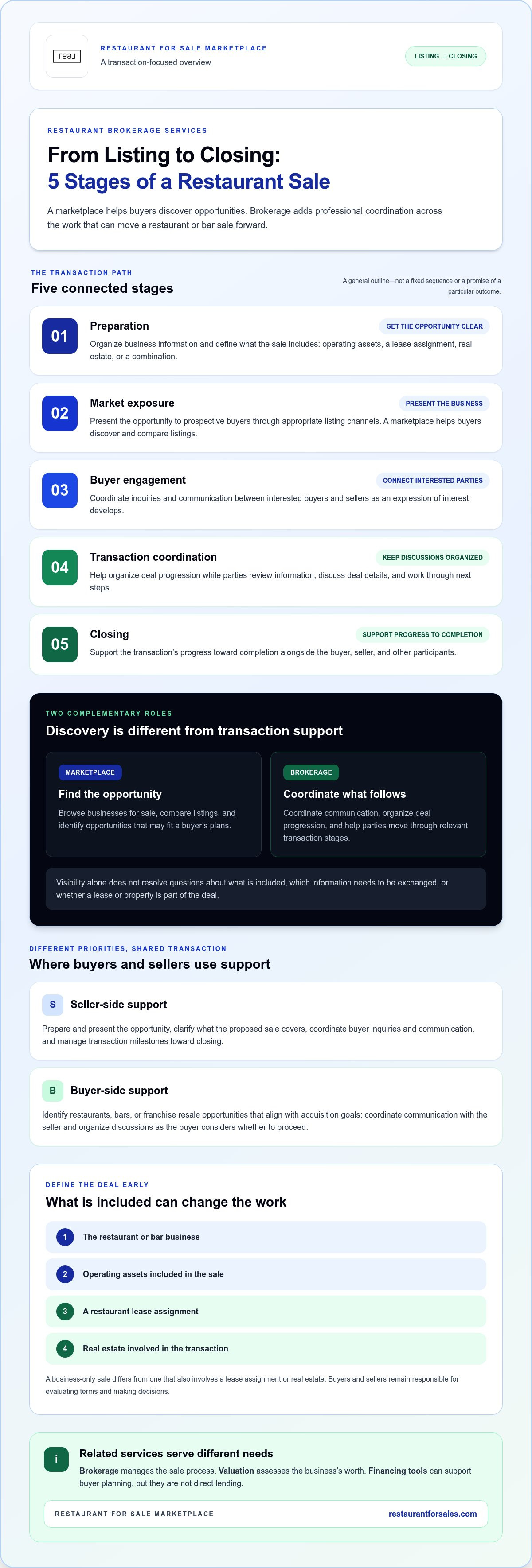
Restaurant brokerage services support the transaction behind a sale, not just the publication of an advertisement. A marketplace helps buyers discover restaurants and bars for sale. Brokerage adds professional coordination across the stages that take an opportunity from preparation to closing. The work depends on the transaction, its participants, and what is being sold.
A restaurant sale commonly involves several connected stages:
- Preparation: Organize business information and define what the sale includes, such as operating assets, a lease assignment, or real estate.
- Market exposure: Present the opportunity to prospective buyers through appropriate listing channels.
- Buyer engagement: Coordinate inquiries and communication between interested parties.
- Transaction coordination: Keep discussions and next steps moving as the parties review information and work through deal details.
- Closing: Support the transaction’s progress toward completion alongside the buyer, seller, and other participants.
This is a general outline, not a fixed sequence or promise of a particular outcome. A Business broker typically works between parties during a business sale. Restaurant brokerage applies that broader role to transactions involving restaurants and bars, with the specific scope shaped by the deal.
How a brokerage service differs from a restaurant marketplace
A marketplace is primarily a discovery tool. Buyers can browse opportunities, compare listings, and identify businesses that may fit their plans. Brokerage is transaction support: a broker coordinates communication, organizes deal progression, and helps the parties move through relevant stages. The two functions complement each other. A listing brings an opportunity to a buyer’s attention, while brokerage helps manage the work that follows an expression of interest.
Visibility alone doesn’t resolve the practical questions that arise once a buyer and seller begin discussing a deal. What is included? Which parties need to exchange information? Does the transaction involve a lease or property as well as the business? Brokerage helps structure these discussions, while the buyer and seller remain responsible for evaluating terms and making decisions.
Who uses restaurant brokerage services?
Owners preparing to sell an operating restaurant or bar can use seller-side support to present the opportunity, engage prospective buyers, and coordinate the process. Sellers need to explain the business clearly and define which assets or property are part of the proposed sale.
Buyers use brokerage support to pursue an existing restaurant or bar, including a franchise resale opportunity. Their focus is different: understanding the opportunity, reviewing relevant details, and progressing discussions toward a potential purchase. Some transactions also involve a restaurant lease assignment or real estate. Identifying these components early helps the parties understand the scope of the transaction and what needs coordination.
What Restaurant Brokerage Services Can Include for Buyers and Sellers
The support involved in a restaurant transaction depends on who is making a move and what the deal includes. Sellers need to present an opportunity clearly and manage buyer interest. Buyers need to find businesses that fit their acquisition goals and move discussions forward in an organized way. Restaurant brokerage services connect those needs and coordinate the transaction from listing through closing.
Seller-side services from preparation to closing
For a seller, brokerage support begins with preparing the business opportunity for market presentation. This means organizing the information used to describe the restaurant or bar and clarifying what the proposed sale covers. A business-only transaction differs from one that also involves a lease assignment or real estate, so accurately describing the opportunity helps set expectations from the start.
Once a listing is available to buyers, a broker coordinates inquiries, communication, and transaction milestones. When a buyer expresses interest, for example, the parties may need to exchange information, discuss the proposed sale components, and agree on next steps. Coordinated communication keeps those conversations connected instead of leaving the seller to manage each inquiry independently. Brokerage support continues as the parties progress toward closing, with the work shaped by the transaction. For more context on this seller-side role, see the restaurant broker's role in a business sale.
Valuation services can also inform a seller’s preparation, but valuation and brokerage address different needs. Brokerage manages the sale process; valuation assesses the business’s worth. Restaurant For Sale Marketplace provides both services for sellers preparing for a transaction.
Buyer-side support for restaurant and franchise opportunities
Buyers can use active listings to identify restaurants or bars that align with their goals, whether they’re looking to acquire an existing operation or explore a franchise resale. Once an opportunity stands out, brokerage support coordinates communication with the seller and organizes the progression of discussions. This doesn’t replace the buyer’s decision-making. It provides structure as the buyer considers whether to proceed.
Financing tools can support a buyer’s planning, but they aren’t direct lending. A listing involving a lease assignment or real estate also has different components from an opportunity centered on the restaurant business alone. Identify those elements early so you understand what you’re considering and what information may be relevant as discussions advance. Buyers planning their next steps can also consult this restaurant acquisition guide.
For either party, brokerage scope should reflect the transaction rather than an assumed package of identical tasks. If you’re beginning to explore opportunities, browse restaurant and bar listings to see the businesses available and clarify what fits your goals.
Are Restaurant Brokerage Services Worthwhile If a Listing Is Already Online?
An online listing and brokerage support serve different purposes. A listing makes a restaurant or bar visible to prospective buyers. Brokerage coordinates the work that follows when someone expresses interest. Putting a business online supports discovery, but it doesn’t manage conversations, decisions, or transaction milestones.
What a listing can do, and what it cannot replace
A listing gives buyers a way to find and compare opportunities. It presents key information about a business and helps interested people decide whether to make an inquiry. That visibility is useful, but it doesn’t establish that an inquiry is qualified, resolve questions between the parties, or ensure a sale will close. Those steps depend on the parties’ decisions and the details of the transaction.
After an inquiry, practical coordination may be needed. The seller may need to respond to questions, share information, and track discussions with more than one interested buyer. A buyer may need to clarify what is included and identify issues that require follow-up. When the parties communicate independently, details and next steps can become difficult to organize. A broker coordinates transaction communication and progression, with the work shaped by the deal.
Keep the distinction in mind: exposure helps people find an opportunity, while brokerage addresses the process of moving discussions forward. Neither function guarantees a particular outcome. A listing can attract interest without producing an agreement, and brokerage can organize a transaction without determining whether the parties reach acceptable terms.
When coordinated brokerage support may be useful
Brokerage support is especially useful when a sale draws interest from several buyers, when multiple decision-makers need to stay aligned, or when the deal involves more than the operating business. A lease assignment, franchise resale, or restaurant property included in a transaction can bring additional parties and details into the discussions. A restaurant lease assignment, for example, adds lease-related coordination to the business-sale conversation.
To decide how much support you need, consider how much coordination you’re prepared to handle, how many parties are involved, and whether the transaction includes a lease, franchise, or real estate component. If a lease transfer is part of the deal, the restaurant lease assignment guide can help clarify why it warrants attention.
Restaurant brokerage services are useful when transaction management matters as much as online exposure. A listing can start the conversation; the support needed after that depends on the complexity of the deal and the parties’ capacity to coordinate it.
How to Prepare for Restaurant Brokerage Services as a Buyer or Seller
A focused first conversation starts with clear goals and useful information, not a perfectly assembled transaction file. Before exploring restaurant brokerage services, identify what you want to accomplish, gather the details you already have, and note which parts of the deal need discussion. Preparation makes the conversation more productive, though it can’t guarantee a buyer, agreed terms, or a completed sale.
Use this sequence to get oriented:
- Define your goal: Clarify whether you’re selling, buying, or exploring possibilities, and identify what matters most to you.
- Gather available information: Collect relevant business, ownership, and lease details. Focus on accuracy and note any gaps or questions.
- Identify transaction components: Consider whether the deal involves an operating business, a lease assignment, a franchise resale, or real estate.
- Discuss next steps: Use what you’ve gathered to explain your priorities and understand how the transaction could progress.
Seller preparation before discussing a sale
Start by clarifying your preferred timing and transition priorities. Consider what you want to happen to the business after a sale, and whether you’re considering a business-only transaction or one that also includes real estate. These distinctions help frame the opportunity and the questions to address.
For an initial discussion, organize current business and lease information, along with a clear summary of ownership and what you believe would be included. You don’t need to anticipate every question. An accurate overview, plus a short list of unknowns, gives the conversation a practical starting point. If your timing or transition preferences are flexible, say so rather than presenting an early assumption as a firm condition.
Buyer preparation before exploring opportunities
Buyers can begin by defining the type of restaurant or bar they want, their ownership goals, and the acquisition parameters that will guide their search. Decide which factors are essential and which are preferences. This helps narrow listing searches and makes it easier to explain why a particular opportunity may fit.
Organize information about your financing readiness for planning purposes. Marketplace financing tools can support that planning, but the marketplace isn’t a direct lender. Also consider whether you’re open to a franchise resale, whether a lease assignment is relevant, and whether you’re seeking a business with real estate. These components affect what you need to understand about an opportunity. Keep a concise list of priorities and questions, then update it as you review listings and learn more.
Buyers and sellers don’t need identical preparation. Sellers clarify what they’re offering; buyers define what they’re seeking. In both cases, accurate information and realistic priorities create a clearer basis for discussing next steps without committing either party to a particular outcome.
Ready to put your goals into practice? Explore restaurant and bar opportunities and use your priorities to guide what you review.
How Restaurant For Sale Marketplace Connects Listings and Brokerage Support
Restaurant For Sale Marketplace connects restaurant and bar buyers and sellers through active listings and transaction services. Each offering serves a distinct purpose: listings help people discover opportunities, valuation services assess business value, financing tools support planning, and brokerage coordinates the sale process from listing through closing. Buyers and sellers can focus on the support that fits their stage in a transaction.
A marketplace with transaction services
Discovery is a starting point, not the whole transaction. Sellers use brokerage support to bring a restaurant or bar to market and coordinate progress as buyer discussions develop. Buyers review opportunities and pursue conversations about businesses that fit their acquisition goals. The specific work depends on the transaction, and brokerage support doesn’t guarantee a sale, a particular price, or a set timeline.
Other offerings address needs that arise alongside a sale. Restaurant valuation services focus on business value, while valuation and financing tools support planning. Financing tools aren’t direct lending. Lease assignment services apply when a transaction involves a restaurant lease, and listings can include franchise resales or restaurants with real estate. These are distinct deal components. Identifying them helps buyers and sellers understand what an opportunity involves and what needs attention as discussions progress.
Together, listings and restaurant brokerage services connect finding an opportunity with coordinating the transaction. A listing can bring a potential buyer and seller into contact; brokerage support organizes communication and moves the sale forward. The parties still make decisions about terms and whether to proceed.
Choose a next step based on your transaction
If you own a restaurant or bar and are considering a sale, begin by outlining what you may be selling and the priorities that will shape your plans. Brokerage support coordinates the sale process from listing onward. If you’re a buyer, start by exploring active listings and narrowing your search based on the type of business and transaction components you’re seeking. Brokerage support can structure the next stages as you consider an opportunity.
You don’t need to have every detail settled before taking a first step. A clear sense of whether you’re buying or selling, what matters most, and whether a lease, franchise, or real estate is involved provides a practical basis for moving forward.
To explore the support that fits your transaction, explore restaurant brokerage services or browse available restaurant and bar opportunities.
Take the Next Step With a Clear Transaction Plan
A useful next step doesn’t require having every decision made. Start with your immediate goal: are you preparing to sell, exploring a purchase, or still assessing what a transaction could involve? Then note the questions that will help you decide how to proceed. That focus makes a conversation about restaurant brokerage services more practical and helps you identify the support that fits your situation.
If you’re a seller, consider what you want a potential buyer to understand about the opportunity. If you’re a buyer, define the features and deal components that matter most before reviewing options. Your priorities may change as you learn more, which is a normal part of making a considered business decision.
When you’re ready to turn that preparation into action, explore restaurant brokerage services and available opportunities. Whether you’re evaluating a sale or searching for an acquisition, start with the listings and brokerage support that fit your goals.
Frequently Asked Questions
What do restaurant brokerage services include?
Restaurant brokerage services include preparing a business for sale, presenting it to prospective buyers, coordinating inquiries, and managing transaction progress toward closing. The work depends on what’s being sold and the needs of the parties. For example, a sale involving restaurant property or a lease assignment has different components from a business-only transaction. Valuation is a related service that assesses business value rather than replacing transaction coordination.
How long do restaurant brokerage services usually take?
There’s no fixed duration for a restaurant sale. Timing depends on buyer interest, the pace at which the parties review information, negotiations, and transaction details such as a lease assignment or property component. Delays can also occur while decisions are made or requested information is gathered. A broker tracks progress and coordinates next steps, but can’t guarantee a timeline or completed sale.
Is a restaurant broker different from a commercial real estate broker?
Yes, their typical transaction focus differs. A restaurant broker supports the sale of the operating business, which may involve business assets, buyer discussions, and transaction coordination. A commercial real estate broker generally focuses on commercial property transactions or leasing. If a restaurant sale also includes real estate, both business and property considerations are relevant. Be clear about whether the opportunity includes the business, the property, or both.
Can restaurant brokerage services help with a bar sale?
Yes. Restaurant For Sale Marketplace serves buyers and sellers of both restaurants and bars, and its brokerage support manages a sale process from listing through closing. A bar transaction may involve the operating business, a lease, or real estate, depending on what the seller is offering. Clearly identifying the components helps prospective buyers understand the opportunity and keeps discussions focused on the transaction being considered.
What happens if a restaurant sale involves a lease assignment?
A lease assignment means the proposed transaction includes transferring the restaurant lease to the buyer, so lease terms become part of the deal coordination. The parties need to review the lease and understand the steps or decisions relevant to the proposed transfer. Details depend on the lease and transaction. Restaurant lease assignment services keep this element connected to the broader business sale rather than treating it as an afterthought.
Can a buyer explore restaurant listings before arranging financing?
Yes. A buyer can browse listings to understand the types of businesses available and refine acquisition priorities before arranging financing. Early research can clarify preferences, such as business type or whether real estate is part of the opportunity. Financing tools support planning, but Restaurant For Sale Marketplace isn’t a direct lender. A listing is a starting point for exploration, not a financing commitment or assurance that a purchase can proceed.
How do restaurant brokers support a transaction with multiple decision-makers?
A broker coordinates communication so participants understand the current discussion, outstanding questions, and upcoming milestones. For example, a buyer, seller, and other decision-makers may need to review different aspects of a proposed sale before moving forward. Keeping questions and agreed next steps organized reduces confusion between conversations. Each participant remains responsible for their own decisions, while brokerage support helps maintain an orderly transaction process.


