

A low asking price can make a struggling restaurant look like a bargain, but the purchase price is only one part of the risk. When buying a distressed restaurant, the real question is whether its decline stems from problems you can identify, fund, and address, or deeper issues that will keep draining cash.
Be cautious about explanations that rely on assumptions. Sales may be falling for reasons that aren’t obvious, and financial records, equipment condition, lease terms, staffing needs, and working capital may tell different stories. A turnaround starts with reliable evidence, not the belief that new ownership will solve the problem.
This guide explains how to assess an opportunity, distinguish temporary setbacks from structural weaknesses, and build a practical improvement plan for after closing. You’ll learn which financial and operating records to examine, how lease and asset risks can affect a deal, and how to prioritize early steps while protecting cash. Transaction questions that call for review by qualified legal, accounting, or other professional advisers are flagged along the way.
Key Takeaways
- When buying a distressed restaurant, distinguish temporary setbacks from persistent problems with demand, costs, location, or execution.
- Use a consistent screening sequence: review the offer, examine records, inspect operations, test assumptions, and decide whether the evidence supports proceeding.
- Compare distressed and turnkey businesses by operating continuity, improvement needs, and uncertainty, not by purchase condition alone.
- Plan the first 90 days around observation, prioritized changes, and regular review, using operating baselines to guide decisions.
- Set acquisition criteria and use listings, valuation insight, and brokerage support to organize transaction research and open questions.
Buying a Distressed Restaurant: What Distress Reveals, and What It Does Not
A distressed restaurant has significant financial or operating challenges that may affect its ability to continue under current ownership. That description is a reason to investigate, not a conclusion about value. A distressed asset has documented problems; a viable turnaround has problems a buyer can identify, fund, and realistically address. That distinction is central when buying a distressed restaurant.
What makes a restaurant distressed?
Warning signs can include falling sales, overdue obligations, deferred equipment or building maintenance, reduced hours, supplier interruptions, or inconsistent service. Each signals potential pressure, but none reveals the full condition of the business on its own. A sales decline, for example, could reflect a temporary disruption or customers choosing alternatives.
Separate what is reported from what the evidence supports. Verify claims about revenue, debts, staffing, equipment, and operating interruptions through records, direct observation, and appropriate independent review. Compare financial documents with operating evidence, such as schedules, inventory practices, equipment condition, and current service. Record discrepancies and unanswered questions instead of filling gaps with optimistic assumptions.
Distress, turnaround potential, and deal risk
Some weaknesses may be addressable under new ownership. Examples include inconsistent scheduling, limited visibility into food costs, or a menu that has not been reviewed against current sales and costs. Each still calls for a practical plan, time, and sufficient working capital. A new owner’s intentions alone won’t make a problem fixable.
Other challenges may persist regardless of who owns the business. Weak customer demand, a location that no longer fits the concept, costly lease terms, or recurring operating problems can point to structural risk. Ask whether the root cause is clear, whether the proposed response is within your capabilities, and whether you can support the business while changes take effect. Turnaround management strategies offer broader context on why diagnosing causes and sequencing responses matter in a recovery effort.
Price is only one part of the decision. A low asking price doesn’t prove that the assets, cash flow, lease, or operating outlook justify the purchase. Account for the business’s condition and the work required to make it sustainable, then compare those findings with a reasoned view of value. The 2026 restaurant valuation guide offers context for assessing value, but it cannot replace deal-specific due diligence.
Before treating distress as an opportunity, write down the evidence behind the seller’s explanation, the questions still unresolved, and the resources needed to address each known problem. If the root causes remain unclear or the recovery depends on assumptions you can’t substantiate, treat that uncertainty as deal risk, not upside.
How to Evaluate a Distressed Restaurant Before You Buy
A disciplined review turns the seller’s account into questions you can test. When buying a distressed restaurant, don’t move from an attractive asking price straight to a turnaround plan. First establish what the transaction includes and what the records support.
Test the financial and operating story
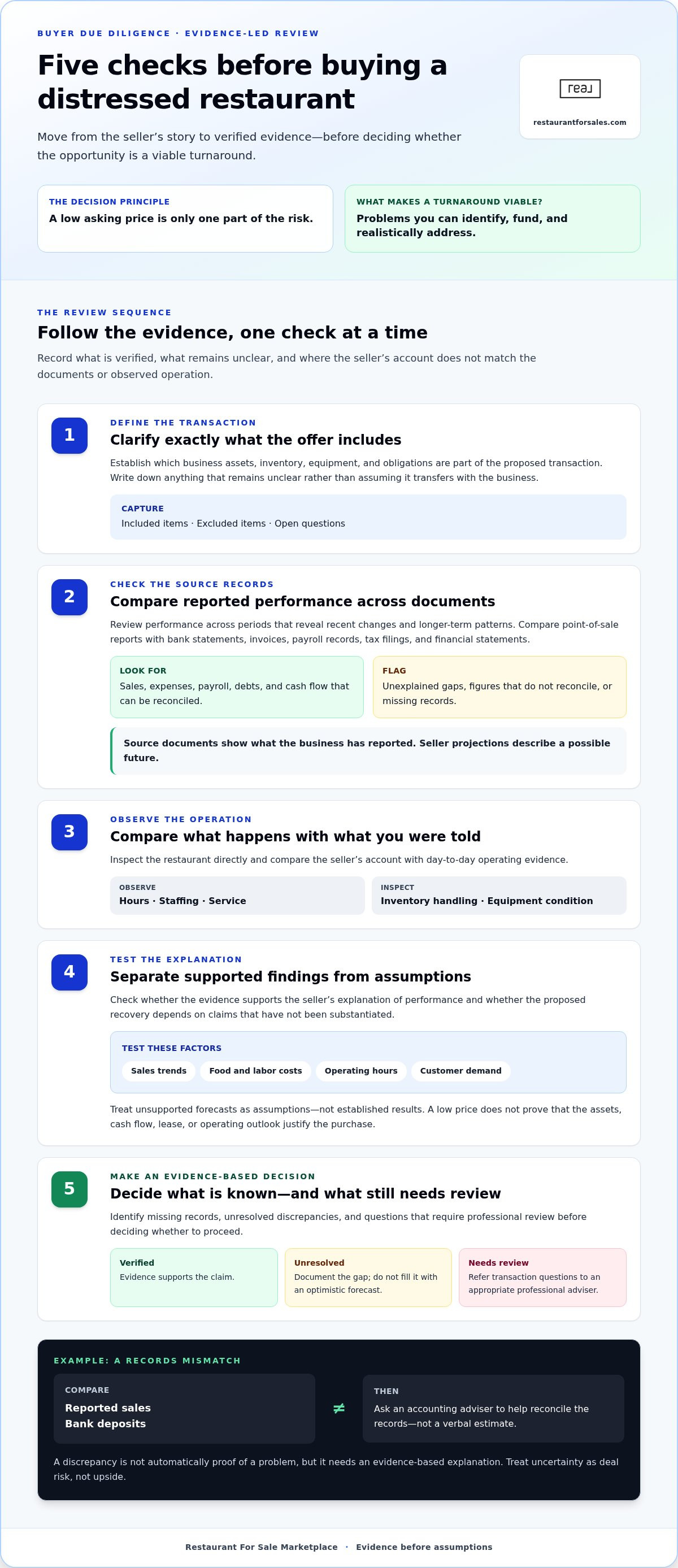
Review performance across periods that show both recent changes and longer-term patterns. Sales, expenses, payroll, tax filings, debts, and cash flow should tell a story that can be compared with what happens in the restaurant. Verified records matter more than seller projections: projections describe a possible future, while source documents show what the business has reported.
- Clarify the offer. Establish which business assets, inventory, equipment, and obligations are included in the proposed transaction. Write down anything that remains unclear.
- Review the records. Compare point-of-sale reports with bank statements, invoices, payroll records, tax filings, and financial statements. Look for unexplained gaps or figures that don’t reconcile.
- Inspect operations. Observe hours, staffing, service, inventory handling, and equipment condition. Compare what you see with the seller’s account of performance.
- Test assumptions. Check whether sales trends, food and labor costs, operating hours, and customer demand support the explanation for the restaurant’s performance. Treat unsupported forecasts as assumptions, not established results.
- Decide what the evidence supports. Identify missing records, unresolved discrepancies, and questions that need professional review before deciding whether to proceed.
A discrepancy isn’t automatically proof of a problem, but it does need an evidence-based explanation. For example, if reported sales and bank deposits appear inconsistent, ask your accounting adviser to help reconcile the records rather than relying on a verbal estimate. Document missing information and account for it in your decision instead of filling the gap with an optimistic forecast.
Assess assets, obligations, and transaction structure
Financial records are only part of the review. Inspect the equipment and inventory included in the offer, note deferred maintenance, and distinguish assets the seller owns from items subject to another agreement. Review debts, contracts, permits, and ownership questions with appropriate legal, accounting, or other qualified advisers. These details can affect what transfers and what work remains after closing.
Use a written diligence list to track each item, its supporting document, and its status. A restaurant acquisition guide can provide broader purchase context, while valuation analysis can help frame the business’s worth against the evidence you’ve gathered. To compare opportunities against consistent criteria, explore restaurant and bar listings and record the questions each one raises.
Distressed Restaurant or Turnkey Business: Compare the Trade-Offs
A distressed restaurant and a more established operation require different levels of preparation. A distressed opportunity may call for more investigation and hands-on corrective work, but that doesn’t make it inherently cheaper or better value. A turnkey business may offer more operating continuity, yet it still needs careful review of its financial performance, assets, lease, and obligations.
Decision rule: Choose a turnaround only when your capabilities, time, and available capital match the needs verified in the business. Otherwise, prioritize an operation whose demands better fit your capacity.
| Factor | Distressed restaurant | More established operation |
|---|---|---|
| Purchase condition | May have unresolved operating, financial, or asset issues to investigate. | May have more established processes and assets in operating condition, subject to inspection. |
| Operating continuity | Service, staffing, suppliers, or hours may need stabilization. | Existing routines and customer relationships may offer more continuity. |
| Improvement needs | Often requires a defined sequence of corrective actions based on evidence. | May need fewer immediate changes, though improvement opportunities can remain. |
| Uncertainty | Open questions may be greater, especially if records or operating history are incomplete. | Established records can offer context, but don’t remove transaction or performance risk. |
When a distressed acquisition may fit
Buying a distressed restaurant may suit a buyer with relevant operating experience, enough time to address identified problems, and a realistic plan for the work ahead. Test whether the current team can support proposed changes, whether equipment is usable or needs attention, and whether customer demand supports the concept. Assess whether available capital can cover both the acquisition and the operating needs identified during due diligence.
Build the improvement plan from verified baselines, not broad promises. Use actual sales, cost, staffing, and customer information to define what needs to change. For each proposed action, state the assumption behind it and how you’ll assess whether it is working. If the plan depends on an untested belief about demand or savings, account for that uncertainty.
When a more established operation may be preferable
An established restaurant may be a better fit if you value operating continuity, have limited time for corrective work, or prefer processes with a track record you can review. It can still require active ownership and have weaknesses, so verify continuity rather than assuming it. Consider your restaurant experience, tolerance for uncertainty, and access to working capital alongside the condition of each business.
Neither path suits every buyer. Compare the workload and open questions with your own capacity, then weigh those factors against transaction value. A guide to buying an existing restaurant can provide broader context for evaluating the purchase process alongside this comparison.
Plan the First 90 Days Around Evidence, Not Assumptions
The first 90 days after closing are a period for learning, stabilizing, and making controlled decisions, not a promise that every problem will be resolved on a fixed schedule. Start by establishing a reliable baseline for sales, costs, staffing, inventory, customer feedback, and cash flow. Without that reference point, you can’t tell whether a change is helping or simply shifting the problem.
Days 1-30: Stabilize and understand operations
Observe how the restaurant works across service periods before making broad changes. Review purchasing and receiving, scheduling, inventory controls, team handoffs, and the customer experience. Compare direct observations with available records, and note where actual practices differ from written procedures or assumptions behind your acquisition plan.
Use this period to confirm urgent priorities. A recurring service disruption, for example, may need attention before a menu change if it affects the guest experience or daily operations. Keep a short issue log with what you observed, how often it occurs, its likely impact, and what evidence could clarify the cause.
Communicate clearly with employees about immediate priorities and how questions will be handled. Avoid making commitments or changing employment practices without considering applicable obligations and obtaining qualified advice. Keep legal, tax, employment, food-safety, and financial decisions with appropriately qualified professionals.
Days 31-90: Test and measure focused improvements
Once you have a usable baseline, select a limited number of changes tied to documented issues. Assign an owner to each action, define the indicator to track, and set a review schedule. For instance, if records and observation point to inconsistent inventory practices, test a more consistent counting and ordering routine. Then compare inventory results and purchasing patterns with the starting baseline.
- Rank each proposed change by supporting evidence, urgency, expected operational impact, and resources required.
- Track relevant indicators such as sales, costs, staffing coverage, inventory movement, customer feedback, and cash flow.
- Review the results regularly against the baseline, accounting for relevant changes in hours, service, or other operating conditions.
- Continue, revise, or stop each initiative based on observed results, not the original projection alone.
Buying a distressed restaurant can create pressure to change everything at once. Resist that impulse. Too many simultaneous changes make it harder to tell what is working, while unplanned spending can add strain. A measured process gives you clearer information for deciding what to adjust next.
Keep transaction support and operating decisions distinct. Brokerage support can help organize the sale process through closing, while ownership leads day-to-day operating decisions with its qualified advisers. Explore restaurant listings to compare opportunities and refine the criteria you’ll use in future acquisition research.
Find and Assess Distressed Restaurant Opportunities with Transaction Support
Once you know what evidence matters, make your search repeatable. Set acquisition criteria before reviewing opportunities, compare each candidate against the same standards, and keep a written record of open questions. This helps prevent an appealing concept or asking price from distracting you from the work, risks, and resources a transaction may require.
Turn a target profile into a focused search
Define the type of restaurant you can operate, the operating requirements you can support, and the transaction scope you’re prepared to consider. Include risk limits, such as how much uncertainty you can tolerate and how much improvement work you can manage. Use a consistent comparison sheet for each opportunity:
- Business records: Note which financial and operating information is available, what it supports, and what remains unverified.
- Assets and condition: Record the equipment, inventory, and other assets included, along with visible maintenance needs.
- Lease considerations: Track lease terms and questions to review as part of the proposed transaction.
- Improvement requirements: List documented problems, proposed actions, resources required, and assumptions that still need testing.
Keep transaction types distinct. A franchise resale may involve franchise-specific terms and processes that differ from an independent restaurant purchase. An opportunity that includes real estate also requires you to assess the property alongside the restaurant business. Separating these elements makes comparisons clearer and helps surface questions for professional review.
Move from initial interest to an informed transaction
Before relying on a turnaround case, organize the supporting records, seller statements, assumptions, and unresolved questions in one place. Identify which claims need further documentation or review by legal, accounting, tax, or other qualified professionals. A clear diligence record helps you see whether the proposed plan is grounded in evidence and where uncertainty remains.
Active listings help you identify and compare opportunities. Restaurant valuation services provide market-value context for assessing a business, while brokerage support helps navigate the sale process through closing. Financing tools can support research into possible funding paths, but they don’t provide direct lending or guarantee financing or transaction results.
Buying a distressed restaurant is a decision about fit as well as opportunity. Compare documented needs with your operating capabilities, available resources, and risk limits. Explore restaurant listings and transaction support as you develop a focused search and assess potential deals.
Make Your Next Move With Clear Criteria
Turn your acquisition goals into a practical search brief. Specify the type of operation you can support, the transaction structure you’re considering, and the risks that would make you walk away. Use the brief to compare opportunities consistently and record what evidence you still need before making a commitment.
For buyers buying a distressed restaurant, discipline matters more than speed. A potential turnaround should make sense not only on paper, but also in light of the people, time, and resources you can bring to it. Restaurant For Sale Marketplace connects restaurant and bar buyers and sellers through a national marketplace, with brokerage and valuation services and financing tools.
Use transaction resources to support your research, and ground operating plans and professional reviews in the details of each opportunity. Explore restaurant listings and transaction support to take the next step with a clearer view of what you’re looking for. A well-defined search helps you assess opportunities and make a sound decision when the right fit emerges.
Frequently Asked Questions
Is buying a distressed restaurant a good investment?
It can be, but distress alone doesn’t make a restaurant a sound investment. Assess whether expected business performance can justify the purchase and the additional resources needed after closing. Build conservative, base, and stronger operating scenarios, then identify what must be true for each. If the investment only works under the strongest assumptions, or depends on a sales recovery you can’t substantiate, carefully assess the downside before proceeding.
How do you know if a distressed restaurant can be turned around?
A turnaround is more credible when you can connect a specific, documented cause to a practical corrective action. For example, compare sales by daypart or menu category with customer activity and service capacity to see whether the issue is isolated or broad. Then assess whether you can implement the change and track its effect. If the cause is unclear, demand remains weak, or the plan depends on untested assumptions, viability is uncertain.
What should you check before buying a distressed restaurant?
Beyond reviewing reported performance, establish who owns the business assets and whether any are pledged, leased, or subject to another agreement. Have qualified advisers review the purchase structure, lease transfer terms, tax matters, employee-related obligations, and the status of permits relevant to continued operation. Confirm that the written agreement matches the assets and responsibilities you intend to acquire. Record unresolved items and how each will be addressed before closing.
How much does it cost to turn around a distressed restaurant?
There’s no reliable standard amount because the required work varies by restaurant. Separate the estimate into one-time needs, such as equipment repairs or replacement, and ongoing operating cash for payroll, inventory, rent, and other expenses. Base estimates on inspections, vendor proposals, and actual operating records rather than a single rough allowance. Include a contingency for uncertain items, then test whether the plan remains viable if costs exceed expectations.
What should a new owner do first after buying a distressed restaurant?
First, secure access to essential business records, payment systems, vendor contacts, and operating documents so daily activity can continue under clear oversight. Confirm who is responsible for opening, closing, purchasing, and handling customer issues. Review near-term cash commitments and avoid nonessential spending until you understand immediate obligations. If control of an account, contract, or operating document is unclear, resolve it promptly with the appropriate adviser rather than relying on informal assurances.
Should I buy a distressed restaurant or a turnkey restaurant?
Choose based on your experience, available time, capital, and tolerance for uncertainty, not on the label. A distressed operation may require closer oversight and more corrective work; an established restaurant may offer functioning routines but still carry risks that need review. Compare each business’s transition demands with your capacity. A buyer with limited restaurant experience or little time for hands-on involvement may prefer a more established operation.
Can you buy a distressed restaurant without taking on its debts?
Possibly, depending on the transaction structure and obligations involved, but an asset purchase doesn’t automatically resolve every liability question. The outcome can depend on the written agreements, existing contracts, and applicable law. Have a qualified transaction attorney review the proposed structure, debt documents, payoff arrangements, and any releases or assumed obligations before signing. Make the agreement explicit about which liabilities transfer and which remain with the seller.


