

What if a bar’s reported profit looks strong, but a buyer can’t verify how much of it will continue after the sale? Learning how to value a bar business starts with more than applying a multiple to revenue. Buyers and sellers need to understand which earnings are supportable, what assets are included, and whether the lease, liquor license, and operating conditions can transfer with the business.
It’s reasonable to want a clear estimate before negotiating, but a generic rule of thumb can miss the factors that shape a bar’s market value. Owner expenses, one-time costs, inventory, equipment, and real estate may all affect the calculation. Operating risks, such as reliance on the current owner or uncertainty about the lease, can also influence buyer interest and deal terms.
This guide explains which records to gather, how to assess earnings, and how income, asset, and market-based approaches can inform a defensible valuation. It also covers how to separate the business from property and other assets, and why lease terms, licensing, management, and operating condition matter. With a clear view of these factors, owners and buyers can compare valuation approaches, identify gaps in the evidence, and understand how professional valuation support can connect financial performance with market context.
Key Takeaways
- Define what the transaction includes before estimating value, separating the business from real estate, leasehold interests, and separately counted assets.
- Build a supportable earnings figure by reconciling financial records and documenting adjustments; SDE or EBITDA may fit depending on the bar’s ownership and operating structure.
- Learn how to value a bar business by comparing earnings, market evidence, and assets rather than relying on a generic multiple.
- Assess factors that may affect buyer confidence and deal terms, including earnings continuity, owner dependence, staffing, seasonality, and lease conditions.
- Turn the estimate into a practical sale or purchase plan by organizing records, stating assumptions, defining what’s included, and grounding the asking price in evidence.
How to Value a Bar Business: Define What the Valuation Includes
A bar business valuation estimates what the operation may be worth in a specific transaction, based on financial performance, assets, operating rights, and sale conditions. It isn’t a fixed figure that applies to every buyer or deal. Bar business valuation is an evidence-based estimate of an operation’s worth, defined by what is being sold and the terms under which it can be transferred.
Start by separating the operating business from the building, any leasehold interest, and assets that may be sold separately. If the bar owns its premises, the real estate may require a separate assessment or be included as a distinct part of the transaction. If the premises are leased, the lease’s terms and assignment provisions can affect the buyer’s ability to continue operating, but the lease itself isn’t the property.
What does a bar business valuation include?
Define the sale package before calculating value. It may include the operating business and its earnings, equipment, furniture, inventory, and other business assets. Some assets may be excluded, owned personally, or valued independently. For example, a buyer and seller might agree that bar equipment is included but the building is not. State clearly what is included, excluded, or subject to separate negotiation.
Operating rights also need careful treatment. A liquor license or other right may affect the business’s appeal, but don’t assume it transfers automatically. Requirements depend on the transaction and applicable rules. A valuation should identify its assumptions about these rights rather than treating them as guaranteed assets.
Why is bar value different from annual sales?
Sales show how much revenue a bar brings in, not what remains after operating costs or what the owner receives. Buyers focus on sustainable earnings and the records that support them. Payroll, rent, inventory costs, and other expenses can leave two bars with similar sales in very different financial positions. The business valuation methods and approaches used to assess value depend on the evidence and transaction context.
Consider two hypothetical bars with the same annual revenue. One has well-documented expenses and consistent earnings; the other has rising costs and incomplete records. Revenue alone makes them look alike, but a buyer may assess their earnings reliability differently. That gap helps explain why an asking price, an estimated value, and a final sale price can diverge. Negotiation, buyer assessment, deal structure, and the quality of supporting information all influence the outcome.
To understand how to value a bar business, define the transaction scope first, then connect the estimate to reliable records and explicit assumptions. Restaurant For Sale Marketplace provides professional restaurant valuation services that assess financial performance alongside market context, rather than relying on a single headline sales figure.
Normalize Bar Earnings Before Applying Any Valuation Method
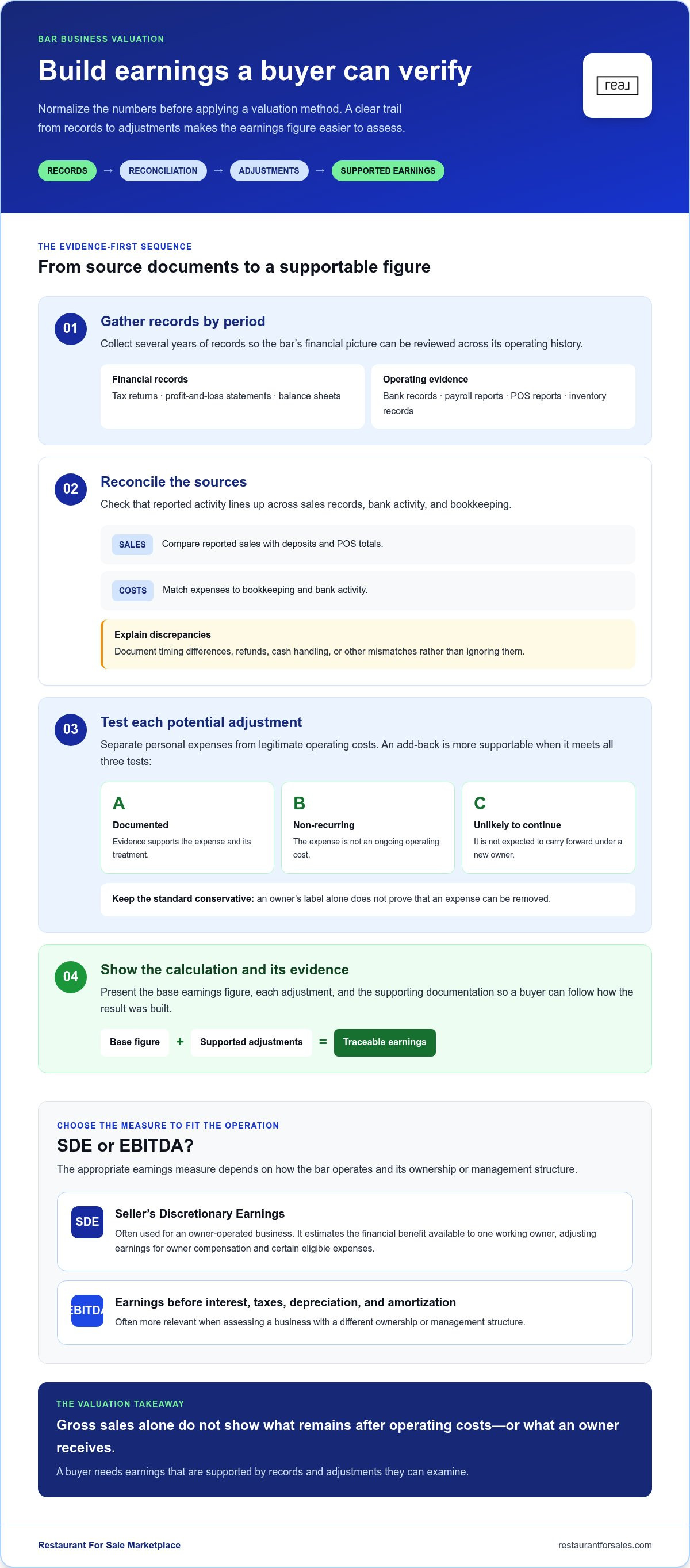
A valuation is only as credible as the earnings figure behind it. Gross sales don’t show what the bar spends to operate or what an owner can reasonably take from the business. Normalized earnings are more useful than gross sales alone because they show the operating performance a buyer can verify and potentially continue.
Build the figure in a clear sequence:
- Gather records: Collect several years of tax returns, profit-and-loss statements, balance sheets, bank records, payroll reports, point-of-sale (POS) reports, and inventory records.
- Reconcile the sources: Compare reported sales with deposits and POS totals, and match expenses to bookkeeping and bank activity. Explain timing differences, refunds, cash handling, or other discrepancies rather than ignoring them.
- Identify adjustments: Separate personal expenses from legitimate operating costs. Consider an add-back only when the expense is documented, non-recurring, and unlikely to continue under a new owner.
- Calculate supported earnings: Show the base figure, each adjustment, and its evidence so a buyer can follow the calculation.
Which financial records should bar owners organize?
Keep tax filings, financial statements, bank statements, payroll records, sales reports, and inventory counts organized by period. POS totals should tie as closely as possible to bookkeeping revenue and deposits. If they don’t, record the reason and supporting detail. Separate personal charges from business expenses, but don’t assume an owner’s label alone proves an expense is removable.
How do SDE, EBITDA, and add-backs differ?
Seller’s Discretionary Earnings (SDE) is often used to assess an owner-operated business. It estimates the financial benefit available to one working owner by adjusting earnings for owner compensation and certain eligible expenses. EBITDA, or earnings before interest, taxes, depreciation, and amortization, is often more relevant when assessing a business with a different ownership or management structure. The appropriate measure depends on how the bar operates.
Be conservative with add-backs. A personal expense must be identifiable in the records, and a one-time cost needs evidence that it won’t recur. If an owner performs work that a buyer would need to replace with paid staff, removing the owner’s full compensation may overstate earnings. Unsupported adjustments can weaken credibility and slow buyer review.
For owners learning how to value a bar business, a transparent earnings schedule is a practical starting point. It helps buyers assess financial performance and market context, while a professional restaurant valuation can refine the analysis. If you’re moving from an estimate toward a sale, restaurant valuation services can help you build a valuation around documented financial performance.
Compare Valuation Methods Without Relying on a Generic Bar Multiple
No single method fits every bar. The right approach depends on the quality of its records, the consistency of its earnings, the assets being sold, and the transaction structure. A useful analysis may consider more than one method, then explain why some evidence carries more weight than other evidence.
| Approach | What it examines | Useful when |
|---|---|---|
| Earnings-based | Normalized SDE or EBITDA and the bar’s ability to sustain those earnings | Records support a credible earnings figure |
| Market-comparable | Completed sales of businesses with relevant similarities | Reliable transaction evidence is available and can be meaningfully compared |
| Asset-based | Business assets such as equipment, furniture, and inventory, considered in the sale context | Assets are a material part of the transaction or earnings provide limited guidance |
These approaches answer different questions. Earnings analysis focuses on operating performance. Comparables provide market context, not a guaranteed price formula. Asset analysis helps identify what tangible property contributes, but adding asset values to an earnings-based estimate without checking what that estimate already includes can double-count value. For a broader overview of valuation principles, see the 2026 restaurant valuation guide.
When is an earnings-based valuation useful?
An earnings-based analysis can be useful when normalized SDE or EBITDA is supported by consistent records. It becomes less dependable if financial statements are incomplete, sales reports don’t reconcile, or an unusual operating period makes recent results unrepresentative. Document assumptions, such as whether a one-time disruption will continue to affect operations, and test how the estimate changes if those assumptions prove wrong. Treat projections as assumptions, not established facts.
When do comparable sales and asset value matter?
Completed transactions can help show how buyers have valued similar businesses, but similarity requires more than the same label. Consider the operation’s size, earnings quality, assets, sale scope, and relevant transaction conditions. If reliable comparables aren’t available, don’t force a conclusion from weak matches.
Assess equipment, furniture, and inventory in relation to what the sale includes and how the chosen method treats those items. Apply the same care to the premises: real estate and lease interests require separate consideration where applicable. A leased location and an owned building represent different transaction components, so keep them distinct in the analysis.
When deciding how to value a bar business, compare the methods, state the limits of the evidence, and explain why the selected approach fits the transaction. A professional valuation from Restaurant For Sale Marketplace can help weigh financial performance against market context without presenting a generic multiple as a precise answer.
Assess Bar-Specific Risks That Can Change the Valuation
A bar’s financial history matters, but buyers also consider whether its earnings and operations can continue after a sale. When assessing how to value a bar business, examine risks that could interrupt revenue, increase operating demands, or make the transition less predictable. Evidence helps frame these concerns, but no single factor determines the outcome.
How do lease and licensing issues affect a bar sale?
Review the lease’s remaining term, assignment provisions, renewal options, rent obligations, and other occupancy requirements. A short remaining term or unclear renewal path may leave a buyer uncertain about how long the business can operate at its current premises. Assignment conditions and required approvals can also affect transaction timing and structure. For more context, see restaurant lease assignment considerations.
Liquor-license requirements and transferability vary by jurisdiction. Verify the current rules that apply to the bar’s location and transaction. A license may be central to the operation, but don’t assume it transfers automatically with the business. Keep the valuation’s licensing assumptions distinct from confirmed transaction terms.
Which operating risks should buyers and owners examine?
Look for patterns in the records and day-to-day operating information. Useful questions include:
- Earnings continuity: Do sales and costs show a stable pattern, or do results rely on unusually strong periods?
- Customer concentration and seasonality: Does revenue depend heavily on a small number of customers, events, or particular times of year?
- Staffing and owner dependence: Are key duties concentrated with the owner or a few employees? Are responsibilities and operating procedures documented?
- Vendor relationships: Are essential suppliers and purchasing practices clear enough for a new owner to understand?
- Equipment and maintenance: What is the condition of essential equipment, and are repairs or deferred maintenance documented?
Inventory and other included assets need clear treatment in the sale scope. Record what is included, how inventory is handled, and which equipment or furnishings may need attention. Avoid assigning unsupported values or counting an asset twice in the valuation.
Clear records can reduce uncertainty by showing buyers how the business operates and where transition work may be needed. They can’t guarantee a particular valuation or deal term, but they give both sides a more informed basis for discussion. Restaurant For Sale Marketplace provides professional restaurant valuation services to assess financial performance and market context.
Turn a Bar Valuation Into a Practical Sale or Purchase Plan
A valuation becomes useful when it informs a decision. For an owner, that may mean setting a supportable asking price and preparing for buyer review. For a buyer, it can help identify what needs clarification before making an offer. Treat an early estimate as a planning tool, not a promised sale price. A professional market valuation can assess the bar’s financial performance alongside market context.
Use this sequence to move from estimate to action:
- Organize the records: Assemble reconciled financial statements, tax returns, and supporting sales and expense records, along with an asset list and relevant lease and licensing information.
- Document assumptions: Explain earnings adjustments, note the evidence behind them, and flag figures that still need support.
- Review comparable transactions: Use relevant completed sales as context, accounting for differences in the businesses and transaction terms rather than treating a comparison as a price formula.
- Define the sale scope: Specify what’s included, excluded, or handled separately, such as real estate, inventory, and equipment.
What should owners prepare before setting an asking price?
Make the asking price traceable to the evidence. Keep financial records and assumptions organized, clarify the condition and inclusion of assets, and identify lease obligations that may affect a buyer’s plans. Separate the owner’s preliminary estimate from a professional valuation prepared to inform a sale decision. This gives buyers a clearer basis for evaluating the opportunity and helps owners explain how the proposed price relates to earnings, assets, and transaction scope.
Price also needs to reflect the buyer’s perspective and intended deal structure. The same headline figure can represent different things depending on whether property is included, which assets transfer, and how other terms are arranged. A well-supported asking price is a starting point for negotiation, not a guarantee of the final sale price.
When can professional valuation and brokerage support help?
Professional valuation support can help owners assess performance and market context before setting a sale strategy. As the process advances, Restaurant For Sale Marketplace provides brokerage support to manage the transaction from listing through closing, including buyer engagement. Learn more about the role of a restaurant broker in a business sale.
If you’re ready to move from estimating value to planning a transaction, explore valuation and brokerage support.
Build Your Next Move on a Defensible Valuation
Knowing how to value a bar business means looking beyond revenue or a single rule of thumb. Define what the transaction includes, support the earnings figure with reliable records, and compare valuation methods in light of the bar’s assets, operating conditions, and buyer perspective.
Lease terms, licensing considerations, staffing, seasonality, and equipment condition can all affect how a buyer views the opportunity. Documenting these factors helps owners set a more informed asking price and gives buyers a clearer basis for evaluating the business. A preliminary estimate can guide planning, while a professional valuation can assess financial performance and market trends in the context of a potential sale.
As you move from analysis to action, brokerage support can help manage the sale process from listing through closing. Explore professional bar valuation and brokerage support to plan your next step with a clearer view of the transaction.
A careful process gives both owners and buyers a stronger foundation for productive discussions and a well-prepared deal.
Frequently Asked Questions
How do you calculate the value of a bar business?
Estimate a bar’s value by analyzing supported earnings, relevant assets, comparable transactions, and the terms of the proposed sale. Start with reliable records and calculate SDE or EBITDA when appropriate. Then compare earnings-based, market-based, and asset-based approaches, accounting for the lease, inventory, operating assets, licensing context, and deal structure. The result is an evidence-based estimate, not a guaranteed sale price. Document assumptions so buyers can understand how you reached it.
What is a bar business usually worth?
There’s no dependable universal figure or multiple that applies to every bar. Value depends on documented earnings a buyer can reasonably expect to continue, the assets included, lease conditions, operating continuity, and buyer interest. Any estimate should show its assumptions and supporting evidence. Completed sale comparables can provide context, but only when the businesses and transaction terms are sufficiently similar to make the comparison meaningful.
Is a bar valued on revenue or profit?
Revenue shows the scale and pattern of sales, but it doesn’t reveal what remains after operating expenses. Buyers generally need to assess sustainable earnings and understand how the earnings figure was calculated. A valuation may also consider business assets and transaction conditions. Present sales alongside earnings, but don’t treat revenue alone as proof of value. Two bars with similar sales can have different costs, owner benefits, and earnings reliability.
What financial statements do you need to value a bar?
Gather tax returns, profit-and-loss statements, balance sheets, bank records, payroll information, and point-of-sale reports for relevant periods. Add inventory records and documentation for any proposed owner add-backs. Reconcile sales and expenses across sources, then explain discrepancies, such as differences between POS totals and deposits. Complete, consistent records make the earnings analysis more credible and help prospective buyers assess operating performance with fewer unanswered questions.
Does a liquor license add value to a bar?
A liquor license can be important to a bar’s continued operations, but its transferability and requirements depend on the applicable jurisdiction. Don’t assume it transfers automatically or assign it a separate value without evidence. Identify the license involved and verify current, location-specific requirements. Its status may affect transaction timing and operating continuity, so make the assumptions clear in the valuation and distinguish confirmed terms from issues that still need resolution.
How does a bar lease affect business value?
A bar lease can influence a buyer’s assessment through its remaining term, assignment provisions, renewal options, occupancy obligations, and approval conditions. A short or uncertain term may raise questions about operating continuity; clear renewal and assignment terms can help a buyer assess the premises. Review the actual lease and distinguish the operating business from any real estate included in the deal. Lease conditions are transaction considerations, not a substitute for analyzing earnings.
Should equipment and inventory be included in a bar valuation?
Whether equipment and inventory are included depends on the proposed deal structure. List equipment and furniture, document their condition, and state how inventory will be treated at closing. Clarify which items are included, excluded, or valued separately. When comparing valuation methods, check whether assets are already reflected in the analysis so they aren’t counted twice. Clear scope helps both parties understand what the agreed transaction covers.
When should a bar owner get a professional valuation?
Consider a professional valuation when setting an asking price, planning a sale, reviewing an offer, or resolving uncertainty about earnings and transaction assumptions. Before the valuation, organize financial records, lease documents, and an asset list. A professional assessment can connect documented financial performance with market context and help inform a sale decision. It provides an estimate based on evidence and assumptions, not a guarantee of the asking price or final sale outcome.


