

A restaurant sale can be ready to close while the lease transfer is still unresolved. A restaurant lease transfer may require landlord approval, buyer information, and agreement on lease terms. Treating it as a closing-day task can put the wider deal at risk.
Buyers need to understand the obligations they may take on. Sellers need clarity about their ongoing responsibilities and when they may be released from the lease. Requirements depend on the lease and applicable law, so review the assignment clause early with a qualified attorney.
This guide explains the transfer process, the landlord’s role, and the documents and lease terms that deserve close attention. It compares assignment, sublease, and a new lease, including how each can affect responsibilities and security deposits. Coordinating the lease work with the business sale helps buyers and sellers identify obstacles sooner. Restaurant For Sale Marketplace provides brokerage and lease assignment support to help connect these parts of a transaction.
Key Takeaways
- Start with the assignment clause, remaining lease term, and any conditions that could affect a buyer’s ability to take over.
- A restaurant lease transfer depends on the lease terms and the landlord’s requirements. Map the approval steps before setting closing expectations.
- Compare assignment, sublease, and a new lease to understand how each structure may affect tenant continuity and responsibility.
- Organize buyer information, landlord submissions, and closing documents into a checklist with a clear owner for each action.
- Coordinate lease milestones with the restaurant sale so open approval items are visible before closing approaches.
What a Restaurant Lease Transfer Means for a Buyer and Seller
A restaurant lease transfer changes who holds the right to occupy a leased space, who has duties under the lease, or both. The effect depends on the existing lease, the transaction structure, and applicable law. A buyer may acquire the restaurant business without automatically acquiring the right to occupy its premises. That distinction makes lease review an essential part of sale planning.
Each party has a role. The current tenant reviews the lease, shares its terms with the buyer, and helps arrange the transfer. The proposed incoming tenant provides information needed to assess the transaction and reviews the obligations it may assume. The landlord considers the request and provides any approval required by the lease or law. The business-sale parties coordinate the lease arrangements with the purchase agreement and closing conditions.
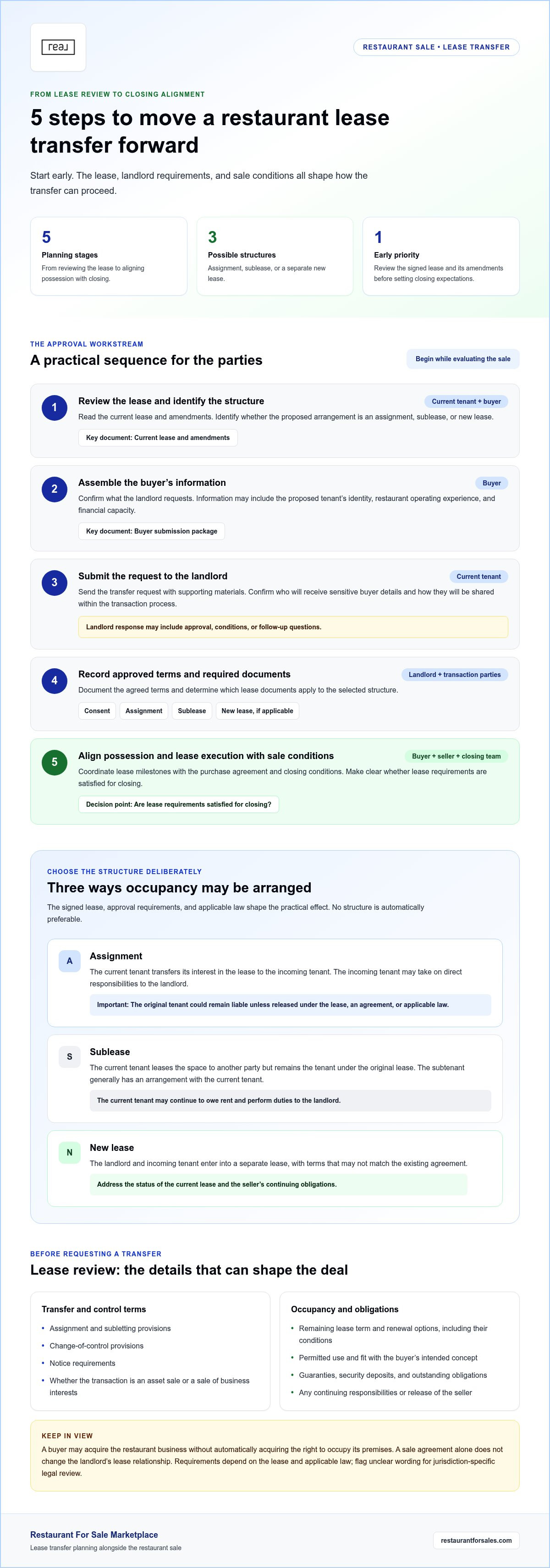
An assignment, sublease, and new lease are distinct ways to structure occupancy. A general overview of assignment or sublease can clarify the terminology, but the signed lease and local law determine the practical effect.
How a lease assignment differs from a sublease
With an assignment, the current tenant transfers its interest in the lease to the incoming tenant. The incoming tenant may take on direct responsibilities to the landlord, while the original tenant could remain liable unless released under the lease, an agreement, or applicable law. An assignment does not necessarily end the original tenant’s obligations.
With a sublease, the current tenant leases the space to another party but remains the tenant under the original lease. The subtenant generally has an arrangement with the current tenant, who may continue to owe rent and perform duties to the landlord. Neither structure is automatically preferable. The lease, approval requirements, and parties’ intended responsibilities matter.
A new lease is different: the landlord and incoming tenant enter into a separate lease, with terms that may not match the existing agreement. The status of the current lease and the seller’s continuing obligations should be addressed as part of that arrangement.
Why the lease can affect the restaurant sale
Occupancy rights affect whether and on what terms the buyer can continue operating at the location. Review the remaining lease term alongside permitted use and renewal options. A short remaining term, restrictions that do not fit the buyer’s intended concept, or uncertain renewal rights can affect operating continuity and the buyer’s assessment of the deal.
Business ownership and lease rights are related but separate transaction matters. A sale agreement may set out what the buyer is purchasing, but it does not by itself change the landlord’s lease relationship. Identify the required lease structure and approvals early, then align them with the business-sale documents and closing conditions.
How a Restaurant Lease Transfer Moves From Initial Review to Approval
Start the lease workstream as soon as the parties are evaluating the sale, not after the purchase agreement is ready to close. The lease determines what can be transferred, what approval may be required, and which documents the landlord expects. Use the steps below as a planning sequence, then tailor them to the lease and the landlord’s stated requirements.
Process at a glance
- Current tenant and buyer: Review the lease and identify the proposed structure. Document: current lease and amendments.
- Buyer: Assemble requested background and financial information. Document: buyer submission package.
- Current tenant: Submit the request and supporting materials to the landlord. Decision: approval, conditions, or follow-up questions.
- Landlord and transaction parties: Record approved terms and any required lease documents. Document: consent, assignment, sublease, or new lease, as applicable.
- Buyer, seller, and closing team: Align possession and lease execution with sale conditions. Decision: whether lease requirements are satisfied for closing.
What to review before requesting a transfer
Read the full lease, including amendments, exhibits, and later written agreements. Locate provisions addressing assignment, subletting, change of control, permitted use, and notice. A transaction structured as a sale of business interests may raise different lease questions from an asset sale, so do not assume the same clause applies in the same way.
Note the remaining term, renewal options and their conditions, guaranties, security deposits, and outstanding obligations. Flag unclear wording for jurisdiction-specific legal review rather than relying on a general interpretation. A transfer request can reveal issues that affect both the lease and the purchase agreement.
What information may support the landlord’s review
The landlord may request information about the proposed tenant, such as identity, restaurant operating experience, and financial capacity. The required package depends on the lease and the landlord’s requirements. Confirm what information is requested, who will receive it, and how sensitive buyer details will be shared within the parties’ agreed transaction process.
Approval, sale conditions, and possession timing are linked. If the buyer’s right to close depends on lease approval, for example, the purchase agreement should account for that condition and explain how the parties will handle a delay or proposed change in terms. Set possession around executed lease documents and agreed closing steps, rather than assuming approval alone transfers occupancy rights.
Keeping these actions aligned is a core part of a restaurant lease transfer. Restaurant For Sale Marketplace’s brokerage and restaurant lease assignment support help connect lease milestones with the wider sale process.
Assignment, Sublease, or New Lease: Compare the Practical Trade-Offs
The structure affects whether the buyer steps into existing lease terms, rents through the current tenant, or negotiates directly with the landlord. Compare the practical differences before choosing a path. The labels alone do not settle who remains liable or what approvals are needed. The signed documents and governing law control.
| Structure | Tenant continuity | Landlord involvement | Possible responsibility changes |
|---|---|---|---|
| Assignment | The buyer may take over the current tenant’s interest in the existing lease. | Consent or other conditions may apply under the lease or law. | The buyer may assume lease duties; the outgoing tenant may remain responsible unless formally released. |
| Sublease | The current tenant remains the landlord’s tenant and grants occupancy rights to the buyer. | The landlord may have approval rights under the existing lease. | The current tenant may continue to owe obligations to the landlord, even if the subtenant has duties to the current tenant. |
| New lease | The buyer enters a separate landlord-tenant relationship. | The landlord negotiates directly with the incoming tenant. | Terms may be reset; the existing tenant’s responsibilities require separate resolution. |
When an assignment may fit a restaurant sale
An assignment may suit a transaction when the parties want the buyer to continue under the existing lease rather than negotiate an entirely new agreement. Preserving existing terms can support operational continuity, but it does not guarantee unchanged obligations or release the seller. Review the remaining term, rent provisions, permitted use, and renewal rights, then account for any consent requirements and conditions in the lease.
When a sublease or replacement lease enters the discussion
A sublease may give the buyer a route to occupy the space while the outgoing tenant remains connected to the landlord under the original lease. A new lease may instead establish fresh terms, which could differ from the seller’s agreement. Either structure can affect the buyer’s costs, rights, and continuity. Compare the documents and transaction details before settling on an approach.
For a restaurant lease transfer, assess more than the proposed tenant’s name. Confirm which agreement governs occupancy, whether the seller is released, what approval is required, and how lease execution aligns with the sale closing. Restaurant For Sale Marketplace’s lease assignment support can help coordinate that work with the broader transaction.
Restaurant Lease Transfer Checklist: Reduce Delays Before Closing
A useful checklist gives every lease-transfer task an owner, a document trail, and a clear dependency. The steps below help buyers and sellers spot missing information while there is still time to address it. The lease, landlord’s requirements, and purchase agreement determine the actual steps and timing.
- Lease review, owner: seller, buyer, and their legal advisers. Gather the signed lease, amendments, notices, and relevant correspondence. Identify transfer conditions, required notices, outstanding obligations, and clauses that need closer review.
- Buyer package, owner: buyer. Prepare the information requested for landlord review, such as buyer identity, operating background, and financial details. Keep sensitive materials within the transaction process agreed by the parties.
- Landlord submission, owner: seller or the designated transaction representative. Submit the request and supporting documents in the required format. Track delivery, follow-up questions, responses, conditions, and proposed changes in one record.
- Transfer agreement, owner: buyer, seller, landlord, and legal advisers as applicable. Document the approved structure and responsibilities. Keep written consent, assignment or sublease documents, amendments, and required notices together.
- Closing and possession, owner: buyer and seller with the closing team. Confirm that lease conditions, purchase agreement conditions, document execution, and the possession date align. Record any agreed treatment of deposits, repairs, arrears, and other lease obligations.
Documents and deal points to align
Compare the lease’s transfer requirements with the purchase agreement’s closing conditions. If the sale depends on landlord approval, make sure the agreement explains how the parties will handle a delayed response, changed lease terms, or approval that does not meet the buyer’s needs. Keep the landlord’s correspondence and final signed documents with the transaction records.
Address responsibility for deposits, repairs, arrears, and other obligations explicitly. Do not rely on an informal understanding between buyer and seller to change the landlord’s rights under the lease. For additional context, review this restaurant lease assignment guide.
Common delays buyers and sellers can anticipate
An incomplete submission can prompt follow-up and slow the review. Unclear buyer information, unresolved defaults or repairs, and lease amendments that have not been collected or reconciled can also cause delays. Assign one person to track open items and dependencies, and avoid assuming the landlord will approve the request or respond on a fixed schedule.
Coordinate the lease workstream with the sale from the outset. Coordinate your restaurant lease assignment with the sale to keep related milestones and responsibilities in view.
Coordinate the Lease Transfer With the Restaurant Sale
A lease transfer should not sit on the edge of the sale plan until closing approaches. Manage it as a parallel workstream, with a clear owner for each action and regular status updates among the buyer, seller, landlord, and transaction representatives. This helps expose dependencies early, while there is still time to address them.
Keep the transaction workstreams aligned
Map the lease and sale milestones together. The tracker should show when the lease has been reviewed, what the landlord needs to decide, which purchase agreement conditions depend on that decision, and what must be completed before possession. If the landlord requests a change to rent, term, guaranty, or another provision, record the proposal and identify who will assess its effect on the deal.
Keep one current record of the documents and status. Include the lease and amendments, transfer request, landlord correspondence, draft consent or assignment documents, purchase agreement conditions, and agreed possession arrangements. Buyers and sellers should know which items are complete, which are pending, and who is responsible for moving each one forward.
Address unresolved terms before closing pressure builds. A repair obligation, outstanding default, unclear deposit treatment, or proposed lease amendment can affect the buyer’s decision and the sale conditions. Raising those issues early gives the parties time to assess their options rather than discovering a mismatch at the last minute.
For wider context on how brokerage fits into the sale process, read about the restaurant broker's role in a business sale. Brokerage coordination can connect sale milestones with lease-transfer tasks, keeping both workstreams visible through closing.
Choose a clear next step for the transaction
Before moving forward, summarize the lease status in one place: the proposed transfer structure, outstanding landlord decisions, documents still needed, responsible parties, and any purchase conditions tied to approval or possession. This gives everyone a shared view of the transaction and highlights dependencies that could affect the closing plan.
A restaurant-focused broker can coordinate the sale process alongside restaurant lease assignment steps. If lease approval is still an open workstream, explore restaurant lease assignment support as a practical next step. Clear ownership and early coordination help keep the transaction organized and make issues easier to address.
Keep the Lease and Sale Moving Together
A successful restaurant lease transfer depends on more than choosing between an assignment, sublease, or new lease. Review the lease terms early, confirm the landlord’s requirements, and make responsibilities for documents, approvals, and possession clear. The signed agreements and applicable law determine the parties’ rights and obligations.
Treat lease approval as a parallel workstream in the restaurant sale. Coordinate its decision points with purchase agreement conditions and closing milestones so potential issues surface before they become last-minute obstacles.
Restaurant For Sale Marketplace provides restaurant lease assignment and brokerage services for transactions from listing through closing. Explore restaurant lease assignment support to connect lease-transfer steps with the wider sale process.
With clear ownership and coordinated planning, buyers and sellers can approach the next stage with greater confidence.
Frequently Asked Questions
What is a restaurant lease transfer?
A restaurant lease transfer changes who holds occupancy rights or lease responsibilities for the restaurant premises. It may involve an assignment, sublease, or a new lease, each with different effects on the outgoing and incoming tenants. The existing lease, transfer documents, and applicable law shape the parties’ rights and obligations. A business sale alone does not automatically transfer the seller’s lease rights to the buyer.
Does a landlord have to approve a restaurant lease transfer?
Not always, but the lease or applicable law may require landlord consent or notice before a transfer. Check the assignment, subletting, and change-of-control provisions, including any conditions and deadlines stated in the lease. The landlord’s role may differ depending on the proposed structure and jurisdiction. Review the specific terms with a qualified attorney before relying on an assumption about whether approval is required.
What is the difference between a lease assignment and a sublease?
In an assignment, the current tenant transfers its interest in the lease to the incoming tenant, who may assume lease responsibilities. The outgoing tenant could remain liable unless formally released. In a sublease, the original tenant generally stays in a direct relationship with the landlord and rents the space to the subtenant. The lease and applicable law determine the precise responsibilities and approval requirements for either structure.
Can a buyer take over a restaurant lease?
Yes, a buyer may take over a restaurant lease through an assignment, subject to the lease terms and any required approvals. The buyer and seller can also explore a sublease or negotiate a new lease with the landlord. The purchase agreement should address how lease approval affects closing and possession. Buyers should review the remaining term, permitted use, renewal options, and obligations before committing to the transfer.
What documents are typically involved in a restaurant lease transfer?
Documents may include the current signed lease and amendments, the transfer or consent request, buyer information requested for landlord review, and written landlord responses. Depending on the agreed structure, the parties may also prepare an assignment, sublease, new lease, or lease amendment. Purchase agreement conditions, required notices, and closing documents should align with the lease arrangements. The specific package depends on the lease, transaction, landlord, and jurisdiction.
How long does a restaurant lease transfer take?
There is no universal timeline for a restaurant lease transfer. The process depends on the lease’s requirements, the landlord’s review process, how quickly the parties provide requested information, and whether terms need to be negotiated or revised. Incomplete buyer materials or unresolved lease issues can add steps. Coordinate the transfer with purchase agreement deadlines and possession plans, but do not treat landlord approval or document completion as guaranteed by a particular date.
What happens if the landlord does not approve the lease transfer?
If approval is denied, the buyer may not be able to occupy the premises under the proposed arrangement. The parties can review the lease and applicable law, discuss whether a revised request or different structure is possible, or negotiate a new lease with the landlord. The purchase agreement may set out what happens if approval is not obtained. Buyers and sellers should address the effect on closing, possession, and ongoing seller obligations before proceeding.


