

A new owner doesn’t always need a new restaurant brand. The familiar name, signature dishes, or atmosphere you’re tempted to replace may be what keeps regulars coming back. Knowing how to rebrand a newly purchased restaurant starts with separating what customers value from what no longer fits your plans.
It’s understandable to want the restaurant to reflect your ownership and business goals. But changing too much, too quickly can confuse loyal guests, while keeping an outdated identity may make it harder to reach the customers you want to serve. Base decisions on evidence, not assumption.
This guide explains how to assess the existing brand and decide whether to retain, refresh, or replace it. You’ll learn how to coordinate changes across menus, signage, staff, and digital channels, and connect the rollout to the restaurant’s operational and financial goals. The aim is a clear transition that builds on what works and gives the business a stronger direction.
Key Takeaways
- Assess the restaurant’s recognition and customer loyalty before deciding whether to preserve, refresh, or replace its identity.
- Set business objectives first, then use transaction records, reviews, and market research to identify the customers the rebrand should serve.
- Compare a light refresh, repositioning, and full identity change by strategic fit, customer recognition, implementation effort, and potential disruption.
- Plan the rollout across staff, signage, menus, ordering materials, listings, website, social profiles, and booking details so the transition is clear.
- Connect each brand change to customer evidence and acquisition priorities, including financial records and lease terms.
Should You Rebrand a Newly Purchased Restaurant or Keep Its Existing Identity?
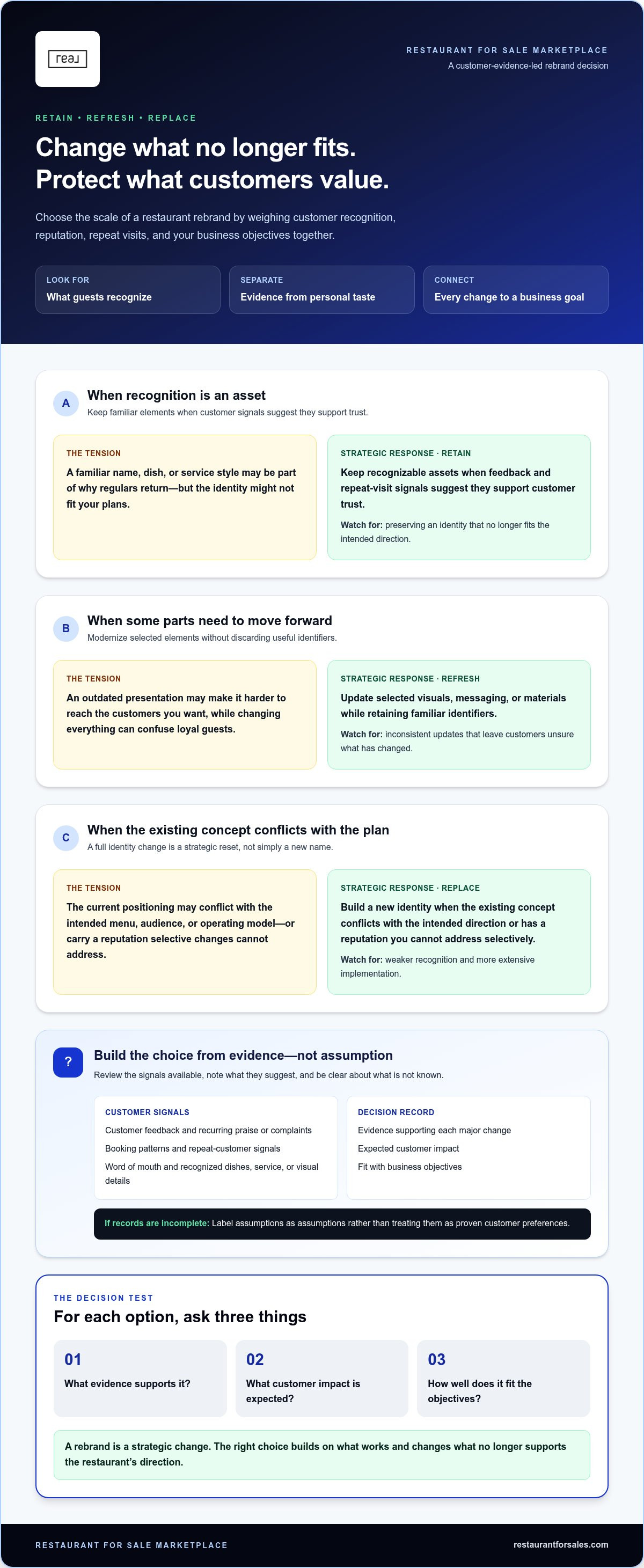
As the new owner, you can preserve the restaurant’s recognition, modernize selected parts of its identity, or build a new one. The right choice depends on what customers value and where you plan to take the business. A new name alone won’t tell you whether a rebrand will help. Treat rebranding as a strategic change, not simply a logo or name update.
Assess the restaurant’s recognition, reputation, repeat visits, and your business objectives together. A familiar name may carry customer goodwill, but it may also signal a menu or experience that no longer matches your plans. The practical question is which changes support the next phase without discarding customer value unnecessarily.
What parts of the existing restaurant brand still carry value?
Review available customer feedback, booking patterns, repeat-customer signals, and word of mouth. Look for recurring praise and complaints, and note which dishes, service qualities, or visual details customers recognize. A signature dish or distinctive service style may matter more to guests than the current logo.
Separate that evidence from personal taste. Record what customers appear to value, what needs improvement, and what you simply prefer to change. If records are incomplete, label assumptions as assumptions rather than treating them as proven customer preferences.
When does a restaurant rebrand make strategic sense?
A change may be justified when the existing positioning conflicts with the intended menu, target audience, or operating model. A reputational concern or ownership transition may also prompt a review, but changing the name won’t automatically resolve the underlying issue. Identify what needs to change in the customer experience as well as in the brand.
Document the reason for keeping, refreshing, or replacing each major element. This creates a decision trail tied to business goals instead of a collection of subjective design preferences.
- Retain: Keep recognizable assets when customer feedback and repeat-visit signals suggest they support trust. The risk is preserving an identity that no longer fits your plans.
- Refresh: Update selected visuals, messaging, or materials while retaining familiar identifiers. This can balance continuity with a more current presentation, but inconsistent updates can make the change unclear.
- Replace: Create a new identity when the existing concept conflicts with the intended direction or carries a reputation you cannot address through selective changes. This offers a clearer reset, but may weaken recognition and require more extensive implementation.
For each option, note the evidence that supports it, the expected customer impact, and how well it fits your objectives. That comparison turns a broad rebrand decision into a reasoned acquisition choice.
How to Build a Restaurant Rebrand Strategy Around Customers and Business Goals
Set business objectives before choosing a name, logo, design direction, or launch campaign. Decide what the rebrand needs to support: a different menu, a new customer segment, stronger recognition of a distinctive dining experience, or a clearer market position. Then use those objectives to evaluate creative ideas. A rebrand should help the business deliver on its plan, not become a plan of its own.
Start by connecting customer evidence to business priorities, then turn both into clear direction for everyone involved.
How do you identify the right audience for the new restaurant brand?
Start with the information available. Review customer feedback, booking patterns, and sales mix where records are reliable and relevant. Look for clues about dining needs, occasions, preferences, and the experience guests expect. For example, feedback about quick service at lunch points to a different priority than comments about leisurely dinners or a special-occasion atmosphere.
Describe the target audience by what they need from the restaurant, not just by broad labels. Don’t assume a new audience will appear because the name or visual identity changes. The concept, menu, service, and customer experience must give that audience a reason to visit and return.
Which brand elements should stay consistent across the experience?
Translate the intended customer promise into practical standards across the restaurant. If the promise is a relaxed, approachable meal, the menu descriptions, pricing presentation, service style, and atmosphere should all support that expectation. The concept must also work in daily operations. Cornell’s example of learning through restaurant management and operations reflects how concept development and execution connect.
Write a concise brand brief so owners, managers, and designers can make aligned decisions. Keep it focused on:
- Objective: The business outcome the brand should support.
- Audience: The priority guests and the occasions they visit for.
- Promise: What customers should reliably expect.
- Expression: Guidance for tone, visual identity, photography, and customer communications.
Add one positioning statement staff can understand and apply, such as: “A welcoming place for guests who want a satisfying meal and attentive, unhurried service.” Use it to check whether decisions reinforce the intended experience. If you’re still evaluating a purchase, explore restaurant acquisition opportunities as part of your planning.
Refresh, Rename, or Start Over: Compare Restaurant Rebranding Options
Choose the scope that addresses a documented business need without creating unnecessary change. A light refresh adjusts presentation; a repositioning changes how the restaurant is understood and experienced; a full identity change replaces the established brand. The right option depends on customer recognition, the intended concept, and what the business can implement consistently.
Use this comparison to weigh the trade-offs. Implementation effort and disruption depend on the scope, existing assets, approvals, and site requirements. Assess them against the actual transaction and location rather than assuming a fixed timeline or cost.
| Option | Customer recognition | Effort and disruption | Strategic fit and evidence |
|---|---|---|---|
| Light refresh | Usually preserves familiar identifiers, such as the name or signature dishes. | More limited, though customer-facing materials still need consistent updates. | Fits when the concept remains sound but presentation needs attention. Look for positive recognition of existing assets alongside specific feedback about outdated visuals or messaging. |
| Repositioning | Can retain the name while changing the restaurant’s promise and audience. | Moderate. Menu, service, atmosphere, and communications may all need to support the new position. | Fits when the business direction is changing but some brand equity remains useful. Look for evidence of a gap between the current experience and the customers you want to attract. |
| Full identity change | Risks losing recognition tied to the old name and identity. | Broadest, with updates likely across customer touchpoints and operating materials. | Fits a major concept shift or serious reputation concern. Support the decision with clear evidence that retaining the old identity would hinder the business objective. |
What does a restaurant brand refresh change, and what does it preserve?
A refresh can update visual assets, messaging, menus, and digital presentation without discarding everything guests recognize. If customer evidence supports the existing name or a signature offering, keeping it can signal continuity while other elements evolve. But even a modest update can look careless if menus, signs, listings, and online profiles tell different stories. Set a consistent standard for every touchpoint.
When should a new owner consider a complete restaurant rebrand?
Consider a full change when the concept is shifting substantially, the existing positioning conflicts with the intended customers, or reputation concerns make continuity difficult. Before committing, account for name rights, lease provisions, permits, and other transaction-specific requirements with appropriate advisers. A new logo or name won’t fix an experience that still fails to match the promise.
Choose the smallest change that credibly supports the documented objective. Record the reason for each major change and the evidence behind it. That discipline keeps the rebrand connected to the acquisition plan instead of letting the visual update become an end in itself.
How to Roll Out a Restaurant Rebrand Without Confusing Customers
A coordinated rollout helps guests understand what’s changing and what they can still expect. Plan the transition in stages, and don’t announce a new identity until staff, customer information, and essential operating materials are ready. This is especially important when regulars recognize the restaurant by its existing name, menu, or service style.
Use a simple sequence:
- Preparation: Confirm the launch scope, finalize customer-facing materials, and identify every physical and digital place where the current brand appears.
- Staff briefing: Explain the new brand promise, any menu changes, and the service expectations guests should experience.
- Channel updates: Coordinate signage, menus, ordering materials, listings, the website, social profiles, and booking details so they reflect the same information.
- Launch: Share a concise explanation of what is changing and what customers can still expect from the restaurant.
- Follow-up: Gather customer feedback and staff observations, resolve inconsistencies, and adjust communications where guests remain confused.
For example, if the name is changing but a signature dish remains, say so plainly. A short message that connects the new identity with a familiar offering can help returning guests understand the transition without suggesting the restaurant is unchanged in every respect.
What should restaurant staff know before the rebrand launches?
Brief staff before making a public announcement. Make sure they can explain the brand promise, describe menu changes accurately, and deliver the service experience the new positioning implies. Prepare clear answers to likely questions from regulars and first-time guests, including what has changed and what remains familiar. Confirm that menus, ordering processes, and service routines are ready before launch. Inconsistent answers can undermine the new message.
Which digital and physical customer touchpoints need updating?
Build an inventory rather than relying on memory. Check exterior and interior signage, menus, receipts, ordering platforms, booking profiles, the website, social accounts, and relevant listings or review platforms. Google Business Profile is one example. Verify current platform procedures before editing profiles, and make sure updates appear consistently wherever customers look for information.
Check practical details as well as visual identity: restaurant name, menu information, hours, contact details, booking information, and photographs. If a new menu is live but an ordering platform still displays old items, customers may receive conflicting information. Assign responsibility for each channel and review the live updates after launch.
Track guest questions, feedback, and operational issues after the change. Use those signals to clarify messaging and correct gaps. If you’re planning a purchase, explore restaurant acquisition opportunities as part of your transition planning.
Make the Rebrand Part of a Strong Restaurant Acquisition Plan
A rebrand should follow the acquisition plan, not run ahead of it. Connect each proposed change to customer evidence and your operating objectives, then test whether the assumptions behind the purchase support the new direction. If the plan depends on a particular menu, audience, or service model, make sure the available business information supports those choices before setting a launch date.
Review financial records and customer information alongside lease terms, assets, obligations, and transition dependencies. A name or concept change may depend on rights connected to the existing business, site requirements, or the timing of the ownership transition. Broader purchase planning is covered in this restaurant acquisition guide. If the proposed brand depends on changes to the premises or continued use of a location, review the restaurant lease assignment guidance as part of that assessment.
How can acquisition due diligence inform a restaurant rebrand?
Use documented performance and customer information to test assumptions rather than treating the seller’s description or your initial impression as the full picture. Compare the proposed concept with what the records show about the business, and identify assets or obligations that could affect the name, menu, or customer experience. Transaction details can shape these decisions, so understanding the restaurant broker’s role in a business sale can provide useful context as you assess the purchase.
What should the new owner do next?
Before committing to a launch date, create a short transition plan that records the chosen rebrand scope, the evidence behind it, who is responsible for each change, and the milestones to complete. Include any dependencies involving the lease, site, operating materials, or ownership transition. This gives the team a shared reference and makes it easier to adjust timing if an essential step is not ready.
In practice, rebranding a newly purchased restaurant comes down to disciplined decisions: preserve what customers value, change what supports the business plan, and coordinate the transition with the realities of the acquisition. Buyers evaluating their next step can explore restaurant acquisition opportunities and brokerage resources through Restaurant For Sale Marketplace, which connects restaurant and bar buyers and sellers.
Build the Next Chapter on a Clear Plan
A successful rebrand begins with evidence, not a new logo or name. Assess what customers recognize, define the business goals, and choose the smallest change that credibly supports them. Then coordinate staff, menus, signage, and digital updates so the guest experience matches the new brand promise.
Knowing how to rebrand a newly purchased restaurant also means treating the transition as part of the acquisition. Review the business information, financial records, lease terms, and dependencies that could affect your plans before setting a launch date. These checks help keep brand decisions grounded in the realities of ownership.
Restaurant For Sale Marketplace connects restaurant and bar buyers and sellers, with restaurant brokerage and valuation services to support transaction planning. If you’re considering a purchase, explore restaurant acquisition opportunities and take your next step with a clearer view of the business ahead. A thoughtful plan can help you build on what already works and move forward with confidence.
Frequently Asked Questions
Should I keep the original name when I buy a restaurant?
Keep the original name if customer recognition, reputation, and repeat visits appear to give it value and it still fits your business direction. Review customer feedback, booking patterns, and other available signals before deciding. If the name is familiar but the presentation feels outdated, a selective refresh may preserve recognition while updating the brand. Don’t assume a new name will attract customers or improve performance on its own.
How do I know whether a newly purchased restaurant needs a rebrand?
A rebrand may make sense if the existing identity conflicts with your planned menu, target customers, or operating model, or if reputation concerns make the old positioning difficult to sustain. Compare those issues with customer feedback and available business records. Decide what the change needs to accomplish before choosing a name or design. Rebranding a newly purchased restaurant starts with evidence and business objectives, not personal preference alone.
Can I change a restaurant name after buying the business?
Generally, a new owner can pursue a name change, but the process depends on how the business is structured and what was included in the transaction. Distinguish a public-facing operating name from a legal entity name. Review the purchase documents, name rights, lease terms, and relevant registrations, licenses, and permits. A trade name or legal name change may involve different steps, so get advice on the requirements that apply to your transaction.
What should I rebrand first in a restaurant?
Start by defining the business objective and the promise you want customers to experience. Then identify which brand elements need to change to support it. Prioritize operational readiness and high-visibility customer touchpoints, such as staff communications, menus, ordering materials, signage, and online listings. Coordinate their updates so guests don’t see conflicting names, menu information, or brand messages. A new logo should not come before a clear plan for the customer experience.
How do I tell regular customers about a restaurant rebrand?
Explain the change clearly and directly. Tell regulars what is changing, why the restaurant is making the change, and what they can still expect, such as familiar dishes or service features that remain. Brief staff first so they can answer questions consistently. Share the message through the channels customers already use, including in-person conversations, the website, social accounts, and relevant booking profiles. Keep the details consistent across each channel.
How long does it take to rebrand a restaurant?
There’s no single timeline. A focused visual refresh may involve fewer decisions than a new name, concept, menu, signage, and digital identity. Timing also depends on existing assets, transaction and lease considerations, approvals, site requirements, and how quickly materials and systems can be updated. Build a schedule around dependencies, assign responsibility for each task, and set the launch date only when staff and essential customer touchpoints are ready.
What should I check before changing a restaurant’s name or signage?
Review the purchase documents and confirm what name and brand assets transferred with the business. Check for potential conflicts with existing names or trademarks, and review lease provisions related to signage or changes to the premises. Identify any applicable registration, permit, or license updates, along with changes needed across customer listings and business records. Requirements vary by transaction and location, so get guidance from appropriate legal and business advisers before committing to a name or sign.


