

The most expensive mistakes in a restaurant sale happen months before the listing ever goes live. For many owners, the process is a source of intense anxiety, fueled by the fear of staff discovering the sale or the confusion of calculating valuation multiples in a shifting 2026 market. It's natural to worry about deal fatigue when the average sale takes six to twelve months to finalize. Understanding the specific mistakes to avoid when selling a restaurant is the only way to protect your legacy and your bottom line.
You deserve a clean break with maximum profit and a smooth transition to a qualified buyer. This article provides a professional roadmap to help you navigate the complexities of modern brokerage and lease assignments. We'll explore the professional strategies used to maintain total confidentiality while ensuring your business is positioned for a high-value exit. From managing IRC Section 1060 tax allocations to vetting buyers against current SBA 7(a) interest rates, you'll learn how to avoid the pitfalls that devalue most listings and ensure your transition is handled with the precision it requires.
Key Takeaways
- Recognize the "Success Rate Gap" and understand why specialized restaurant brokerage services significantly outperform DIY sale attempts.
- Discover the most common mistakes to avoid when selling a restaurant, specifically the trap of overpricing based on future potential rather than current financial performance.
- Implement strict confidentiality measures to prevent staff turnover and maintain business stability during the sensitive landlord notification process.
- Keep operational standards and equipment maintenance high during the listing phase to avoid revenue drops that devalue your final sale price.
- Utilize professional valuation services and success-based commission structures to ensure your exit strategy aligns with actual 2026 market trends.
The High Cost of DIY: Why Most Restaurant Sales Fail
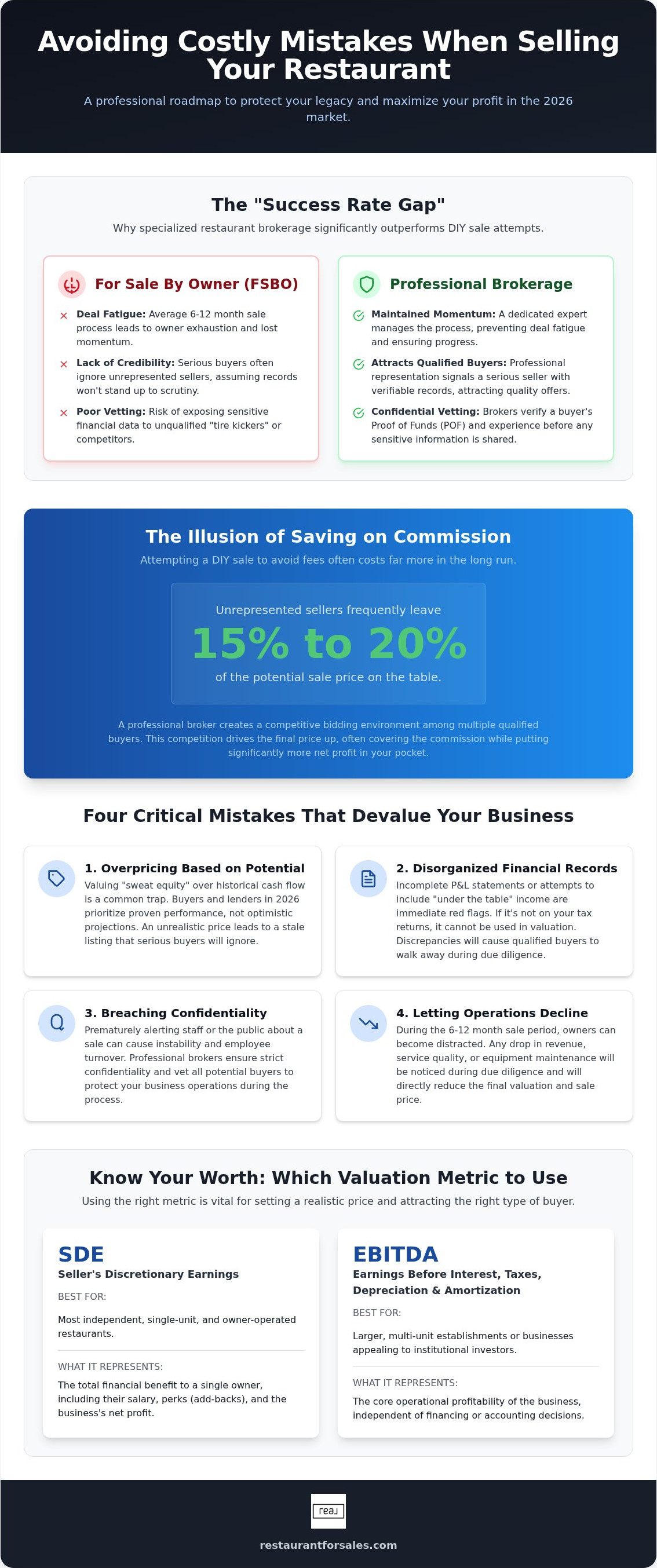
Selling a restaurant is a full-time job that requires a specific expertise most owners haven't developed. While 91% of operators rate their business health as good or excellent in 2026, translating that health into a successful sale is where many stumble. The "Success Rate Gap" between For Sale By Owner (FSBO) attempts and broker-led transactions is significant. Unrepresented sellers often face a steep learning curve that leads to one of the most common mistakes to avoid when selling a restaurant: failing to close the deal due to simple exhaustion.
Professional facilitators prevent the deal fatigue that often plagues long-tail commercial transactions. When a sale drags on for six to twelve months, an owner's attention naturally drifts back to daily operations, causing the deal to lose momentum. Buyers often ignore unrepresented sellers entirely. They view a lack of professional vetting as a sign that the seller isn't serious or that the business records won't stand up to scrutiny. A buyer needs to know that the transaction is being handled by a professional who understands the mechanics of a high-value exit.
Owners frequently fall into the psychological trap of valuing sweat equity over actual market data. While you've put years of effort into your brand, a buyer is strictly purchasing future cash flow and tangible assets. Gaining a realistic perspective starts with understanding business valuation through a lens of professional multiples rather than personal sentiment. If your price isn't grounded in current market reality, your listing will likely sit dormant until it becomes stale.
The Illusion of Saving on Commission
Many owners attempt a DIY sale to avoid brokerage fees, but this strategy often backfires. Unrepresented sellers frequently leave 15% to 20% of the potential sale price on the table because they don't know how to create a competitive bidding environment. A specialized broker manages the marketplace to ensure multiple qualified parties are interested. This competition drives the price up, often covering the commission cost while putting more net profit in the seller's pocket. Professional representation also filters out tire kickers who lack the capital to close, ensuring you only spend time on viable offers.
Vetting Buyers Before Sharing Data
Sharing sensitive financial records with unqualified individuals is a dangerous move. Without a broker to act as a buffer, you risk exposing your tax returns and lease terms to competitors or people who are just curious. Professional brokers verify a buyer's Proof of Funds (POF) and industry experience before a single document is exchanged. This vetting process protects your confidentiality and keeps your emotions out of the negotiation. It's one of the primary mistakes to avoid when selling a restaurant; don't let a lack of professional screening compromise your business's security.
Valuation and Financial Record Pitfalls: Where Sellers Lose Money
Accuracy in financial reporting is the cornerstone of a successful exit. One of the most frequent mistakes to avoid when selling a restaurant is overpricing the business based on future potential rather than historical performance. While you may see untapped growth, buyers and lenders in 2026 are risk-averse. They prioritize proven cash flow over optimistic projections. If your records are incomplete or disorganized, they serve as immediate red flags that can derail a deal during the due diligence phase.
Clean Profit and Loss (P&L) statements are non-negotiable. Many owners attempt to include "under the table" income in their internal calculations to justify a higher price. This is a tactical error. If income isn't reported on your tax returns, it cannot be included in a professional valuation or considered by a bank for buyer financing. Discrepancies between your internal books and your tax filings will likely cause a qualified buyer to walk away.
SDE vs. EBITDA: Which Metric Defines Your Worth?
Most independent restaurants sell based on a multiple of Seller's Discretionary Earnings (SDE). This metric represents the total financial benefit to a single owner-operator, including their salary and perks. In contrast, larger or multi-unit establishments typically use EBITDA to appeal to institutional investors. Understanding which metric applies to your specific business model is vital for a realistic valuation. For a deeper dive into these methodologies, review our 2026 Restaurant Valuation Guide for Owners and Buyers.
| Metric | Typical Business Type | Primary Focus |
|---|---|---|
| SDE | Owner-operated, single-unit locations | Total cash flow available to one owner. |
| EBITDA | Multi-unit, investor-owned, or managed-run | Operating profitability before financial deductions. |
Normalization of Financial Statements
Your financial statements must be normalized to reflect the true earning power of the business. This process involves "adding back" one-time expenses or personal items that won't carry over to the new owner. However, a common error is failing to account for a market-rate manager's salary if you currently run the daily operations yourself. Buyers need to see what the profit looks like if they aren't working 60 hours a week on the floor.
Preparing for 2026 SBA loan audit requirements is essential for a smooth transition. With SBA 7(a) interest rates currently ranging from 9.75% to 14.75%, buyers require impeccable documentation to secure financing. Clean books help you navigate these hurdles and avoid the common mistakes to avoid when selling a restaurant. If you're unsure where your financials stand, securing professional restaurant valuation services can provide the clarity needed for a high-value exit.
Confidentiality and Lease Transfer Errors That Kill Deals
Confidentiality is the lifeblood of a successful transaction. If word leaks that a sale is pending, the business often suffers immediate and measurable damage. Staff members, fearing for their job security, may begin looking for new employment before the deal closes. Competitors might use the news to poach your loyal customer base or spread uncertainty among your suppliers. This "Leak Effect" can cause a sudden dip in revenue, which then gives the buyer leverage to renegotiate the price or walk away entirely. Protecting your legacy requires an airtight Non-Disclosure Agreement (NDA) before any sensitive details are shared. Don't rely on a handshake or a generic template; you need a document that specifically protects your proprietary recipes, staff lists, and financial data.
Managing the 'Quiet Sale' Strategy
A professional approach involves marketing the business through "blind listings." These descriptions highlight the restaurant's strengths, such as its high-traffic location or specialized equipment, without revealing the name or exact street address. All initial buyer inquiries should be handled through a secure portal to maintain a layer of separation. When it comes to physical inspections, the proper protocol is to show the restaurant after hours or during days when the business is closed. This prevents staff and customers from sensing a change in ownership. You should only inform key staff members about the transition once a firm commitment is in place and the due diligence period is nearly complete. This is one of the most critical mistakes to avoid when selling a restaurant, as early disclosure almost always leads to operational instability.
The Lease Assignment Hurdle
Your lease is often as valuable as your kitchen equipment. A "weak" lease, such as one with less than five years remaining or no renewal options, can make an otherwise profitable business unsellable. Landlords act as the final gatekeeper in most transactions. One of the common mistakes to avoid when selling a restaurant is ignoring "assignment with consent" clauses until the final stages of the deal. In the 2026 market, landlords are increasingly selective about tenant credit scores and previous industry experience. Preempting these objections by preparing a professional buyer profile can save months of delays. If you don't address the lease terms early, you risk the landlord demanding a rent increase or a hefty assignment fee that eats into your profit. For detailed strategies on navigating this process, consult our Understanding Restaurant Lease Assignments guide to ensure a smooth transfer of the premises.
Operational and Timing Mistakes: Maintaining Value During the Exit
The decision to sell often brings a sense of relief, but mentally checking out too early is a dangerous trap. This "Foot Off the Gas" syndrome is one of the most frequent mistakes to avoid when selling a restaurant. If your revenue slips during the six to twelve months it takes to finalize a transaction, you provide the buyer with significant leverage to renegotiate the purchase price. Buyers look for stability and growth. A sudden dip in sales or a decline in social media engagement suggests the business is losing its momentum. You must continue to manage the operation as if you plan to keep it for another decade.
Neglecting equipment maintenance during the listing period is another costly error. A buyer who discovers a leaking walk-in cooler or a non-functional hood system during due diligence will likely demand a repair credit that far exceeds the actual cost of the fix. It's also vital to secure your key vendor contracts and ensure all permits are transferable. If a buyer realizes they'll have to re-apply for a difficult liquor license or lose a favorable food supply rate, the deal's perceived value drops instantly. Maintaining these relationships ensures a smooth transition and protects your final payout.
Operational Readiness for Due Diligence
A buyer's first walkthrough often dictates the tone of the entire negotiation. A messy kitchen or deferred maintenance in the dining area signals that the owner has stopped caring. This lack of pride in the facility often leads to more rigorous financial scrutiny. To prepare, ensure all health department permits are in good standing and your equipment inventory list is fully up to date. In 2026, 39% of operators are focusing on tighter inventory management to combat inflation. Showing a buyer that you have a disciplined, lean system in place proves the business is efficient and ready for a new owner to take over without immediate capital expenditures.
The Impact of Market Timing in 2026
Timing the market requires looking at external economic factors alongside your internal sales. As of August 2026, the Wall Street Journal Prime Rate sits at 6.75%, making SBA 7(a) loan interest rates range from 9.75% to 14.75%. These high rates reduce buyer purchasing power, meaning your business must be performing at its peak to justify a high valuation multiple. Selling during a seasonal low point or waiting until the business is already declining are critical mistakes to avoid when selling a restaurant. "Selling on a high" is the only way to maximize your exit value in a high-interest environment. If you want to ensure your business is ready for the market, our restaurant brokerage services can help you identify the optimal window for your exit.
Choosing the Right Brokerage Strategy for a Successful Exit
Selecting a general business broker is one of the subtle mistakes to avoid when selling a restaurant. While a generalist might understand basic financial statements, they often lack the technical depth required to navigate the complexities of the hospitality industry. A restaurant specialist understands prime costs, labor percentages, and the specific hurdles of municipal health permits. They speak the language of operators and can translate your business value to a buyer in a way a generalist cannot. Properly vetting your representation helps you sidestep the common mistakes to avoid when selling a restaurant.
Alignment of interest is critical for a smooth transition. Success-based commissions ensure that your broker is fully invested in achieving the highest possible sale price. Unlike models that rely on heavy upfront retainers, this structure means the broker only gets paid when you do. It creates a partnership based on results rather than promises. By utilizing a national marketplace, you also gain access to a wider pool of qualified buyers than a local listing could provide. This increased exposure often leads to multiple offers, giving you the leverage needed for a high-value exit.
The Value of an Industry Specialist
A specialist understands the granular details of your operation. They effectively communicate the value of your leasehold improvements and the stability of your supply chain to prospective investors. You can learn more by reading about The Role of a Restaurant Broker in Your Business Sale. Their expertise is particularly valuable when managing lease assignments and coordinating with lenders for SBA financing. They know how to present your financials to ensure a buyer's loan is approved even in a high-interest environment.
Preparing for the Closing Table
The final stages of a sale require meticulous coordination. Last-minute surprises in the Asset Purchase Agreement (APA) can cause a deal to collapse just days before the scheduled handover. Your broker manages the escrow process and ensures all contingencies are met. This includes verifying that all equipment is in the promised condition and that the landlord has provided written consent for the lease transfer. Before signing a listing agreement, use this final checklist to ensure you're ready for the market:
- Review the final inventory list to ensure accuracy and functionality.
- Confirm the transferability of all third-party delivery contracts and software licenses.
- Ensure all utility accounts are scheduled for final readings and transfer on the closing date.
- Verify that the buyer has secured all necessary insurance policies required by the lease terms.
Following a disciplined brokerage strategy ensures that your exit is handled with the same professionalism you used to build the business. By choosing a partner who understands the specific 2026 market trends, you can secure a clean break with the maximum profit you've earned.
Securing Your Legacy and Maximizing Your Exit Value
Selling your business is the culmination of years of hard work. Success in the 2026 market requires more than just a listing; it demands a disciplined approach to valuation, confidentiality, and operational consistency. By understanding the critical mistakes to avoid when selling a restaurant, you position yourself to navigate complex lease assignments and rigorous financial audits with total confidence. Professional representation bridges the gap between a stagnant listing and a successful, high-value closing.
You don't have to manage this transition alone. Our platform provides national marketplace exposure and expert lease assignment management to ensure your transaction is handled with precision. Because we operate on success-based commissions, our goals are directly aligned with your final financial outcome. We provide the stability and expertise needed to protect your profit and your reputation during the entire process.
Get a Professional Restaurant Valuation and Start Your Exit Strategy Today
Your next chapter is waiting. Take the first step toward a clean break and a profitable future by choosing a partner that understands the specific demands of the hospitality industry.
Frequently Asked Questions
How long does it typically take to sell a restaurant in 2026?
In the 2026 market, it takes an average of six to twelve months to sell a restaurant. This timeline accounts for the time needed to market the listing, vet potential buyers, and complete the due diligence process. Additionally, the landlord's approval for a lease assignment and the buyer's financing through the SBA can add several months to the schedule. Preparing your financial records in advance is the best way to shorten this duration.
Can I sell my restaurant without my employees finding out?
Maintaining confidentiality is a primary concern for most owners. You can successfully market your business without alerting staff or competitors by using blind listings and strict Non-Disclosure Agreements. Professional brokers manage this process by vetting every inquiry before any identifying information is released. One of the major mistakes to avoid when selling a restaurant is early disclosure, which can lead to immediate staff turnover and a decline in customer confidence.
What is the difference between an asset sale and a stock sale in a restaurant?
Asset sales are the most common structure for restaurant transactions, governed by IRC Section 1060. In an asset sale, the buyer purchases specific items like equipment, inventory, and goodwill, while the seller retains the corporate entity. This provides the buyer with tax benefits through depreciation. Conversely, a stock sale involves the transfer of the entire entity, including all liabilities, which is generally less favorable for buyers in the hospitality industry.
Do I need a formal valuation before listing my restaurant for sale?
A formal valuation is essential before listing to ensure your asking price is grounded in market reality. Professional valuation services analyze your Seller's Discretionary Earnings (SDE) or EBITDA against current industry multiples. Listing without a professional appraisal often leads to overpricing, which can cause your business to sit on the market until it becomes a stale listing. Starting with an accurate number builds trust with qualified buyers and speeds up the due diligence process.
How much is the typical commission for a restaurant broker?
Commissions for specialized restaurant brokers are typically structured as a percentage of the final transaction value. This success-based model ensures your broker is fully invested in achieving the highest possible price for your business. Because the fee is only paid upon a successful closing, it aligns the interests of the facilitator with the seller's goals. This structure covers the end-to-end management of the sale process, including marketing, buyer vetting, and lease coordination.
What happens to my liquor license when I sell the business?
Liquor license transfers vary by jurisdiction but are typically handled through an escrow process during the sale. The license is usually considered a valuable asset that is transferred to the buyer as part of the asset purchase agreement. It's vital to ensure the buyer meets all character and fitness requirements early in the process. Delays in license transfers can postpone the closing date, so proactive management of this step is necessary for a smooth transition.
Is it a mistake to sell my restaurant during the winter months?
Selling during the winter isn't necessarily one of the mistakes to avoid when selling a restaurant if your annual financials are strong. Buyers prioritize trailing twelve-month performance over single-season fluctuations. While some operations see a dip in revenue during colder months, others benefit from holiday catering and events. The key is to provide a comprehensive financial picture that shows consistent year-over-year growth. A well-timed listing depends more on your business health than the calendar month.
How do 2026 SBA loan rules affect my ability to find a buyer?
As of August 2026, the Wall Street Journal Prime Rate is 6.75%. This base rate influences SBA 7(a) loans, which currently feature maximum interest rates between 9.75% and 14.75% depending on the loan size. These higher borrowing costs mean buyers have less purchasing power than in previous years. Sellers must provide impeccable financial records to help buyers qualify for financing at these rates, ensuring the deal moves toward a successful closing and a clean transition.


