

The most profitable restaurant sales are won during the audit phase, not at the negotiation table. If you're wondering how to prepare a restaurant for sale in 2026, you likely feel the weight of several competing priorities. You want to maximize your cash-in-hand at closing while keeping the process confidential from staff and competitors. It's common to feel uncertain about your true business value, especially if your financial records aren't as organized as they should be.
We understand that your restaurant represents years of hard work and significant personal investment. To ensure a smooth transition to a qualified buyer, you need a disciplined approach that prioritizes transparency and operational efficiency. This guide provides a masterclass in the tactical steps required to audit your financials, streamline your daily operations, and leverage current tax laws like the One Big Beautiful Bill Act to increase your market value. We'll walk through professional valuation methods, lease assignment strategies, and the essential documentation needed to secure buyer financing in today's market.
Key Takeaways
- Learn how to align your tax returns with P&L statements to maximize Seller’s Discretionary Earnings (SDE) and justify a higher valuation.
- Master the tactical steps of how to prepare a restaurant for sale by utilizing a three-pillar valuation approach that accounts for assets, income, and lease longevity.
- Increase your market multiple by documenting Standard Operating Procedures (SOPs) to transition from an owner-dependent business to a turnkey acquisition.
- Implement a strict confidentiality protocol using blind listings to protect staff morale and vendor relationships throughout the marketing phase.
- Evaluate the strategic benefits of specialized brokerage services to navigate complex lease assignments and franchise resales for a high-value exit.
Financial Reconstruction: Auditing Your Books for Maximum SDE
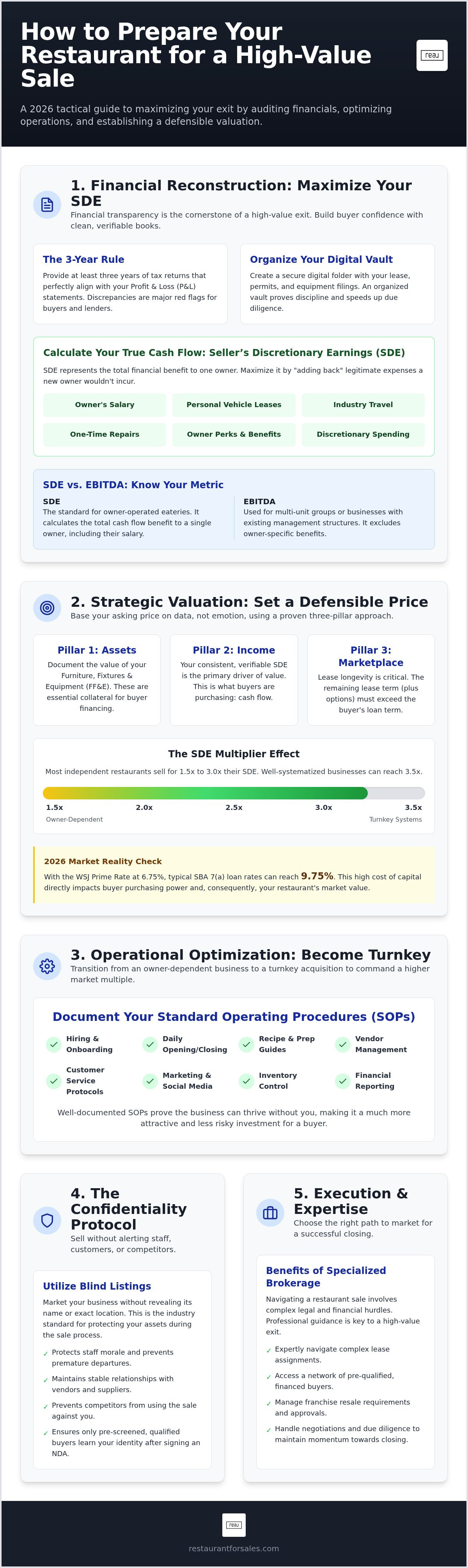
Financial transparency is the cornerstone of a high-value exit. When you begin learning how to prepare a restaurant for sale, your first priority must be a rigorous internal audit of your financial history. Buyers and lenders in 2026 demand at least three years of tax returns that align perfectly with your Profit and Loss (P&L) statements. Discrepancies in these documents often signal mismanagement or hidden liabilities. Such inconsistencies can derail a deal before it ever reaches the letter of intent phase.
Maximizing your sale price requires identifying your Seller's Discretionary Earnings (SDE). This process involves "adding back" legitimate business expenses that a new owner might not incur or that primarily benefit the current owner. Common restaurant add-backs include personal vehicle leases, travel to industry conferences, and non-recurring repairs like a one-time roof fix or walk-in cooler replacement. By formalizing these add-backs, you present a truer picture of the total cash flow available to a buyer. Additionally, clean up your balance sheet by reconciling inventory and addressing aging equipment. A kitchen full of functional, well-maintained gear is a selling point; a basement of obsolete inventory is a liability that suggests poor cost control.
SDE vs. EBITDA: Which Metric Matters for Your Sale?
The metric you use depends largely on the scale of your operation. SDE is the standard for owner-operated eateries where the proprietor manages daily tasks. It accounts for the total financial benefit to a single owner, including their salary and perks. Conversely, EBITDA (Earnings Before Interest, Taxes, Depreciation, and Amortization) is the primary metric for multi-unit groups or larger corporate structures where management is already in place. In 2026, buyers are increasingly risk-averse. They prioritize clean, verifiable cash flow over speculative growth projections. Understanding these business valuation methods ensures you don't leave money on the table by misapplying a multiple to the wrong earnings figure.
Organizing the 'Due Diligence' Digital Vault
Preparation is the best antidote to deal fatigue. Create a secure digital folder containing your lease agreement, current health permits, and equipment UCC filings. An organized vault builds immediate buyer confidence. It proves you run a disciplined operation. Use this space to highlight your competitive advantages, such as food cost percentages that beat industry averages or optimized labor schedules. When a buyer sees well-documented records, they perceive less risk. This clarity speeds up the due diligence process and helps you maintain momentum toward a successful closing. Master the details of how to prepare a restaurant for sale now to avoid frantic document hunting later.
Strategic Restaurant Valuation: Establishing a Defensible Asking Price
A successful exit requires more than a gut feeling. When determining how to prepare a restaurant for sale, you must build a valuation based on defensible data rather than emotional attachment. We utilize a three-pillar approach that examines your hard assets, consistent income, and the current national marketplace. This structure ensures your asking price aligns with what the 2026 market will actually bear, providing a clear roadmap for both you and potential buyers.
The "Multiplier Effect" is a critical concept in this phase. Most independent restaurants in the United States currently sell for 1.5 to 3 times their Seller's Discretionary Earnings (SDE). A concept with high customer retention and automated systems might command a 3.5x multiple, while an owner-dependent bistro might struggle at 1.5x. Your lease terms also play a defining role. A buyer cannot secure long-term financing if the remaining lease options don't exceed the loan term. Additionally, the value of your furniture, fixtures, and equipment (FF&E) must be documented accurately. These assets provide essential collateral for the buyer's lender and justify the physical component of your asking price.
Market-Based Valuation Methods in 2026
Buyers in 2026 are highly sensitive to the cost of capital. With the Wall Street Journal Prime Rate at 6.75%, SBA 7(a) loan rates for amounts over $350,000 can reach 9.75%. This interest rate environment directly impacts purchasing power and, by extension, your business's market value. Using a 2026 restaurant valuation guide helps you set a baseline that accounts for these macroeconomic shifts. It's also vital to understand the IRS guidelines on selling a business to prepare for the tax allocation of your sale price between goodwill and tangible assets.
The Intangible Value: Brand, Reputation, and Goodwill
Your restaurant's reputation is a quantifiable asset. A consistent 4-star or higher review profile and a robust loyalty program database add significant "goodwill" value to the transaction. Proprietary recipes and trade secrets also contribute to a premium price, as they ensure the brand's continuity after you depart. Because these factors are often subjective, a professional appraisal is your best defense against lowball offers. If you want an objective look at your business's worth, consider our restaurant valuation services to ensure you don't leave money on the table during negotiations.
Operational Optimization: Creating a Turnkey Acquisition
A turnkey operation is the gold standard for 2026 buyers. When you evaluate how to prepare a restaurant for sale, you must view your business as a product rather than a personal project. Buyers are looking for a functional system, not a platform that requires their constant physical presence. This is why "absentee-run" restaurants consistently sell for higher multiples than owner-dependent ones. If the business cannot survive without your specific culinary skills or personal relationships, it represents a high-risk investment for an acquirer. Shifting your role from daily operator to high-level manager before listing is a strategic move that directly impacts your final sale price.
Start by documenting Standard Operating Procedures (SOPs) for every station, from the host stand to the dish pit. These manuals act as the "operating system" for your successor. Simultaneously, perform a tech stack audit. Ensure your point-of-sale (POS) and inventory management software are up to date and ready for immediate transfer. Modern buyers value data-driven operations; having clean digital records of labor costs and inventory turnover makes your business more attractive. Don't overlook physical "curb appeal" either. Small repairs like fresh paint, updated lighting, or professional upholstery cleaning offer a high ROI by improving the buyer's first impression during initial tours.
Documenting the 'Institutional Knowledge'
Your recipes are intellectual property. Create a comprehensive recipe book that includes exact Cost of Goods Sold (COGS) for every menu item. This level of detail proves your margins are sustainable and repeatable. Pair this with staff training manuals and a clear succession plan for key management roles. Understanding the how to buy a restaurant mindset helps you anticipate the acquirer’s concerns during the transition. If a buyer sees that the staff is well-trained and the recipes are codified, they will feel much more confident in the business's longevity.
Lease and Real Estate Preparation
The lease is often the most complex part of a transaction. Review your agreement for "assignment" clauses and landlord consent requirements early in the process. If you own the property, consider the benefits of investing in a restaurant with real estate versus selling a leasehold interest alone. Real estate adds significant collateral and stability to the deal. If you are a tenant, pre-negotiating lease extensions or options can make the business more "bankable" for SBA loans. Lenders typically require the lease term to match or exceed the loan duration. Securing these terms now is a vital step in learning how to prepare a restaurant for sale effectively.
The Confidentiality Protocol: Selling Without Alerting the Public
Maintaining secrecy is the most challenging aspect of learning how to prepare a restaurant for sale. Premature disclosure often triggers a cascade of negative events, including key employee turnover and vendor panic. If staff believe their jobs are at risk, they may seek employment elsewhere, which immediately devalues the business during the vetting phase. To prevent this, professional brokers use "Blind Listings." These advertisements highlight the restaurant's concept, financial performance, and general location without revealing the specific name or address. This approach attracts qualified leads while keeping your identity shielded from the general public.
A robust Non-Disclosure Agreement (NDA) is your primary legal defense. Every potential buyer must sign this document before receiving any sensitive information, such as your P&L statements or tax returns. However, an NDA is only effective when paired with a professional "Deal Team." This group, typically consisting of your broker, accountant, and attorney, understands the need for total discretion. They ensure that communication remains controlled and that the sale process does not interfere with daily operations.
Managing the Information Flow
Timing is everything. You don't need to tell your entire staff about the sale until the deal is nearly closed. However, you might utilize a "Closer" strategy by informing one key manager who can help facilitate inspections in exchange for a stay-on bonus. Conducting walkthroughs after-hours or on days when the restaurant is closed prevents suspicion from regular employees and customers. Additionally, understanding restaurant lease assignments protects your privacy during landlord negotiations, as it allows you to frame the discussion as a strategic long-term planning session rather than an immediate exit.
Vetting Buyers Before Sharing Financials
Protect your time by identifying "tire-kickers" early. Require a Proof of Funds (POF) and a professional resume from every inquiry before sharing the digital vault mentioned in previous sections. Institutional investors and serious individuals will expect this level of scrutiny. A broker acts as a vital buffer, vetting candidates so you only meet with those who have the capital and experience to close. If you need assistance managing this delicate process, our restaurant brokerage services provide the anonymity and expertise required for a silent, high-value transition. Knowing how to prepare a restaurant for sale includes knowing who to trust with your data.
Execution: Choosing Your Path to Market and Closing the Deal
Deciding on a sales channel is the final strategic hurdle in how to prepare a restaurant for sale. While some owners consider the For Sale By Owner (FSBO) route to save on commission, they often underestimate the cost of their own time and the complexity of vetting buyers. Managing inquiries while maintaining daily operations is a recipe for burnout and often leads to lower final offers. A specialized professional understands that the role of a restaurant broker is to act as a proactive facilitator, securing higher closing prices through competitive bidding environments that typically offset the commission cost.
Once a qualified buyer is identified, the process moves from a non-binding Letter of Intent (LOI) to a definitive Purchase Agreement. This legal transition requires precision to ensure that all assets, including lease assignments and equipment titles, are transferred correctly. A standard closing also includes a defined training period. Typically, the seller remains on-site for two to four weeks to ensure the new owner understands the proprietary systems and staff dynamics established in earlier preparation phases. This transition period is essential for maintaining the "goodwill" value you worked hard to build.
Selecting the Right Marketplace
Specialized marketplaces are more effective than general business-for-sale websites because they attract a concentrated pool of industry-specific investors. These platforms are particularly valuable when seeking buyers for franchise resale opportunities, where the buyer must also meet strict franchisor qualifications. Utilizing a national marketplace with success-based commissions ensures that the broker's interests are perfectly aligned with yours; they only profit when you achieve a successful, high-value exit. This alignment is crucial for navigating the high-stakes environment of 2026 commercial transactions.
Closing Day and Beyond
Closing day involves more than just a signature. It requires a final physical inventory count of food and beverage stock on the eve of the transfer to adjust the final payout. Escrow management handles the secure transfer of funds while you execute the "Keys and Codes" handover. This includes providing the buyer with access to all POS systems, alarm codes, and digital marketing accounts. After the sale, consult with a financial advisor regarding the 2026 long-term capital gains tax rates, which can reach 20% for high-income filers. Proper post-sale planning is the final step in learning how to prepare a restaurant for sale and securing the maximum cash-in-hand from your life's work.
Securing Your Legacy and Maximizing Your Exit Value
Success in a 2026 transaction relies on the rigorous preparation of your financials and the codification of your daily operations. By maximizing your Seller's Discretionary Earnings (SDE) and establishing turnkey systems, you shift the business from being owner-dependent to a high-value acquisition target. Understanding how to prepare a restaurant for sale is the vital first step toward a clean, high-value closing that protects your confidentiality while attracting serious buyers.
To ensure you don't leave money on the table, partner with a team that offers expert appraisal services and a national reach to qualified leads. List your restaurant with the experts at Restaurant For Sale Marketplace to leverage our success-based commissions and connect with investors ready to close. Your years of hard work deserve a transition that reflects the true value of your brand. With the right preparation and professional facilitation, you can achieve the disciplined, profitable exit you've earned.
Frequently Asked Questions
How long does it typically take to prepare a restaurant for sale in 2026?
Preparation usually takes three to six months before listing to ensure all financial audits and operational manuals are complete. Once listed, the average time on the market for a restaurant ranges from 6 to 18 months. Starting early is essential for how to prepare a restaurant for sale because it allows you to correct any financial discrepancies that might lower your valuation. A rushed preparation often leads to a lower multiple during the negotiation phase.
Can I sell my restaurant if I have less than two years of financial records?
You can sell a restaurant with limited records, but it significantly restricts your pool of potential buyers. Most SBA lenders require at least two to three years of clean tax returns to approve a loan for an acquirer. Without these records, you may be forced to offer seller financing or accept a lower cash offer from an asset-only buyer. Consistent cash flow documentation is the most effective way to justify a premium asking price.
What is the average commission for a professional restaurant broker?
Specialized restaurant brokers typically charge a commission between 10% and 12% of the final sale price. This rate is higher than general business brokerages because of the complexity involved in liquor license transfers and lease assignments. Many professional firms also maintain a minimum fee, often ranging from $15,000 to $25,000. These fees are success-based, meaning the broker only receives payment when the transaction successfully closes at the escrow stage.
How do I value my restaurant equipment versus the business as a whole?
Equipment is valued as tangible assets based on its current market value or replacement cost. The business as a whole is valued using a multiple of its earnings, typically 1.5 to 3 times the Seller's Discretionary Earnings (SDE). While the equipment provides collateral for a buyer's loan, the income-generating potential of the brand is what drives the final sale price. A professional appraisal ensures you account for both tangible and intangible assets correctly.
Should I tell my landlord I am selling before I find a buyer?
You should generally wait until you have a signed Letter of Intent (LOI) and have vetted the buyer's financial capability. Prematurely notifying a landlord can lead to unnecessary complications or even a refusal to renew your lease if they suspect a change in tenancy. Once you have a qualified buyer, you can approach the landlord with a formal request for a lease assignment. This strategy maintains your operational stability while protecting your confidentiality during the marketing phase.
What happens to my staff after the restaurant is sold?
In most restaurant transactions, the staff remains with the business to ensure operational continuity and preserve brand goodwill. Buyers typically want a turnkey operation where the existing team is already trained on recipes and service standards. You should plan a communication strategy to inform employees only after the deal is finalized. Keeping the team in place is a major selling point that can help you how to prepare a restaurant for sale effectively.
Is it better to sell a restaurant as an asset sale or a stock sale?
Most restaurant transactions are structured as asset sales rather than stock sales. An asset sale allows the buyer to pick specific assets like equipment and goodwill while avoiding the historical liabilities of your corporation. This structure also provides tax benefits for the buyer through 100% bonus depreciation, which was made permanent by the 2025 tax laws. Stock sales are generally reserved for very large multi-unit groups or complex corporate structures with significant tax advantages.
How do I handle a lease assignment if the landlord is being difficult?
Difficult lease assignments are best handled by a specialized restaurant broker who understands the legal nuances of your agreement. If a landlord is being uncooperative, you may need to offer a personal guarantee from the new buyer or show proof of their operational experience. Professional facilitators bridge the gap between the landlord's desire for a stable tenant and your goal of a clean exit. Pre-negotiating lease options before listing can also prevent these issues from arising.


