

Did you know that the median sale price for an eatery for sale in the first half of 2026 reached $205,000, with businesses typically closing at 90.3% of their asking price? With the National Restaurant Association projecting industry sales to hit $1.1 trillion this year, the opportunity for acquisition is massive, but so is the risk of overpayment. It's common to feel overwhelmed by the volume of listings or confused by the technical gap between SDE and EBITDA. You're likely looking for a turnkey operation that generates immediate cash flow, not a failing project that drains your capital.
We understand that the transition from browsing listings to signing a closing statement requires more than just passion; it requires a scientific approach to due diligence. This guide provides a comprehensive framework to help you identify, vet, and acquire a profitable restaurant with total confidence. We'll walk you through professional valuation techniques, lease assignment strategies, and the latest 2026 regulatory requirements. By the end of this article, you'll have a clear roadmap to evaluate the current market and successfully secure a business that aligns with your professional goals.
Key Takeaways
- Learn to distinguish between turnkey operations, asset sales, and franchise resales to determine which acquisition model best fits your investment goals.
- Identify the "big three" financial metrics, including Revenue and Rent-to-Sales ratios, to accurately vet any eatery for sale for long-term profitability.
- Discover how to spot common "red flag" listings that omit critical data, protecting you from overpayment and high-risk business ventures.
- Master a structured step-by-step framework for managing NDAs and analyzing Offering Memorandums to move efficiently through the due diligence phase.
- Understand the role of professional brokerage and lease assignment expertise in securing a successful, turnkey business acquisition.
Understanding the Eatery for Sale Market in 2026
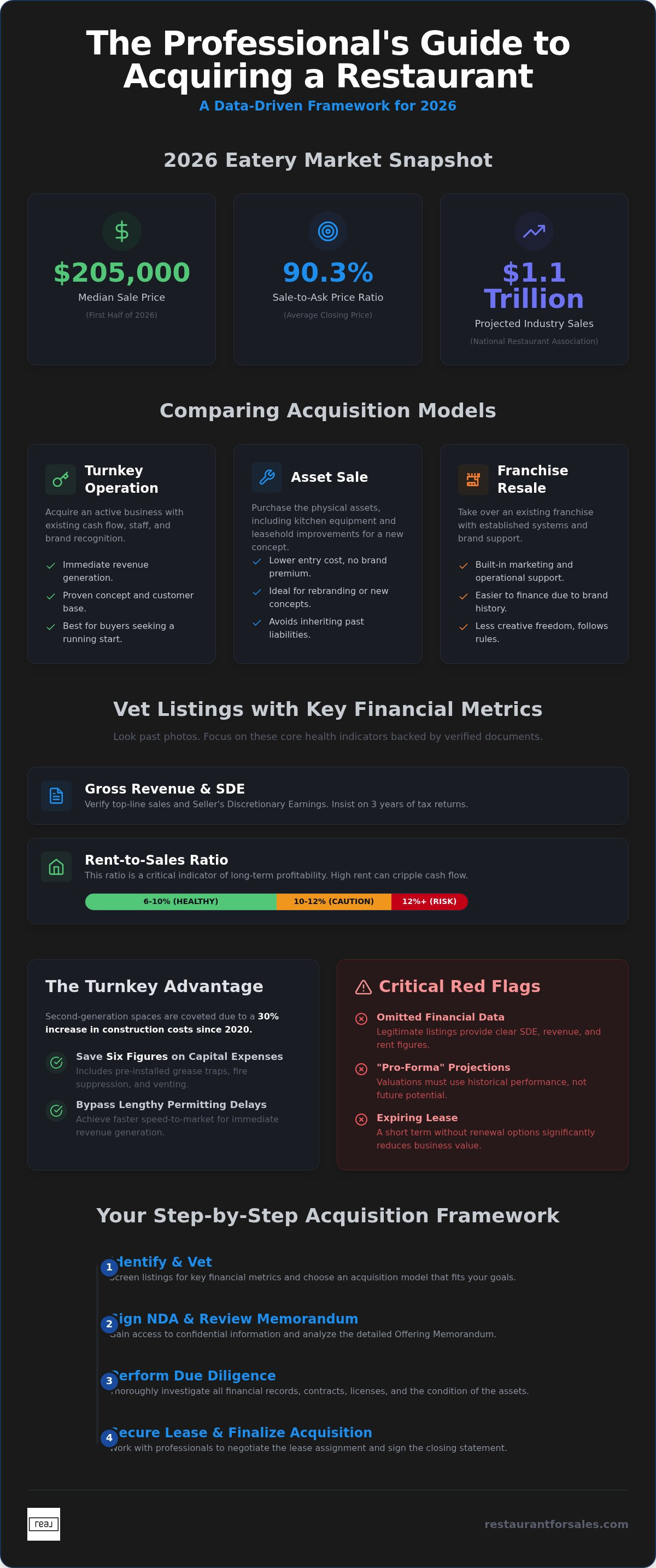
In the 2026 commercial landscape, an eatery for sale is viewed as a strategic asset rather than just a culinary venture. The market has shifted toward high-utility investments where the physical infrastructure often holds as much weight as the brand itself. Buyers must distinguish between three primary models: turnkey operations with active cash flow, asset sales consisting of equipment and lease rights, or franchise resales that offer established systems. This selection process mirrors the professional standards of mergers and acquisitions (M&A), requiring a disciplined investment thesis before the first listing is even viewed. You need to decide if you're buying a job, a passive investment, or a platform for expansion.
Second-generation spaces have become the most competitive segment of the market. These are locations that were previously built out as restaurants, meaning the heavy lifting of utility upgrades is already complete. In a market where speed to market is everything, these spaces allow for rapid rebranding and lower capital expenditures. Whether you're looking at a full-service dining room or a quick-service kiosk, the underlying lease terms and equipment condition are the true anchors of the valuation.
The Shift Toward Turnkey Investments
Current buyers are increasingly prioritizing existing infrastructure over new builds. This trend is driven by a 30% increase in non-residential construction costs since 2020, making second-generation spaces highly coveted. These locations come with pre-installed grease traps, fire suppression hoods, and specialized venting systems that can save a new owner six figures in startup capital. Opting for a turnkey restaurant for sale allows an entrepreneur to bypass the lengthy permitting delays that often plague new construction. It provides a direct path to immediate revenue generation while minimizing the "burn rate" typically associated with the first year of operation.
Market Drivers: Labor, Inflation, and Interest Rates
Economic conditions in 2026 have fundamentally changed how asking prices are calculated. With SBA 7(a) loan interest rates for amounts over $350,000 capped at 9.75% as of August 2026, debt service coverage is a critical factor in every deal. Buyers are no longer paying premiums for "blue sky" potential. They're paying for proven margins that can withstand inflationary pressure on food and labor costs. "In 2026, the value of an eatery for sale is determined as much by its operational efficiency as its menu." Successful acquisitions now require a focus on businesses that have already optimized their labor models and supply chains to meet new federal traceability requirements. Efficient operations are the only way to protect your ROI in a high-interest environment.
How to Evaluate a Restaurant Listing Beyond the Surface
Evaluating an eatery for sale requires looking past glossy photos and marketing copy to analyze the underlying data. Success in this market depends on your ability to verify the "big three" metrics: Gross Revenue, Seller’s Discretionary Earnings (SDE), and the Rent-to-Sales ratio. A healthy operation typically maintains a rent-to-sales ratio between 6% and 10%. If the rent exceeds this range, the business may struggle to remain profitable regardless of its popularity. Red flags often appear early; be wary of listings that omit critical financial data or rely solely on "pro-forma" projections. A legitimate investment is backed by three years of verified tax returns and a clear paper trail.
Location-agnostic factors also play a vital role in your assessment. Parking availability, street visibility, and the remaining term on the lease can dictate the long-term viability of the site. If a lease is expiring soon without options to renew, the business value drops significantly. You're not just buying a kitchen; you're buying a legal right to occupy a specific market position. For a deeper dive into these metrics, consult this SBA guide to buying a business to understand the standard due diligence requirements.
Decoding Financial Disclosures
Understanding the difference between SDE and EBITDA is essential for any serious buyer. SDE represents the total financial benefit to a single owner-operator, including salary and personal add-backs. EBITDA is generally reserved for larger, managed operations where the owner is not involved in daily tasks. Always request a Profit and Loss (P&L) statement during the initial inquiry phase. You can use our profitable restaurant for sale guide to compare these high-yield investments against industry benchmarks. If the numbers don't align with the tax returns, the asking price is likely inflated.
The Physical Inspection: What the Photos Don’t Show
A physical walkthrough is your opportunity to verify the condition of expensive infrastructure. Professional buyers often visit as a customer first to observe staff efficiency and cleanliness without the pressure of a formal tour. Once the official inspection begins, focus on these critical areas:
- HVAC and Refrigeration: Check the age and maintenance logs for walk-in coolers and rooftop units.
- Plumbing and Grease Traps: Ensure the grease trap meets current city codes and has been pumped recently.
- Equipment List: Cross-reference the provided asset list with the serial numbers on-site to ensure everything is owned, not leased.
If you're unsure about the equipment's remaining lifespan, utilizing professional valuation services can help you determine a fair market price based on actual asset conditions.
Comparing Acquisition Models: Business vs. Asset vs. Franchise
Choosing the right acquisition model for an eatery for sale depends on your operational experience and risk tolerance. A "Going Concern" sale involves purchasing the entire business entity, including its brand, staff, and existing cash flow. This is the ideal path for those seeking immediate profitability without the downtime of a rebranding phase. Conversely, an "Asset Sale" focuses on the physical infrastructure and lease rights. This model is preferred by experienced operators who want to implement a new concept while avoiding the high costs of a ground-up build-out. Reviewing key considerations when buying a business can help you determine which structure protects your capital best.
For investors seeking a more hands-off approach, the absentee owner restaurant for sale model offers a path to passive income. These businesses already have management teams in place, allowing the owner to focus on high-level strategy rather than daily shifts. However, these opportunities often command a higher multiple because the systems are already proven and self-sustaining. Success in this model requires a deep dive into labor costs and management retention rates.
The Pros and Cons of Franchise Resales
Franchise resales provide a middle ground between a startup and an independent turnkey operation. You benefit from established brand recognition and standardized operational systems from day one. However, these deals come with unique hurdles. Most franchisors require a transfer fee and may mandate a "refresh" or remodel of the premises to meet current brand standards. It's also critical to remember that the franchisor typically holds the "right of first refusal," meaning they can step in and buy the unit themselves if they don't approve of your qualifications as a buyer.
Lease Assignments and Real Estate Considerations
In many transactions, the lease is actually the most valuable asset being transferred. A restaurant lease assignment is a complex legal process where the landlord must approve the new tenant. Without a favorable lease with multiple renewal options, the business value can evaporate quickly. While most eateries occupy leased space, some buyers prefer listings that include the underlying property. Owning the building eliminates the risk of sudden rent hikes and provides a secondary layer of asset appreciation, though it requires a significantly higher initial investment and different financing structures.
Step-by-Step: The Process of Buying an Existing Eatery
Acquiring an eatery for sale is a methodical process that moves from initial inquiry to final possession through five distinct stages. First, you must complete financial qualification and sign a Non-Disclosure Agreement (NDA). Sellers require proof of liquid capital and professional experience before releasing sensitive operational data. Once cleared, you'll receive the Offering Memorandum (OM), a comprehensive document detailing the business's history, financial performance, and lease terms. Analyzing this document allows you to determine if the asking price aligns with the market multiples and cash flow requirements discussed earlier.
After your initial analysis, you'll move to Step 3: submitting a Letter of Intent (LOI). This document outlines your proposed price and terms. It's critical to include contingencies for third-party financing, landlord consent for lease assignment, and a satisfactory due diligence period. If the seller accepts the LOI, you enter the formal due diligence phase to verify every claim made in the OM. Finally, the process concludes with a formal closing and a structured transition period to ensure operational continuity. To ensure you have professional support throughout this complex journey, consider engaging our restaurant brokerage services to manage the paperwork and negotiations.
Navigating the Due Diligence Phase
The due diligence phase is where you confirm the business's actual health. You'll need to examine three years of federal tax returns, monthly sales tax filings, and current vendor contracts. A first time restaurant buyer should hire a CPA specializing in the hospitality industry to assist with this review. Your goal is to verify "add-backs" in the SDE calculation, ensuring that personal expenses or one-time costs are accurately represented. If the books don't match the bank statements, you have the right to renegotiate the price or walk away from the deal entirely.
Closing the Deal and Transition
Once the books are verified and the lease is secured, the transaction moves to escrow. An independent escrow agent handles the proration of rent, utilities, and taxes while ensuring all liens are cleared before the title transfers. A critical part of this final stage is the training period, which is typically included in the purchase price. This period allows you to learn proprietary recipes, POS systems, and staff management nuances without disrupting service. "A successful closing is one where the staff and customers don’t even notice the ownership change on day one." Mastering this transition is just as important as the financial audit itself.
Leveraging Professional Brokerage to Secure Your Investment
Engaging a specialist broker is one of the most strategic moves a buyer can make when searching for an eatery for sale. In the majority of commercial transactions, the seller pays the success-based commission, which means you receive professional representation and market expertise at no direct cost. A broker does more than just present listings; they act as a disciplined project manager for the entire how to buy a restaurant roadmap. They bridge the technical gap between your investment goals and the seller's exit requirements, ensuring that the momentum of the deal remains steady from the initial inquiry to the final signature.
One of the most overlooked benefits of professional brokerage is the management of the "emotional gap." Business owners often have deep personal ties to their establishments, which can lead to friction during the negotiation of price or lease terms. A broker facilitates objective, data-driven communication that prevents a deal from collapsing over minor disagreements. Additionally, a national marketplace platform provides access to "off-market" or pocket listings. These are high-value opportunities where the seller requires total confidentiality to protect staff morale and customer loyalty, making them invisible to the general public.
Valuation and Financing Support
Determining if an asking price is fair requires access to real-time market data. Brokers utilize recent sales statistics, such as the 2.41 average cash flow multiple seen in the first half of 2026, to verify if a listing is priced accurately. They also maintain deep connections with specialized restaurant lenders who understand the nuances of SBA 7(a) and 504 loans. Beyond the numbers, having a professional manage the complex lease assignment paperwork is essential. They ensure that the landlord's requirements are met and that the transfer of occupancy rights doesn't become a bottleneck that delays your opening day.
Maintaining Confidentiality
Confidentiality is the cornerstone of a successful restaurant sale. If employees or competitors learn about a potential transfer prematurely, it can destabilize the business and diminish the value of your investment. Brokers implement a rigorous vetting process, requiring all prospects to sign NDAs and provide proof of funds before any sensitive financial information is released. This protective layer ensures that only qualified, serious buyers gain access to the operational details. When you're ready to move from research to action, you can Browse current restaurant listings and find your next opportunity today.
Securing Your Future in the 2026 Restaurant Market
Success in acquiring a profitable eatery for sale requires a transition from emotional browsing to rigorous financial analysis. You now have the framework to distinguish between immediate turnkey profits and long-term asset-based potential. By focusing on verified SDE and Rent-to-Sales ratios, you can protect your capital and ensure operational stability in a high-interest environment. The acquisition process is complex; however, following a disciplined roadmap ensures that you stay ahead of the competition and avoid the pitfalls of failing operations.
Our platform provides access to a national database of active listings, backed by professional valuation services and success-based brokerage expertise. We bridge the gap between opportunity and execution, helping you navigate lease assignments and financial audits with total confidence. Whether you're a first-time buyer or a seasoned operator, having the right data is the key to a successful transition. Find Your Perfect Eatery for Sale in Our National Marketplace and take the first step toward ownership today. Your journey to becoming a successful restaurateur is just one data-driven decision away.
Frequently Asked Questions
Is it better to buy an existing eatery or start a new one?
Buying an existing eatery for sale is generally more advantageous because it offers immediate cash flow and established infrastructure. Starting a new restaurant involves significant delays in permitting and construction. Given that non-residential construction costs have increased by 30% since 2020, acquiring a second-generation space or a turnkey operation allows you to bypass these high entry costs. You gain a proven location and an existing customer base from day one.
How much of a down payment do I need for an eatery for sale?
For a standard acquisition, most lenders require a down payment between 10% and 25% of the total purchase price. If you're utilizing an SBA 7(a) loan, the specific requirement often depends on your experience and the business's financial health. As of August 2026, maximum variable interest rates for these loans range from Prime plus 3.0% to 6.5%. Having a higher down payment can help secure more favorable terms in a high-interest environment.
What is a fair rent-to-sales ratio for a restaurant?
A fair rent-to-sales ratio typically falls between 6% and 10%. If the occupancy costs exceed 10% of gross revenue, the business may struggle to maintain profitability after accounting for labor and food costs. When evaluating an eatery for sale, you should analyze the lease terms alongside the historical sales data. A ratio lower than 6% is excellent, while anything above 12% is generally considered a red flag for long-term sustainability.
Can I buy a restaurant with no experience?
You can buy a restaurant without direct experience, though securing financing may be more difficult. Lenders like the SBA often prioritize buyers with a background in hospitality or management. For those new to the industry, a franchise resale is frequently the best entry point because it provides standardized training and operational support. If you choose an independent turnkey operation, ensure the seller provides a comprehensive training period to help you master the systems.
How long does the process of buying an eatery typically take?
The acquisition process generally takes between 60 and 120 days from the initial offer to the final closing. This timeline includes the due diligence period, which usually lasts 15 to 30 days, and the time required for the landlord to approve the lease assignment. If SBA financing is involved, the process can lean toward the longer end of that range. Working with a professional broker helps streamline these steps and prevents common administrative delays.
What is included in an "asset sale" for a restaurant?
An asset sale includes the physical furniture, fixtures, and equipment (FF&E), along with the rights to the existing lease. Unlike a "going concern" sale, it doesn't typically include the brand name, recipes, or historical cash flow. This model is ideal for buyers who want to launch a new concept in a second-generation space. You're essentially buying the infrastructure, such as grease traps and hoods, to save on build-out costs and time.
How do I know if the seller’s financial records are accurate?
Verification requires cross-referencing the seller's internal Profit and Loss statements with their official federal tax returns and sales tax filings. You should also request daily reports from the Point of Sale (POS) system to confirm revenue trends. Hiring a CPA who specializes in the restaurant industry is a critical step during due diligence. They can identify inconsistencies in the Seller's Discretionary Earnings (SDE) and verify that all claimed add-backs are legitimate.
Does the seller stay on to train me after the sale?
Most purchase agreements include a training and transition period where the seller stays on for two to four weeks. This period is usually included in the purchase price and covers everything from proprietary recipes to vendor relationships. It's essential to define the specific terms of this training in the Letter of Intent. A structured handoff ensures that the staff remains comfortable and the quality of service stays consistent after the ownership change.


