

Buying a restaurant is a commercial real estate transaction disguised as a hospitality dream. If you treat it as anything less than a high-stakes financial acquisition, you risk losing your capital before the first order ever hits the kitchen. Success in this industry requires a methodical, data-driven approach to separate emotional excitement from actual equity.
For a first time restaurant buyer, the process often feels like a maze of Seller's Discretionary Earnings (SDE) calculations and complex lease assignments. It's natural to worry about overpaying for a business that might be failing beneath the surface or feeling outmatched during commercial negotiations. You don't have to navigate this transition alone or rely on guesswork. This guide provides a professional, step-by-step framework designed to help you evaluate a business's true value and minimize your financial risk during the transition.
We will walk through the essential stages of the acquisition process, starting with listing discovery and moving into deep financial due diligence. You will learn how to verify profit and loss statements, negotiate lease terms with confidence, and manage the escrow process with professional precision. This roadmap ensures you move from the initial search to the closing table with the stability and reliability of a seasoned market expert.
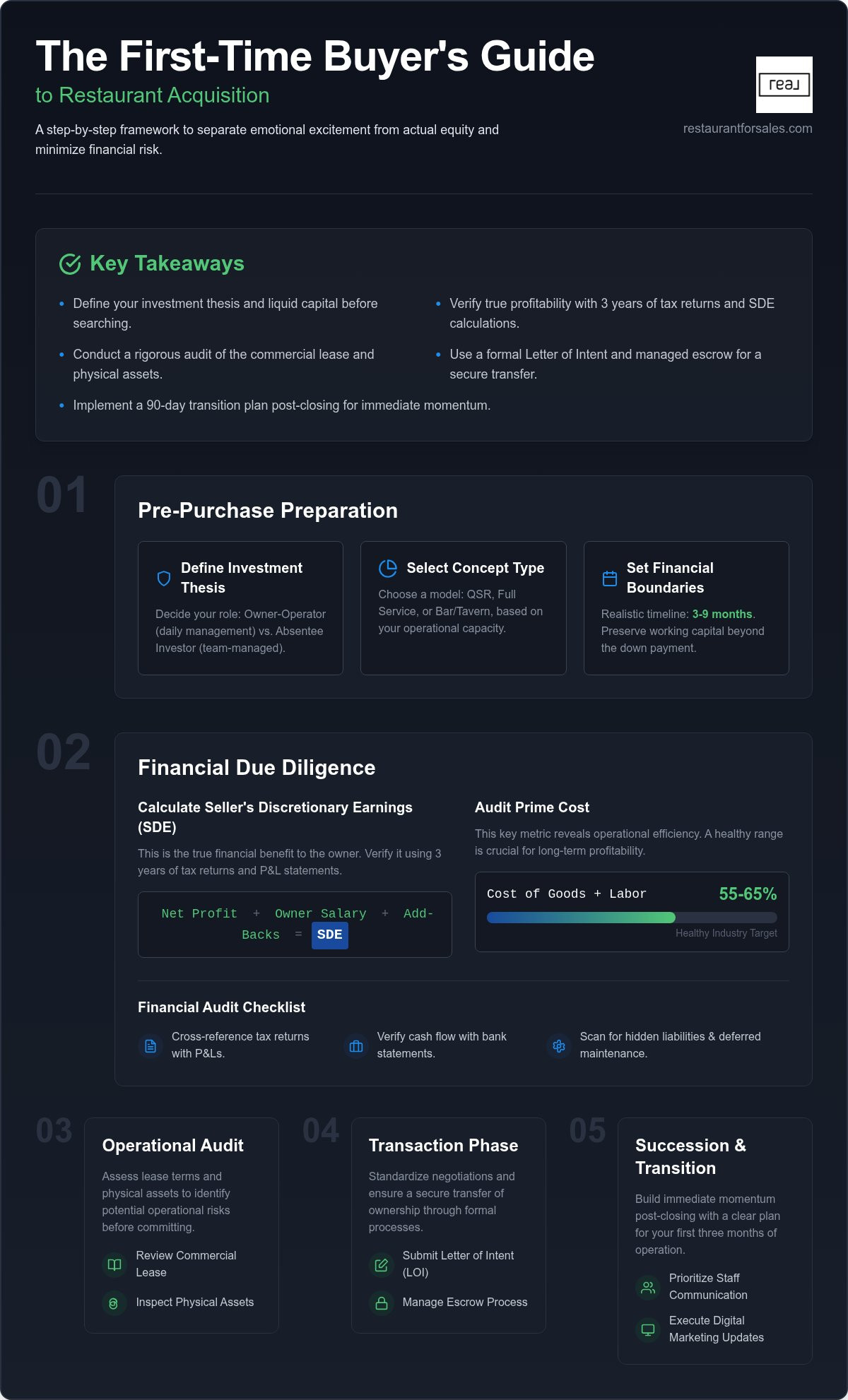
Key Takeaways
- Define your investment thesis and liquid capital reserves before starting your search to ensure the acquisition matches your professional goals.
- Verify true profitability by analyzing three years of tax returns and calculating Seller’s Discretionary Earnings (SDE) rather than relying on top-line revenue.
- Every first time restaurant buyer needs to conduct a rigorous audit of the commercial lease and physical assets to identify potential operational risks.
- Use a formal Letter of Intent and a managed escrow process to standardize negotiations and ensure a secure transfer of ownership.
- Build immediate momentum post-closing by implementing a 90-day transition plan that prioritizes staff communication and digital marketing updates.
Pre-Purchase Preparation: Defining Your Investment Goals
Before searching listings, you must establish an "Investment Thesis." For a first time restaurant buyer, this document serves as your strategic North Star, preventing you from being distracted by businesses that don't align with your lifestyle or financial goals. Are you seeking an owner-operator role where you manage daily shifts, or are you looking for an absentee investment where a management team runs the floor? Deciding this early dictates the types of listings you should pursue.
You also need to select a concept type that fits your vision and operational capacity. Quick Service Restaurants (QSR) often offer high volume and lower labor costs, while Full Service establishments require more complex management but potentially higher average checks. Bars and taverns present a different set of regulatory and licensing demands. Once you choose a direction, expect a realistic timeline of 3 to 9 months to complete an acquisition from the initial search to the final closing.
Skill Set and Experience Audit
Be honest about your operational strengths. A front-of-house specialist understands service flow and customer retention, while a back-of-house expert focuses on food cost and kitchen efficiency. If you lack direct industry experience, you'll likely need to retain or hire a general manager to bridge the knowledge gap. Many people believe passion alone ensures success, but buying a restaurant for the first time requires a balance of hospitality and rigorous business management. Every first time restaurant buyer should identify where they need external support before signing a Letter of Intent.
Setting Financial Boundaries
Success depends on assessing your liquid capital against your total acquisition budget. Don't exhaust your emergency funds on the down payment. You must preserve working capital reserves to cover payroll, inventory, and marketing during the first few months of operation. It's also vital to understand whether you're buying the assets of a business or the corporate entity itself, as each path has different tax and liability implications. Consulting with a professional can help you understand the how to buy a restaurant roadmap and ensure your financial boundaries remain secure. By establishing these limits early, you protect your personal stability while pursuing a professional opportunity.
Financial Due Diligence: Verifying Profitability and Cash Flow
Financial due diligence is where the reality of the investment meets the seller's claims. For a first time restaurant buyer, this stage is about verification rather than trust. You must request at least three years of Profit and Loss (P&L) statements alongside federal tax returns. Discrepancies between these documents are common, but they must be explained. A critical metric during this review is Seller’s Discretionary Earnings (SDE). This represents the total financial benefit an owner derives from the business, including net profit, their own salary, and non-essential "add-backs" like personal travel or vehicle expenses.
Beyond the bottom line, you need to understand how the business generates its revenue. Reviewing Point of Sale (POS) reports allows you to verify sales trends and identify peak performance hours. This data reveals whether the restaurant relies on a few high-traffic shifts or maintains steady volume throughout the week. Simultaneously, audit the "Prime Cost," which is the combined total of cost of goods sold (COGS) and labor. In a healthy operation, this figure typically sits between 55% and 65%. If these costs are higher, the business may lack the efficiency needed to sustain long-term profitability.
The Financial Audit Checklist
- Cross-reference tax returns with P&L statements to ensure reported income matches what was filed with the IRS.
- Request bank statements from the last 12 months to confirm that the cash reported in the POS actually reached the business accounts.
- Scan for hidden liabilities such as deferred maintenance on expensive kitchen equipment or upcoming escalations in equipment leases.
Evaluating Revenue Stability
A business that looks successful on paper may still be vulnerable to external shifts. Every first time restaurant buyer should look for profitable restaurant for sale indicators such as a robust loyalty program or a consistent catering book of business. These elements suggest recurring revenue that isn't dependent on foot traffic alone. You must also account for seasonality. A restaurant near a university or a summer tourist destination will face significant cash flow swings. Finally, analyze the local competitive landscape to see if new openings have eroded the seller's market share in recent months. If you need help interpreting these complex financial patterns, a professional restaurant valuation service can provide an objective assessment of the business's worth.
Operational Audit: Assessing Lease Terms and Physical Assets
The physical infrastructure of a restaurant holds the key to its long-term viability. While financial records tell the story of the past, the operational audit predicts the costs of your future. For a first time restaurant buyer, the lease is typically the most critical asset in the entire transaction. You must verify the remaining term and ensure there are options to renew that extend at least ten years into the future. Without a secure lease, you are effectively buying used equipment rather than a sustainable business. Scrutinize the assignment clauses to understand if the landlord has the right to increase rent or deny the transfer based on your specific professional background.
Beyond the legal documents, you must audit the health department records and past inspection reports. Recurring violations for plumbing or temperature control often suggest systemic issues with the building’s infrastructure rather than just poor management. Simultaneously, verify that all Furniture, Fixtures, and Equipment (FF&E) are included in the bill of sale. Ensure these assets are confirmed to be free of any UCC-1 liens or existing lease-to-own obligations that could complicate the transfer of ownership.
The Lease Assignment Checklist
Landlords act as the ultimate gatekeepers in commercial transactions. They will likely require a detailed credit report and a personal financial statement before approving a lease assignment. Beyond the base rent, you must account for Common Area Maintenance (CAM) charges. These costs can fluctuate and significantly impact your monthly overhead. Ensure the lease explicitly allows for your specific concept. If you plan to change the menu significantly, the landlord or local zoning may have restrictions on the types of cooking equipment or ventilation systems permitted in the space.
Equipment and Inventory Inspection
A kitchen that looks clean during a brief tour may have hidden mechanical failures. Every first time restaurant buyer should conduct a "working" inspection where every piece of refrigeration, every range, and the hood system is tested under a full operational load. These systems are expensive to replace and can cost tens of thousands of dollars if they fail shortly after closing. To ensure a turnkey restaurant for sale is truly ready for service, perform a full inventory of smallwares, cutlery, and glassware. This prevents unexpected expenses on your first day of operation. Additionally, verify the current status of the liquor license and its transferability in your jurisdiction, as this process often requires significant lead time.
The Transaction Phase: Negotiation and Closing the Deal
Once you've verified the financials and inspected the physical assets, the process shifts into the formal transaction phase. This stage begins with a Letter of Intent (LOI). This document outlines your purchase price, financing terms, and specific contingencies that must be met before the deal becomes binding. For a first time restaurant buyer, opening an escrow account is a non-negotiable step to ensure the secure transfer of funds. Escrow acts as a neutral third party, holding your deposit and the seller's documents until every condition of the sale is satisfied.
Following the LOI, your legal counsel will help you finalize the Asset Purchase Agreement (APA). This is the definitive contract that details exactly what you're acquiring, from the trade name to the specific equipment list. Don't skip the final walk-through, which should occur 24 hours before the close of escrow. This is your last opportunity to confirm that the kitchen is in the promised condition and that no major assets have been removed since your initial inspection. Managing these legal and financial hurdles requires expert oversight. Engaging professional restaurant brokerage services from Restaurant For Sale Marketplace ensures that every contingency is met and your capital remains protected throughout the transition.
Negotiation Strategy for First-Timers
Successful negotiations are built on data rather than emotion. You should use a professional restaurant valuation to justify your offer based on current market multiples and comparable sales. Beyond the price, negotiate for "Seller Training." It's standard to require the current owner to stay for 2 to 4 weeks post-sale to introduce you to vendors and explain kitchen workflows. You must also address inventory valuation. This is usually calculated as "cost plus a percentage" and is determined through a physical count on the night of closing.
The Closing Checklist
The final days of the transaction require disciplined organization to avoid operational gaps on day one. Every first time restaurant buyer must verify that all utility transfers, including gas, electric, and water, are scheduled for the exact day of the ownership change. You also need to ensure that employee files and payroll records are transitioned correctly to maintain continuity with the staff. Most importantly, confirm the "Bulk Sale" filing with your state’s taxing authority. This legal step protects you from inheriting the seller’s unpaid sales taxes or other hidden government liabilities.
Succession and Transition: Managing Your First 90 Days
The closing of escrow marks the end of a transaction but the beginning of an operational marathon. For a first time restaurant buyer, the first 90 days serve as a stabilization phase where you must transition from a strategic investor to an effective leader. Your priority is to maintain continuity while identifying "leakage" points that drain profitability. Update your digital presence immediately, including your Google Business Profile and social media accounts, to signal a fresh start to the community. Internal changes should be handled with more precision to avoid disrupting the existing workflow.
Operational shock is a real risk when new ownership takes over. If you plan to implement a new POS or inventory reporting system, do so gradually. Start by running the new system alongside the old one or training a small group of lead employees first. Watch the numbers daily. You should monitor food and labor costs weekly rather than monthly. This frequency allows you to catch waste or scheduling inefficiencies before they compound into significant financial losses. By maintaining a disciplined reporting schedule, you ensure the business remains aligned with the financial projections you verified during due diligence.
Staff and Culture Management
Employees often feel a sense of uncertainty during a change in ownership. You should meet with every staff member individually within the first week to communicate your vision and listen to their concerns. Trust your staff's expertise during this phase. Observe current workflows for at least 30 days before making major structural changes. During this period, identify "influencer" employees who hold the respect of the team. These individuals can help bridge the gap between your new management style and the established culture. Additionally, ensure all new hire paperwork and I-9 forms are compliant with current federal regulations to protect your new entity from administrative penalties.
Growth and Optimization
Once the operation is stable, focus on optimizing your margins. Review all existing vendor contracts to see if better pricing can be negotiated based on your growth plans or new volume. A "Grand Re-Opening" or "New Ownership" event can be a powerful tool to drive local awareness and re-engage lapsed customers. This event should showcase any subtle improvements you've made to the service or menu. Finally, establish a formal 90-day performance review for the business. Compare your actual revenue and expenses against your initial pro forma to determine if the acquisition is meeting your investment goals. This analytical approach allows a first time restaurant buyer to pivot quickly if the business isn't performing as expected.
Securing Your Future in the Restaurant Industry
Success for a first time restaurant buyer depends on moving from emotional interest to analytical due diligence. You now have a framework to define a clear investment thesis, verify SDE through rigorous financial audits, and protect your capital during lease assignments. These methodical steps transform a complex acquisition into a manageable, professional process. By focusing on verified data rather than seller claims, you build a foundation for long-term operational stability.
Navigating these high-value transactions requires a partner who understands the nuances of the national market. Our professional brokerage services provide end-to-end management, while our expert-led business valuation services ensure you pay a fair market rate. We offer comprehensive access to nationwide turnkey and franchise resale opportunities to help you find a business that aligns with your specific goals. Taking the right first step ensures your transition into ownership is both secure and disciplined.
Ready to move from planning to execution? Browse current restaurant listings and start your acquisition journey today. With the right checklist and professional support, you can step into your new role with total confidence.
Frequently Asked Questions
How much experience do I need to be a first time restaurant buyer?
While direct hospitality experience is beneficial, it isn't strictly required if you have strong business management skills. Successful owners often come from corporate backgrounds but hire experienced general managers to handle daily operations. A first time restaurant buyer should focus on their ability to manage P&L statements and labor costs rather than just culinary skill. If you lack back-of-house knowledge, retaining the existing kitchen manager during the transition is a strategic necessity.
What is the most common mistake first-time buyers make during due diligence?
The most frequent error is accepting the seller's internal financial reports without verifying them against federal tax returns. Buyers often overlook "add-backs" that aren't legitimate business expenses, which inflates the perceived profitability. Failing to conduct a professional equipment inspection is another critical oversight. You must ensure that high-value assets like hood systems and walk-in coolers are fully operational before closing. Relying on data instead of emotion prevents overpayment for a failing business.
Can I buy a restaurant with no money down using SBA loans?
Buying a restaurant with zero down payment is extremely rare in the commercial market. Most SBA 7(a) loans require a minimum of 10% to 20% equity injection from the buyer. Lenders also look for secondary sources of income and sufficient collateral to secure the debt. You should prepare to have liquid capital available for both the down payment and a working capital reserve to cover initial operating expenses during the first few months of ownership.
Is it better to buy a franchise or an independent restaurant for a first-timer?
A franchise provides a proven operational blueprint and brand recognition, making it an excellent choice for those who prefer structured systems. However, franchises come with ongoing royalty fees and strict corporate guidelines. Independent restaurants offer more creative freedom and higher profit potential but carry more risk because you are responsible for developing all systems. Your decision depends on whether you value a turnkey support network or total autonomy over your brand concept and menu.
How long does the process of buying an existing restaurant typically take?
The acquisition process generally takes between 3 and 9 months from the initial search to the final closing. This timeline includes the discovery phase, negotiating the Letter of Intent, and conducting deep financial due diligence. Lease assignments and liquor license transfers are often the primary causes of delays. You should work with a professional broker to manage these moving parts and ensure the escrow timeline stays on track for a successful transition into your new business.
What should I do if the seller refuses to show their tax returns?
If a seller refuses to provide federal tax returns, you should view this as a significant red flag and consider walking away from the deal. Tax returns are the only verifiable way to confirm the income reported on a P&L statement. Without this documentation, you cannot accurately value the business or secure traditional financing. Transparency is a requirement for any high-value commercial transaction. Professional buyers never rely on unverified claims that don't appear on paper.
Do I need a restaurant broker to buy a business?
While you can technically buy a business independently, a professional broker provides essential expertise in valuation and lease negotiations. Brokers act as intermediaries who manage the complex escrow process and ensure all legal contingencies are met. They also provide access to vetted listings that aren't available on public marketplaces. For a first time restaurant buyer, having an experienced facilitator helps minimize financial risk and prevents common pitfalls during the closing and transition phases.
What happens to the existing employees when a restaurant is sold?
Most restaurant sales are asset purchases, meaning employees are technically terminated by the seller and rehired by the buyer. It's usually in your best interest to retain key staff to maintain operational continuity and customer relationships. You should meet with the team individually after the sale is finalized to explain your vision and offer new employment agreements. Retaining a seasoned kitchen or floor manager can significantly reduce the learning curve during your first 90 days.


