

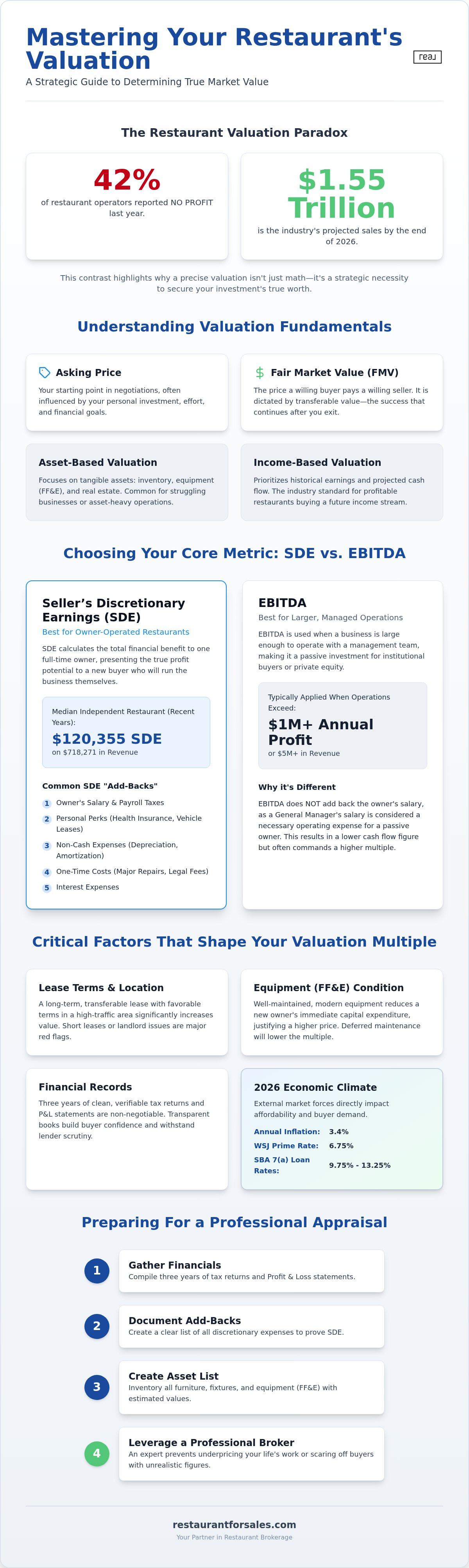
Did you know that 42% of restaurant operators reported no profit last year, yet the industry is projected to reach $1.55 trillion in sales by the end of 2026? This stark contrast highlights why a precise restaurant business valuation is more than just a math exercise; it's a strategic necessity. You've likely spent years building your brand, and the thought of underpricing that effort is understandably stressful. It's difficult to make sense of fluctuating multiples while wondering how your lease terms or outstanding debt will affect the final check you receive at closing.
We're here to replace that uncertainty with professional expertise. This comprehensive 2026 guide promises to help you master the financial methodologies and market factors used to determine true market value. We will explore the vital distinctions between SDE and EBITDA, analyze how the latest tax law changes affect your bottom line, and provide a clear roadmap for preparing your financial documents. By the end of this article, you'll have realistic expectations for your sales price and the tools to defend it during negotiations.
Key Takeaways
- Understand the critical distinction between Fair Market Value and your asking price to ensure your listing attracts serious interest from the start.
- Identify whether your operation requires a valuation based on Seller’s Discretionary Earnings (SDE) or EBITDA to accurately reflect transferable cash flow.
- Evaluate how external factors like remaining lease terms and the condition of your equipment can significantly increase or decrease your final multiple.
- Learn the specific steps to prepare three years of clean financial records for a professional restaurant business valuation that stands up to buyer scrutiny.
- Discover why leveraging a professional broker prevents the common mistake of underpricing your life’s work or scaring off buyers with unrealistic figures.
Understanding the Fundamentals of Restaurant Business Valuation
A restaurant business valuation is the methodical process of determining the economic worth of a food service operation. Whether you're preparing for a sale, a merger, or a partnership buyout, this calculation provides a defensible figure that reflects the entity's true market standing. It's a critical tool for entrepreneurs who need to justify their price to savvy investors or secure financing from lenders. Most professional appraisals follow the Fundamentals of Business Valuation to ensure the final number is rooted in financial logic rather than emotion.
Distinguishing between the "Asking Price" and "Fair Market Value" (FMV) is essential for any seller. The asking price is your starting point in negotiations, often influenced by your personal investment and future goals. However, FMV is the price at which the business would change hands between a willing buyer and a willing seller, neither being under any compulsion to act. This value is heavily dictated by "transferable value," which measures how much of the restaurant's success can continue after the current owner exits. If a restaurant's popularity is tied solely to the owner's personal presence, its market value will be lower than a business with robust, independent systems.
The Difference Between Asset and Income Valuation
Asset-based valuation focuses on the tangible components of the business. This includes the inventory, furniture, fixtures, and equipment (FF&E), along with any leasehold improvements. This method is common for struggling eateries or those with significant real estate holdings. Conversely, income-based valuation prioritizes historical earnings and projected future cash flow. Income-based valuation is the industry standard for profitable eateries because buyers are essentially purchasing a predictable stream of future income.
Why Industry Standard Multiples Change Over Time
Valuation multiples aren't static figures; they fluctuate based on the national economic climate. In 2026, with an annual inflation rate of 3.4% and SBA 7(a) loan interest rates ranging from 9.75% to 13.25%, the cost of capital has a direct impact on what buyers can afford. When the WSJ Prime Rate sits at 6.75%, buyers often demand higher returns to offset their borrowing costs, which can compress multiples. While industry averages provide a useful starting point, your specific restaurant business valuation will ultimately depend on local demand, lease stability, and operational efficiency.
Primary Valuation Methodologies: SDE vs. EBITDA
Choosing the right formula is the most critical step in a restaurant business valuation. While some online resources claim EBITDA is the only standard, the reality is that most independent, owner-operated restaurants are valued using Seller’s Discretionary Earnings (SDE). SDE calculates the total financial benefit a single owner-operator derives from the business. In contrast, Earnings Before Interest, Taxes, Depreciation, and Amortization (EBITDA) is used for larger operations where a management team is already in place. Misapplying these metrics can lead to a valuation that is either too high to attract buyers or low enough to leave significant capital on the table.
Calculating SDE for Independent Restaurants
For single-unit restaurants, the median SDE in recent years was approximately $120,355 against median revenues of $718,271. To calculate this, you start with your net income and add back specific expenses that won't necessarily carry over to a new owner. This process, known as recasting, allows you to present the true profit potential. Buyers and lenders will scrutinize your tax returns to verify these figures, especially since restaurants account for 18-22% of all SBA 7(a) loan approvals. You must ensure all personal expenses are transparently documented to maintain credibility during the due diligence phase.
Common add-backs used during recasting include:
- Owner's salary and associated payroll taxes
- Personal health insurance or vehicle leases paid by the business
- Non-cash expenses like depreciation and amortization
- One-time repairs, legal fees, or rebranding costs
- Interest expenses from current business debt
When to Use EBITDA for Larger Hospitality Groups
Institutional buyers and private equity firms prioritize EBITDA because they view the restaurant as a passive investment. This metric is typically applied once an operation exceeds $1 million in annual profit or $5 million in revenue. Because these buyers aren't looking to work a shift behind the line, they require the business to include a full management salary as an expense. The primary driver for this shift is management structure. Having a general manager in place makes the owner replaceable, which can add a 0.5x to 1.5x turn to the multiple. These larger hospitality groups often command multiples ranging from 4x to 7x EBITDA for proven, scalable brands.
If you're unsure which category your business falls into, obtaining a professional restaurant business valuation ensures you don't misapply these multiples and leave money on the table.
Critical Factors That Influence the Valuation Multiple
Calculating base earnings is only half of the equation. The multiplier applied to those earnings determines the final price, and this figure is highly sensitive to both internal and external risks. A standard restaurant business valuation typically sees multiples ranging from 1.5x to 3x SDE for independent eateries, but several key factors can push your business toward the higher or lower end of that spectrum. Understanding these levers allows you to make strategic improvements before hitting the market.
The Make-or-Break Power of the Lease
The terms of your lease are often more important than your menu. A business with only two years remaining on its lease can see its valuation drop by 20% to 40% because the buyer lacks long-term security. Lenders generally require the lease term, including options, to meet or exceed the length of the loan. To protect your value, you must manage a restaurant lease assignment with professional precision. Additionally, your total occupancy costs should ideally remain below 10% of gross sales. If rent exceeds this threshold, it eats into the profit margins that justify a higher multiple.
The physical condition of your Furniture, Fixtures, and Equipment (FF&E) also plays a vital role. If a buyer needs to replace a walk-in cooler or a hood system immediately after closing, they'll deduct those costs from the purchase price. A well-maintained, turnkey facility always commands a premium over a fixer-upper that requires immediate capital expenditure. Buyers are looking for assets that are ready to generate revenue from day one without additional investment.
Operational Systems and Transferability
Owner dependency is the most common reason for a low valuation multiple. If the restaurant can't function for a week without your direct supervision, you haven't built a business; you've created a job. Buyers look for documented Standard Operating Procedures (SOPs) that allow a new owner to step in seamlessly. High-value operations in 2026 also demonstrate a diverse revenue mix, with off-premise sales like delivery and takeout accounting for 30% to 40% of total income. This diversification suggests a resilient brand that can withstand economic shifts.
Intangible assets like brand reputation and online presence are equally influential. A restaurant with a 4.5-star rating across major review platforms and a robust social media following has a lower customer acquisition cost. These digital assets provide a competitive moat that justifies a higher multiple during the restaurant business valuation process. Buyers aren't just paying for the kitchen equipment. They're paying for the goodwill and the steady stream of customers you've cultivated in the community.
Preparing Your Business for a Professional Appraisal
A successful restaurant business valuation relies entirely on the quality of your documentation. Professional appraisers and serious buyers require at least three years of comprehensive financial history to establish a baseline of performance. If your records are disorganized or incomplete, you risk appearing unprofessional and losing leverage during negotiations. Preparation should begin at least 12 to 18 months before you plan to list, allowing you to address any red flags that could devalue the operation.
One of the most common hurdles in this process is the "cleanliness" of the books. Many owners co-mingle personal expenses with business operations, such as vehicle payments or family cell phone plans. While these might offer tax advantages today, they complicate the recasting process and can create distrust with a buyer. You must decouple these personal costs well in advance to present a clear, undisputed picture of profitability. Utilizing a 2026 restaurant valuation guide helps you align your expectations with current market realities rather than emotional attachments. Avoid the mistake of overvaluing "potential." Buyers pay for historical facts and proven cash flow; they rarely pay a premium for ideas you haven't yet executed.
The Essential Document Checklist
To facilitate an accurate appraisal, you must compile a standardized set of records. This includes your Profit & Loss (P&L) statements, Balance Sheets, and federal tax returns for the last three years. A detailed POS (Point of Sale) report is particularly critical because it provides third-party verification for cash sales and menu mix. Additionally, maintain an updated equipment inventory list that notes the age and condition of every asset. Having these documents ready can reduce the median time on market, which currently sits at 181 days for most restaurants.
Timing the Market for Maximum Value
Valuations are heavily weighted toward the Trailing Twelve Months (TTM) of performance. Selling while your sales are on an upward trend is vital for securing a high multiple. If a buyer sees declining revenue over the last six months, they'll view the business as a distressed asset, even if your three-year average is strong. Engage a professional appraiser while your numbers are peaking to lock in the highest possible market value. If you're ready to see what your business is worth in today's market, you can request a professional restaurant business valuation to get started.
Leveraging Professional Brokerage for Accurate Valuation
While online calculators offer a quick estimate, they lack the nuanced context required for a high-value commercial transaction. A professional restaurant broker provides market-based pricing derived from actual, local transaction data rather than theoretical formulas. Many owners attempt the "For Sale By Owner" (FSBO) route, but this often results in either leaving significant capital on the table or setting an inflated price that scares away qualified buyers. Restaurant For Sale Marketplace uses real-world data from thousands of national listings to ensure your restaurant business valuation is both competitive and defensible to lenders.
The process of moving from a valuation to a confidential marketplace listing requires a delicate balance of transparency and discretion. A broker acts as a proactive facilitator, bridging the gap between your financial reality and a buyer's investment goals. By leveraging a national platform, you gain access to a broader pool of pre-qualified buyers who understand the complexities of the current market, including the impact of 2026 interest rates and labor trends.
The Value of Success-Based Brokerage
A success-based brokerage commission model ensures that your broker's incentives are perfectly aligned with your pricing goals. This structure means the professional is invested in maximizing the sales price and seeing the deal through to the closing table. Beyond the appraisal, a broker manages the end-to-end process, including the legal complexities of lease transfers and franchise approvals. Confidentiality is paramount during this stage. Professional brokers utilize blind listings and strict non-disclosure agreements (NDAs) to ensure that employees, vendors, and competitors remain unaware of the potential sale until the appropriate time.
Next Steps: From Appraisal to Acquisition
The path from valuation to a finalized sale follows a methodical and structured rhythm. For current owners, the first step is a formal review of financial records to identify all potential add-backs and maximize the multiple. For those looking to buy a restaurant, accurate valuation data provides the confidence needed to secure SBA financing and complete due diligence. This data-driven approach removes the guesswork from the transaction, creating a sense of stability for both parties. If you're ready to discover the true market value of your operation, get a professional restaurant valuation today and take the first step toward your next professional journey.
Secure Your Exit Strategy with a Precise Valuation
Determining the true market value of your operation is the first step toward a successful transition. You now understand that a professional restaurant business valuation involves more than just applying a multiple to your net income. It requires a deep analysis of transferable cash flow, the stability of your lease assignment, and the strength of your operational systems. By cleaning your financial records and timing the market during an upward trend, you position yourself to capture the highest possible price for your life's work.
Navigating these financial and legal complexities alone often leads to missed opportunities. Restaurant For Sale Marketplace provides a national platform with thousands of active buyers and specialized expertise in complex lease transfers. Our success-based brokerage commissions ensure our goals are perfectly aligned with yours. If you're ready to move from uncertainty to a concrete sales strategy, Request a Professional Restaurant Valuation today. We're ready to help you achieve the value you've worked so hard to build.
Frequently Asked Questions
What is the most common multiple for a small restaurant business?
The most common multiple for a single-unit, owner-operated restaurant ranges from 1.5x to 3x Seller's Discretionary Earnings (SDE). While the five-year average multiple is 2.15x, highly profitable independent establishments with strong systems can reach higher ranges. These figures are heavily influenced by your specific cash flow stability and the current interest rate environment. SBA 7(a) loans, which fund many of these transactions, often carry rates between 9.75% and 13.25% in 2026.
How does a restaurant lease affect the overall business valuation?
Your lease is a primary driver of value because it secures the location's future revenue. A lease with fewer than five years remaining, including options, can reduce a restaurant business valuation by 20% to 40%. This happens because short terms create significant risk for the buyer and their lender. To maintain maximum value, ensure your total occupancy costs stay below 10% of gross sales and that terms cover a standard ten-year loan.
What are add-backs in a restaurant valuation, and why do they matter?
Add-backs are expenses currently paid by the business that won't necessarily be required by a new owner. These include the owner's salary, personal health insurance, one-time repairs, and non-cash items like depreciation. They matter because they allow a broker to recast your financial statements, showing the true discretionary income available to a buyer. This transparency is vital for justifying a higher multiple and helping buyers secure financing from national lending institutions.
Can I value my restaurant based on gross sales alone?
Valuing a restaurant based solely on gross sales is a common mistake that often leads to unrealistic expectations. While sales volume indicates market demand, buyers and lenders prioritize transferable profit and cash flow. Two restaurants with $1 million in sales can have vastly different values if one has a 15% profit margin and the other is barely breaking even. A credible valuation must focus on profit metrics to reflect the actual return on investment.
How much does a professional restaurant business valuation cost?
The cost of a professional appraisal varies depending on the complexity of the operation and the depth of analysis required. While some automated tools provide estimates, a comprehensive restaurant business valuation from a specialized broker includes a detailed recasting of financials and a market-based multiple analysis. Many owners find that the professional fee is a necessary investment to avoid the risk of underpricing their work or losing a deal during the due diligence phase.
Does the value of the real estate get included in the business valuation?
Business valuations and real estate appraisals are typically conducted as separate calculations. If you own the property, the real estate is valued based on comparable market sales, while the business is valued based on its operational cash flow. When selling both together, the total price is the sum of these distinct assets. This approach ensures you receive full credit for your tangible property and your intangible business goodwill and brand.
How do I value a restaurant that is currently losing money?
If a restaurant is currently losing money, the valuation shifts from an income-based approach to an asset-based methodology. In this scenario, the value is determined by the Fair Market Value of the Furniture, Fixtures, and Equipment (FF&E) and the cost of leasehold improvements. These "asset sales" are often priced based on what it would cost a buyer to build a similar facility from scratch, rather than on the business's current earnings.
What is the difference between SDE and EBITDA for a restaurant owner?
The difference lies in how management costs are handled. SDE includes the owner's salary, making it the standard for owner-operated businesses where the buyer intends to work in the restaurant. EBITDA deducts a professional management salary, treating the business as a passive investment. Large hospitality groups with revenues over $5 million typically use EBITDA multiples, which currently range from 4x to 7x for scalable brands that have a manager or general manager in place.


