

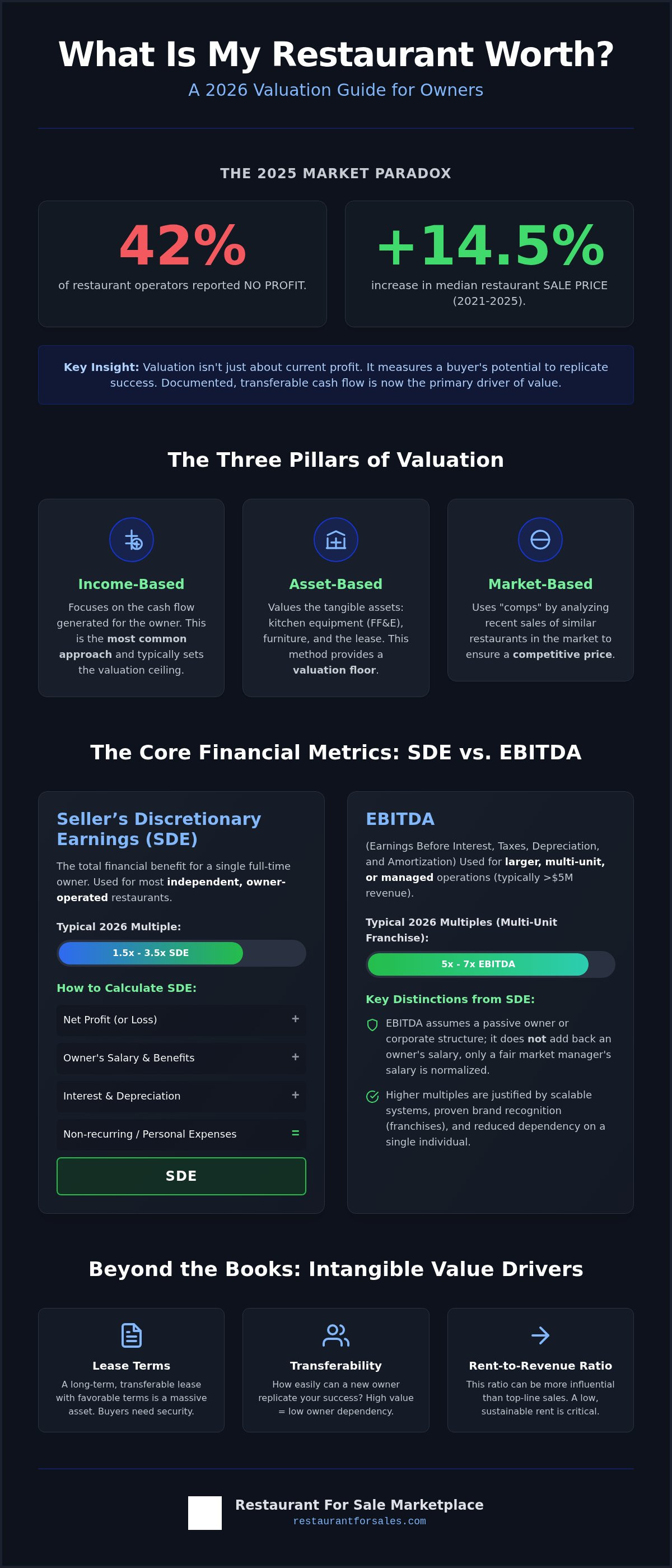
In 2025, 42% of restaurant operators reported no profit, yet the median sale price for restaurants actually rose 14.5% between 2021 and 2025. This paradox highlights a critical reality for owners asking "what is my restaurant worth" in today's competitive market. Valuation is not just about your current bank balance; it is a measure of how easily a new owner can replicate your success. If you feel uncertain about which financial metrics truly matter or fear leaving money on the table during a sale, you are facing a common challenge in the brokerage world.
We understand that your business is likely your most significant asset. You deserve a valuation process grounded in hard data rather than guesswork. This 2026 guide provides the exact formulas, SDE multiples, and market factors professional brokers use to determine real-world market value. We will clarify the confusion over fluctuating industry multiples and help you establish a realistic ballpark figure for your business. You will also learn specific steps to improve your business value before listing, ensuring you approach the market with the confidence of a seasoned industry insider.
Key Takeaways
- Learn how to distinguish between emotional value and fair market value to set a realistic baseline for your exit strategy.
- Identify whether to apply SDE or EBITDA multiples based on your business size to answer "what is my restaurant worth" with professional accuracy.
- Discover why your lease terms and rent-to-revenue ratio can be more influential than your top-line sales during a brokerage transaction.
- Evaluate the market value of your furniture, fixtures, and equipment to determine a baseline price even if the business is not currently profitable.
- Understand the essential financial documentation required for a professional appraisal to ensure you approach the market with complete transparency.
What Is My Restaurant Worth? Defining the Baseline
Determining the Fair Market Value (FMV) is the essential first step in any professional exit strategy. FMV represents the price a willing buyer and a willing seller agree upon when neither is under pressure to act. When you start asking what is my restaurant worth, you're looking for a baseline that reflects the current reality of the market. It's a common mistake to confuse a business's theoretical value with its actual sale price. A restaurant might have significant emotional value to its founder, but a buyer only cares about the risk and the return on investment.
Market conditions in 2026 have shifted significantly for independent eateries. Buyers now prioritize documented, transferable cash flow over top-line revenue growth. Transferability is the role your business plays without you. If the restaurant's success depends entirely on your personal recipes or presence, the value drops. A business that can run efficiently under new management commands a much higher premium. You must view your operations through the lens of a stranger to accurately answer what is my restaurant worth before listing.
The "Rule of Thumb" vs. Real-World Appraisals
Many owners rely on outdated industry benchmarks, such as valuing a business at 30% of annual sales or a flat multiple of net income. These rules of thumb are dangerous for specialized concepts because they ignore specific lease terms, local competition, and equipment condition. Using a generic formula often leads to overpricing, which leaves a listing stagnant for months. For a precise calculation, you should consult a 2026 restaurant valuation guide that accounts for modern labor costs and supply chain shifts. Professional appraisals provide the data needed to defend your asking price during negotiations.
The Three Main Valuation Pillars
Brokers typically use three primary Business Valuation Methods to establish a price range. Each pillar offers a different perspective on the business's health:
- Income-based: This is the most common approach. It focuses on the cash the business generates for the owner, often using SDE or EBITDA.
- Asset-based: This method tallies the value of physical assets. It includes kitchen equipment, furniture, and the value of a long-term lease in a prime location.
- Market-based: This relies on "comps" or comparable sales. It examines what similar restaurants in the national market have recently sold for to ensure the price is competitive.
A balanced valuation often blends these three perspectives. While the income-based approach usually sets the ceiling, the asset-based approach provides a floor for the transaction. Understanding these pillars ensures you aren't surprised when a buyer's lender performs their own due diligence.
The Financial Foundation: SDE and EBITDA Multiples
Financial records are the heartbeat of any business sale. To answer the question "what is my restaurant worth," you must first identify which earnings metric applies to your specific operation. Most independent, owner-operated restaurants are valued using Seller’s Discretionary Earnings (SDE). This figure represents the total financial benefit available to a single full-time owner. In 2026, single-location independent restaurants typically trade at multiples between 1.5x and 3x SDE. High-performing venues in prime locations can occasionally push toward 3.5x if they demonstrate consistent year-over-year growth.
The calculation shifts when dealing with larger entities or managed groups. Earnings Before Interest, Taxes, Depreciation, and Amortization (EBITDA) is the standard for multi-unit operations or restaurants with revenue exceeding $5 million. Quick Service Restaurants (QSR) and established franchises often command higher multiples than Full Service Restaurants (FSR) due to their scalable systems and lower labor intensity. While a single-unit franchise might sell for 3x to 5x SDE, a multi-unit franchise group (5+ units) can reach 5x to 7x EBITDA. You can view how these multiples translate into real-world prices by reviewing our current franchise resale listings.
Calculating Seller’s Discretionary Earnings (SDE)
The key to a higher valuation lies in "add-backs." These are expenses currently on your P&L that a new owner would not necessarily incur. Legitimate add-backs include the owner's salary, one-time equipment repairs, and personal travel or auto expenses run through the business. A common mistake is trying to add back essential operating costs, such as a necessary manager's salary when the owner is already semi-absentee. This practice often scares off savvy buyers during due diligence. A professional restaurant broker identifies these hidden values while ensuring the final SDE figure remains defensible to lenders.
EBITDA and Institutional Buyers
Institutional buyers and private equity firms focus on EBITDA because it allows them to compare the profitability of different companies regardless of their capital structure. These buyers often seek a "multiple expansion" effect. They buy individual units at lower SDE multiples and eventually sell the entire group at a much higher EBITDA multiple. In the hospitality sector, EBITDA represents the operational cash flow available to service debt and provide investor returns after all site-level operating expenses are paid. For those looking to understand the academic side of these figures, Cornell University provides an excellent deep dive into the Valuation of Restaurant Facilities and their underlying business components. Understanding these institutional preferences is vital if you're asking what is my restaurant worth as part of a multi-unit exit strategy.
Beyond the Books: Intangible Factors That Drive Value
While financial statements provide the foundation, intangible assets often determine whether a buyer pays the high or low end of a market multiple. When assessing what is my restaurant worth, professional brokers look closely at the "Owner-Independent" premium. If your business requires your presence for 60 hours a week to function, it is a job rather than a transferable asset. Conversely, a restaurant with a stable, long-term management team and documented processes commands a higher price because the risk of operational collapse after the sale is significantly lower.
The distinction between a "location" and a "destination" also influences the final multiple. A restaurant relying on high foot traffic in a premium retail corridor is valued differently than a destination spot that customers travel to specifically. High foot traffic locations offer a safety net for new owners, while destination brands rely more heavily on marketing and brand equity. Concept scalability is another factor buyers weigh heavily. A brand that can be easily replicated in other markets is more attractive to growth-oriented investors because it represents a platform for expansion rather than just a single-unit operation.
The Critical Importance of the Lease
Your lease is arguably your most valuable intangible asset. A rent-to-revenue ratio exceeding 10% can quickly erode your valuation, regardless of how popular the concept is. Buyers seek security, typically looking for at least 10 years of remaining term, including options. A short lease with no guaranteed renewal makes the business nearly impossible to finance. You must also understand the impact of a restaurant lease assignment on the saleability of your business. Assignability clauses are often silent deal-killers; if a landlord has the right to withhold consent or increase rent upon transfer, your market value will suffer. Ensuring your lease is transferable is a prerequisite for any successful exit.
Technology and Operational Efficiency
In 2026, a restaurant's digital infrastructure is as important as its physical kitchen. Buyers analyze how well your POS system integrates with third-party delivery platforms and whether those delivery margins are sustainable. A modern tech stack that tracks inventory in real-time and manages labor costs effectively reduces the learning curve for a new owner. Documented systems, such as proprietary recipes and standard operating procedures (SOPs), ensure that the brand's quality remains consistent under new ownership. Comprehensive, written operational systems increase buyer confidence by providing a clear roadmap for future success. When you ask what is my restaurant worth, remember that a buyer is paying for the certainty that they can maintain your current profit levels from day one.
Valuing Restaurants Without Profit: The Asset Method
In 2025, 42% of restaurant operators reported no profit; however, this doesn't mean those businesses lacked market value. When a restaurant isn't generating positive cash flow, brokers shift from income-based multiples to the asset method. This approach answers "what is my restaurant worth" by totaling the value of everything a new owner would otherwise have to build or buy from scratch. For many buyers, purchasing an existing, non-profitable location is a strategic move to bypass the high costs and long timelines of a fresh build-out.
The core of this valuation lies in Furniture, Fixtures, and Equipment (FF&E). We distinguish between fair market value and replacement cost. Fair market value is what your equipment would sell for today on the open market; replacement cost is what a buyer would spend to purchase and install those items new. Buyers also pay "Key Money" for the right to take over a lease in a desirable area. This premium often includes the value of transferable permits and specialized infrastructure like grease traps, heavy-duty HVAC systems, and professional venting. In premium real estate markets, these "second-generation" spaces are highly coveted because they can save a new concept six to twelve months in permitting and construction time.
Determining Turnkey Value
A buyer might pay a significant sum for a loss-making location if the infrastructure is high-quality and the lease is favorable. This is known as turnkey value. The savings in "time-to-market" is a powerful motivator; every month a new owner isn't open is a month of lost revenue and ongoing rent. If you have a transferable liquor license in a state with a quota system, its value can be substantial. Industry data shows that in some regions, a transferable license alone represents 20% to 50% of the total enterprise value. To get an accurate assessment of your tangible assets, you can utilize our professional restaurant valuation services.
The Liquidation Value Floor
The absolute minimum your business is worth is its liquidation value. This is the amount you would receive if you had to sell every piece of equipment at an immediate auction. It is a common mistake to fall into the "sunk cost" fallacy, where owners believe their business is worth what they spent on the original build-out. Unfortunately, a buyer won't pay for your expensive custom light fixtures if they don't fit their new concept. Liquidation value is often significantly lower than in-place value, as it doesn't account for the labor and permits required to install the equipment. Understanding this floor helps you set a realistic exit strategy when an income-based sale isn't an option. When asking "what is my restaurant worth" in an asset sale, the focus remains on the utility of the space for the next tenant.
Professional Appraisal: The Path to a Successful Sale
Online calculators provide a starting point, but they cannot account for the nuances of current buyer demand or specific lease complications. When you ask "what is my restaurant worth," a Broker’s Opinion of Value (BOV) offers a realistic look at the actual market. Unlike a certified appraisal, which is often a rigid document used for bank lending or legal disputes, a BOV focuses on marketability. It considers what active buyers in the national market are currently offering for similar concepts. This professional assessment becomes your most powerful tool during negotiations, providing the evidence needed to defend your asking price against low-ball offers.
The Valuation Process Steps
A professional valuation follows a methodical, three-step approach to ensure no value is left on the table. The first step involves normalizing the financials. We meticulously review your profit and loss statements to identify legitimate add-backs, such as owner salaries or non-recurring repairs, which reveal the true earning power of the business. The second step is a site and lease inspection. We evaluate the condition of your kitchen equipment and the strength of your lease agreement, as a weak lease can diminish even the highest profit margins. Finally, we analyze comparable sales. We look at real-time data from across the country to see what similar restaurants have actually sold for, rather than just their initial listing prices.
Bridging the Gap Between Buyer and Seller
The transition from valuation to a successful closing requires clear communication and professional documentation. Skeptical buyers often question the sustainability of a restaurant's cash flow. A broker uses the valuation report to justify the applied multiple, pointing to intangible strengths like a modern tech stack or a high "Owner-Independent" premium. Seller financing is another strategic lever used to bridge the gap. By offering to carry a portion of the note, you demonstrate confidence in the business's continued success, which can often secure a higher overall valuation.
Whether you are preparing to exit or are currently buying a restaurant, this level of valuation rigor is essential. It moves the conversation from emotional guesswork to a disciplined, data-driven transaction that protects your most significant investment. Preparing your financial documents early ensures that when an ideal buyer arrives, you are ready to move from valuation to a signed purchase agreement without unnecessary delays.
Securing Your Financial Future Through Accurate Valuation
Achieving a successful exit requires moving beyond guesswork and emotional attachments. By understanding the complex interplay between your financial multiples and intangible assets like lease stability, you can accurately answer what is my restaurant worth in the current 2026 market. Whether your business is a high-growth multi-unit group or a single-location turnkey space, a data-driven approach ensures you don't leave capital on the table during final negotiations. Professional guidance transforms a confusing process into a clear, strategic roadmap for your transition.
Our firm provides expert brokerage for high-value commercial transactions, leveraging a national marketplace reach to connect you with qualified buyers. We operate on success-based commissions, which ensures our goals are perfectly aligned with your financial success. It's time to replace uncertainty with the confidence that comes from a professional market analysis. Get a Professional Restaurant Valuation Today to take the first definitive step toward a profitable and secure exit. Your years of hard work deserve a valuation that reflects the true market potential of your legacy.
Frequently Asked Questions
What is the most common multiple used for small independent restaurants?
Most small independent restaurants use a multiple of 1.5x to 3x Seller's Discretionary Earnings (SDE). This range applies to businesses with revenue under $3 million where the owner is active in daily operations. Factors like location stability and year-over-year growth determine where a specific business falls within this range. Well-established venues with clean books often push toward the 3.5x mark when market demand is high.
Can I include my personal vehicle or health insurance as an add-back?
Yes, personal expenses such as health insurance, vehicle payments, and cell phone bills are legitimate add-backs if they are run through the business. These are considered discretionary because a new owner might not choose to incur the same costs. By adding these back to the net profit, you reveal the true cash flow available to a buyer. Accurate documentation is essential to ensure these figures pass the due diligence phase without dispute.
How does a long-term lease affect my restaurant’s worth?
A long-term lease significantly increases your business value by providing a buyer with operational security and predictable overhead. Lenders typically require the lease term, including options, to meet or exceed the length of the business loan. If your lease has less than five years remaining without options, it can decrease your multiple or make the business nearly impossible to sell. A favorable, transferable lease is often a restaurant's most valuable intangible asset.
Is my restaurant worth more if I own the real estate?
Yes, owning the real estate substantially increases the total deal value and opens the door to different buyer pools. When you ask what is my restaurant worth while including property, you are combining the business's operational value with the appraisal of the commercial land and building. This structure allows for SBA 504 financing, which often features lower down payments and longer terms, making the acquisition more attractive to long-term investors.
Why is my net profit different from my SDE?
Net profit is the bottom line after all taxes and non-cash expenses, whereas SDE adds back the owner's salary and discretionary benefits. SDE is designed to show the total financial benefit a single owner-operator receives from the business. For most small restaurants, the SDE is significantly higher than the reported net profit because it accounts for interest, depreciation, and personal perks that won't necessarily transfer to a new owner.
What happens to the valuation if I have high staff turnover?
High staff turnover can depress your valuation multiple because it signals operational instability and high training costs to a buyer. Buyers pay a premium for turnkey operations with a loyal, seasoned team. If the business relies on a revolving door of employees, the risk of a post-sale collapse increases. Stabilizing your workforce before listing can answer the question what is my restaurant worth with a much higher figure during negotiations.
How often should I get a professional valuation for my business?
You should seek a professional valuation at least once a year or whenever there is a significant shift in your revenue or local market conditions. Regular valuations help you track the effectiveness of your growth strategies and identify areas where you can improve the business's exit value. Staying updated on market trends ensures you are ready to list immediately if an unsolicited offer arrives or if personal circumstances change.
Do online restaurant valuation calculators provide accurate results?
Online calculators provide a helpful baseline but often fail to account for specific market nuances and lease terms. These tools use generic algorithms that cannot distinguish between a destination brand and a struggling neighborhood spot. While they offer a quick estimate, they lack the rigor of a professional analysis that considers real-time buyer demand and local competition. For high-value transactions, a broker's opinion of value is far more reliable.


