

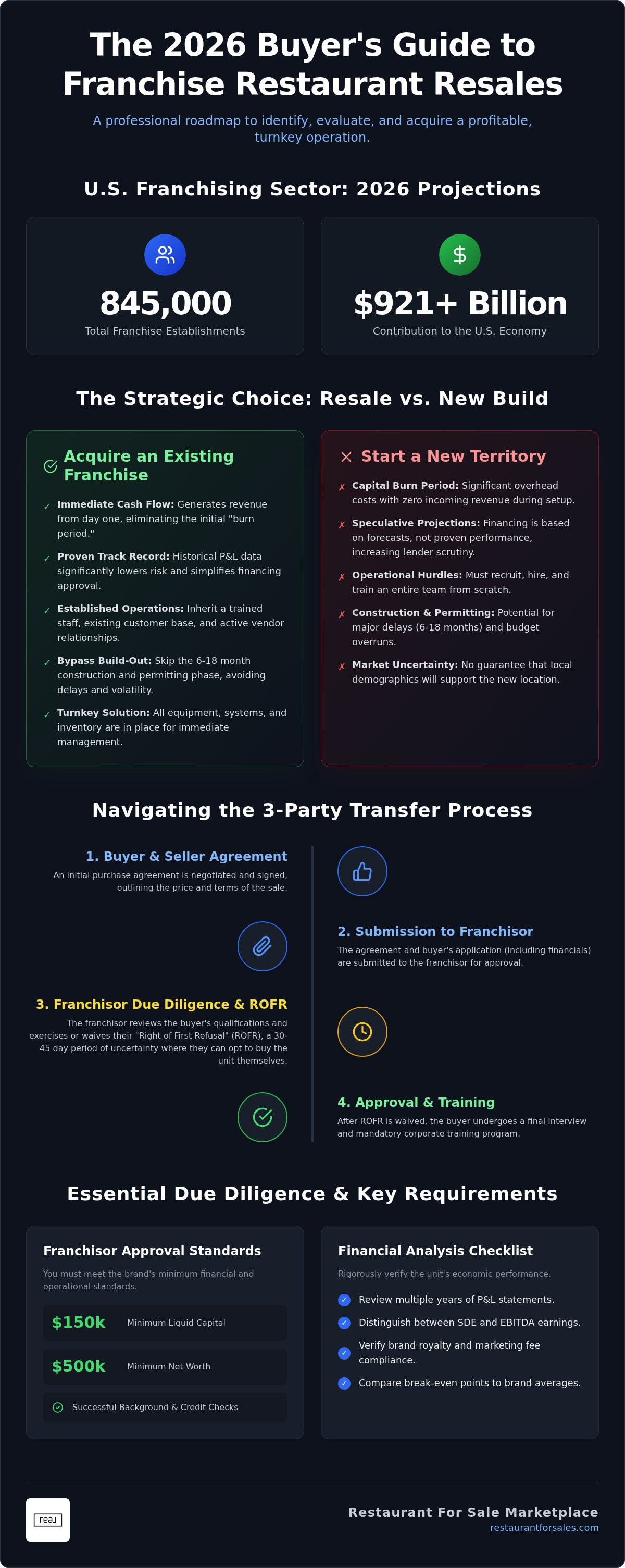
The U.S. franchising sector is projected to reach approximately 845,000 establishments in 2026, contributing over $921 billion to the national economy. For many entrepreneurs, searching for franchise restaurants for sale represents a strategic shortcut to market entry that bypasses the high failure rates associated with independent startups. You're likely looking for a way to secure immediate cash flow and leverage established brand recognition without the uncertainty and long lead times of new construction. You recognize that acquiring an existing location is often the most efficient path to professional growth.
This 2026 buying guide provides a professional roadmap to identify, evaluate, and successfully acquire a profitable franchise resale. You'll learn how to navigate the technical complexities of franchisor approval processes and conduct rigorous financial due diligence. We'll analyze the current SBA lending environment, where combined loan limits have reached $10 million, and provide a structured framework for transitioning into a turnkey operation. This article ensures you're equipped to manage the end to end acquisition process with the confidence of a seasoned industry insider.
Key Takeaways
- Identify why acquiring established franchise restaurants for sale offers a strategic shortcut to market entry with operational systems already in place.
- Learn to navigate the three-party approval process and the critical impact of the "Right of First Refusal" on your closing timeline.
- Discover how to evaluate unit-level economics by distinguishing between SDE and EBITDA while verifying brand royalty compliance.
- Compare the break-even points of resales versus new territory builds to determine the most efficient allocation of your capital.
- Recognize how professional brokerage manages the complex transition requirements and maintains confidentiality throughout the sale process.
The Strategic Advantage of Buying a Franchise Restaurant for Sale
Buying a franchise resale involves acquiring an existing, operational business unit that is already generating revenue. This path is fundamentally different from starting a location from scratch. When you evaluate franchise restaurants for sale, your primary objective is often to secure immediate cash flow from day one. This eliminates the "burn period" where capital is spent on overhead without incoming revenue. To understand what franchising is at its core, you must recognize that a resale combines a proven corporate system with a location-specific track record. It's a merger of brand power and local operational history.
Beyond the immediate financials, you inherit an established customer base and a trained staff. Recruiting and training a new restaurant team is a significant operational hurdle that often delays profitability. With a resale, the systems are already in place, and the local market already recognizes the brand. You also bypass the 6 to 18 month build-out and permitting phase. In many markets, securing permits and managing construction can be the most volatile part of the business cycle. A resale allows you to skip these delays and move directly into management and optimization.
Why Resales Beat New Builds in 2026
The 2026 market environment favors resales because they provide "proof of concept" at a specific address. Historical financial data, specifically Profit and Loss (P&L) statements, significantly lower the hurdle for financing. Lenders look favorably on existing cash flow compared to the speculative projections of a new build. This reduction in market entry risk is measurable. You aren't guessing if the local demographics will support the brand; you have the sales receipts to prove it. This stability is particularly valuable when interest rates for SBA loans remain a critical factor in acquisition math.
The Turnkey Nature of Existing Franchise Units
"Turnkey" refers to a business that is ready for immediate operation. In a franchise context, this means the kitchen equipment is installed, inventory is stocked, and vendor relationships are active. You don't have to negotiate new supply chain contracts or wait for long equipment lead times. This setup minimizes the typical "ramp-up" period where new businesses struggle to reach a break-even point. Instead of building a foundation, you're focused on scaling an existing one. It's a strategic move for entrepreneurs who prioritize execution over construction.
Understanding the Franchise Resale Process and Transfer Requirements
The process of acquiring franchise restaurants for sale involves a complex three-party dynamic between the buyer, the seller, and the franchisor. Unlike a standard independent business sale, the franchisor holds the ultimate authority to approve or reject the transfer. This authority is often exercised through the "Right of First Refusal" (ROFR). This clause allows the franchisor to match your purchase price and terms to buy the unit themselves. This typically creates a 30 to 45 day window of uncertainty during the escrow period where the deal remains tentative until the franchisor formally waives their right.
Prospective owners must review the latest Franchise Disclosure Document (FDD). This document provides critical insights into the brand's financial health, litigation history, and the specific obligations of the franchisee. For a detailed breakdown of legal protections and requirements, consult the FTC's consumer guide to buying a franchise. Additionally, most agreements require a Transfer Fee. This fee covers the franchisor’s administrative, legal, and training costs associated with onboarding a new owner. While the seller traditionally pays this fee, it's a point of negotiation that can impact the final net proceeds of the sale.
Navigating Franchisor Approval
The franchisor interview is a rigorous assessment of your operational capability and cultural fit. You aren't just a buyer; you're a potential brand ambassador. You must demonstrate that you meet specific 2026 financial standards. These standards often require a minimum liquid capital of $150,000 and a net worth exceeding $500,000 for mid-tier casual dining brands. Background and credit checks are mandatory. Even after receiving a "green light" from the brand, you won't take control immediately. Most brands mandate a comprehensive training program, often lasting four to eight weeks, to ensure you can maintain corporate standards from your first day.
The Role of Lease Assignments in Franchise Sales
The physical location is secured by a lease that must be legally transferred through an assignment. Landlord approval is just as critical as franchisor approval. If the landlord refuses the assignment or demands unreasonable new terms, the deal can collapse regardless of franchisor consent. This process requires managing the landlord’s requirements alongside the franchisor’s timeline. To understand the nuances of this transition, read our detailed article on Understanding Restaurant Lease Assignments. Managing these moving parts requires a disciplined approach. If you're ready to explore current listings, you can view our available franchise resales to begin your search.
Franchise Resale vs. New Territory: A Comparative Investment Analysis
Choosing between a new territory and existing franchise restaurants for sale requires a disciplined analysis of capital allocation. A new build typically involves a lower initial franchise fee but carries significant speculative risk. You're responsible for site selection, lease negotiation, and the entirety of the construction process. Conversely, a resale purchase price includes the "Blue Sky" value and existing physical assets. While the upfront cost may be higher, you're buying a proven location with historical sales data. This data is essential for meeting the disclosure requirements mandated by the FTC Franchise Rule, which ensures transparency in the investment process.
Time-to-profitability is the most distinct differentiator. New units often face a "ramp-up" period of 12 to 24 months before reaching a break-even point. During this time, you're funding operating losses while building brand awareness. A resale offers operational stability from the first day of ownership. You inherit a trained staff, which eliminates the immediate costs of recruitment and baseline training. This existing human capital allows you to focus on high-level management rather than basic kitchen operations.
Cost Structure Breakdown
When you buy an existing unit, you're paying a premium for immediate cash flow. This premium is often more cost-effective than navigating the hidden expenses of a new build. Construction delays, rising material costs, and complex municipal permitting can inflate a new build's budget by 20% or more. In a franchise context, "Blue Sky" value is defined as the intangible value of the business based on its reputation, customer loyalty, and expected future earnings. Evaluating this value requires professional valuation to ensure the purchase price aligns with the unit's actual Seller’s Discretionary Earnings (SDE).
Growth Potential and Territory Rights
Acquiring a resale can serve as a strategic entry point for multi-unit development. Success with an existing unit often makes it easier to secure additional territory rights from the franchisor. However, you must carefully review the existing franchise agreement for protected territory clauses. These clauses prevent the brand from opening competing units within a specific radius. Be aware that a transfer often triggers a "remodel" requirement. Franchisors use the sale as an opportunity to bring the facility up to current brand standards, which can require an additional capital investment shortly after closing.
Due Diligence Checklist for Existing Franchise Acquisitions
Conducting due diligence on franchise restaurants for sale requires a dual-track approach. You must audit the seller's financial performance while simultaneously verifying their standing with the corporate franchisor. This process begins with a clear understanding of unit-level economics. Most buyers evaluate these opportunities using Seller’s Discretionary Earnings (SDE), which represents the total financial benefit available to a single owner-operator. However, if you're planning a semi-absentee model or multi-unit acquisition, EBITDA is the more appropriate metric. For a deeper analysis of these calculation methods, refer to our 2026 Restaurant Valuation Guide.
Beyond the bottom line, you must verify that "Ad Fund" and "Royalty" payments are current. Franchisors will not approve a transfer if the current owner is in arrears. You should also assess the condition of all Furniture, Fixtures, and Equipment (FF&E). In a franchise environment, equipment must meet specific brand specifications. If the current refrigeration or POS systems are outdated, you may face immediate capital expenditures to bring the unit into compliance after the sale.
Financial Document Verification
Cross-referencing Point of Sale (POS) reports with federal tax returns is the most reliable way to verify reported income. Discrepancies between these documents often indicate poor record-keeping or overstated earnings. You should analyze labor and food cost percentages against established brand benchmarks. If the brand average for food cost is 28% but the unit is running at 34%, it suggests operational inefficiency or waste. During this phase, identify "add-backs" carefully. Legitimate add-backs include one-time repairs or the owner's health insurance; however, aggressive add-backs that lack clear documentation should be viewed with skepticism to ensure you don't overpay for the business.
Operational and Brand Compliance Audit
Review the latest Quality, Service, and Cleanliness (QSC) scores from the franchisor's field consultants. These inspection reports provide an unbiased view of how the restaurant is actually performing relative to brand standards. A history of low scores is a red flag that could lead to a default notice. You must also understand the "Transfer Audit" process. This is a mandatory inspection triggered by the sale where the franchisor identifies required facility upgrades. These "deferred maintenance" items are often non-negotiable and must be completed within a specific timeframe post-closing. Before finalizing your offer, it's essential to request a formal market valuation to ensure the asking price reflects these potential upgrade costs.
How Professional Brokerage Facilitates Successful Franchise Transitions
A specialized restaurant broker serves as the central coordinator for the complex timeline of a franchise resale. This role is essential because a single transaction requires simultaneous coordination between the buyer, the seller, the franchisor, and the landlord. Each party has specific requirements and deadlines that must align to reach a successful closing. By managing these moving parts, a broker prevents the common delays associated with the Right of First Refusal or lease assignment approvals. To better understand how these experts operate, you can read about The Role of a Restaurant Broker in our detailed guide.
Confidentiality is a cornerstone of the brokerage process. When searching for franchise restaurants for sale, you'll notice that most listings don't disclose the exact location until a Non-Disclosure Agreement (NDA) is signed. This protects the existing business from staff turnover and customer attrition that often occurs when a sale becomes public knowledge. Additionally, professional brokers facilitate access to specialized financing. With the 2026 SBA combined loan limit now at $10 million, having a broker who understands how to package a deal for lenders is vital. They help present the unit's historical cash flow to meet the underwriting requirements of the 7(a) and 504 loan programs.
The Advantage of Success-Based Commissions
Our firm operates on a success-based commission model. This structure ensures that our goals are perfectly aligned with yours; we only succeed when the transaction successfully closes. A critical part of this service is professional valuation. By conducting a formal market appraisal, we prevent you from overpaying for the "Blue Sky" value mentioned in previous sections. We also manage the intensive paperwork flow, ensuring that all Franchise Disclosure Documents, transfer agreements, and lease assignments are executed correctly. This methodical approach reduces the administrative burden on both the buyer and the seller.
Next Steps: Starting Your Franchise Search
The first step in your acquisition journey is to register for confidential listing alerts. This ensures you receive immediate notification when new franchise restaurants for sale enter the market. Before your first consultation, you should prepare a Personal Financial Statement (PFS). This document is required by both franchisors and landlords to verify your liquidity and net worth. Having this information ready allows you to move quickly when a profitable opportunity arises. If you're prepared to take the next step, you can view active franchise resale listings and start your acquisition journey today.
Securing Your Future in Franchise Ownership
Acquiring a profitable resale is a strategic move for entrepreneurs who value immediate cash flow and established operational systems. By focusing on existing branded units, you bypass the lengthy construction and permitting phases that often delay profitability. Success in this market requires a disciplined approach to due diligence and a clear understanding of franchisor transfer requirements. You've seen how professional valuation and structured brokerage can mitigate risk and ensure a fair purchase price based on actual unit-level economics.
Our team provides specialized franchise resale expertise to bridge the gap between opportunity and execution. We utilize a success-based brokerage commission model to align our goals with your closing. With our expert restaurant valuation services, you can move forward with the confidence that your investment is grounded in market reality. When you're ready to transition into a turnkey operation, browse current franchise restaurants for sale on our marketplace to start your search. The path to successful restaurant ownership is most efficient when you have an experienced partner managing the complexities of the sale.
Frequently Asked Questions
What is the difference between a franchise resale and a new franchise?
A franchise resale is an acquisition of an existing, operational business unit, whereas a new franchise is a startup build-out in a fresh territory. Resales offer immediate cash flow and a proven track record at a specific location. Conversely, new franchises require significant lead time for site selection and construction. Most buyers choose resales to bypass the development phase and secure a turnkey operation with an established customer base.
How much is the typical transfer fee for a franchise restaurant?
Transfer fees are administrative costs charged by the franchisor to process the change of ownership and provide mandatory training. While the exact dollar amount varies significantly between different brands, the seller traditionally pays this fee from the sale proceeds. However, this cost is often a point of negotiation during the escrow process. It's important to review the latest Franchise Disclosure Document to understand the specific fee structure for the brand you're acquiring.
Do I need franchisor approval to buy an existing location?
You must obtain formal franchisor approval before the transaction can close. The franchisor will evaluate your financial liquidity, net worth, and professional background through a series of interviews and credit checks. They also hold the Right of First Refusal, which allows them to match your offer and purchase the unit themselves. No transfer of ownership is legally binding without the franchisor's written consent and the completion of their required training program.
Can I negotiate the royalty rate when buying a franchise resale?
Royalty rates are generally non-negotiable because they're standardized across the entire franchise system to ensure fairness among all operators. These rates are clearly outlined in the brand’s FDD. When you acquire a resale, you'll either assume the remaining term of the seller's existing agreement or sign the franchisor’s current standard agreement. While you can't negotiate the percentage, you should verify the unit’s compliance with these payments during your due diligence process.
How long does the process of buying a franchise restaurant for sale take?
The acquisition process typically spans 90 to 120 days from the signed letter of intent to the final closing. This timeline accounts for several critical phases, including financial due diligence, securing financing, and the franchisor's review period. Additionally, the landlord must approve the lease assignment, which can add complexity to the schedule. Working with a professional broker helps keep these moving parts on schedule to prevent the deal from stalling or collapsing.
Is financing easier to get for a franchise resale than a startup?
Financing is often more accessible for a resale because the business has a documented history of revenue and expenses. Lenders view existing cash flow as a lower risk compared to the speculative projections of a startup. In 2026, the SBA 7(a) and 504 loan programs offer limits up to $10 million, making it easier to fund the purchase of profitable franchise restaurants for sale. Verified P&L statements significantly strengthen your loan application.
What happens to the existing staff when I buy a franchise restaurant?
Existing staff members typically remain with the restaurant, providing essential operational continuity during the transition. Inheriting a trained team is a major advantage of buying franchise restaurants for sale, as it eliminates the immediate need for large-scale recruitment. While you'll eventually implement your own management style, keeping the current crew helps maintain service standards and customer relationships from your first day. You should review employee files as part of your operational audit.
Will I be required to remodel the restaurant immediately after purchase?
Many franchisors require a facility remodel or "refresh" as a condition of the transfer. This ensures the restaurant meets the most current brand standards and design specifications. These requirements are often triggered by the sale and can involve significant capital expenditure for new signage, furniture, or equipment. You should identify these mandatory upgrades during the "Transfer Audit" phase so you can factor the costs into your overall investment math before closing.


