

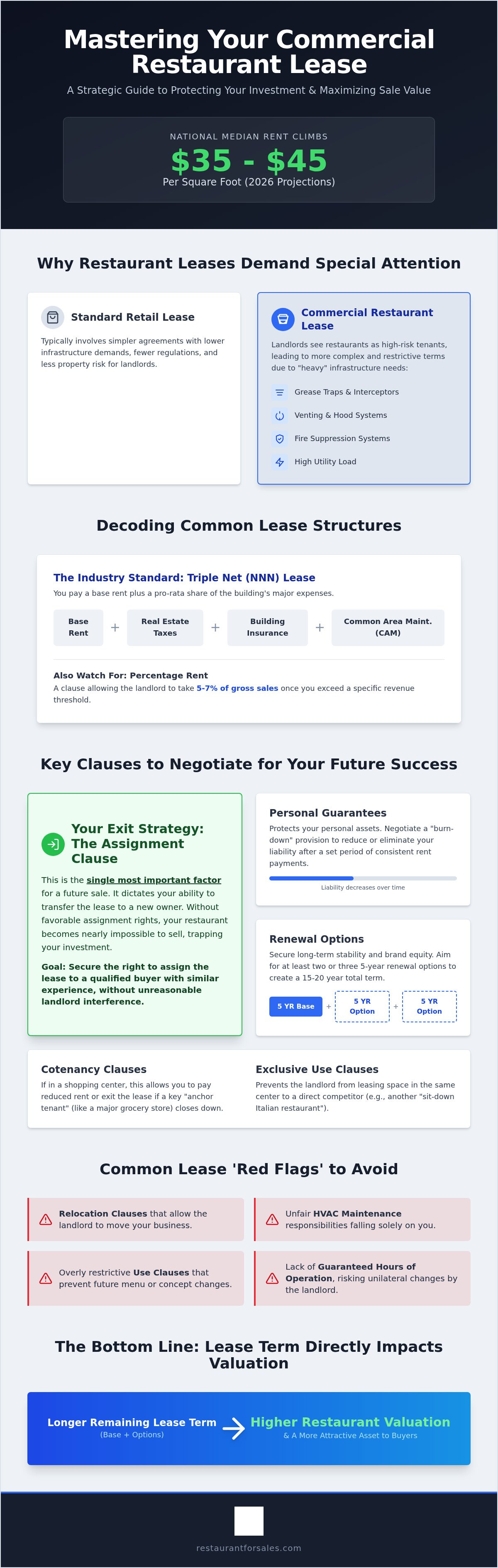
Did you know that the national median rent for restaurants has climbed to between $35 and $45 per square foot in 2026? While many owners focus on the kitchen, your commercial restaurant lease terms are the real foundation of your financial success. It's easy to feel overwhelmed by the complexities of triple net charges or the fine print of personal guarantees. You might worry about hidden costs eroding your margins or whether you can even sell your business when the time comes.
We believe a lease should be a tool for growth, not a source of constant anxiety. This guide will help you master these complexities so you can protect your investment and secure your business's future. You'll gain a clear understanding of current market terms and the confidence to negotiate a lease that allows for a future sale. We'll walk through everything from maintaining predictable occupancy costs to securing the assignment rights you need to exit on your own terms. By the end of this guide, you'll have the expert knowledge required to turn a standard rental agreement into a strategic business asset.
Key Takeaways
- Identify why restaurant-specific infrastructure requirements, such as grease traps and venting, necessitate more complex lease agreements than standard retail spaces.
- Master the art of negotiating commercial restaurant lease terms that prioritize assignment rights, which are critical for any future business exit or sale.
- Learn how to protect your personal assets by implementing "burn-down" provisions that reduce your liability as the lease term progresses.
- Recognize common red flags, such as relocation clauses and unfair HVAC maintenance responsibilities, that can lead to unpredictable occupancy costs.
- Understand the direct correlation between your remaining lease term and your restaurant’s valuation to maximize your return when it is time to sell.
Why Commercial Restaurant Lease Terms Differ from Standard Retail
A restaurant lease isn't just a rental agreement; it's a high-intensity operational contract. Unlike a clothing boutique or a professional office, a restaurant places extreme physical demands on a building. Landlords recognize this and draft commercial restaurant lease terms with a level of scrutiny that standard retail tenants rarely face. This complexity stems from the specialized infrastructure required to run a commercial kitchen safely and legally. Because the potential for property damage is higher, the legal protections for the landlord are significantly more robust.
Landlords view restaurants as high-risk tenants due to the "heavy" infrastructure involved. These specific requirements often include:
- Grease Traps and Interceptors: Specialized plumbing systems that require regular, documented maintenance to prevent sewer clogs.
- Venting and Hood Systems: High-capacity exhaust systems that must penetrate the roof and meet strict fire codes.
- Fire Suppression: Complex Ansul systems integrated into the cooking line.
- Utility Load: Higher-than-average consumption of gas, water, and electricity that may require building-wide upgrades.
Stricter "Use Clauses" are also a hallmark of these agreements. A landlord won't just lease you space for "retail"; they'll lease it specifically for a "sit-down Italian restaurant." This prevents you from pivoting to a high-volume takeout concept that might overwhelm the building's parking or trash facilities.
The Concept of Operational Resilience in a Lease
Operational success depends on flexibility. Your lease must explicitly permit the hours you intend to operate, especially if your business model relies on late-night dining or 24/7 service. Without these protections, a landlord could unilaterally restrict your hours based on noise complaints from neighboring tenants. Additionally, exclusive use clauses are vital. These prevent the landlord from leasing the space next door to a direct competitor. Securing these protections early is essential because lenders often review lease longevity and operational rights before approving business financing.
Common Lease Types: NNN vs. Modified Gross
In 2026, the Triple Net (NNN) lease remains the industry standard for restaurants. Under an NNN structure, you pay a base rent plus your pro-rata share of real estate taxes, building insurance, and common area maintenance (CAM). While a Modified Gross lease might offer more predictable monthly costs, they are rare in the hospitality sector. You should also watch for "Percentage Rent" clauses. These allow the landlord to take a cut of your gross sales, typically 5-7% in 2026, once you exceed a specific revenue threshold. Understanding how these commercial restaurant lease terms impact your bottom line is the first step toward a sustainable business model.
10 Essential Clauses Every Restaurant Owner Must Negotiate
Negotiating commercial restaurant lease terms requires you to look far beyond the monthly rent. While the base rate is important, the "fine print" clauses determine your operational freedom and your eventual exit value. You must view the lease as a living document that protects your capital today and your sale price tomorrow. A well-negotiated agreement acts as a shield against landlord overreach and market volatility.
In 2026, landlords are increasingly open to providing Tenant Improvement (TI) allowances to secure high-quality operators. This capital is essential for covering the specialized infrastructure costs, such as grease traps and fire suppression, that we discussed in the previous section. Beyond the build-out, you should prioritize these key protections:
- Personal Guarantees: Most landlords insist on a personal guarantee. You should negotiate a "burn-down" provision that reduces or eliminates your personal liability after a set period of consistent performance.
- Renewal Options: Secure at least two or three five-year renewal options. This ensures you can stay in your location for 15 to 20 years, which is vital for building long-term brand equity.
- Cotenancy Clauses: If your restaurant is in a shopping plaza, your foot traffic likely depends on an anchor tenant. A cotenancy clause allows you to pay reduced rent or exit the lease if that anchor tenant closes.
The Assignment Clause: Planning Your Exit
The assignment clause is the single most important factor when you decide to sell your business. It dictates how and if you can transfer your lease to a new owner. You must ensure the language states that the landlord’s consent "shall not be unreasonably withheld, conditioned, or delayed." Without this protection, a landlord could block your sale or demand a significant portion of your sale proceeds as a "transfer fee." For a comprehensive look at this process, see our guide on Understanding Restaurant Lease Assignments. If you want to see how these clauses impact current listings, you can browse restaurants for sale with pre-negotiated assignment rights.
Exclusivity and Non-Compete Protections
You must protect your specific niche within the building or shopping center. An exclusivity clause prevents the landlord from leasing space to a direct competitor. It's important to define "primary use" versus "ancillary use." For example, if you run a pizza shop, you don't want a new grocery store next door to start a large-scale hot pizza program. In 2026, these clauses must also account for the rise of food delivery apps. If a neighboring tenant operates a "ghost kitchen" that competes directly with your menu, your exclusivity clause should provide a remedy. Precision in this language prevents future disputes and protects your market share.
Common Pitfalls and 'Red Flags' in Restaurant Leases
Identifying commercial restaurant lease terms that act as financial landmines is a critical part of your due diligence. Many tenants focus exclusively on the base rent while ignoring "capital expenditure" traps that can bankrupt a business in its first year. You must scrutinize the maintenance and repair sections to ensure you aren't subsidizing the landlord's long-term asset value. A lease that looks affordable on paper can quickly become a liability if it contains hidden obligations for major building systems.
The HVAC responsibility trap is one of the most frequent issues we see. If your lease requires you to "maintain and replace" the heating and cooling systems, you could be forced to spend $20,000 or more on a new unit for a building you don't own. You should negotiate to limit your responsibility to a monthly service contract. If a unit fails because it's reached the end of its useful life, the landlord should bear the replacement cost. Similarly, watch for relocation and demolition clauses. These allow a landlord to move your restaurant to a less visible space or terminate your lease early to redevelop the property. In 2026's active real estate market, these clauses are increasingly common and should be struck or heavily modified to include high compensation triggers.
Infrastructure and Maintenance 'Gotchas'
Infrastructure maintenance goes beyond just keeping the lights on. In a restaurant, grease trap maintenance and municipal compliance are paramount. If the lease doesn't clearly define who is responsible for municipal fines related to building-wide plumbing issues, you may find yourself paying for a neighbor's negligence. You also need guaranteed roof access rights. Without them, you cannot maintain the exhaust fans and makeup air units that are the heartbeat of your kitchen. For a detailed breakdown of these risks, review our checklist on Restaurant Lease Red Flags.
The Personal Guarantee: A 2026 Perspective
While most landlords still require a personal guarantee in 2026, you don't have to accept an unlimited one. A "Good Guy" clause is a professional standard that limits your personal liability to the specific date you surrender the keys and vacate the premises. This prevents a landlord from suing you for the remaining years of rent if the business fails. You can also propose a "cap" on the guarantee, such as 12 to 24 months of rent, rather than the entire lease term. Whenever possible, aim for a corporate guarantee backed by the business entity rather than a personal one that puts your home and savings at risk. These commercial restaurant lease terms are often flexible if you have a strong business plan and a solid track record.
How to Negotiate Your Restaurant Lease Like a Pro
Negotiation is a strategic exercise in establishing leverage. To secure favorable commercial restaurant lease terms, you must enter the room with more than just a menu; you need data and a professional presentation. Landlords in 2026 are looking for stability in a market where retail vacancy sits at approximately 5.4%. To win the best space, you must follow a methodical approach that proves you're a low-risk, high-value partner.
- Conduct Market Analysis: Research comparable "cents per square foot" rates in your specific neighborhood. With national medians between $35 and $45 per square foot (NNN) in 2026, knowing the local average prevents you from overpaying.
- Define Your Priorities: Categorize your needs into "Must-Haves," such as assignment rights and renewal options, and "Nice-to-Haves," like exterior signage upgrades.
- Utilize Professional Representation: Hire a restaurant-specialized broker to handle the back-and-forth communication. They understand the nuances of hospitality infrastructure and can push for concessions you might miss.
Leveraging Your Business Plan for Better Terms
A landlord's greatest fear is a dark storefront. You can mitigate this fear by presenting a professional business plan that showcases a strong financial track record. If you can prove your concept is a "destination" that will drive consistent foot traffic to the plaza, you gain significant leverage to negotiate lower security deposits or higher TI allowances. Tenant Worthiness is the primary leverage point in 2026, serving as the definitive measure of your brand's reliability and financial strength in the eyes of a landlord.
The Role of the LOI in Lease Negotiations
The Letter of Intent (LOI) is the most important document in the negotiation process. While it's generally non-binding, it serves as the roadmap for the final lease. It's much easier to negotiate major points like rent escalations, TI allowances, and assignment rights in a three-page LOI than in a sixty-page formal lease. A common mistake is moving to the final document before the LOI is fully vetted. Ensure all contingencies are clearly outlined to protect your deposit if the deal falls through. If you're ready to find a space with pre-vetted commercial restaurant lease terms, our restaurant brokerage services can help you identify the right opportunities in your market.
The Impact of Lease Terms on Restaurant Valuation and Sale
A restaurant's market value is inextricably linked to its occupancy agreement. When calculating a business's multiple, professional appraisers look at the remaining longevity and stability provided by your commercial restaurant lease terms. A high-performing restaurant with only three years left on its lease is a high-risk investment. Conversely, a location with ten years of secured term plus options is a premium asset that justifies a higher asking price. Buyers pay for the certainty that they can operate long enough to recoup their initial investment and generate a profit.
The "Market Rate" adjustment is another critical factor in your valuation. If your current rent is significantly lower than the 2026 national median of $35 to $45 per square foot, that delta represents immediate value to a buyer. This "rent savings" directly increases your Seller's Discretionary Earnings (SDE), which in turn raises the overall valuation. Buyers specifically look for "assumability" in restaurant listings to ensure they can step into these favorable rates without a total renegotiation that could reset the rent to current market highs.
Lease Longevity and Financing
Lease length is often the deciding factor for business financing. Most SBA lenders require the lease term, including options, to at least match the duration of the loan, which is typically ten years. If your lease lacks sufficient renewal options, your restaurant may become effectively "unsellable" to buyers who rely on traditional financing. We explore these financial mechanics in depth in our 2026 Restaurant Valuation Guide. Securing long-term commercial restaurant lease terms isn't just about operational security; it's a prerequisite for a successful exit strategy.
Winning the Transfer: Working with a Broker
The lease assignment is the most delicate part of any business sale. A professional broker facilitates the conversation between the buyer, the seller, and the landlord to ensure a smooth transfer. Landlords often require a comprehensive "Buyer Profile" to approve an assignment. This profile typically includes:
- Financial statements proving the buyer's net worth and liquidity.
- A detailed resume highlighting industry-specific management experience.
- A business plan that aligns with the existing "Use Clause" of the property.
Our brokers act as proactive facilitators, helping you prepare these documents and negotiating with the landlord to protect your equity. If you're ready to maximize your business's market price, contact our expert brokers today to evaluate your lease and business value.
Secure Your Restaurant’s Future Today
Mastering the nuances of commercial restaurant lease terms is the difference between a struggling business and a high-value asset. You now understand that a lease is more than a monthly expense; it's a strategic tool that dictates your operational resilience and your eventual exit price. By prioritizing assignment rights and capping personal liabilities, you protect your capital and your legacy. These provisions ensure that you aren't just renting a space, but building a transferable business that attracts qualified buyers. A well-negotiated lease provides the stability needed to focus on what matters most: your guests and your growth.
Navigating these complexities requires a partner who understands the high stakes of the 2026 market. At Restaurant For Sale Marketplace, we provide a national database of vetted restaurant listings and expert lease assignment support to ensure your transaction is seamless. Our team focuses on finding opportunities with favorable terms that set you up for success from day one. We operate on a success-based commission model, meaning our goals are perfectly aligned with yours. Start your search for the perfect restaurant listing today and take the first step toward securing a location that supports your long-term vision. You have the knowledge to negotiate with confidence; now it's time to take action.
Frequently Asked Questions
What is a Triple Net (NNN) lease in a restaurant context?
A Triple Net (NNN) lease requires the tenant to pay a base rent plus their pro-rata share of the building's operating expenses. These expenses include property taxes, building insurance, and common area maintenance (CAM) costs. In the hospitality industry, NNN is the standard structure for commercial restaurant lease terms. This model shifts the risk of rising property costs from the landlord to the tenant, making it essential to audit CAM charges annually to ensure accuracy.
How much is a typical Tenant Improvement (TI) allowance in 2026?
Tenant Improvement (TI) allowances in 2026 vary based on the space's condition and the tenant's creditworthiness. For a second-generation restaurant space, landlords often provide smaller allowances since major infrastructure like grease traps is already present. For shell spaces, industry professionals report that allowances can range between $50 and $150 per square foot depending on the local market's demand. Negotiating a higher TI allowance can significantly reduce your upfront capital requirements during the initial build-out phase.
Can a landlord refuse to transfer my lease to a new buyer?
A landlord can only refuse to transfer a lease if the document lacks language preventing them from "unreasonably" withholding consent. Most modern commercial restaurant lease terms include protections that require the landlord to approve a transfer if the new buyer meets specific financial and experience criteria. Without these protections, a landlord could block your business sale or demand a transfer fee. Working with a professional broker ensures your assignment rights are clearly defined and enforceable.
What is a 'Percentage Rent' clause and should I agree to it?
A Percentage Rent clause requires you to pay a portion of your gross sales to the landlord once you exceed a specific revenue threshold, known as a breakpoint. In 2026, the standard rate for these clauses is 5-7% of gross sales. You should only agree to this if the base rent is significantly lower than the market average. It is vital to ensure the breakpoint is "natural," meaning it is calculated by dividing your base rent by the percentage.
How long should a standard restaurant lease term be?
A standard restaurant lease term should typically be at least ten years when including renewal options. This length is critical because SBA lenders generally require the lease term to match the duration of the business loan. Securing a five-year initial term with two five-year options provides the flexibility to exit if needed while protecting your location for the long term. This structure also helps preserve the business's valuation when it comes time to sell.
What happens to the lease if my restaurant business fails?
If your restaurant business fails, your liability depends entirely on the specific language of your personal guarantee. Unless you negotiated a "Good Guy" clause or a "burn-down" provision, you may remain personally responsible for the rent due for the remainder of the lease term. In some cases, the landlord may allow you to find a replacement tenant to take over the obligations. This highlights why negotiating exit contingencies is just as important as the monthly rent.
Is a personal guarantee always required for a restaurant lease?
A personal guarantee is almost always required for independent restaurant owners and small franchise groups. Landlords use these to ensure they have recourse if the business entity cannot pay its debts. However, you can negotiate to limit this liability. Common strategies include "capping" the guarantee at 12 to 24 months of rent or using a "burn-down" clause that removes the guarantee entirely after a few years of consistent, on-time payments.
What is the difference between a lease assignment and a sublease?
The primary difference lies in who remains liable for the lease obligations. In a lease assignment, you transfer all rights and responsibilities to a new tenant, and you are typically released from future liability. In a sublease, you remain the primary tenant and are responsible to the landlord if the subtenant fails to pay rent. For sellers, a full assignment is always the preferred method because it provides a clean break from the property and the landlord.


