

Choosing the flexibility of a lease might feel like the safest way to launch, but in 2026, it could be the very thing that caps your business's ultimate resale value. The debate of buying vs leasing restaurant space is no longer just about monthly cash flow. It's about whether you want to build a brand or a tangible asset. Most entrepreneurs hesitate at the high upfront capital required for a purchase, while others worry that a long-term lease will lock them into a location that no longer serves their concept. These are valid concerns in a market where commercial mortgage rates start near 5.87% and restaurant build-out costs can exceed $650 per square foot.
You need a strategy that balances immediate operational needs with long-term financial stability. This guide will help you master the financial and operational differences between owning and leasing so you can choose the right path for your restaurant's future. We will break down the impact of the restored 100% bonus depreciation, provide a checklist to evaluate your specific situation, and compare how each choice affects your business's value when it's time to sell. By the end, you'll have the clarity needed to make a disciplined, results-driven decision for your next location.
Key Takeaways
- Distinguish between fee-simple ownership and leasehold interests to understand how each model impacts your long-term asset growth and balance sheet.
- Identify the 2026 tax advantages, including 100% bonus depreciation, that make purchasing a strategic move for established restaurant brands.
- Assess the operational benefits of leasing, focusing on capital preservation and the flexibility required for testing new market concepts with lower risk.
- Apply a rigorous financial checklist when weighing the choice of buying vs leasing restaurant space to ensure your cash reserves can support either path.
- Master the process of evaluating "business-only" sales versus "business with real estate" listings through professional valuation and brokerage expertise.
Buying vs. Leasing Restaurant Space: The Fundamental Financial Choice
The decision of buying vs leasing restaurant space represents the most significant financial fork in the road for any hospitality operator. This choice determines whether you are acquiring a "Fee Simple" interest or a "Leasehold" interest. Fee simple ownership means you own both the building and the land it sits on, giving you total control over the asset. In contrast, a leasehold interest provides you with the right to occupy the space for a specific period under the terms of a contract. Both paths impact your balance sheet differently.
Current 2026 market conditions have shifted the math for many entrepreneurs. With the Wall Street Journal Prime Rate at 6.75% and conventional commercial mortgage rates starting around 5.87%, the cost of debt is a primary factor in your decision. Choosing to buy turns your monthly occupancy cost into a capital investment that builds equity over time. Leasing keeps that cost firmly in the category of an operational expense. Rent is typically fully deductible as a business expense, but it provides zero residual value once the lease term expires. Debt costs matter, but so does the asset you leave behind.
Understanding the Capital Commitment
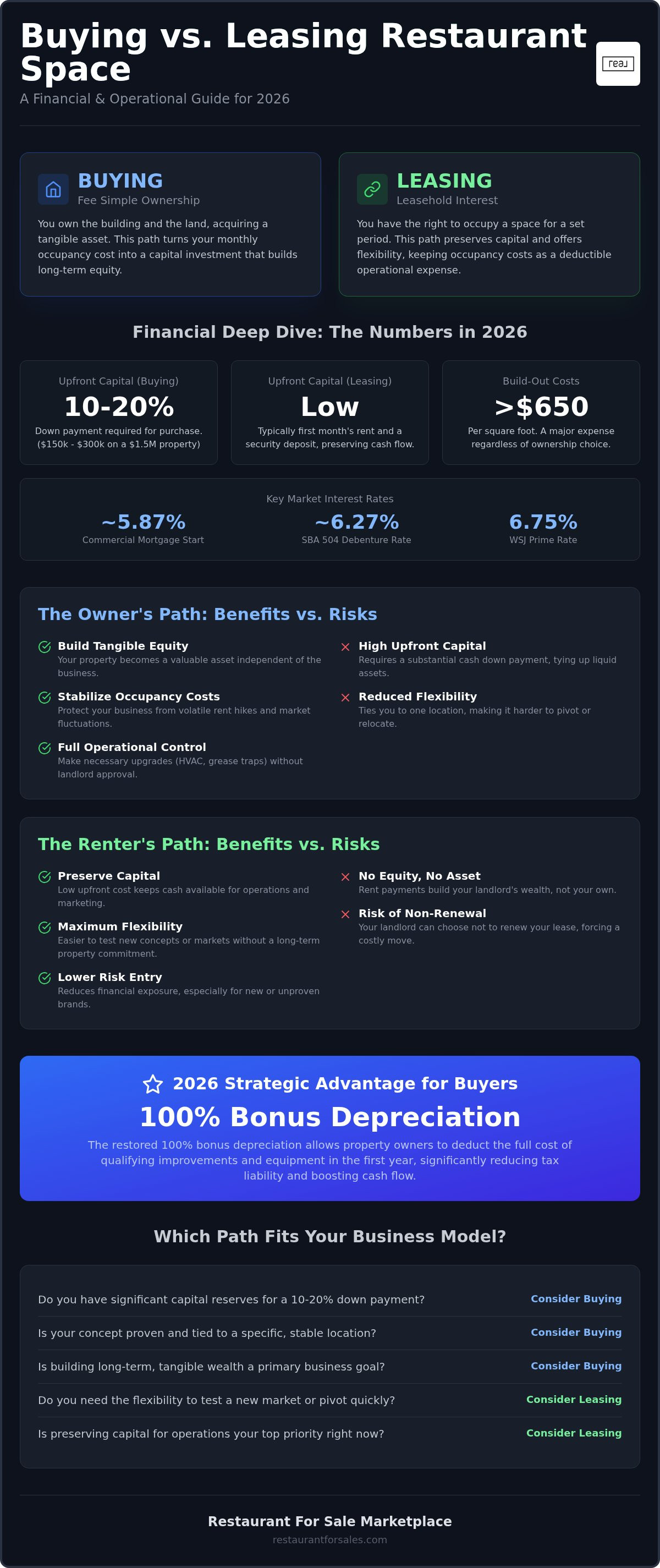
The initial financial hurdle for purchasing is substantial. Most lenders, including those facilitating SBA 504 loans with current debenture rates near 6.27%, require a down payment of at least 10% to 20%. For a $1.5 million property, that's $150,000 to $300,000 in liquid cash diverted from your operating budget. Leasing usually only requires a security deposit and the first month's rent. This preserves capital for the critical first 12 months of operation. Your restaurant's capital stack is the specific blend of owner equity, senior debt, and mezzanine financing used to fund the total acquisition cost.
Long-Term Equity vs. Short-Term Flexibility
Property ownership creates a secondary asset that can appreciate independently of your restaurant's brand strength. If the business fails, you still hold a valuable real estate asset that can be sold or leased to another tenant. Some owners even utilize understanding sale-leaseback agreements to extract equity for expansion while maintaining their operational footprint. This long-term stability is a stark contrast to the flexibility of a lease. A lease allows you to test a new neighborhood or concept without being tied to the dirt for 20 years. Before deciding, it's helpful to compare the nuances of starting a restaurant vs buying an existing one to see how real estate ownership fits into your broader growth strategy.
Benefits and Risks of Buying a Restaurant and Building for Sale
Owning the real estate where you serve your guests provides a level of security that a lease simply cannot match. When you evaluate buying vs leasing restaurant space, the primary benefit is the stabilization of your largest fixed cost. In a 2026 market where retail rents have reached a national median of $26.40 per square foot (NNN), owning the building protects you from the volatility of market-rate adjustments. You aren't just paying for the right to operate; you're building a tangible asset that exists independently of your menu's popularity.
The Perks of Being Your Own Landlord
Eliminating the risk of lease non-renewal is vital for legacy brands. If you own the property, you'll never face an unexpected exit because a landlord decided to redevelop the block or sell to a competitor. This control extends to the physical structure. You can install a new grease trap, upgrade the HVAC, or overhaul the venting system without waiting for third-party approval. If your building is larger than your operational footprint, you can even generate secondary income by leasing out unused space to sub-tenants. For those ready for this level of control, investing in a restaurant with real estate for sale offers a clear path to long-term wealth accumulation.
Tax benefits in 2026 are particularly aggressive for property owners. The One Big Beautiful Bill Act restored 100% bonus depreciation for qualifying properties. This allows you to deduct the full cost of certain improvements and equipment in the first year rather than over decades. When you combine these depreciation schedules with mortgage interest deductions, your effective tax rate is often significantly lower than that of a standard tenant.
Hidden Costs of Property Ownership
Ownership isn't without its burdens. You are the sole party responsible when the roof leaks or the plumbing fails. These capital expenditures can be staggering, especially with national commercial construction costs averaging $345 per square foot in 2026. You must also account for property taxes and insurance premiums, which have seen steady increases across the country. There's also the risk of over-concentration. If the neighborhood declines, both your business revenue and your property value will drop simultaneously. This "all eggs in one basket" scenario can make an exit difficult if the market turns. Zoning changes can also impact your resale value. If local ordinances shift in a way that limits future restaurant use, your property's value could plummet regardless of your business's success. To mitigate these risks, it's wise to browse verified restaurant listings to understand current market valuations and property conditions before committing your capital.
The Operational Flexibility of Leasing Restaurant Space
Leasing remains the most common path for operators because it offers a significantly lower barrier to entry. When analyzing the choice of buying vs leasing restaurant space, the preservation of liquid capital is the primary advantage for the tenant. In 2026, restaurant build-out costs in existing spaces range from $125 to over $650 per square foot. By opting for a lease, you avoid the 10% to 20% down payment required for a property purchase, allowing you to divert those funds toward aggressive marketing and high-quality staffing during your critical first year of operation.
This model provides the agility to test a new market or concept without a multi-decade commitment to a single piece of real estate. Many of the most desirable high-traffic retail corridors are owned by institutional developers who do not sell individual parcels. In these prime locations, a lease is your only gateway to high visibility. However, the success of this strategy relies on your ability to navigate commercial restaurant lease terms, which often include complex clauses regarding personal guarantees and rent escalation.
Navigating Lease Assignments and Transfers
Acquiring a restaurant via a lease assignment is often the fastest route to opening your doors. Instead of enduring the lengthy permitting process for ground-up construction, which currently costs between $350 and $750 per square foot in hard costs, you can step into an existing operational footprint. This process requires a deep dive into the original lease to ensure you have favorable "Assignment" rights and a "Right of First Refusal" should the landlord ever decide to sell. Developing a mastery of understanding restaurant lease assignments is a vital skill for any growth-oriented operator looking to scale quickly through acquisitions.
The Landlord Relationship
In a leasehold scenario, your business's stability is partially tied to your landlord's professional standing. Most restaurant agreements are structured as Triple Net (NNN) leases, meaning you are responsible for your share of property taxes, insurance, and Common Area Maintenance (CAM) fees. These costs can fluctuate, making it essential to audit CAM charges annually to protect your margins. A landlord who neglects the building's exterior or parking lot can directly hurt your foot traffic and brand reputation. Before committing to a long-term contract, consult a restaurant lease red flags checklist to identify potential issues with maintenance responsibilities or restrictive use clauses that could limit your menu offerings.
Decision Checklist: Which Path Fits Your Business Model?
Determining the right path requires a cold look at your balance sheet and your five-year growth plan. The choice of buying vs leasing restaurant space isn't just about monthly payments. It's about capital allocation and risk management. You must evaluate whether your resources are better spent on physical assets or operational excellence. Use the following criteria to assess your readiness for each model.
- Financial Health: Do you have a 10% to 25% down payment available without starving your daily operations?
- Concept Longevity: Is your menu designed as a 5-year "trend" or a 20-year legacy brand?
- Market Stability: Is the target neighborhood appreciating or currently in a volatile transition?
- Maintenance Capacity: Do you have the professional bandwidth to manage property repairs and structural upkeep?
- Exit Strategy: Do you plan to eventually sell the business, the property, or a combined package?
The 'Buy' Checklist: Signs You Are Ready to Own
Ownership is often the preferred route for established operators with stable, predictable cash flow. If you find yourself in a market with high local rent inflation, leasing becomes unsustainable over a ten-year horizon. Additionally, if your concept requires highly specialized build-outs that a landlord wouldn't permit, such as massive underground grease traps or specific structural reinforcements, owning the property is the only way to ensure your operational needs are met. You are ready to buy when your business can support a mortgage while maintaining a 6-month cash reserve for emergencies.
The 'Lease' Checklist: Signs You Should Rent
Leasing is the logical choice for first-time owners with limited liquid reserves. It allows you to preserve capital for the soft costs of opening, such as marketing and initial inventory. If you have a rapidly growing concept that may outgrow its square footage in three years, a long-term mortgage is a liability rather than an asset. Many trophy locations in premium high-rise developments or mall environments are exclusively lease-only opportunities. These spaces offer high-density foot traffic that a standalone purchase simply cannot replicate in the 2026 market.
If you are uncertain about which model fits your current trajectory, you can browse current restaurant listings to compare the costs of leased spaces versus properties for sale in your target market. This direct comparison will help you visualize the impact on your monthly cash flow and long-term equity.
Navigating the Marketplace: Finding Your Next Location
Finding the right location in the 2026 market requires a precise search strategy. When you evaluate the choice of buying vs leasing restaurant space, your search parameters must reflect your long-term exit goals. Listings for "restaurants with real estate" involve fee-simple ownership, whereas "leasehold" listings focus on the transfer of the right to occupy. A specialized broker is essential here to help you distinguish between the value of the business operations and the value of the physical property. Before you commit to any transaction, obtaining a professional restaurant valuation is critical. This ensures you aren't overpaying for goodwill if the real estate market is in a bubble, or overvaluing the dirt if the kitchen equipment is obsolete.
Due Diligence for Buyers and Tenants
Due diligence requirements vary significantly based on your chosen path. Property buyers must conduct environmental assessments and verify ADA compliance to avoid future litigation or remediation costs. If you are pursuing a lease, you must conduct a thorough review of what to check before buying a restaurant lease. This process involves auditing historical CAM charges and ensuring the lease term is long enough to amortize your investment.
For both paths, reviewing the Seller's Discretionary Earnings (SDE) is mandatory. This figure justifies the purchase price by showing the true cash flow available to an owner-operator after all non-essential expenses are added back. Whether your goal is buying vs leasing restaurant space, the 2026 market demands a high level of financial transparency. Lenders currently require at least three years of clean tax returns and a detailed business plan to approve any acquisition.
Closing the Deal with a Specialized Broker
Closing a transaction that involves both a business and real estate is a complex, multi-layered process. Specialized brokers act as proactive facilitators, bridging the gap between the operational nuances of a kitchen and the legal rigidities of commercial real estate. They manage the escrow process for the property while simultaneously coordinating the lease assignment with the landlord and handling any franchise resale approvals. This synchronization prevents the dangerous "gap" where you own a business but have no legal right to occupy the space. If you are ready to secure your future, Contact our expert brokers today to find your ideal restaurant space and navigate these complexities with confidence.
Secure Your Restaurant's Future in the 2026 Market
The choice of buying vs leasing restaurant space is a pivotal moment that defines your business's financial legacy. Whether you prioritize the equity-building power of fee-simple ownership or the capital preservation of a strategic leasehold, your success depends on disciplined due diligence. You've seen how property ownership offers aggressive tax advantages like 100% bonus depreciation, while leasing provides the agility to capture high-traffic locations with less upfront risk. Both paths require accurate valuations and a clear understanding of your long-term exit strategy.
Navigating these high-value transactions doesn't have to be overwhelming. Our firm provides expert brokerage services, comprehensive valuation tools, and access to a national network of restaurant-ready properties to ensure you move forward with confidence. We bridge the gap between real estate complexity and operational reality. Take the next step in your professional journey today.
Browse Active Restaurant and Building Listings Nationwide and find the perfect foundation for your brand's growth.
Frequently Asked Questions
Is it better to buy or lease a restaurant in 2026?
The decision depends on your capital reserves and long-term goals. Buying is superior for established brands seeking fixed occupancy costs and tax benefits like 100% bonus depreciation. Leasing is better for startups testing a market, as it preserves capital for operations. In 2026, with commercial mortgage rates starting at 5.87%, the choice of buying vs leasing restaurant space often hinges on whether you have the 10% to 25% down payment available.
What is the average down payment for a restaurant with real estate?
Expect to provide a down payment between 10% and 25% of the total purchase price. For SBA 504 loans, which currently have a 25-year debenture rate of 6.27%, the requirement is typically 10%. Conventional commercial loans often demand closer to 20% or 25%. This upfront capital is significantly higher than the security deposit required for a leasehold interest, making it a major factor in your initial capital allocation strategy.
Can I buy the building later if I start with a lease?
You can buy the building later if you negotiate a "Right of First Refusal" or an "Option to Purchase" in your initial lease agreement. These clauses ensure you have the first opportunity to buy the property if the landlord decides to sell. Without these protections, the landlord can sell the building to a third party at any time. Securing these rights early is a strategic way to transition from a tenant to an owner-operator.
What does 'Triple Net' (NNN) mean in a restaurant lease?
A Triple Net (NNN) lease is a structure where the tenant pays a base rent plus their pro-rata share of three additional expenses: property taxes, insurance, and Common Area Maintenance (CAM). This is the standard for most retail spaces in 2026, where the national median rent is $26.40 per square foot. Tenants must budget for these variable costs, which can increase annually based on the building's total operating expenses and local tax assessments.
How does owning the real estate affect the sale price of my restaurant?
Owning the real estate significantly increases the total deal value and provides more exit options. You can sell the business and the property together as a combined transaction, or sell the business alone and become the new owner's landlord. This dual-asset approach builds equity outside of the restaurant's operational brand. It protects your wealth if market trends shift. Professional valuation services are essential to determine the separate market values of each asset correctly.
What are the common SBA loan options for buying a restaurant building?
The SBA 504 and 7(a) programs are the primary vehicles for property acquisition. The 504 loan offers a fixed-rate, 25-year term, currently around 6.27%, specifically for real estate. The 7(a) loan is more flexible and can cover both the property and business goodwill, with rates ranging from 6.5% to 11.5% in 2026. Note that as of March 2026, applicants must be U.S. citizens or nationals to qualify for these specific federal programs.
Do I need a different broker for the building than for the business?
It's highly recommended to use a specialized restaurant broker who understands both commercial real estate and business operations. A general real estate agent may not grasp the value of specialized kitchen equipment, venting, or health permits. A firm like Restaurant For Sale Marketplace manages both the fee-simple real estate sale and the business transfer. This ensures that the escrow for the property and the business valuation remain synchronized throughout the closing process.
What happens to my restaurant if the building owner sells the property?
Your lease remains valid and typically transfers to the new owner under the existing terms. The new landlord must honor your remaining term and any renewal options you've already secured. However, a change in ownership can lead to stricter enforcement of lease clauses or changes in how common areas are managed. It's critical to review your Estoppel Certificate during the sale process to confirm all current lease terms are accurately recorded for the buyer.


