

If your employees discovered today that your business was for sale, how many would show up for their shift tomorrow? It's a question that keeps many owners awake at night, especially in a market where staff retention is already a constant challenge. Selling a restaurant in California is a high-stakes regulatory hurdle where a single slip in confidentiality can destabilize your team and devalue your equity. Engaging professional California restaurant brokers is the most effective way to protect your legacy while ensuring you don't leave money on the table during the transaction.
You've likely spent years building your brand, and you deserve a clean exit at the highest possible price. This article provides the tools to manage the complex California restaurant market with professional brokerage services that maximize your valuation and ensure a confidential sale. We'll examine the impact of the latest menu transparency laws, the 2.72% inflation adjustment to ABC liquor license fees, and the professional vetting process required to secure a qualified buyer. We'll also look at how 2026 valuation multiples are shifting for independent operators versus multi-unit groups to help you time your exit perfectly.
Key Takeaways
- Expert California restaurant brokers provide specialized valuation metrics that general business brokers often overlook, ensuring your listing reflects its true market potential.
- Learn how to identify and apply "add-backs" to your financial statements to maximize your Seller’s Discretionary Earnings (SDE) and final sale price.
- Navigate the complex 2026 California regulatory environment, including the transfer of ABC liquor licenses and the essential role of bulk sale escrow.
- Discover a success-based brokerage model that prioritizes a confidential exit while leveraging a national buyer database for maximum reach.
- Understand the strategic timeline for lease assignments and franchise resales to ensure a smooth transition of ownership without operational disruptions.
The Essential Role of California Restaurant Brokers in 2026
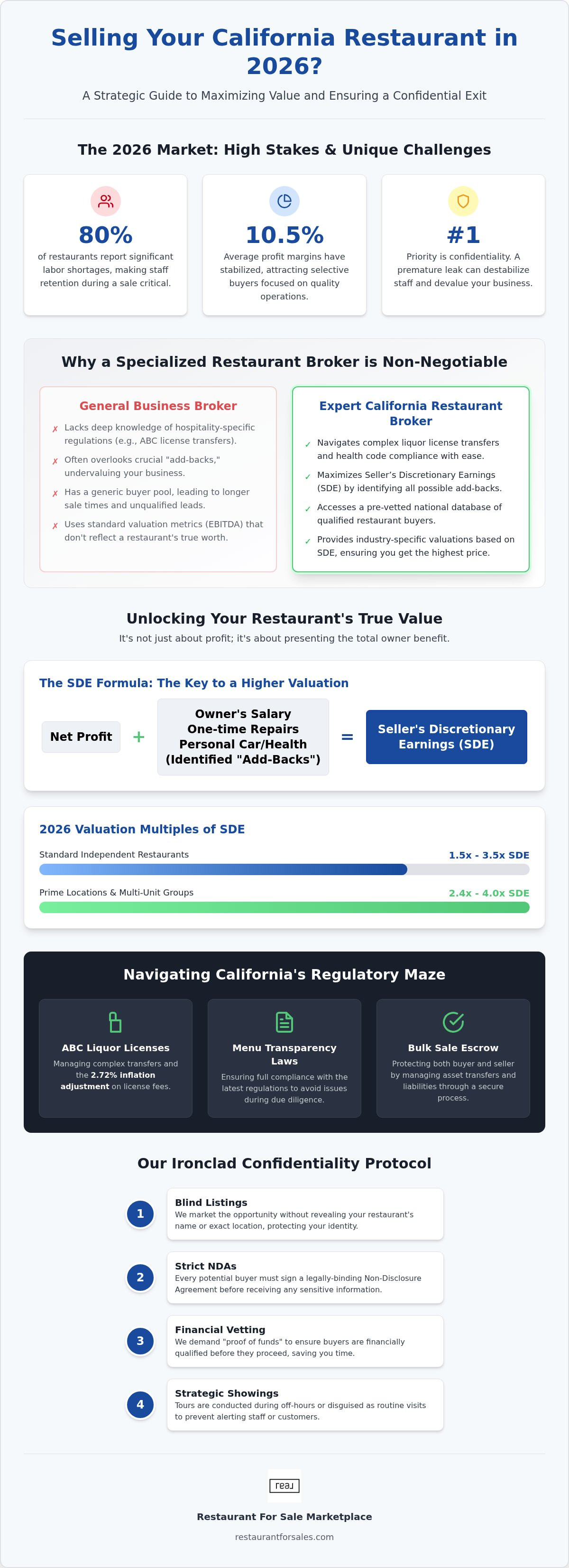
A restaurant broker acts as a specialized intermediary dedicated exclusively to the hospitality sector. While general business brokers handle a wide variety of industries, they often lack the technical depth required to manage the unique financial and regulatory demands of a commercial kitchen. Expert California restaurant brokers bridge the gap between a seller's hard-earned equity and a buyer's need for a viable, profitable investment. In the 2026 market, where average profit margins have stabilized at 10.5%, having a facilitator who understands the nuances of food service is no longer optional; it's a strategic necessity.
The 2026 market climate is characterized by a "flight to quality." Buyers are increasingly selective, prioritizing businesses with disciplined operations and clear cash flow. Because 80% of restaurants currently report labor shortages, a broker's ability to position your business as an efficient, well-staffed machine is critical. They don't just list a business; they package it to withstand the scrutiny of sophisticated investors who are wary of rising food costs and complex menu transparency laws.
Why Specialization Matters in Hospitality
Valuation in the restaurant world relies heavily on Seller's Discretionary Earnings (SDE) rather than just EBITDA. Most independent establishments trade between 1.5x and 3.5x SDE. A specialist understands how to identify "add-backs," such as one-time repairs or owner perks, that a generalist might overlook. This distinction can mean the difference of tens of thousands of dollars in your final valuation. Furthermore, specialized California restaurant brokers maintain a pre-vetted database of buyers specifically looking for hospitality opportunities, which accelerates the timeline for lease assignments and equipment appraisals.
Protecting Your Reputation: The Confidentiality Factor
Confidentiality is the cornerstone of a successful sale. If news of a pending exit leaks prematurely, it can trigger a mass exodus of staff or cause vendors to tighten credit terms. To prevent this, professional brokers utilize "blind listings" that describe the opportunity without revealing the specific name or location. They manage the following steps to shield your identity:
- Enforcing Strict NDAs: Every potential lead must sign a legally binding Non-Disclosure Agreement before receiving any sensitive data.
- Financial Vetting: Brokers verify a buyer's "proof of funds" to ensure they're capable of closing the deal before they ever step foot in your kitchen.
- Strategic Showings: Tours are scheduled during off-hours or disguised as routine inspections to keep the process hidden from employees and customers.
By acting as a buffer, the broker ensures that your daily operations remain stable while the sale progresses in the background. This professional handling protects your brand's integrity and ensures that the transition of ownership is seamless and secure.
Maximizing Value: The Professional Valuation Process
Accurate pricing is the difference between a stale listing and a successful exit. In 2026, California restaurant brokers utilize a multi-pronged appraisal approach that combines historical performance with current market demand. This process begins with a deep dive into your Seller’s Discretionary Earnings (SDE). To set realistic expectations from the start, owners should consult our 2026 Restaurant Valuation Guide for Owners and Buyers. This resource outlines how profitable independent restaurants in prime locations are currently reaching multiples of 2.4x to 4.0x SDE, depending on their operational discipline.
A critical part of this appraisal involves identifying "add-backs." These are expenses that won't carry over to a new owner, such as your personal health insurance, vehicle leases, or one-time equipment repairs. By adding these back to the net profit, you reveal the true owner benefit. Additionally, your lease terms are a major value driver. A buyer won't pay a premium for a business with only two years left on the lease and no options to renew. Securing a long-term lease assignment or having favorable options is often a prerequisite for a high-value exit.
Financial Documentation and Transparency
Transparency is your greatest asset during due diligence. You'll need to organize at least three years of profit and loss (P&L) statements and federal tax returns for buyer review. When you partner with experienced California restaurant brokers, they'll help you reconcile your internal books with your tax returns to present the most profitable version of your business. Buyers and lenders prioritize verifiable income. While some owners might be tempted to highlight cash that isn't reflected on tax documents, sophisticated buyers in 2026 rarely assign value to income that isn't documented. Clean books don't just result in higher multiples; they significantly reduce the time spent in escrow. For more details on the legalities of the handover, the official California Transfer of Ownership guidelines provide a helpful roadmap for the process.
Intangible Assets and Market Positioning
Beyond the numbers, your business's "turnkey" status adds significant weight to the price. This includes proprietary recipes, a trained management team, and a robust social media presence. In a market where 52% of operators report that technology adoption has led to measurably faster service, having modern POS systems and delivery integrations already in place makes your business more attractive. If you're unsure where your business stands in the current market, you can request professional restaurant valuation services to ensure you're not leaving money on the table during your exit.
Navigating California-Specific Regulatory Hurdles
Selling a hospitality business in California involves more than just a handshake and a wire transfer. It requires navigating a dense web of state-mandated procedures, from bulk sale escrow to health department inspections. Specialized California restaurant brokers act as project managers for these multi-agency timelines, ensuring that one regulatory delay doesn't derail the entire transaction. Compliance is non-negotiable; you must adhere to California's Official Business Transfer Requirements to avoid post-closing liabilities with the CDTFA or EDD.
Liquor License Transfers and Escrow
For establishments serving alcohol, the Department of Alcoholic Beverage Control (ABC) license is often the most valuable intangible asset. In 2026, a person-to-person transfer of an existing general license carries a fee of $1,565. This process is distinct from a premises-to-premises transfer, which involves moving a license to a new location. Brokers coordinate with escrow officers to manage the mandatory 30-day posting period. During this time, the public has the right to protest the transfer. If a protest occurs, your broker’s expertise in ABC regulations becomes vital to keep the sale on track. Because license fees increased by 2.72% on January 1, 2026, accurate closing cost projections are essential for both parties.
Lease Assignments and Landlord Negotiations
The lease is the foundation of the business valuation. Even with a willing buyer and seller, a landlord can stall a deal by withholding consent for a transfer. It's critical to begin Understanding Restaurant Lease Assignments well before you go to market. Landlords often require the buyer to demonstrate a specific net worth or relevant experience before approving the assignment. California restaurant brokers facilitate these negotiations, often securing lease extensions or new terms that satisfy the buyer's lender.
Beyond the lease, the local health department typically requires a change-of-ownership inspection. This can trigger requirements for building code updates, such as grease trap installations or ADA compliance. A proactive broker identifies these potential hurdles early, preventing surprise expenses that could lead to a price renegotiation just before closing. Managing these moving parts requires a disciplined approach that only an industry specialist can provide. By coordinating with inspectors and contractors, the broker keeps the transition of ownership on a predictable schedule.
How to Choose the Right Restaurant Brokerage Partner
Selecting a representative is the most critical decision in the sales process. You need a partner who understands the high stakes of 2026 commercial transactions. Professional California restaurant brokers offer more than just a listing service; they provide a buffer between your business and the market. Look for brokers with active memberships in the California Association of Business Brokers (CABB) or the International Business Brokers Association (IBBA). These affiliations ensure they adhere to a strict code of ethics and stay current on evolving state regulations, such as the new 2026 franchise broker registration requirements.
A broker's value is often tied to their professional network. In a market where buyers are increasingly selective, a local sign in the window is insufficient. You need a facilitator with a national buyer database to create competitive tension. This reach ensures your business is seen by qualified investors, including multi-unit groups looking for manager-run acquisitions. These larger groups are currently valued at higher multiples of 4x to 7x adjusted EBITDA, compared to the lower multiples typically found in owner-operated independent shops.
Key Questions for Potential Brokers
Before signing a listing agreement, conduct a thorough interview. Ask specific questions to gauge their hospitality expertise and operational discipline:
- How many restaurant-specific closings have you successfully facilitated in the last 24 months?
- What specific protocols do you use to maintain confidentiality while marketing a listing?
- Do you provide a formal, data-driven valuation or merely a "suggested" price based on intuition?
A qualified broker should provide a structured marketing plan that outlines how they will vet buyers and manage the flow of sensitive financial data. They should also be transparent about their availability. High-value transactions require a high-touch approach, especially during the final stages of escrow and landlord negotiations.
Understanding Commission Structures
In 2026, average business broker commissions for deals under $1 million range from 8% to 12%, though smaller deals can reach 15%. While some brokers might offer lower rates, the "cheapest" option often results in a lower final sales price or a failed escrow. Professional California restaurant brokers generally operate on a success-based commission structure. This aligns their incentives with yours: they only win when you win. This fee should cover a comprehensive suite of services, including professional valuation, national marketing, and the management of complex lease assignments. If you are ready to explore your options with a specialist, you can view our full range of restaurant brokerage services to begin the process.
Closing the Deal with Restaurant For Sale Marketplace
At Restaurant For Sale Marketplace, we've refined a results-driven approach to high-value exits. As specialized California restaurant brokers under the corporate umbrella of BBMT, Inc., we provide a level of stability and professional oversight that smaller, localized firms often lack. Our success-based commission model ensures that our interests are perfectly aligned with yours. We only win when you win, which drives our commitment to securing the highest possible valuation for your business. By integrating professional valuation, aggressive national marketing, and comprehensive closing support, we bridge the gap between your current operations and a clean, profitable exit.
The Marketplace Advantage
The marketplace advantage lies in our ability to connect qualified, pre-vetted buyers with serious sellers through a robust, proprietary platform. We don't just post a listing and wait for inquiries; we actively manage a database that leverages national reach to find the right match for your specific niche. Our team possesses the technical expertise to handle complex commercial transactions, including restaurants with real estate and intricate franchise resales. For those looking to enter the market or expand their portfolio, we also offer comprehensive resources such as our guide on How to Buy a Restaurant in 2026 to ensure all parties are educated and prepared for a smooth transition.
Your Next Steps Toward a Successful Exit
Achieving a successful exit in 2026 requires preparation and a proactive strategy. The most effective way to start is by scheduling a confidential consultation to discuss your specific business goals and timeline. This early interaction allows us to begin the valuation process before your listing goes live, ensuring we have the necessary financial documentation ready to withstand buyer scrutiny. We handle the heavy lifting of lease assignments and regulatory filings so you can focus on maintaining your restaurant's performance during the sale process.
Don't leave your legacy to chance in a complex market. Partnering with expert California restaurant brokers provides the security and professional standing needed to navigate the hurdles of modern hospitality sales. To learn more about how we can facilitate your clean exit at a premium price, Contact Restaurant For Sale Marketplace Today.
Securing Your Future in the California Hospitality Market
Selling your business is a complex transition that requires more than just finding a buyer. It's about protecting your equity and ensuring a confidential handover. By leveraging professional valuation services and navigating the state's intricate regulatory hurdles, you position yourself for a clean, profitable exit. Expert California restaurant brokers act as the essential bridge between your years of hard work and your next professional chapter. They manage the technical details of ABC license transfers and landlord negotiations so you don't have to.
Our team provides deep California market knowledge and a success-based commission structure that puts your goals first. Your legacy deserves a transition handled with the highest level of professional standing. We're here to facilitate that journey from valuation to final closing. Ready to take the next step? List Your Restaurant for Sale with Our Experts to ensure your business reaches its maximum potential. You've built a strong foundation; let's work together to secure the reward for your dedication.
Frequently Asked Questions
How much does a California restaurant broker typically charge?
Most professional brokers operate on a success-based commission structure. This means the fee is earned only when the transaction successfully closes. The commission covers the end-to-end management of the sale process, including professional valuation, marketing, and navigating escrow. While rates vary based on the total transaction value, this model aligns the broker's incentives with yours. It ensures they are motivated to secure the highest possible valuation and a clean exit for your business.
How long does it take to sell a restaurant in California?
The timeline for a sale generally ranges from six to twelve months. Several factors influence this duration, including the complexity of the ABC license transfer and the speed of landlord negotiations for lease assignments. In 2026, the mandatory 30-day posting period for liquor licenses is a fixed regulatory step that cannot be bypassed. Preparing your financial documentation and having a professional valuation ready before going to market can significantly accelerate the closing process.
Can I sell my restaurant without my employees knowing?
Maintaining absolute confidentiality is a standard practice in the hospitality brokerage industry. Brokers use blind listings that describe your establishment’s features and financial performance without revealing its name or exact location. All potential buyers must sign a legally binding Non-Disclosure Agreement (NDA) and undergo financial vetting before receiving sensitive information. This structured approach prevents staff, vendors, or competitors from discovering the sale until you are ready to make a formal announcement.
What is the difference between a business broker and a restaurant broker?
A restaurant broker is a specialized intermediary who focuses exclusively on the hospitality sector. While a general business broker handles various industries, they often lack technical expertise in restaurant-specific financial metrics like Seller’s Discretionary Earnings (SDE). Restaurant specialists understand the nuances of health department permits, equipment appraisals, and the California liquor license transfer process. This industry-specific knowledge is critical for accurately valuing a kitchen’s operational efficiency and navigating the complex regulatory landscape of a food service exit.
Do I need a lawyer if I am already using a restaurant broker?
While a broker facilitates the transaction and manages the escrow process, you may still choose to engage a lawyer for independent legal advice. Brokers handle the valuation, marketing, and coordination between buyers, landlords, and state agencies. However, an attorney can provide a final review of legal contracts or specific lease terms. Most high-value commercial transactions involve a collaborative effort between your broker, an escrow officer, and your legal or tax advisors to ensure a secure transition.
What happens to my liquor license when I sell my restaurant?
Your ABC liquor license is transferred to the new owner through a formal application process with the Department of Alcoholic Beverage Control. In 2026, a person-to-person transfer of a general license involves a fee of $1,565 and a mandatory 30-day public posting period. The broker coordinates this transfer with an escrow company to ensure all state requirements are met. This process is essential for the buyer to continue alcohol service without interruption after the closing date.
How is the value of a restaurant determined?
Valuation is determined by applying a market multiple to your Seller’s Discretionary Earnings (SDE). For most independent establishments in 2026, these multiples range from 1.5x to 3.5x SDE. Factors such as lease longevity, equipment condition, and "add-backs" for owner perks significantly impact the final number. Multi-unit, manager-run groups often command higher multiples of 4x to 7x adjusted EBITDA. A professional appraisal ensures your asking price reflects both your historical performance and current market demand.
What documents do I need to prepare before meeting with a broker?
You should prepare three years of federal tax returns and detailed profit and loss (P&L) statements. Additionally, gather your current lease agreement, a comprehensive equipment list, and recent POS reports showing sales trends. Having these documents organized demonstrates professional standing and operational discipline to potential buyers. California restaurant brokers use this data to perform a formal valuation and build a credible prospectus that can withstand the scrutiny of a buyer’s due diligence team or lender.


