

Did you know that restaurants sold with seller financing typically command 15% to 30% higher prices than all-cash transactions? While many owners view a seller financing for restaurant sale agreement as a last resort for un-bankable deals, savvy sellers in 2026 recognize it as a strategic valuation multiplier. It's common to feel hesitant about the risks involved, especially with SBA loan delays frequently causing deals to collapse and the persistent fear of buyer default looming large. You want a clean exit, but today's tighter lending standards often require a more flexible approach to reach the closing table successfully.
This guide will help you master the complexities of carry-back notes so you can close your deal faster and at a significantly higher valuation. We'll show you how to secure legal protection for your note and leverage interest income to boost your total return. You'll learn about the latest 2026 SBA underwriting shifts, the best methods to vet buyers effectively, and the specific steps needed to ensure your financial interests remain secure long after the keys are handed over. By the end of this article, you'll have a clear roadmap for structuring a deal that benefits both your timeline and your bottom line.
Key Takeaways
- Understand the core components of a carry-back note, including the promissory note and security agreement, to ensure a legally sound transaction.
- Expand your potential buyer pool by five times and bypass the 90-day SBA approval timeline by offering seller financing for restaurant sale.
- Master the strategy behind setting a 30% to 50% down payment to maximize buyer commitment and minimize your financial exposure.
- Secure your future payments using UCC-1 financing statements and personal guarantees to protect against potential buyer default.
- Learn how professional restaurant brokers vet buyer financials and utilize third-party escrow to safeguard the execution of the note.
What is Seller Financing in a Restaurant Sale?
At its core, a seller financing for restaurant sale agreement involves the seller acting as the primary lender for the buyer. Instead of the buyer paying the full purchase price in cash at closing, they provide a down payment and sign a legal agreement to pay the remaining balance over time. This arrangement, often called a "seller carry-back," is frequently the deciding factor in whether a deal closes or collapses. It's particularly essential for independent, non-franchise establishments where traditional lenders might be more conservative with their valuations.
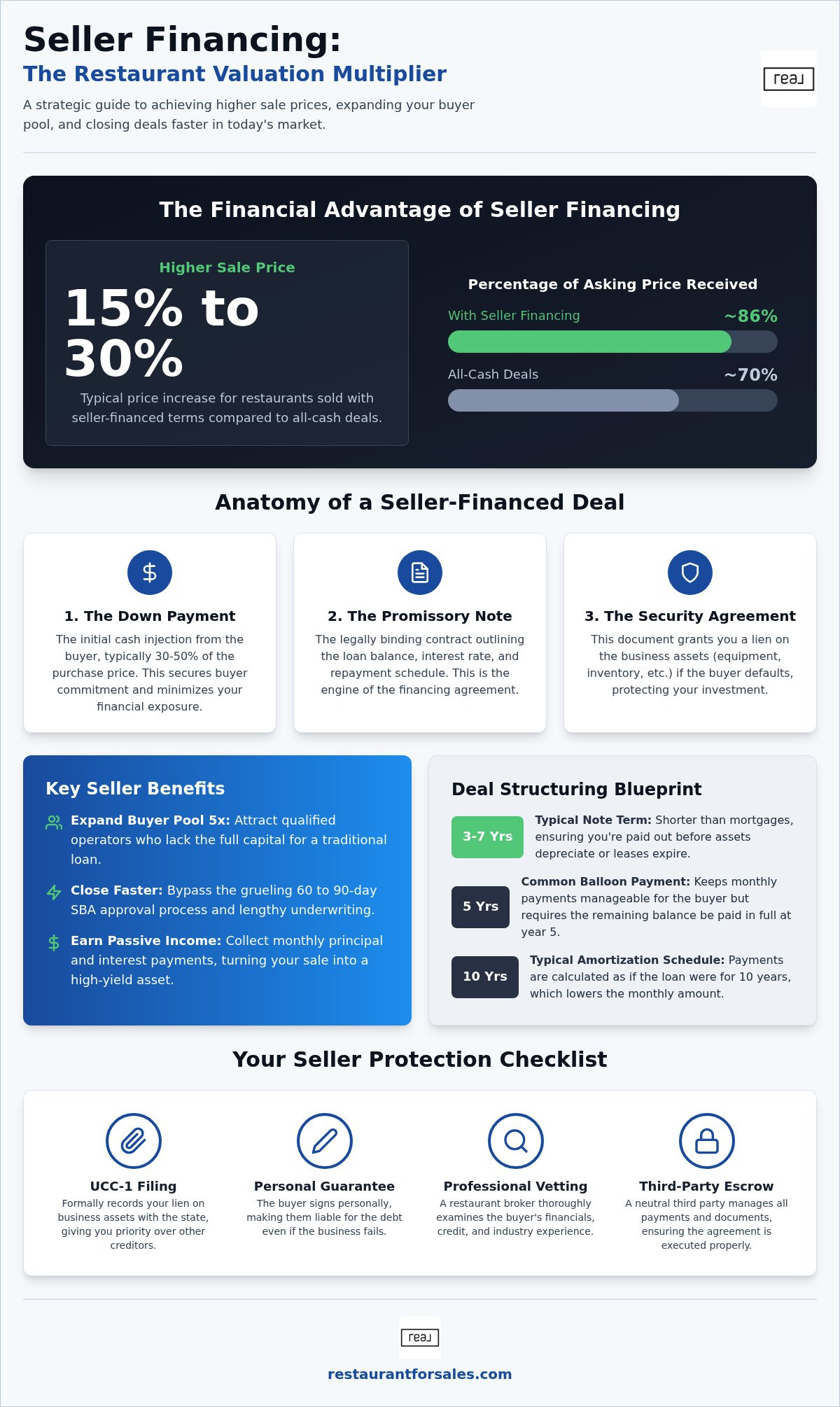
To understand What is Seller Financing in a practical sense, one must look at its three structural pillars:
- The Down Payment: The initial cash injection provided by the buyer at closing.
- The Promissory Note: The legal document outlining the debt, interest rate, and repayment schedule.
- The Security Agreement: The document that grants the seller a lien on the business assets if the buyer defaults.
Unlike traditional bank loans that involve rigorous underwriting and 60 to 90 day waiting periods, seller-financed deals move with significant speed. The flexibility to negotiate terms directly between the parties allows for a more efficient transfer of ownership. It effectively "greases" the marketplace, making transactions possible even when traditional capital markets are tight.
The Mechanics of the Promissory Note
A promissory note is the engine of the financing agreement. It details the principal amount, the interest rate, and the amortization schedule. Most restaurant notes are structured for 3 to 7 years. This is significantly shorter than residential mortgages because the lifespan of restaurant equipment and lease terms is limited. Sellers want to be paid out before the assets depreciate or the lease expires.
A common strategy is to use a longer amortization period, such as 10 years, but set a maturity date at 5 years. This results in a "balloon payment" where the remaining balance is due in full at the end of the fifth year. This structure keeps monthly payments manageable for the buyer while ensuring the seller is paid off relatively quickly. It's a balance between buyer cash flow and seller exit goals.
Common Scenarios for Carry-Back Notes
Seller financing often bridges the "appraisal gap." This occurs when a bank's valuation comes in lower than the agreed-upon asking price. By carrying a note for the difference, the seller can maintain their desired valuation without forcing the buyer to find more cash. It's a way to justify a premium price for a high-performing location.
Another frequent use case involves businesses with high cash income. If a restaurant's financial records show lower profits than reality due to cash handling, SBA lenders will only lend based on reported tax returns. A seller note allows the buyer to pay for the true value that the bank won't recognize. Finally, it helps buyers who have years of industry experience but lack the full 30% liquid capital required for a conventional commercial loan. In these cases, the seller financing for restaurant sale acts as the bridge that makes the transition of ownership possible.
The Strategic Benefits of Offering Seller Financing
Offering seller financing for restaurant sale isn't just a concession; it's a powerful lever to maximize profit. Data shows businesses sold with these terms command 15% to 30% higher prices than all-cash transactions. Sellers offering financing typically receive about 86% of their asking price, while all-cash sellers often settle for just 70%. This valuation premium exists because you're providing the most valuable commodity in a high-interest environment: accessible capital. By acting as the lender, you turn your business into a high-yield asset that continues to pay dividends long after you've handed over the keys.
You effectively quintuple your buyer pool by lowering the barrier to entry. Many qualified operators have the talent and experience to run a successful kitchen but lack the liquid cash for a massive down payment or struggle with 2026's tighter bank lending standards. By bridging that gap, you create a competitive environment where multiple buyers can bid, driving the price toward your target. Buyers benefit by bypassing the grueling 60 to 90 day SBA approval process. With SBA 7(a) variable rates currently ranging from 10.50% to 13.50%, a seller-financed note is often a more attractive and streamlined alternative for the purchaser.
Spreading capital gains tax liability over several years via installment sale rules provides a significant financial cushion. Instead of a massive tax hit in year one, you pay taxes only on the principal as you receive it. This strategy keeps more of your money working for you through interest rather than losing it immediately to the IRS. If you're unsure how these terms affect your bottom line, our team provides professional Restaurant Valuation Services to help you calculate the most profitable exit strategy.
Maximizing the Total Exit Value
When Structuring the Deal, you must look beyond the purchase price. With 2026 interest rates for seller notes typically falling between 7.5% and 9.5%, your total return often exceeds what you'd earn in standard market investments. Providing financing serves as a definitive vote of confidence in the restaurant's future success, signaling to the buyer that the cash flow is robust enough to service the debt. This trust reduces friction and justifies the higher interest income you'll collect over the life of the note.
Speed to Closing and Deal Certainty
Speed is the ultimate deal-saver in commercial transactions. Industry data suggests lender fatigue or strict underwriting kills roughly 30% of restaurant deals before they reach the finish line. Seller financing eliminates this external friction by aligning both parties' interests directly. The buyer gains a mentor with skin in the game who is incentivized to see the transition succeed, while the seller gains a faster, more certain path to the exit without waiting on a bank's committee to approve the buyer's creditworthiness.
Structuring the Deal: Terms and Expectations
A successful seller financing for restaurant sale requires a structure that balances buyer cash flow with seller security. While residential lenders might accept low down payments, the hospitality industry demands a higher threshold. Industry standards in 2026 dictate a down payment of 30% to 50%. This significant cash injection ensures the buyer is fully committed and provides the seller with immediate liquidity. It also creates a buffer against potential operational missteps during the transition.
Interest rate strategies must reflect current market conditions while accounting for the inherent risks of the restaurant sector. Most notes in 2026 fall between 7.5% and 9.5%. Sellers can also implement early repayment incentives to encourage buyers to refinance sooner. For instance, offering a small discount on the principal if the note is paid off within 24 months can accelerate your full exit. Conversely, clawback provisions should be included to protect the seller if the buyer attempts to sell the assets before the note is satisfied.
The "balloon payment" is a common feature but requires careful planning. Most notes use a 10-year amortization schedule to keep monthly payments low, but the entire balance becomes due in 5 to 7 years. You must ensure the buyer has a realistic path to refinancing through a traditional bank before that maturity date arrives. Without a clear exit strategy for the note, both parties risk a default scenario when the balloon payment comes due.
Seller Financing vs. SBA Loans
The differences between private notes and federal loans are stark. Speed is the most obvious differentiator. A seller-financed deal can reach the closing table in as little as 2 weeks. SBA loans typically require 12 weeks of intensive underwriting. The documentation burden is also vastly different. A private agreement relies on a concise promissory note and security agreement. SBA files often exceed 100 pages of federal requirements. Additionally, seller notes offer superior flexibility. They rarely include the strict pre-payment penalties found in institutional commercial lending.
The Role of the Training and Transition Period
A smooth hand-off is the best insurance policy for your carry-back note. It's common to link the financing agreement to the seller's post-sale support obligations. If the seller remains as a consultant, the parties can set performance benchmarks to ensure the business remains healthy enough to service the debt. Protecting the restaurant's cash flow during the first 90 days is critical. This period of stability ensures the buyer masters the operational nuances that generate the revenue used to pay the monthly installments. A well-structured transition period transforms a simple financial transaction into a partnership aimed at long-term success.
Mitigating Risk: Protecting the Seller’s Interest
Protecting your financial interest in a seller financing for restaurant sale requires more than a standard contract. You must file a UCC-1 financing statement to secure a legal lien against the furniture, fixtures, and equipment (FF&E). This ensures that if the buyer fails to pay, you have a priority claim on the physical assets. Additionally, require a personal guarantee from both the buyer and their spouse. This prevents the buyer from hiding behind a corporate shell and ensures their personal assets remain liable for the debt. Insurance requirements provide another critical layer of defense. You should be named as the "Loss Payee" on the restaurant's fire and business interruption insurance policies to ensure any payouts satisfy your note first.
Lease assignment protections are perhaps the most overlooked aspect of seller security. Most brokers focus on the promissory note but ignore the physical space. You need a specific re-entry clause within your Restaurant Lease Assignments that allows you to step back into the lease if the buyer defaults. This prevents the landlord from leasing the space to a third party while you're attempting to recover your collateral. Without this right, you might reclaim your equipment but have nowhere to operate it, effectively destroying your ability to resell the business.
The Default and Re-entry Protocol
A "Default Event" isn't limited to missed installments. It should also include tax liens, repeated health code violations, or failure to maintain the property in good standing. Your agreement needs a "Right to Cure" clause, which gives the buyer a short window, usually 10 to 15 days, to rectify the breach before you accelerate the note. Pay special attention to the liquor license during this process. Your documentation must prevent the buyer from transferring or surrendering the license while a legal dispute is active. Losing a liquor license during a default can permanently devalue the location and make a secondary sale nearly impossible.
Financial Monitoring and Reporting
Vigilance is the best tool for risk mitigation when managing a seller financing for restaurant sale. Mandate that the buyer provides quarterly P&L statements so you can monitor the health of the operation in real-time. If you see declining margins or rising food costs, you can intervene before a total collapse occurs. Your note should also include an "Acceleration Clause," demanding full payment if the business is sold again or if the buyer is found to be grossly mismanaging the assets. To understand how to properly price and secure your collateral, refer to our 2026 Restaurant Valuation Guide for a detailed breakdown of asset classes.
Facilitating the Sale: The Broker's Role in Financed Deals
In a high-stakes seller financing for restaurant sale, a professional broker acts as the essential intermediary between opportunity and execution. We don't simply present offers; we conduct a rigorous vetting of the buyer's entire financial profile. This includes a deep dive into their credit history, liquid capital reserves, and specific operational experience. By screening for these factors, we ensure the seller's note is backed by a capable operator with a high probability of success. Tagging a listing with "Seller Financing Available" in a national marketplace is one of the most effective marketing strategies. It signals flexibility and confidence, often doubling the initial inquiry rate from qualified prospects.
A broker utilizes a comprehensive restaurant valuation to bridge the gap between the down payment and the total asking price. This data-driven approach provides a neutral foundation for negotiation, allowing the seller to justify a higher valuation through the convenience of the terms provided. To maintain deal integrity, we coordinate with third-party escrow services. These entities manage the down payment and the formal execution of the promissory note, ensuring that all funds and legal documents are secured before the keys change hands.
Drafting the Legal Framework
Standard purchase agreements often fall short in complex carry-back deals. It's vital to use industry-specific attorneys rather than general practitioners. Attorneys specializing in hospitality understand the critical nature of lease contingencies and the specific language required for the UCC-1 filings mentioned in previous sections. We facilitate the standardization of the Closing Statement to reflect the deferred payment structure accurately, ensuring no ambiguity exists regarding payment dates or interest calculations. For purchasers looking to understand this process from the other side, our guide on How to Buy a Restaurant in 2026 provides a detailed roadmap for a successful acquisition.
Closing the Deal with Confidence
The final walkthrough and inventory count serve as the "Day Zero" for the seller note. This process confirms the condition and value of the assets that serve as your collateral. Our marketplace streamlines the connection between vetted buyers and motivated sellers, ensuring that every step, from the initial listing to the final signature, is handled with professional precision. Ready to sell? Get a professional valuation to see how seller financing impacts your price.
Secure Your Exit with Strategic Financing
Implementing a seller financing for restaurant sale strategy transforms a standard transaction into a high-yield exit. Success lies in balancing attractive buyer terms with the rigorous risk mitigation protocols discussed throughout this guide. By utilizing UCC-1 filings, personal guarantees, and the specific lease re-entry rights we've outlined, you protect your financial future while commanding a significant valuation premium. A well-executed note doesn't just close the deal faster; it provides a steady stream of interest income that often outperforms traditional market investments in today's climate.
Navigating these complexities requires a partner with deep expertise in the hospitality sector. We provide expert brokerage for high-value hospitality transactions and dedicated support for deal structuring and valuation. Our national reach to qualified restaurant buyers ensures your listing gains maximum visibility among serious prospects. Ready to take the next step in your professional journey? List Your Restaurant on the National Marketplace today. You've built a successful business, and now it's time to ensure you receive the full value you deserve.
Frequently Asked Questions
Is seller financing safe for a restaurant owner?
Safety in a seller financing for restaurant sale is achieved through the multi-layered legal protections we have discussed, such as UCC-1 filings and personal guarantees. These tools ensure you have a priority claim on physical assets and personal liability from the buyer. When you vet the purchaser's operational history and financial reserves thoroughly, the risk of default is significantly minimized. It creates a secure environment where your financial interest is protected by the very assets you are selling.
What is a typical interest rate for restaurant seller financing in 2026?
Interest rates for a seller financing for restaurant sale in 2026 generally fall between 7.5% and 9.5%. This range remains competitive compared to SBA 7(a) variable rates, which often exceed 10.5% in the current market. The specific rate is usually negotiated based on the buyer's creditworthiness and the size of their cash injection. Higher rates are often applied to notes with longer amortization periods or those involving higher-risk independent concepts.
How much down payment should I require for a seller carry-back?
Industry standards for 2026 dictate a down payment of 30% to 50% of the total purchase price. This threshold ensures the buyer is financially committed and provides a necessary cash cushion for the seller at closing. Requiring less than 30% increases the risk of the buyer walking away if the business faces a temporary downturn. A substantial down payment also facilitates the payoff of any existing small business debts or closing costs.
Can I offer seller financing if I still have a mortgage or SBA loan on the business?
You generally cannot carry a note if existing liens remain, as most commercial loans contain "due on sale" clauses. These require you to pay off the remaining balance of your mortgage or SBA loan upon the transfer of the business. You must use the buyer's down payment and closing funds to satisfy these debts and clear the title. Once your lenders release their liens, you can legally occupy the primary lien position on the new promissory note.
What happens to the seller financing if the buyer goes out of business?
If a buyer fails, your primary recourse is to exercise the re-entry and repossession protocols outlined in your security agreement. You can reclaim the furniture, fixtures, and equipment (FF&E) to satisfy the debt or prepare the business for a secondary sale. If you secured the lease assignment properly, you may also be able to take back the space. Personal guarantees allow you to pursue the buyer's personal assets if the business collateral is insufficient.
How does seller financing affect the transfer of a liquor license?
The liquor license is a critical intangible asset that should be protected within your financing documents. Your agreement must include clauses that prevent the buyer from transferring or endangering the license while the note is active. In a default scenario, having control over the license transfer is vital for maintaining the restaurant's market value. We recommend including specific language that requires the buyer to cooperate with a license transfer back to the seller if payments cease.
Can a seller sell their promissory note to a third party for cash?
Sellers have the option to sell their promissory note to secondary market investors if they need immediate liquidity. However, note buyers typically purchase these at a discount, often between 10% and 30% of the remaining principal balance. The discount rate depends on the interest rate of the note, the buyer's payment history, and the remaining term. While this provides instant cash, it does reduce the total interest income you would have earned over time.
Do I need a lawyer to draft the seller financing documents?
Engaging an attorney who specializes in hospitality transactions is essential for drafting enforceable financing documents. General practitioners often overlook industry-specific protections like lease re-entry rights or the nuances of UCC-1 filings for restaurant equipment. A specialized lawyer ensures that your promissory note, security agreement, and personal guarantees are compliant with 2026 regulations. Professional drafting is the only way to ensure your note is legally sound and your financial interests are fully protected.


