

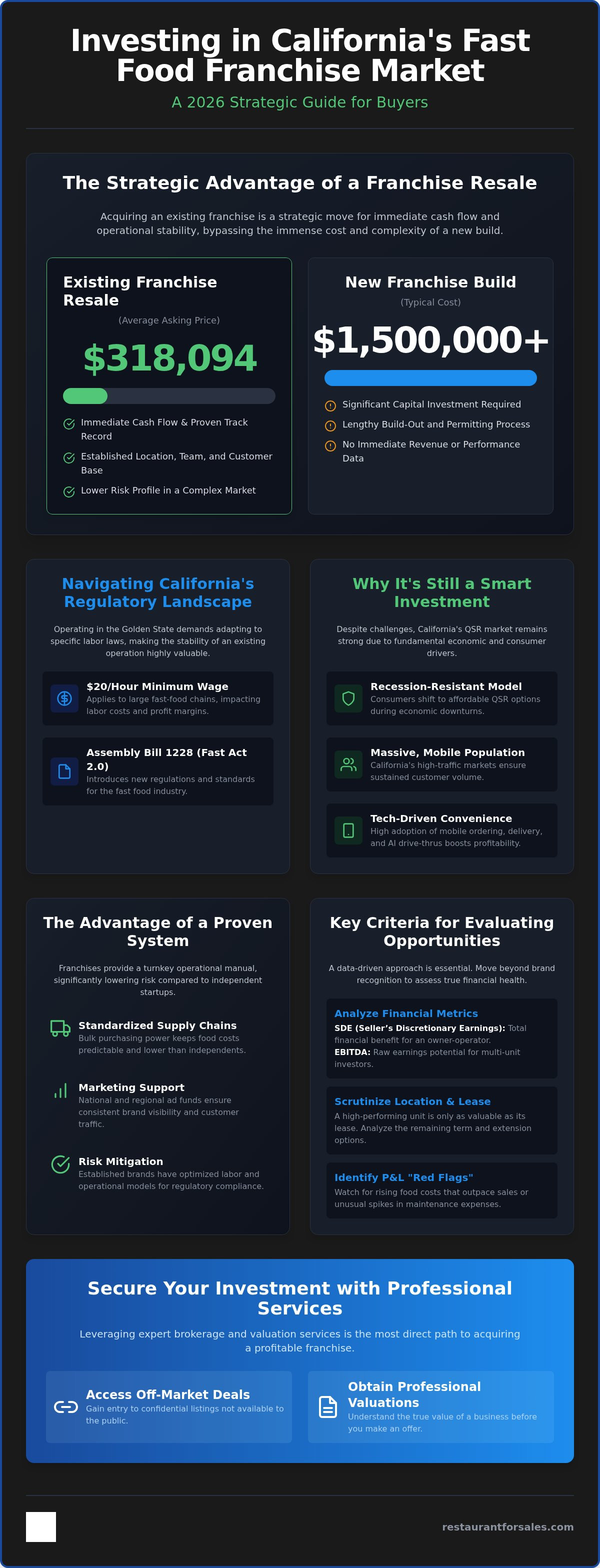
Did you know the average asking price for an existing fast food franchise in California is approximately $318,094? This figure stands in sharp contrast to the $1.5 million or more typically required to build a new location from the ground up. If you're searching for the top fast food franchises for sale in California, focusing on the resale market isn't just a cost-saving measure; it's a strategic move to secure immediate cash flow in a complex regulatory environment.
You likely understand that operating in the Golden State requires more than just a great brand. You're facing a $20 per hour minimum wage for large chains and the intricacies of Assembly Bill 1228. It's natural to feel concerned about identifying a truly profitable location versus one that's struggling under these new standards. This 2026 guide provides the clarity you need to move forward. You'll discover the most resilient brands, learn how professional valuation protects your investment, and find a streamlined path to ownership through expert brokerage. We'll examine the current labor landscape and the specific brands currently leading the market.
Key Takeaways
- Understand why high-traffic California QSR markets remain a resilient investment choice despite shifting economic landscapes.
- Learn how to evaluate the top fast food franchises for sale in California using precise financial metrics like Seller’s Discretionary Earnings and EBITDA.
- Identify strategies to maintain profit margins while navigating California's 2026 labor laws and the Fast Act 2.0 requirements.
- Discover why acquiring an existing franchise resale offers immediate cash flow and operational stability compared to the high costs of a new build.
- Access confidential, off-market opportunities by leveraging professional brokerage services and specialized restaurant valuations.
Why California Fast Food Franchises are a Strategic Investment in 2026
California's fast food market continues to demonstrate remarkable strength in 2026. This sector remains a primary target for investors because it serves a fundamental need: quick, reliable, and affordable meals for a massive, mobile population. While other industries face volatility, the quick-service restaurant (QSR) model is widely regarded as recession-resistant. During economic downturns, consumers often shift their spending from full-service dining to more affordable alternatives. This behavior sustains high transaction volumes even when discretionary income is tight. The model works.
Finding the top fast food franchises for sale in California requires an understanding of these macro trends. The state's extensive infrastructure, from specialized logistics to established distribution hubs, provides a backbone for large-scale operations. This network ensures that inventory costs remain predictable and supply chains stay resilient. Success is about execution.
Market Resilience and Consumer Trends
The shift toward convenience-driven dining has accelerated. Modern consumers prioritize speed and digital accessibility. Franchises that have integrated advanced mobile ordering and AI-driven drive-thru systems are seeing significant gains in profitability. California often serves as the proving ground for these innovations. Whether it's the latest plant-based menu item or a new delivery optimization tool, concepts tested here frequently set the standard for major fast-food chains across the country. Success in this market isn't just about the food; it's about mastering the technology that gets the food to the customer.
The Advantage of Proven Systems
One of the most compelling reasons to look at top fast food franchises for sale in California is the security of a proven system. Independent startups face a high failure rate because they lack standardized processes. In contrast, an established franchise provides a blueprint for every aspect of the business. You aren't just buying a brand; you're acquiring a turnkey operational manual. It's built for scale.
- Standardized Supply Chains: Bulk purchasing power keeps food costs lower than what an independent owner can negotiate.
- Marketing Support: National and regional ad funds ensure consistent brand visibility without the need for local creative development.
- Risk Mitigation: Established brands have already optimized their labor models to handle specific regulatory requirements.
This structured approach significantly lowers the risk profile for new owners. By following a tested methodology, you can focus on growth rather than trial-and-error management. It provides a clear path to profitability.
Key Criteria for Evaluating the Best Fast Food Opportunities
Identifying the top fast food franchises for sale in California requires a data-driven approach that moves beyond brand recognition. You must evaluate the underlying financial health and the long-term viability of the location. While a popular logo attracts customers, the profit and loss statement (P&L) determines your return on investment. Professional buyers prioritize two primary metrics: Seller’s Discretionary Earnings (SDE) and EBITDA. SDE represents the total financial benefit to an owner-operator, including net profit and owner salary. EBITDA is the standard for multi-unit investors looking at the business's raw earnings potential before interest and taxes.
Location quality and lease terms are equally critical. A high-performing unit is only as valuable as its right to occupy the space. You should analyze the remaining lease term and any available extension options. If you're unsure how to weigh these variables, a professional restaurant valuation can provide the necessary clarity before you submit an offer.
Financial Performance and ROI Analysis
Interpreting a franchise P&L requires looking past the top-line revenue. You need to identify "red flags" like rising food costs that outpace sales growth or unusual spikes in maintenance expenses. High-volume brands often operate on lower margins but offer massive scale. Conversely, boutique franchise concepts might offer higher margins with lower overhead. When reviewing the Franchise Disclosure Document (FDD), pay close attention to the Federal Trade Commission's Franchise Rule. This regulation ensures you receive transparent data regarding the franchisor's financial standing and any litigation history.
Brand Stability and Market Saturation
The lifecycle of a brand significantly impacts your risk. Legacy brands like McDonald's or Taco Bell offer proven stability and standardized supply chains, though they often come with higher entry costs. Emerging brands might offer larger territory protections and more room for expansion, but they carry a higher risk profile. You must also evaluate market density. A brand that is oversaturated in a specific region may limit your ability to grow through multi-unit acquisition. Corporate support levels also vary. Some franchisors provide extensive field training and marketing assistance, while others take a more hands-off approach. Understanding these dynamics is essential to finding the top fast food franchises for sale in California that align with your professional goals.
Finally, consider the transferability of the franchise agreement. Most brands charge a transfer fee and require the buyer to meet specific net worth and experience requirements. You don't want to find a perfect location only to be rejected by the corporate office during the final approval stage.
Navigating California’s Operational and Regulatory Landscape
Operating in California requires a sophisticated understanding of a unique regulatory environment. For those seeking the top fast food franchises for sale in California, the primary concern is often the rising cost of labor. As of 2026, the statewide minimum wage has reached $16.90 per hour. However, fast food workers in chains with 60 or more national locations are entitled to a $20 per hour minimum wage. This discrepancy creates a specialized set of financial pressures that must be accounted for during the acquisition phase. Success depends on your ability to manage these costs through operational efficiency rather than just price increases.
Labor Management and the Fast Food Council
The Fast Food Council, established under Assembly Bill 1228, now wields significant influence over industry standards and wages. This legislation doesn't just impact pay scales; it also includes provisions that can hold franchisors jointly liable for labor law violations at the unit level. An Hoover Institution analysis on California's fast-food regulations highlights the complexities this law introduces for modern operators. To maintain healthy margins, successful owners are increasingly turning to technology. Automated ordering kiosks and AI-driven scheduling tools help reduce headcount during off-peak hours while maintaining service quality. Precision in labor management is no longer optional; it's a requirement for profitability.
Environmental and Health Compliance
California’s environmental mandates are among the strictest in the nation. Owners must navigate complex waste management protocols and specific packaging requirements that directly impact operational expenses. Furthermore, health department ratings are highly visible and serve as a primary driver of consumer trust. A dip in these ratings can immediately decrease a unit's market value. You must also consider the costs associated with mandatory equipment upgrades for energy efficiency and ongoing ADA compliance. These capital expenditures can significantly alter the long-term ROI of a location.
Accounting for these variables is difficult for the average buyer. This is why a professional restaurant valuation is essential. It ensures that every regulatory hurdle and potential cost is integrated into the financial analysis. By identifying these factors early, you can negotiate from a position of strength and ensure you're paying a fair market price for the top fast food franchises for sale in California. Understanding the rules of the game is the first step toward winning it.
The Strategic Advantage of Buying a Franchise Resale
Buying an existing business is the most efficient way to enter the market. When you evaluate the top fast food franchises for sale in California, you'll find that resales provide a massive head start over new developments. A new build-out typically requires 12 to 18 months of planning, permitting, and construction. During this period, you're spending capital without generating any revenue. A franchise resale allows you to take over an operating unit with immediate cash flow. Closing a transaction often takes as little as 60 days. It lets you bypass the most volatile stages of business ownership.
Historical financial data is another major benefit. Lenders are more likely to approve financing for a business with a proven track record. You can present actual tax returns and P&L statements rather than speculative projections. This transparency reduces the risk for both you and the bank. It provides a stable foundation for your investment.
Bypassing the Development Barrier
The permitting process in California is notoriously slow. Local regulations and environmental reviews can delay a grand opening by months or even years. By purchasing an existing unit, you avoid these bureaucratic hurdles and the risk of construction cost overruns. Existing operations are turnkey. The equipment is installed, the systems are in place, and the doors are already open to the public. You start on day one with a functional business.
Acquiring Established Intangible Assets
In a tight labor market, an existing workforce is invaluable. A resale includes a team of trained employees who already understand the brand's standards. This eliminates the high costs and time associated with mass hiring. You also inherit local goodwill. The community already knows the location, and a customer base is already established. This brand equity is difficult to build from scratch.
Securing a prime location is often impossible through new leases because the best real estate is already occupied. A strategic restaurant lease assignment allows you to step into a location that would otherwise be unavailable. It's a powerful way to secure a high-traffic spot with long-term value. If you're ready to explore these opportunities, you can browse our current franchise listings to find a location that fits your investment criteria.
Securing Your Investment with Professional Brokerage Services
Acquiring a high-value commercial asset requires more than just capital; it requires expert representation. Many entrepreneurs mistakenly contact a listing agent directly when searching for the top fast food franchises for sale in California. It's vital to remember that a listing agent's primary fiduciary duty is to the seller. By working with a dedicated buyer's broker, you ensure your interests are protected during every stage of the transaction. We act as a proactive facilitator, bridging the gap between your investment goals and the operational realities of the California market.
Professional brokerage provides a significant competitive advantage through access to information. A seasoned restaurant broker often has access to confidential, off-market listings that never appear on public portals. Sellers of high-performing units frequently prefer private transactions to avoid alarming staff or competitors. This insider access allows you to evaluate opportunities based on merit rather than just availability.
Expert Valuation and Negotiation
In a competitive market, overpaying is a common risk for unrepresented buyers. Professional business valuation services provide an objective analysis of a unit's worth based on current market multiples and historical performance. This data-driven approach prevents emotional decision-making. Beyond the purchase price, brokers manage the complexities of lease assignments and franchise transfer approvals. Negotiating favorable terms with landlords and corporate offices is essential for protecting your long-term ROI. We maintain strict confidentiality throughout this process, ensuring that sensitive financial data remains secure while we build a compelling case for your approval as the new owner.
Streamlining the Acquisition Path
The journey from an initial inquiry to a final closing involves multiple technical steps. A structured approach is necessary to manage due diligence, escrow, and financing connections efficiently. Brokers act as the central point of contact, coordinating with attorneys, accountants, and lenders to keep the momentum of the deal moving forward. This oversight reduces the administrative burden on you, allowing you to focus on your operational transition plan.
If you're ready to take the next step, learning how to buy a restaurant with professional guidance can save you months of trial and error. We provide the end-to-end management required to turn an investment opportunity into a successful reality. By leveraging our specialized expertise, you can navigate the 2026 landscape with confidence. Our goal is to ensure that your entry into the market is both secure and profitable.
Strategic Path to California Franchise Ownership
Securing a high-performing QSR asset in 2026 requires a disciplined approach to both valuation and operational strategy. A resale-first strategy remains the most effective way to bypass long development timelines and secure immediate cash flow. By focusing on Seller’s Discretionary Earnings and understanding the impact of the $20 minimum wage, you can identify sustainable growth opportunities in a competitive landscape. Identifying the top fast food franchises for sale in California is the beginning of a complex transaction process that demands expert oversight.
You need a partner with deep expertise in the California commercial market to manage lease assignments and franchise transfers efficiently. Our team of professional business valuation experts ensures your investment is grounded in financial reality, while our success-based brokerage commissions provide a results-driven partnership. We act as your guide from the initial inquiry to the final closing, protecting your interests at every stage. Take the next step toward a secure and profitable professional future. Browse our exclusive fast food franchise listings today to identify your next operational opportunity.
Frequently Asked Questions
What is the average cost of a fast food franchise resale in California?
The average asking price for an existing fast food franchise in California is approximately $318,094 as of 2026. This figure represents a strategic entry point compared to the $1.5 million or more often required for a new build-out. Individual costs vary significantly based on brand strength, location quality, and historical earnings. Buyers should also account for transfer fees and initial working capital requirements when calculating their total investment.
How do California labor laws affect franchise profitability in 2026?
Labor laws impact margins through the $20 per hour minimum wage for chains with 60 or more national locations. Successful operators mitigate these costs through technological integration, such as AI-driven ordering and automated scheduling tools. When evaluating the top fast food franchises for sale in California, it's essential to analyze the current labor-to-sales ratio. Professional valuations help determine if a unit's performance can sustain these expenses while maintaining healthy profitability.
Can I buy a franchise if I have no prior restaurant experience?
Yes, though many franchisors require a minimum level of business management experience. While prior restaurant ownership isn't always mandatory, corporate offices typically look for strong leadership skills and financial stability. Most brands provide comprehensive training programs to bridge the knowledge gap. First-time owners often find that purchasing an existing resale with a trained staff is a more manageable entry point than building a new location from scratch.
What is the difference between an asset sale and a stock sale in a franchise resale?
Most franchise resales are structured as asset sales, where the buyer acquires specific items like equipment, inventory, and leasehold rights. This allows the buyer to step up the tax basis of the assets and avoids assuming the seller's unknown liabilities. In contrast, a stock sale involves purchasing the legal entity itself. Stock sales are less common in the QSR industry because they carry higher risks regarding the historical legal or tax obligations of the previous owner.
How long does the franchise approval process typically take for a buyer?
The franchise approval process usually takes between 60 and 90 days. This timeline runs parallel to the due diligence and escrow period. It involves multiple stages, including an initial application, background checks, financial verification, and an interview with the corporate team. You must also account for the time required to complete mandatory training. Using a professional broker helps ensure that your application package is complete, which prevents unnecessary delays in the approval cycle.
What documents are required for due diligence when buying a fast food business?
Essential documents include the last three years of Profit and Loss statements, tax returns, and current balance sheets. You should also review the existing lease agreement, equipment lists, and the Franchise Disclosure Document (FDD). Examining labor reports and health department inspections is equally critical. These records allow you to verify the seller's claims and identify potential liabilities. A professional valuation expert uses this data to confirm the business's true earnings and market value.
Are there specific financing options for franchise acquisitions in California?
Buyers typically utilize SBA 7(a) loans or conventional commercial financing to acquire existing franchises. SBA loans are popular because they offer competitive rates and longer repayment terms for qualified buyers. While Restaurant For Sale Marketplace does not provide direct business lending, we assist by connecting buyers with specialized lenders who understand the QSR industry. Having a professionally prepared valuation and historical financial data significantly improves your chances of securing favorable loan terms from these institutions.
How do I find off-market fast food franchise listings?
Finding off-market opportunities requires working with a specialized restaurant broker who maintains a private inventory of listings. Many high-performing units are sold through confidential channels to protect the business's operational stability and staff morale. By registering as a qualified buyer with a brokerage firm, you gain access to these exclusive opportunities before they reach public portals. This is often the most effective way to identify the top fast food franchises for sale in California without facing heavy competition.


